PagerTree
PagerTree helps teams share on-call duties and respond to incidents.
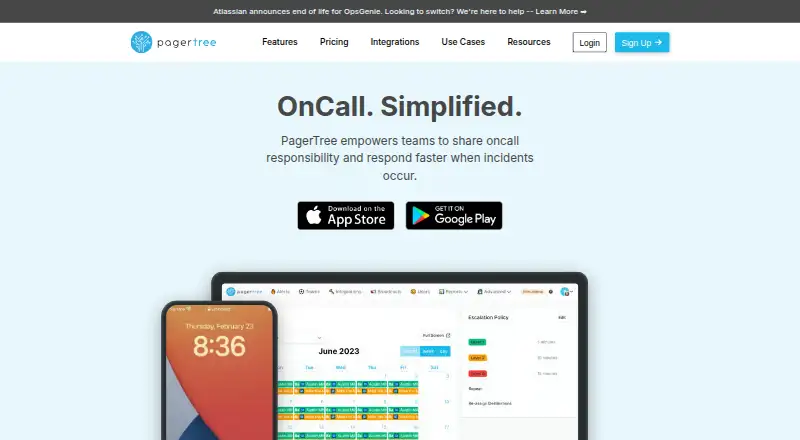
What PagerTree is
PagerTree helps teams share on-call duties and respond to incidents. Its scheduler supports rotations, overrides, reminders, calendar sync, and schedules that can be public, private, or password-protected. Escalation policies allow unlimited layers, configurable timeouts, repeated alerts up to three times, and reassignment. Notifications can be sent by push, email, SMS, voice, WhatsApp, or Slack. PagerTree can aggregate and deduplicate similar alerts, with aggregation periods from 15 minutes to 30 days. Integration options include email, webhook, and custom webhook. Single sign-on uses SAML 2.0 and supports identity providers such as Azure, Okta, and Google. PagerTree says data is encrypted at rest with AES-256, communications use SSL/HTTPS, and encrypted database backups run hourly. Basic is free for up to five users and two teams, with three months of data retention. Pro is $15 a month per user, and Elite is $19 a month per user. SMS and voice coverage varies by country.
Good
- Schedules include rotations, overrides, and calendar sync
- Escalation policies allow unlimited layers
- Offers push, email, SMS, voice, WhatsApp, and Slack alerts
- Can aggregate and deduplicate similar alerts
- Uses SAML 2.0 for single sign-on
Watch out
- Basic is limited to five users and two teams
- Basic retains data for three months
- SMS and voice availability varies by country
Who it suits
PagerTree suits teams that need shared on-call schedules, escalation rules, and multiple incident notification channels. Its plans range from a limited free option to tiers for larger teams.
Verdict
PagerTree combines on-call scheduling with escalation, alert management, and several notification channels. Its Basic plan has firm team and retention limits, and international SMS and voice support varies.
Plans and prices
From PagerTree's own pricing page, checked 14 Oct 2026.
| Plan | Price | What it gives you |
|---|---|---|
| Basic | Free | up to 5 users · up to 2 teams · unlimited integrations · on-call schedules · push, email and Slack notifications · 3-month data retention · community support · $0/user/mo or $0/user/year |
| Pro | $15 a month | up to 25 users · unlimited teams · recurring schedules · SMS, voice and WhatsApp notifications · 1-year data retention · email support · $15/user/mo or $150/user/year |
| Elite | $19 a month | unlimited users · unlimited teams · SSO · live call routing · 1-year data retention · email and phone support · $19/user/mo or $190/user/year |
| Enterprise | Priced on request | unlimited users and teams · dedicated account manager · MSA, DPA and security review · NET 30 invoicing and purchase-order support · custom data retention · Custom |
The facts
Each one read from PagerTree's own pages, with the date it was checked.
What it does
- Alert aggregation
- Similar alerts can be aggregated and deduplicated with configurable windows from 15 minutes to 30 days.checked 14 Oct 2026
- Alert management
- It can aggregate and deduplicate similar alerts, with configurable aggregation periods from 15 minutes to 30 days.checked 30 Sep 2026
- API authentication
- API requests require bearer API keys over HTTPS, and keys can be managed in user settings.checked 14 Oct 2026
- API capabilities
- The documented API exposes integration creation, retrieval, updating, deletion and listing endpoints, plus integration-type endpoints.checked 14 Oct 2026
- CLI
- PagerTree documents a command-line client for creating, acknowledging and resolving alerts and managing teams through the REST API.checked 14 Oct 2026
- Compliance
- PagerTree says its public security policies are reviewed at least annually and align with SOC 2, ISO 27001, and industry best practices.checked 30 Sep 2026
- Compliance claims
- The security page states GDPR compliance and says its policies align with SOC 2 and ISO 27001 practices.checked 14 Oct 2026
- Data retention
- The security page says alert and notification content and metadata are retained for up to one year before removal.checked 14 Oct 2026
- Documentation
- The documentation covers users, teams, schedules, escalation policies, alerts, integrations, broadcasts, notifications, reports, billing, routers, notification rules, SSO and email-to-text.checked 14 Oct 2026
- Do-not-disturb bypass
- The mobile apps can bypass do-not-disturb and mute settings and repeat persistent push notifications.checked 14 Oct 2026
- Escalation
- Escalation policies support unlimited configurable layers, repeated alerts up to three times and reassignment to another team or user.checked 14 Oct 2026
- Escalations
- Escalation policies support unlimited layers, configurable timeouts, repeating alerts up to three times, and reassignment.checked 30 Sep 2026
- Integrations
- Official integrations include Microsoft Teams, Zendesk, Twilio, SolarWinds and Honeybadger, and custom integrations are supported.checked 14 Oct 2026
- International coverage
- SMS and voice support varies by country, and the company accepts requests to enable additional countries.checked 30 Sep 2026
- Legal entity and address
- PagerTree identifies itself as PagerTree LLC and lists a physical address in Tempe, Arizona, USA.checked 14 Oct 2026
- License evidence
- PagerTree's GitHub organization lists public integration repositories under licenses including AGPL-3.0 and MIT, while the hosted PagerTree product itself is commercially provided.checked 14 Oct 2026
- Limit: review coverage
- Capterra, GetApp and Software Advice currently provide little or no user-review evidence, limiting independent validation.checked 14 Oct 2026
- Limit: service incidents
- PagerTree's status page records a 34-minute web-app outage on September 29, 2026 and a two-hour connection-latency incident on July 16, 2026.checked 14 Oct 2026
Where it runs
- Android availability
- The Google Play listing shows the official PagerTree app with 1K-plus downloads, an October 31, 2025 update and Android 16 support.checked 14 Oct 2026
- Limit: Apple app usability
- Apple reviewers report random sign-outs, difficult navigation, buggy interfaces, missing controls and dropdown problems.checked 14 Oct 2026
The company
- Company and contact
- PagerTree describes itself as a small, bootstrapped business built in the USA and lists its physical address in Tempe, Arizona.checked 30 Sep 2026
- Company profile
- LinkedIn lists PagerTree as a privately held technology company founded in 2016 with one employee and headquarters in Phoenix, Arizona.checked 14 Oct 2026
- Funding and ownership
- The company describes itself as a small bootstrapped U.S. business whose customers are its investors.checked 14 Oct 2026
- Headquarters
- Tempe, Arizona, USAchecked 28 Sep 2026
The full review of PagerTree
Overview
PagerTree is an incident response service for teams that need to share on-call duty and route alerts when something goes wrong. It suits teams that want scheduling, escalation, and alert handling in one service, especially if they can work within the Basic plan’s small-team and retention caps. Its strongest case is the combination of flexible rotations and escalation with several ways to reach responders; notification usage limits and uneven international coverage call for attention.
Key features
Scheduling supports rotations, overrides, reminders, calendar sync, and schedules that can be public, private, or password-protected. That range gives teams options for coordinating handoffs and controlling who can view a schedule. Escalation policies allow unlimited layers, configurable timeouts, repeat alerts up to three times, and reassignment, making the service suitable for routing an alert onward when the first responder does not act.
Alerts can be aggregated and deduplicated, with aggregation periods set from 15 minutes to 30 days. This can help reduce repeated notifications for similar events, while the wide period range lets teams choose how aggressively to group them. Notifications include push, email, SMS, voice, WhatsApp, and Slack. However, SMS, voice, and WhatsApp usage can reach 50% of the subscription price; once it does, those channels stop unless auto-recharge is enabled. SMS and voice coverage also varies by country.
SAML 2.0 single sign-on supports providers including Azure, Okta, and Google. Its security policies describe AES-256 encryption at rest, SSL/HTTPS communications, and hourly encrypted database backups; the company says its public security policies are reviewed at least annually and align with SOC 2, ISO 27001, and industry best practices.
Pricing
PagerTree has a free Basic plan, paid plans from $15/user/mo, and a 14-day trial. Basic costs $0/user/year and supports up to 5 users and 2 teams, with 3 months of data retention and community support. It is a useful starting point for a small team, but the seat and team ceilings and shorter retention make it a limited fit for expanding operations or teams that need longer incident history.
Pro is $15/user/mo for up to 25 users, unlimited teams, 1 year of data retention, and email support. It fits growing teams that need more team capacity and a longer record, though its 25-user cap may become a constraint. Elite is $19/user/mo with unlimited users and teams, 1 year of retention, and email and phone support. The higher price buys room to grow and phone support, making it the more suitable published tier for larger teams.
Enterprise has custom pricing and includes unlimited users and teams, custom data retention, a dedicated account manager, MSA, DPA and security review, plus NET 30 invoicing and PO support. Its terms are aimed at organizations with procurement or security review needs. On paid plans, teams using SMS, voice, or WhatsApp should account for the 50%-of-subscription notification threshold and enable auto-recharge if they need those channels to continue beyond it.
Platforms
PagerTree supports Android, iOS, and web, as well as an API. Mobile apps and multiple notification channels suit responders who need to receive alerts away from a desktop, while the API provides another way to connect PagerTree to a team’s systems.
Who it's for
PagerTree is best suited to teams that need configurable on-call rotations and escalation paths, and want to combine those with alert aggregation and several notification channels. Basic makes it accessible to a small team with modest retention needs; Pro and Elite better fit teams that need unlimited teams or users. It is a less comfortable choice for teams that rely heavily on international SMS or voice, or need those channels to remain uninterrupted without managing usage and auto-recharge.
Pros and cons
- Pros: Unlimited escalation layers, configurable timeouts, repeat alerts, and reassignment support complex response paths.
- Pros: Scheduling includes rotations, overrides, reminders, calendar sync, and access-controlled schedule options.
- Pros: Alert aggregation periods span 15 minutes to 30 days, giving teams control over how similar alerts are grouped.
- Cons: Basic is capped at 5 users and 2 teams, with only 3 months of retention, so a growing team may need to move to a paid tier.
- Cons: SMS, voice, and WhatsApp stop at the stated usage threshold unless auto-recharge is enabled, which can interrupt those channels if usage is not monitored.
- Cons: SMS and voice support varies by country, which may make it a poor fit for teams with responders in unsupported regions.
Alternatives
For broader browsing, see On-Call Scheduling Software and On-Call Management Software.
- incident.io is worth considering for teams that want Slack or Microsoft Teams native incident response; its free Basic plan includes single-team on-call, a status page, and essential incident automation.
- TaskCall may suit teams prioritizing unlimited global SMS and voice notifications; its $9.00 USD/month Starter plan includes those notifications and features from its Free plan.
- MonoDuty offers a free tier with defined limits, including 1 user, 3 services, 1 team, 1 on-call schedule, and 50 incidents per month.
- PagerDuty has a free Incident Management plan for up to 5 users, with 1 on-call schedule, 1 escalation policy, basic chat, and limited email and push notifications.
- IncidentRelay is an open-source, self-hosted alternative.
- Opsgenie has a free plan for 5 users and a Standard plan priced at $19.95 a month.
- Runframe has a free plan for up to 5 users, with a basic schedule, Slack incident response, and a basic hosted status page.
- GoAlert is a free open-source option for teams prepared to self-host it and run PostgreSQL.
Verdict
Choose PagerTree if your team wants a single service for flexible on-call scheduling, layered escalation, alert aggregation, and multiple notification channels. Its free plan is a credible starting point for a small team, while Pro and Elite add team capacity and longer retention. Look elsewhere if international SMS or voice reliability is central to your response process, or if managing notification thresholds and recharge is unwelcome.
Getting started
- Open the PagerTree website
- Choose web, Android, iOS, or API access
- Start with the Basic free plan or select a paid plan
- Use the 14-day trial when evaluating paid features
- Configure rotations, escalation policies, and notification channels
Limits worth knowing
Basic is limited to five users, two teams, three months of data retention, and community support. Notification usage can reach 50% of the subscription price, after which SMS, voice, and WhatsApp stop unless auto-recharge is enabled.
Questions
Is PagerTree free?
Yes. The Basic plan costs nothing and includes up to five users, up to two teams, three months of data retention, and community support.
How much do paid plans cost?
Pro costs $15 a month per user. Elite costs $19 a month per user. Enterprise uses custom pricing.
Which platforms does PagerTree support?
PagerTree supports Android, iOS, web, and API access.
Does it offer a free trial?
Yes. A 14-day trial is listed.
What notification channels are available?
Notifications can use push, email, SMS, voice, WhatsApp, or Slack.
Does PagerTree support single sign-on?
Yes. SAML 2.0 single sign-on supports identity providers such as Azure, Okta, and Google.
Alternatives to PagerTree
- 1

PagerDuty
Free planAndroidiOSWebAPI8.3From $21 a month - 2

MangoApps
AndroidiOSWebAPI7.9From $9 a month - 3

incident.io
Free planAndroidiOSWebAPI7.6From $15 a month - 4

TaskCall
Free planAndroidiOSWebAPI7.4From $9 a month - 5

OpsKnight
Free planAndroidiOSWebAPI7.3Free plan - 6
MonoDuty
Free planAndroidiOSWebAPI7.2From €9 a month