
OpsKnight
OpsKnight is a self-hosted incident command and on-call platform for alerting, paging, escalations, war rooms, status pages, and post-incident timelines.
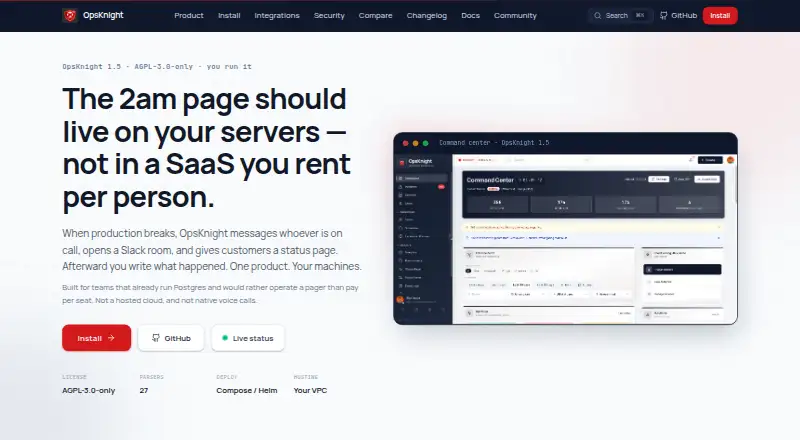
What OpsKnight is
OpsKnight is a self-hosted incident command and on-call platform for alerting, paging, escalations, war rooms, status pages, and post-incident timelines. Monitoring webhooks can create incidents that responders acknowledge, assign, resolve, or group by fingerprint to reduce duplicate paging. On-call schedules support rotations, time zones, and swaps; pages can go through SMS, push, Slack, Microsoft Teams, WhatsApp, or automated voice calls, where pressing 1 acknowledges the page. Its Community edition includes one status page per install, with SLA policies, support-hours rules, and MTTA/MTTR analytics. The integrations page lists 27 native integrations, including Datadog, Sentry, Prometheus Alertmanager, Grafana Alerting, AWS CloudWatch, GitHub Actions, Slack, and Jira Cloud. Community is self-hosted and licensed under AGPL-3.0-only. Deployment requires PostgreSQL 14+ and configured secrets; Docker Engine 20+ with Compose 2+ or Kubernetes 1.24+ are recommended. The maker says the platform has no hosted cloud, external telemetry, or vendor phone-home, and it is not intended for users seeking a fully managed service today.
Good
- Supports on-call rotations, time zones, and swaps.
- Pages through SMS, push, chat, and voice calls.
- Community includes one status page per install.
- Supports generic JSON webhooks and fingerprint deduplication.
- Provides local accounts and OIDC single sign-on.
Watch out
- Requires PostgreSQL 14+ and configured secrets.
- Community edition is self-hosted.
- Includes only one status page per install.
- Not intended for teams needing a managed service today.
Who it suits
OpsKnight is aimed at SRE, DevOps, and platform teams already able to run PostgreSQL, Docker, or Kubernetes. It may suit teams that want incident data and encryption keys kept in their own environment.
Verdict
OpsKnight brings incident response, on-call scheduling, and status reporting into a self-hosted system. It is a fit for teams prepared to operate the required infrastructure, rather than those looking for a managed service.
Plans and prices
From OpsKnight's own pricing page, checked 5 Oct 2026.
| Plan | Price | What it gives you |
|---|---|---|
| Community | Free | Self-hosted · AGPL-3.0-only · one status page per install |
The facts
Each one read from OpsKnight's own pages, with the date it was checked.
What it does
- Audience
- The maker describes it as intended for SRE, DevOps, and platform teams already running Postgres, Docker, or Kubernetes, including teams with strict compliance requirements.checked 5 Oct 2026
- Commercial boundary
- The Community application is licensed under AGPL-3.0-only, while separately licensed Enterprise modules, support, or hosted offerings may be offered independently.checked 4 Oct 2026
- Custom ingestion
- Generic JSON webhooks are supported for internal tools, Kubernetes operators, cron jobs, and custom monitoring scripts.checked 5 Oct 2026
- Deployment
- Community is self-hosted and can be deployed with Docker Compose, Docker Swarm, Helm, or Kustomize.checked 5 Oct 2026
- Deployment requirements
- The install page lists Docker Engine 20+ with Compose 2+ or Kubernetes 1.24+, PostgreSQL 14+, and configured secrets as prerequisites.checked 4 Oct 2026
- Identity
- OpsKnight supports local accounts and OIDC single sign-on with Google Workspace, Okta, Azure AD, Keycloak, and Authentik.checked 5 Oct 2026
- Identity controls
- OpsKnight supports local accounts and OIDC single sign-on with Google Workspace, Okta, Azure AD, Keycloak, and Authentik, along with workspace and team roles.checked 4 Oct 2026
- Incident workflow
- It groups related alerts into incidents that responders can acknowledge, assign, resolve, and document from a timeline.checked 5 Oct 2026
- Integrations
- The integrations page lists 27 integrations, including Datadog, New Relic, Prometheus Alertmanager, Grafana, AWS CloudWatch, Slack, and Jira Cloud.checked 5 Oct 2026
- Intended users and limitation
- OpsKnight describes itself as intended for SRE, DevOps, and platform teams that can run Postgres, Docker, or Kubernetes, and says it is not for users who need a fully managed hosted service today.checked 4 Oct 2026
- On-call and paging
- It supports rotations and escalation, with voice calls, SMS, push, Slack, Microsoft Teams, and WhatsApp notifications.checked 5 Oct 2026
- Phone access
- Responders can acknowledge incidents from an installable PWA that uses the same login as desktop; the site says it is not a separate app-store product.checked 4 Oct 2026
- Purpose
- OpsKnight is a self-hosted incident command and on-call platform for alerting, paging, escalation, war rooms, status pages, and postmortem timelines.checked 5 Oct 2026
- Requirements
- OpsKnight requires PostgreSQL 14+ and configured secrets; the install page recommends Docker Engine 20+ with Compose 2+ or Kubernetes 1.24+.checked 5 Oct 2026
- Security
- The security page says stored credentials use AES-256-CBC envelope encryption and inbound webhook signatures are checked with constant-time verification.checked 5 Oct 2026
- Status and reporting
- The Community edition includes one public, restricted, or private status page per install, plus SLA policies, support-hours rules, and MTTA/MTTR analytics.checked 4 Oct 2026
- Status page limit
- The Community edition includes one public, restricted, or private status page per install, with an optional custom domain.checked 5 Oct 2026
- Support and hosting
- The maker says OpsKnight is not for users who need a fully managed hosted service today; separately licensed support or hosted offerings may be offered independently.checked 5 Oct 2026
- Telemetry
- The maker states there is no external telemetry, no vendor phone-home, and no hosted cloud holding encryption keys.checked 5 Oct 2026
- Telemetry and hosting
- OpsKnight says it has no hosted SaaS cloud, external telemetry beacons, or vendor phone-home; the Community data plane runs in the operator’s environment.checked 4 Oct 2026
- Voice calls
- Responders can acknowledge a voice page by pressing 1, and unanswered or unacknowledged calls advance to the next escalation tier.checked 5 Oct 2026
- What it does
- OpsKnight is a self-hosted incident command and on-call platform with alerting, paging, escalation policies, war rooms, status pages, and incident timelines.checked 4 Oct 2026
The full review of OpsKnight
OpsKnight is a self-hosted incident-response and on-call platform for teams that want to manage alerting, escalation, and status reporting in their own environment. It suits SRE, DevOps, and platform groups already operating container infrastructure and PostgreSQL. Its breadth is appealing, but the trade-off is clear: your team must run the service rather than rely on a managed cloud.
Overview
Monitoring webhooks can open incidents for responders to acknowledge, assign, and resolve. Grouping alerts by fingerprint helps cut duplicate paging, while war rooms, stakeholder updates, and incident timelines carry work through coordination and post-incident review. This makes OpsKnight a fuller incident command system than a notification relay, provided the team can support its infrastructure.
Key features
On-call rotations accommodate time zones and swaps, and escalation policies route incidents onward when a responder does not act. Notifications can reach responders through SMS, push, Slack, Microsoft Teams, WhatsApp, or automated voice calls. A voice page can be acknowledged by pressing 1; unanswered or unacknowledged calls advance to the next tier. Responders can also use an installable PWA with their desktop login, not a separate app-store product.
The Community edition provides one public, restricted, or private status page per installation, with an optional custom domain. SLA policies, support-hours rules, and MTTA/MTTR analytics add useful response tracking, though the one-page cap may be restrictive for organizations separating services or audiences.
OpsKnight lists 27 native integrations, including Datadog, Sentry, Prometheus Alertmanager, Grafana Alerting, AWS CloudWatch, GitHub Actions, Slack, and Jira Cloud. Generic JSON webhooks extend ingestion to custom tools and scripts, with SHA-256 fingerprint deduplication. For teams with unusual monitoring sources, that flexibility reduces dependence on a prebuilt connector.
Credentials are encrypted at rest in PostgreSQL using AES-256-CBC envelope encryption, and inbound webhooks use cryptographic verification. Identity options include local accounts and OIDC single sign-on through Google Workspace, Okta, Azure AD, Keycloak, or Authentik, alongside workspace and team roles. The Community data plane runs in the operator’s environment; OpsKnight says it uses no external telemetry beacons or vendor phone-home and has no hosted cloud holding encryption keys. These controls will matter to teams with strict data and compliance requirements, but they do not remove the operator’s responsibility for deployment and security.
Pricing
| Plan | Price | What it includes |
|---|---|---|
| Community | free | Self-hosted, AGPL-3.0-only application with one status page per install |
Community is a free self-hosted edition with on-call scheduling, escalation policies, a basic status page, post-incident reviews, stakeholder updates, and ChatOps incident actions. It is the natural starting point for teams able to host the system and accept the one-page limit. Separately licensed Enterprise modules, support, or hosted offerings may be offered independently; Community is not a managed-service plan. Docker Engine 20+ with Compose 2+ or Kubernetes 1.24+ is recommended, and PostgreSQL 14+ plus configured secrets are required. Deployment options include Docker Compose, Docker Swarm, Helm, and Kustomize.
Platforms
OpsKnight is listed for web, API, Android, iOS, and self-hosted use. For phone access, responders use the installable PWA rather than a dedicated app-store product.
Who it's for
OpsKnight is best for SRE, DevOps, and platform teams already running PostgreSQL and Docker or Kubernetes, especially those that want incident data to remain in their own environment. It is a poor fit for organizations that need a fully managed hosted service today or lack the staff to operate the required infrastructure.
Pros and cons
- Pro: One workflow covers alert intake, deduplication, escalation, incident coordination, status updates, and post-incident reviews, reducing the need to split response work across separate tools.
- Pro: Native integrations and generic JSON webhooks accommodate both common monitoring stacks and custom sources.
- Pro: Local hosting, OIDC controls, and the stated absence of vendor phone-home suit teams seeking operational and data control.
- Con: Teams must operate PostgreSQL and a supported container environment; there is no hosted Community service.
- Con: Community permits only one status page per installation, which may not suit organizations that need separate pages for multiple services.
- Con: Mobile response uses a PWA rather than a separate app-store application.
Alternatives
PagerDuty is worth considering for teams that want a freemium alternative with a defined free allowance: its Incident Management Free plan is free, billed per year, for 5 users, 1 on-call schedule, 1 escalation policy, basic chat, and limited email and push.
Opsgenie offers a free plan for 5 users and paid tiers, making it an option for teams comparing a freemium service with defined user limits and pricing.
incident.io may suit teams centered on Slack or Microsoft Teams: its Basic plan is free, billed Forever, and includes native incident response in either chat platform, single-team on-call, a status page, and essential incident automation.
TaskCall is an alternative for teams that want a paid tier with unlimited global SMS and voice notifications; its Starter plan is $9 a month.
PagerTree offers a free Basic plan for up to 5 users and 2 teams, with 3 months of data retention and community support, for teams wanting defined free-tier limits.
Runframe is another free option, with a hosted status page and Slack incident response in its plan for up to 5 users.
All Quiet is a paid alternative with a Standard plan at $4.99 a month per user, for teams comparing a per-user subscription with unlimited users, integrations, incidents, and email or push notifications.
IncidentRelay is another free, open-source, self-hosted option.
For category comparisons, see On-Call Scheduling Software, IT Incident Management Software, and On-Call Management Software.
Verdict
Choose OpsKnight if your team wants a broad incident-response workflow, operator-controlled data, and the ability to connect both established monitoring tools and custom webhooks. Its strongest case is the combination of scheduling, escalation, coordination, and reporting in a self-hosted Community edition. Look elsewhere if you need managed hosting or a dedicated mobile app, or if one status page per install will not cover your needs.
Getting started
- Visit the OpsKnight website.
- Choose a deployment route: Docker Compose, Docker Swarm, Helm, or Kustomize.
- Prepare PostgreSQL 14+ and configured secrets.
- Meet the recommended Docker Engine 20+ with Compose 2+ or Kubernetes 1.24+ requirements.
- Deploy Community in your own environment.
- Use desktop or the installable PWA with the same login to respond by phone.
Limits worth knowing
Community includes one public, restricted, or private status page per install. It is self-hosted and requires PostgreSQL 14+ and configured secrets.
Questions
Is OpsKnight free?
Yes. The Community plan costs nothing.
Is OpsKnight open source?
The Community application is licensed under AGPL-3.0-only. Separately licensed Enterprise modules, support, or hosted offerings may be offered independently.
Which platforms are supported?
The listed platforms are Android, API, iOS, self-hosted, and web. Responders can also use an installable PWA with their desktop login; it is not a separate app-store product.
What does Community include?
It includes one status page per install, along with incident response, on-call, SLA, support-hours, and analytics features.
What integrations are available?
The integrations page lists 27 native integrations, including Datadog, Sentry, Prometheus Alertmanager, Grafana Alerting, AWS CloudWatch, GitHub Actions, Slack, and Jira Cloud. Generic JSON webhooks are also supported.
Does OpsKnight offer hosted service or telemetry?
The maker says there is no hosted SaaS cloud, external telemetry, or vendor phone-home. Separately licensed support or hosted offerings may be offered independently.
Alternatives to OpsKnight
- 1

PagerDuty
Free planAndroidiOSWebAPI8.3From $21 a month - 2
PagerTree
Free planAndroidiOSWebAPI8.2From $15 a month - 3

MangoApps
AndroidiOSWebAPI7.9From $9 a month - 4

incident.io
Free planAndroidiOSWebAPI7.6From $15 a month - 5

TaskCall
Free planAndroidiOSWebAPI7.4From $9 a month - 6
MonoDuty
Free planAndroidiOSWebAPI7.2From €9 a month