MonoDuty
MonoDuty is a workspace-based incident management service for teams responsible for production systems.
What MonoDuty is
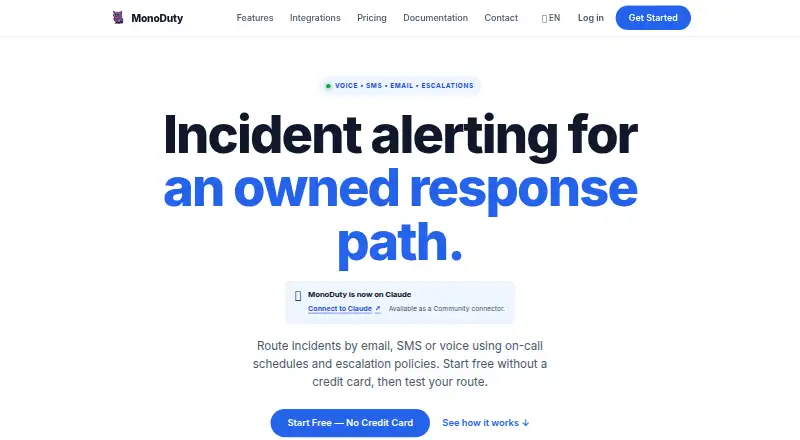
MonoDuty is a workspace-based incident management service for teams responsible for production systems. It brings together team-owned services, on-call schedules, escalation policies, Heartbeats, uptime Monitors, and email, SMS, and voice notifications. Systems able to send HTTP requests can submit incidents through its Universal HTTP Webhook using MonoDuty’s documented JSON payload. Pro and Business plans can send incident lifecycle updates to Slack, Discord, and Microsoft Teams. Monitors check websites and APIs from Helsinki, tracking response times, validating responses, verifying HTTPS certificates, and alerting on recovery. A REST API uses scoped, short-lived customer tokens, with documented access for incidents, services, and Monitors. Security measures include TLS 1.2/1.3, workspace roles, rate limits, and optional time-based one-time-password MFA. MonoDuty says it does not currently publish security certifications. Its production service runs on a single European virtual server, without promised geographic failover, load-balanced application replicas, or provider redundancy. A free plan is available; Pro is €9 a month per user, and a 14-day trial is listed.
Good
- Every listed plan includes on-call scheduling
- Webhook ingestion accepts documented MonoDuty JSON payloads
- Monitors check websites and APIs from Helsinki
- Email, SMS, and voice notifications are available
Watch out
- Free incident history retention is 7 days
- MonoDuty does not publish security certifications
- Production runs on a single European virtual server
- Geographic failover and provider redundancy are not promised
Who it suits
MonoDuty suits people responsible for production incidents who need explicit alert routes, on-call scheduling, and service monitoring. Teams needing Slack, Discord, or Microsoft Teams incident updates would need Pro or Business.
Verdict
MonoDuty combines incident handling, on-call workflows, and website and API monitoring. Consider its stated infrastructure and certification limits when assessing whether it suits your operational requirements.
Plans and prices
From MonoDuty's own pricing page, checked 1 Oct 2026.
| Plan | Price | What it gives you |
|---|---|---|
| Free | Free | 1 user · 3 services · 5 Monitors · 5 Heartbeats · 1 team · 1 on-call schedule · 5 webhooks · 50 incidents/month · Email alerts · 7-day retention · forever |
| Pro | €9 a month | Up to 25 users · 3 Account Admins · 50 services · 50 Monitors · 100 Heartbeats · 10 teams · 10 schedules · 50 webhooks · 5,000 incidents/month · Email + SMS (500/mo) + voice calls (200/mo) · 10 custom escalation policies · API access + audit logs · 30-day retention · per user monthly; annual billing €90/user/year charged once a year |
| Business | €19 a month | Unlimited users & webhooks · 10 Account Admins · 500 services · 250 Monitors · 500 Heartbeats · 50 teams · 50 schedules · Unlimited incidents · Email + SMS (2,000/mo) + voice calls (500/mo) · 50 custom escalation policies · API access + audit logs · Priority support · 90-day retention · per user monthly; annual billing €190/user/year charged once a year |
The facts
Each one read from MonoDuty's own pages, with the date it was checked.
What it does
- API
- MonoDuty documents a REST API with scoped, short-lived customer API tokens and an explicit v1 allowlist for incidents, services, and Monitors.checked 1 Oct 2026
- Chat integrations
- Pro and Business can deliver incident lifecycle updates outward to Slack, Discord, and Microsoft Teams.checked 1 Oct 2026
- Compliance status
- MonoDuty states that it does not currently publish ISO, SOC, payment-card, health-data, or similar security certifications.checked 1 Oct 2026
- Core product
- MonoDuty provides workspace-based incident management, team-owned services, universal HTTP Webhook ingestion, on-call schedules, escalation policies, Heartbeats, uptime Monitors, and email, SMS, and voice notifications.checked 1 Oct 2026
- Inbound integration
- The generally available inbound integration is a Universal HTTP Webhook that accepts the documented MonoDuty JSON payload from HTTP-capable systems.checked 1 Oct 2026
- Infrastructure limitation
- The production service runs on a single European virtual server and does not promise geographic failover, load-balanced application replicas, or provider redundancy.checked 1 Oct 2026
- Monitoring
- Monitors check websites and APIs from Helsinki with response-time tracking, response validation, HTTPS certificate verification, and recovery alerts.checked 1 Oct 2026
- On-call workflow
- Every published Free, Pro, and Business plan includes on-call scheduling.checked 1 Oct 2026
- Retention
- Incident history retention is 7 days on Free, 30 days on Pro, and 90 days on Business.checked 1 Oct 2026
- Security controls
- The service uses TLS 1.2/1.3, one-way password and credential hashing where applicable, scoped API tokens, workspace roles, CSRF protection, rate limits, and optional time-based one-time-password MFA.checked 1 Oct 2026
- Support
- Support is available through a help center, support tickets, contact form, and email, with contact messages reviewed on business days.checked 1 Oct 2026
- Target users
- MonoDuty says it is built for people responsible when production breaks and focuses on explicit, testable alert routes.checked 1 Oct 2026
The company
- Headquarters
- Tallinn, Harju County, Estoniachecked 28 Sep 2026
The full review of MonoDuty
MonoDuty is a workspace-based service for incident response, on-call scheduling, escalation, and website or API monitoring. It suits small operational teams that want a free starting tier and a clear per-user upgrade path. Choose it for integrated alert routing and scheduling; avoid it when certification or infrastructure redundancy is a hard requirement.
Overview
MonoDuty organizes incidents around team-owned services inside workspaces. A universal HTTP Webhook accepts the documented MonoDuty JSON payload, allowing any HTTP-capable system to send alerts without a vendor-specific connector. On-call scheduling is included in Free, Pro, and Business, so the no-cost tier can support an actual rotation rather than merely collecting incidents.
Monitoring is built into the same workflow. Website and API Monitors run checks from Helsinki, record response time, validate responses, verify HTTPS certificates, and issue recovery alerts. That combination is useful for a small team that wants detection and response in one service, but a single stated check location is not a substitute for broad geographic monitoring.
Key features
Incident routing and on-call
Rotation scheduling, handoffs, and escalation policies let teams define who responds and what happens when an acknowledgement does not arrive. Free sends email alerts; Pro adds 500 SMS messages and 200 voice calls per month per user, while Business raises those allowances to 2,000 SMS and 500 voice calls. The paid channels matter for incidents that cannot depend on inbox attention.
Integrations and API
Pro and Business can publish incident lifecycle updates to Slack, Discord, and Microsoft Teams. That is a practical advantage for teams coordinating in chat, while Free remains limited to email delivery. MonoDuty documents a REST API with scoped, short-lived customer tokens and a v1 allowlist covering incidents, services, and Monitors. It is a deliberately bounded interface rather than a claim of unrestricted platform control.
Security and resilience
TLS 1.2/1.3, one-way password and credential hashing where applicable, scoped API tokens, workspace roles, CSRF protection, rate limits, and optional time-based one-time-password MFA provide sensible baseline controls. MonoDuty does not publish ISO, SOC, payment-card, health-data, or similar certifications. Production runs on one European virtual server, without promised geographic failover, load-balanced application replicas, or provider redundancy. Those constraints are material for regulated workloads and services that require high availability.
Pricing
MonoDuty uses a freemium model with a 14-day trial and paid plans from €9/user/mo.
| Plan | Price and limits | Best fit |
|---|---|---|
| Free | free, billed forever. One user, three services, five Monitors, five Heartbeats, one team, one schedule, five webhooks, 50 incidents/month, email alerts, and seven-day retention. | A solo operator or very small team validating a basic on-call process. |
| Pro | €9 per user monthly, or €90/user/year billed once a year. Up to 25 users, three Account Admins, 50 services, 50 Monitors, 100 Heartbeats, 10 teams, 10 schedules, 50 webhooks, 5,000 incidents/month, paid SMS and voice allowances, and 30-day retention. | A growing team needing chat delivery, multi-channel paging, and materially higher quotas. |
| Business | €19 per user monthly, or €190/user/year billed once a year. Unlimited users and webhooks, 10 Account Admins, 500 services, 250 Monitors, 500 Heartbeats, 50 teams, 50 schedules, unlimited incidents, paid SMS and voice allowances, and 90-day retention. | Larger operations that have outgrown Pro's user, incident, or service ceilings. |
The free plan's single user, short retention, and small quotas are meaningful trade-offs, not cosmetic restrictions. Annual billing lowers the listed monthly equivalent but charges once a year; teams should also account for per-user billing on paid tiers.
Platforms
MonoDuty provides Android, iOS, web, and API access. A mobile app supports responders away from a desk, while the API and web interface cover integration and administration.
Who it's for
MonoDuty is aimed at people responsible when production breaks and at teams that want explicit, testable alert routes. Free is credible for a solo maintainer or one small team with modest incident volume. Pro fits teams adding chat coordination and SMS or voice escalation. Business is the more practical tier for multiple teams and services, provided the single-server architecture and absence of published certifications are acceptable.
Pros and cons
Pros
- On-call scheduling, handoffs, and escalation are included even on Free, giving small teams a usable response structure.
- Website and API monitoring combines response-time tracking, validation, certificate checks, and recovery alerts.
- Pro and Business add Slack, Discord, and Microsoft Teams updates plus SMS and voice channels.
- Scoped, short-lived API tokens and optional MFA support controlled operational access.
Cons
- Free is capped at one user, three services, five Monitors, 50 incidents per month, and seven-day retention.
- Monitoring checks originate from Helsinki, limiting the geographic perspective of uptime checks.
- No published ISO, SOC, payment-card, or health-data certification may disqualify regulated deployments.
- A single European production server without promised redundancy is a substantial resilience limitation.
Alternatives
Choose incident.io instead if native Slack or Microsoft Teams incident response and a status page on its Basic free plan are the priority.
OpsKnight is the better choice for teams wanting an AGPL-3.0-only, self-hosted community edition.
Pick PagerTree when its free five-user, two-team allowance and three-month retention suit your starting scale.
TaskCall fits readers seeking a $9 monthly Starter plan with unlimited global SMS and voice notifications.
Consider PagerDuty for a free five-user incident-management tier with one schedule and one escalation policy.
IncidentRelay is a free, open-source, self-hosted option.
Piro is a free multi-platform alternative.
LinkedIn Databus is a free Apache 2.0 open-source project for teams seeking a self-hosted API and web deployment.
For broader comparisons, see On-Call Scheduling Software and On-Call Management Software.
Verdict
MonoDuty is a sensible choice for small teams that want incident intake, on-call rotation, escalation, and basic monitoring in one affordable service. Its strongest reason to choose it is the capable Free tier and straightforward Pro upgrade. Look elsewhere if your operation needs certified compliance, multi-region resilience, or monitoring from several geographic locations.
Alternatives to MonoDuty
- 1

PagerDuty
Free planAndroidiOSWebAPI8.3From $21 a month - 2
PagerTree
Free planAndroidiOSWebAPI8.2From $15 a month - 3

MangoApps
AndroidiOSWebAPI7.9From $9 a month - 4

incident.io
Free planAndroidiOSWebAPI7.6From $15 a month - 5

TaskCall
Free planAndroidiOSWebAPI7.4From $9 a month - 6

OpsKnight
Free planAndroidiOSWebAPI7.3Free plan