LinkedIn Databus
LinkedIn Databus is a self-hosted system for capturing changes in primary data and sending them to downstream systems such as indexes, caches, and read repli…
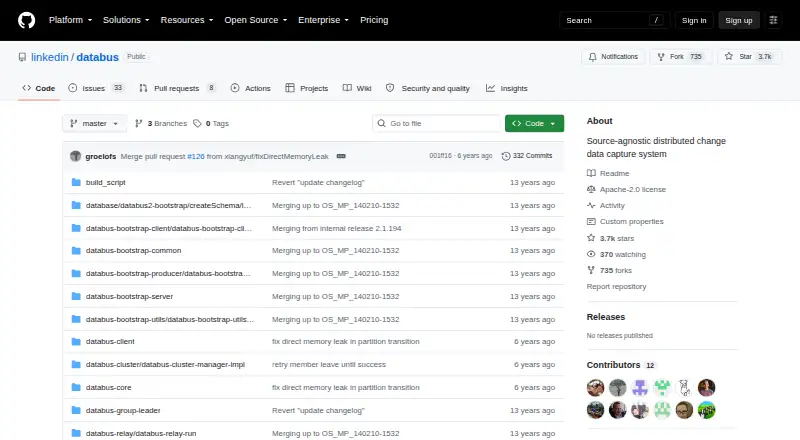
What LinkedIn Databus is
LinkedIn Databus is a self-hosted system for capturing changes in primary data and sending them to downstream systems such as indexes, caches, and read replicas. Relays serve change events, clients process them, and bootstrap servers supply historical events so consumers can catch up. Consumers can start at a chosen point in the stream, use a full-data bootstrap, and consume partitioned data while preserving source consistency. The project describes in-order, at-least-once delivery with high availability, low-millisecond transport latency, and throughput of thousands of events per second per server. It supports Oracle sources; a documented MySQL adapter is a proof of concept and was not deployed in LinkedIn production. LinkedIn describes using Databus to feed search and social-graph indexes and member-profile read replicas. It is free and licensed under Apache 2.0. Building it requires Gradle 1.0 or above and Oracle's ojdbc6 driver version 11.2.0.2.0, obtained under the Oracle Technology Network License. The repository points users to its wiki for documentation and examples.
Good
- Free and licensed under Apache 2.0
- Consumers can start at an arbitrary stream point
- Supports full-data bootstrap and catch-up
- Partitioned consumption preserves source consistency
Watch out
- Building requires Gradle 1.0 or above
- Build requires an Oracle driver under Oracle's license
- MySQL adapter is a proof of concept, not production-deployed
Who it suits
Databus suits teams routing primary database changes to derived stores, including indexes, caches, and read replicas. It is intended for self-hosted data architectures that need replay and bootstrap capabilities.
Verdict
Databus offers change capture, replay, and bootstrap for teams maintaining downstream data stores. Its build prerequisites and Oracle-focused source support are important considerations.
Plans and prices
From LinkedIn Databus's own pricing page, checked 7 Oct 2026.
| Plan | Price | What it gives you |
|---|---|---|
| Databus (Apache 2.0 open source) | Free | Source code licensed under Apache 2.0 |
The facts
Each one read from LinkedIn Databus's own pages, with the date it was checked.
What it does
- Architecture
- Databus uses relays to serve change events, clients to process them, and bootstrap servers to provide historical events for catch-up.checked 7 Oct 2026
- Build requirement
- The README says Databus requires Gradle version 1.0 or above to build.checked 7 Oct 2026
- Consumption
- Databus supports partitioned consumption and preservation of source consistency.checked 7 Oct 2026
- Database support
- The project README describes Oracle sources, and its wiki documents a MySQL adapter as a proof-of-concept implementation.checked 7 Oct 2026
- Delivery
- The wiki describes guaranteed in-order, at-least-once delivery with high availability.checked 7 Oct 2026
- Documentation and support
- The repository points users to its wiki for documentation and examples; the reviewed project pages do not state a support service.checked 7 Oct 2026
- Downstream uses
- LinkedIn says Databus feeds its Social Graph Index, People Search Index, and Member Profile read replicas.checked 7 Oct 2026
- History and bootstrap
- Consumers can start from an arbitrary point in the change stream, with full-data bootstrap capability.checked 7 Oct 2026
- Integration requirement
- Building Databus requires Oracle's ojdbc6 driver version 11.2.0.2.0, obtained under the Oracle Technology Network License.checked 7 Oct 2026
- Intended use
- The README describes Databus as part of LinkedIn's data-processing pipeline for keeping derived stores and indexes consistent with primary data.checked 7 Oct 2026
- Intended users
- The project describes use in data architectures that route primary database changes to derived stores such as indexes, caches, and read replicas.checked 7 Oct 2026
- Latency and throughput
- The README describes low-millisecond transport latency and throughput of thousands of events per second per server.checked 7 Oct 2026
- License
- The repository identifies Databus as licensed under Apache 2.0.checked 7 Oct 2026
- MySQL limitation
- The wiki says the MySQL adapter was not deployed in LinkedIn production and was intended to demonstrate how to write a fetcher.checked 7 Oct 2026
- Product
- Databus is a source-agnostic distributed change data capture system.checked 7 Oct 2026
- Purpose
- It captures, transports, and processes changes to primary data so they can flow to downstream systems.checked 7 Oct 2026
- Replay and bootstrap
- Consumers can start at an arbitrary point in the change stream, and the system supports full-data bootstrap and catch-up.checked 7 Oct 2026
- Sources and downstream uses
- The README says Databus supports Oracle sources and describes downstream use for search and social-graph indexes and member-profile read replicas.checked 7 Oct 2026
The company
- Founded
- 2015checked 28 Sep 2026
- Headquarters
- Sunnyvale, California, United Stateschecked 28 Sep 2026
The full review of LinkedIn Databus
LinkedIn Databus is a self-hosted, source-agnostic change-data-capture system for moving primary-database changes into downstream stores. It fits engineering teams responsible for keeping indexes, caches, read replicas, or similar derived systems consistent, especially where Oracle is central. Its strongest case is ordered, replayable delivery with historical catch-up; its build dependency and limited documented source coverage make it a specialized choice.
Overview
Databus captures changes from primary data, sends them through relays, and lets client applications process the resulting events. Bootstrap servers retain historical events for consumers that are new, paused, or fallen behind, while consumers can resume from an arbitrary position in the stream. That gives a downstream store a practical recovery path instead of forcing every incident to begin with a complete rebuild.
The project describes transport latency in the low-millisecond range and throughput of thousands of events per second per server. Delivery is guaranteed in order and at least once, with high availability. That combination favors consistency-sensitive pipelines, although at-least-once delivery requires downstream handlers that can tolerate duplicate processing.
Key features
- Relays, clients, and bootstrap servers: The separation between event serving, processing, and historical catch-up supports larger deployments and distinct recovery workflows, but it also leaves teams responsible for operating a multi-part service.
- Replay and full bootstrap: A consumer can start at a chosen stream position or obtain a full historical dataset. This is valuable when creating a new index or restoring a lagging read replica.
- Partitioned consumption: Partitioning allows processing work to be distributed while preserving source consistency, a useful balance for high-volume derived stores.
- Documented downstream patterns: LinkedIn describes feeding its Social Graph Index, People Search Index, and Member Profile read replicas. Those examples make Databus a credible fit for database-to-index and database-to-replica pipelines.
- Source support: Oracle is the documented source. The wiki includes a MySQL adapter as a proof of concept, but it was not deployed in LinkedIn production, so it should not be treated as equivalent production support.
- Operational profile: The project is log-based, supports an initial snapshot, and is identified with static binary analysis, sensitive-data flow, rotation scheduling, handoff tools, and multichannel notifications. Escalation policies are not provided.
Pricing
Databus (Apache 2.0 open source) — free. The source code is licensed under Apache 2.0, with no free trial because the software is already free. There are no paid seats, usage quotas, or renewal terms stated. The trade-off is that self-hosting, integration, and ongoing operation remain the user's responsibility; the project pages do not describe a support service.
Platforms
Databus is offered as a self-hosted deployment with API and web access. Android is listed among its mobile platforms. Building it requires Gradle 1.0 or newer and Oracle's ojdbc6 driver version 11.2.0.2.0, obtained under the Oracle Technology Network License. Those prerequisites matter for teams standardizing build environments or avoiding Oracle-licensed components.
Who it's for
Choose Databus when your team operates derived data stores and needs ordered, highly available change delivery, arbitrary-point replay, and full historical bootstrap. It is particularly suited to Oracle-backed architectures modeled on indexes, caches, and read replicas. It is a poorer fit when you need broad, production-proven database coverage, a managed service, or vendor-provided support; the documented MySQL path is only experimental and deployment is self-managed.
Pros and cons
Pros
- Recovery-aware design: Replay and bootstrap let new or damaged consumers catch up without treating every outage as a total rebuild.
- Strong delivery semantics: In-order, at-least-once delivery and high availability address consistency and continuity requirements.
- Scalable consumption: Partitioned processing and reported throughput of thousands of events per second per server suit substantial pipelines.
- No license fee: Apache 2.0 licensing permits use without a subscription charge.
Cons
- Oracle-centric prerequisites: The required ojdbc6 driver and Oracle license add build and compliance work.
- Narrow proven source range: Oracle is documented, while the MySQL adapter is explicitly a non-production proof of concept.
- Self-hosting burden: Teams must run the relays, clients, and bootstrap servers themselves, with no stated support service.
- Duplicate-event handling required: At-least-once delivery is not exactly-once processing, so consumers need idempotent or deduplication-aware logic.
Alternatives
For a broader comparison of replication and event-capture tools, see Change Data Capture Software. Teams choosing a mobile-security workflow should instead review Mobile Application Security Testing Software, while incident-response scheduling belongs in On-Call Scheduling Software.
AppSweep is the better choice for unlimited Android and iOS scans, team members, static and interactive analysis, CI CLI integration, and OWASP MASVS alignment at no cost. Ostorlab suits mobile scan and attack-surface workflows, with a free Community plan and a $299.00 USD-per-month AppSec Web/API plan billed yearly. Reversense Security is an alternative for Android instrumentation and dynamic deobfuscation through its free Dexcalibur Community Edition.
SEBASTiAn is a free, AGPL-3.0 open-source option for Linux, macOS, and Windows. Quixxi Scan fits teams wanting one-off Android or iOS SAST and API scans, with $29.00 USD-per-scan plans and a free trial. Data Theorem Mobile Secure is a paid mobile-security product with demo-based pricing, while Quokka provides paid iOS and Android app-vetting and testing plans. Silker AI Mobile Security is aimed at mobile security teams wanting a $19.50 USD-per-month Pro plan during its beta offer.
Verdict
LinkedIn Databus is a strong fit for engineers maintaining Oracle-centered downstream indexes, caches, and replicas who value ordered delivery, replay, and bootstrap more than turnkey operations. Its Apache 2.0 license and recovery model are compelling. Look elsewhere if you need managed hosting, broad production database adapters, or support beyond community documentation.
Alternatives to LinkedIn Databus
- 1
Estuary
Free planWebAPILinuxmacOS7.9$0.50 usage-based - 2
TiCDC
Free planOpen sourceAPILinuxmacOSSelf-hosted7.2Free plan - 3

Google Cloud Datastream
Free planWebAPI6.8From $0.40 a month - 4

PeerDB
Free planWebAPISelf-hosted6.8From $250 a month - 5
Debezium
Free planAPILinuxSelf-hostedWindows6.6Free plan - 6

Decodable
Free planWebAPISelf-hosted6.6From $0.10 a year