SEBASTiAn
SEBASTiAn is a free, open-source tool for static security assessment of mobile applications.
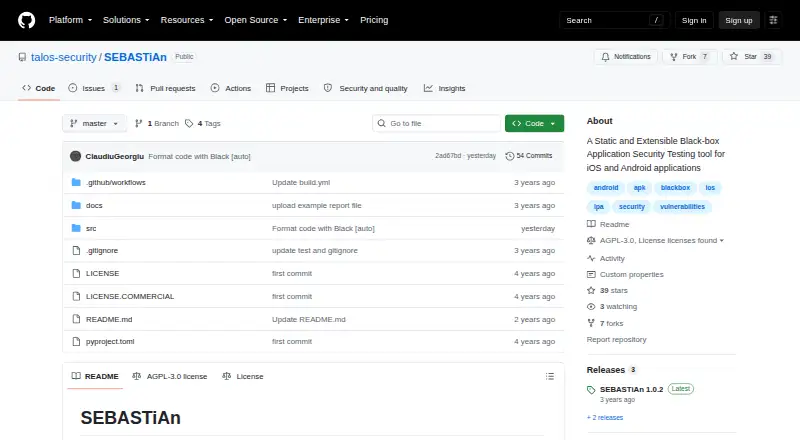
What SEBASTiAn is
SEBASTiAn is a free, open-source tool for static security assessment of mobile applications. It analyzes Android APK and iOS IPA files on Linux, macOS and Windows, and can produce a unified JSON report with vulnerabilities, remediation suggestions, further-reading links and locations of vulnerable code or configuration. Android checks include insecure networking, cryptography, permissions, exported components and WebView configuration. iOS checks cover binary encryption and signatures, insecure APIs and TLS settings, weak cryptography and memory-protection flags. The project is modular and extensible, and can be run from source or through its official Docker image. The `--generate-report` option saves identified vulnerabilities as JSON; reports can be in English or Italian. The default analysis timeout is 1,200 seconds, and users can set another value. Installation guidance lists Python 3 and CMake as requirements. The README notes that Python 3.12 or later may require manually installing LIEF because stable prebuilt wheels are unavailable. SEBASTiAn performs static binary analysis, not dynamic app analysis. Its AGPL-3.0 open-source plan is listed as free; commercial or closed-source use requires a commercial license.
Good
- Analyzes Android APK and iOS IPA files.
- Produces JSON reports with remediation suggestions.
- Runs on Linux, macOS and Windows.
- Offers source and Docker run options.
- Reports can be in English or Italian.
Watch out
- Does not perform dynamic app analysis.
- Commercial or closed-source use requires a commercial license.
- Python 3.12 or later may require manual LIEF installation.
Who it suits
SEBASTiAn suits developers or security teams assessing Android and iOS application binaries with static checks. Its open-source plan is for open-source projects; commercial or closed-source use requires a commercial license.
Verdict
SEBASTiAn provides static checks for Android and iOS binaries, with report details that include remediation suggestions and affected locations. It is free for open-source projects, but commercial or closed-source use requires a separate license.
Plans and prices
From SEBASTiAn's own pricing page, checked 7 Oct 2026.
| Plan | Price | What it gives you |
|---|---|---|
| AGPL-3.0 open-source license | Free | For open-source projects |
| Commercial license | Priced on request | Required for commercial use or closed-source projects; contact [email protected] |
The facts
Each one read from SEBASTiAn's own pages, with the date it was checked.
What it does
- Analysis checks
- Its Android checks cover issues including insecure networking, cryptography, permissions, exported components, and WebView configuration.checked 7 Oct 2026
- Analysis limit
- The default analysis timeout is 1,200 seconds, and users can set a different timeout.checked 7 Oct 2026
- Compatibility note
- The README says Python 3.12 or later may require manually installing LIEF because stable prebuilt wheels are unavailable.checked 7 Oct 2026
- Extensibility
- The project describes SEBASTiAn as extensible and modular.checked 7 Oct 2026
- Language support
- The command line offers English and Italian as vulnerability-report languages.checked 7 Oct 2026
- Mobile targets
- It analyzes Android APK and iOS IPA applications.checked 7 Oct 2026
- Output option
- The command-line option --generate-report saves identified vulnerabilities as a JSON file.checked 7 Oct 2026
- Project support
- The maintainers welcome questions, bug reports, and pull requests on GitHub.checked 7 Oct 2026
- Publication
- The project README links to a 2023 SoftwareX paper about SEBASTiAn.checked 7 Oct 2026
- Purpose
- SEBASTiAn is a static, extensible, platform-agnostic tool for assessing mobile application security.checked 7 Oct 2026
- Reports
- It can produce a unified JSON report with vulnerabilities, remediation suggestions, further-reading links, and the location of vulnerable code or configuration.checked 7 Oct 2026
- Run options
- The tool can be run from source or from its Docker image, and the repository links to an official Docker Hub image.checked 7 Oct 2026
Where it runs
- iOS checks
- Its iOS checks include binary encryption and signature, insecure APIs and TLS settings, weak cryptography, and memory-protection flags.checked 7 Oct 2026
- Platform requirements
- The README lists Ubuntu, Windows, and macOS installation guidance and requires Python 3 and CMake.checked 7 Oct 2026
The company
- Maker
- Talos Security identifies itself as a Genoa-based innovative SME founded in 2016 as a spin-off of the University of Genoa.checked 7 Oct 2026
The full review of SEBASTiAn
SEBASTiAn is a self-hosted static analyzer for Android APKs and iOS IPAs, best suited to developers and security teams who want one open-source tool for both mobile platforms. Its focused checks and actionable JSON findings make it useful for an initial security review, but it cannot assess runtime behavior.
Overview
SEBASTiAn assesses mobile application security without requiring a hosted analysis service. It covers both Android and iOS, and its modular design offers room for teams to adapt or contribute to the project. The trade-off is a self-managed tool: installation requires Python 3 and CMake, and Python 3.12 or later may require manually installing LIEF because stable prebuilt wheels are unavailable.
Key features
Android checks look for problems including insecure networking, weak cryptography, risky permissions, exported components, and WebView configuration. iOS checks cover binary encryption and signatures, insecure APIs and TLS settings, weak cryptography, and memory-protection flags. This gives teams a shared static-analysis starting point across both mobile targets, but findings are limited to what can be identified from the binaries; SEBASTiAn does not perform dynamic app analysis.
Reports can combine vulnerabilities with remediation suggestions, further-reading links, and the locations of vulnerable code or configuration. The --generate-report option saves the findings as JSON, making them easier to pass into downstream workflows. Vulnerability reports can be generated in English or Italian. These outputs are useful for prioritizing fixes, though the project does not replace runtime testing.
Teams can run SEBASTiAn from source or use its official Docker image. Analysis has a default timeout of 1,200 seconds, which can be changed. The project welcomes questions, bug reports, and pull requests on GitHub.
Pricing
The AGPL-3.0 open-source license costs free for open-source projects. That makes SEBASTiAn a no-cost option for eligible teams that can work with a self-hosted static analyzer. Commercial use and closed-source projects require a separate commercial license with custom pricing; contact [email protected]. The free license therefore does not make it a free choice for every organization.
Platforms
SEBASTiAn runs on Linux, macOS, and Windows, with installation guidance for Ubuntu, Windows, and macOS. It analyzes Android APK and iOS IPA files, so its host-platform support should not be confused with the mobile targets it assesses. Python 3 and CMake are required.
Who it's for
SEBASTiAn fits open-source developers and security teams that need static checks across Android and iOS, can manage a self-hosted tool, and value machine-readable findings. Its configurable timeout and Docker option offer practical flexibility for different environments. Teams needing runtime analysis, or commercial and closed-source organizations unwilling to arrange a separate license, should look elsewhere.
Pros and cons
- Pros: Android and iOS checks in one tool give open-source teams broad static coverage without a license fee.
- Pros: JSON findings can include remediation guidance and affected locations, supporting follow-up beyond simply flagging a vulnerability.
- Pros: Source and Docker run options, plus a configurable timeout, suit teams with different self-hosting setups.
- Cons: No dynamic analysis means it cannot assess behavior while an app is running.
- Cons: Commercial or closed-source use requires a separately priced license, complicating adoption for those teams.
- Cons: Python 3.12 or later may need a manual LIEF installation, adding setup work on newer environments.
Alternatives
Compare mobile application security testing software if you want to weigh tools by category. AppSweep is a stronger fit for teams seeking static and interactive analysis, CI CLI support, OWASP MASVS alignment, and unlimited Android and iOS scans and team members on its free plan.
Ostorlab suits readers who want unlimited mobile scans plus attack-surface discovery, remediation, and ticketing in its free Community plan, or need its paid AppSec Web/API offering. Reversense Security is worth considering when Android instrumentation generation and dynamic deobfuscation are more important than SEBASTiAn's cross-platform static checks.
LinkedIn Databus is another free, open-source option. Quixxi Scan offers one-off Android and iOS SAST scans at $29, paid once, which may suit buyers who prefer per-scan pricing. Data Theorem Mobile Secure, Quokka, and Silker AI Mobile Security are other options to compare.
Verdict
Choose SEBASTiAn if you work on open-source projects, need static security checks for both Android and iOS, and can operate a self-hosted tool. Its strongest case is the combination of broad platform coverage and structured, remediation-oriented findings at no cost for eligible projects. Look elsewhere if you need dynamic analysis or commercial use without negotiating a separate license.
Alternatives to SEBASTiAn
- 1

AppSweep
Free planAndroidiOSWebAPI7.8Free plan - 2

Ostorlab
Free planAndroidiOSWebAPI7.3From $299 a month - 3

Oversecured
AndroidiOSWebAPI6.8$1,000 usage-based - 4
Quixxi Scan
AndroidiOSWeb6.8From $299 a year - 5
 6.6From $599 a year
- 6
Silker AI Mobile Security
AndroidiOSWeb6.6From $19.50 a month