Debezium
Debezium is a free, open source platform that captures database row changes and streams them to applications as events.
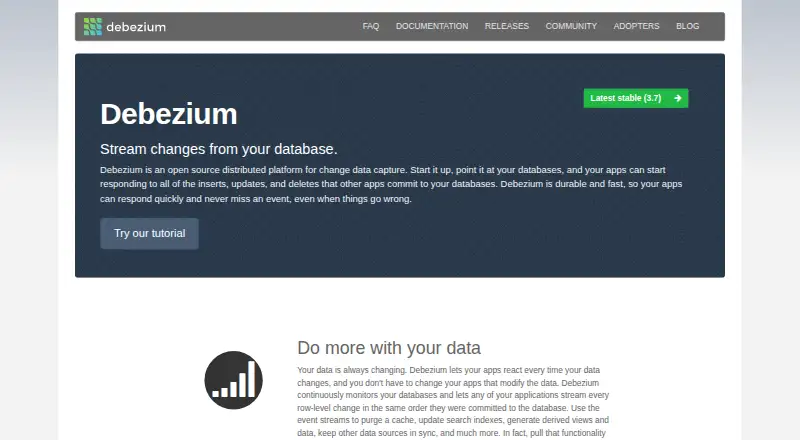
What Debezium is
Debezium is a free, open source platform that captures database row changes and streams them to applications as events. Its connectors read database logs to capture inserts, updates, and deletes with low delay, without requiring changes to the data model. They can take initial or incremental snapshots, filter schemas, tables, and columns, and mask selected column values. Listed source databases include MongoDB, MariaDB, MySQL, PostgreSQL, SQL Server, Oracle, Db2, and Cassandra. Connectors for Vitess, Spanner, Informix, CockroachDB, YashanDB, Ingres, and Milvus are marked incubating and may change without backward compatibility. A common deployment uses Apache Kafka Connect; Debezium can also run through Debezium Server or as an embedded library in JVM applications. Debezium Server can send serialized events to Amazon Kinesis, Google Cloud Pub/Sub, and Apache Pulsar. Ready-to-use transformations support routing, filtering, and event flattening. The project is licensed under Apache 2.0. Its quay.io container images are for testing and evaluation, not production use.
Good
- Captures inserts, updates, and deletes from database logs.
- Supports snapshots and filters for schemas, tables, and columns.
- Can mask selected column values.
- Offers Kafka Connect, Server, and embedded deployment options.
- Licensed under Apache 2.0.
Watch out
- Several listed connectors are incubating and may change incompatibly.
- quay.io container images are not intended for production.
- Embedded connectors are less fault tolerant without Kafka logs.
Who it suits
Debezium suits teams that need to capture database changes as events for applications or messaging systems. It is open source and welcomes community participation in using, discussing, and developing the project.
Verdict
Debezium offers multiple ways to capture and route database changes, with connectors for a broad set of databases. Treat incubating connectors and the testing-only container images with care when planning deployment.
Plans and prices
From Debezium's own pricing page, checked 7 Oct 2026.
| Plan | Price | What it gives you |
|---|---|---|
| Debezium | Free | Open-source distributed change data capture platform · Apache License 2.0 |
The facts
Each one read from Debezium's own pages, with the date it was checked.
Where it runs
- CDC approach
- Its source connectors use database features for log-based change data capture, which can capture deletes without requiring changes to the data model.checked 7 Oct 2026
What it does
- Change capture
- Its log-based CDC captures inserts, updates, and deletes with low delay, without requiring changes to the data model.checked 7 Oct 2026
- Community support
- The project points users to documentation, a Zulip chat room, and a Google Group for questions.checked 7 Oct 2026
- Database connectors
- The connector list includes MongoDB, MariaDB, MySQL, PostgreSQL, SQL Server, Oracle, Db2, and Cassandra, as well as several connectors marked incubating.checked 7 Oct 2026
- Database integrations
- Source connectors are listed for MongoDB, MariaDB, MySQL, PostgreSQL, SQL Server, Oracle, Db2, and Cassandra, among others.checked 7 Oct 2026
- Data masking
- Debezium can mask values in specified columns, including columns containing sensitive data.checked 7 Oct 2026
- Deployment
- The most common deployment uses Apache Kafka Connect; Debezium can also be embedded in JVM applications or run through Debezium Server.checked 7 Oct 2026
- Deployment limit
- The installation page lists Kafka Connect connector deployment and says the Debezium Operator, Server, and CLI installation methods are coming soon.checked 7 Oct 2026
- Embedded reliability
- The installation documentation says embedded connectors are lighter weight without Kafka services, but are less fault tolerant because the application must manage state normally kept in Kafka logs.checked 7 Oct 2026
- Embedded use
- Debezium connectors can be embedded as a library in custom JVM-based applications.checked 7 Oct 2026
- Event delivery
- Debezium records changes in commit order and is designed to resume monitoring after applications or services are unavailable.checked 7 Oct 2026
- Event destinations
- Debezium Server can send serialized change events to messaging systems including Amazon Kinesis, Google Cloud Pub/Sub, and Apache Pulsar.checked 7 Oct 2026
- Incubating feature caveat
- The documentation says embedding a connector library removes the need for Kafka services but is less fault tolerant because the application must manage state normally kept in Kafka's distributed replicated logs.checked 7 Oct 2026
- Installation caveat
- The documentation says Debezium container images from quay.io are for testing and evaluation and are not intended for production because they do not undergo rigorous testing or security analysis.checked 7 Oct 2026
- Intended users
- The project describes itself as an open-source platform and welcomes community participation in using, discussing, and developing it.checked 7 Oct 2026
- License
- All Debezium project code is licensed under the Apache License 2.0.checked 7 Oct 2026
- Message transformations
- Ready-to-use transformations support message routing, filtering, event flattening, and other operations.checked 7 Oct 2026
- Preview connectors
- The site marks Vitess, Spanner, Informix, CockroachDB, YashanDB, Ingres, and Milvus connectors as incubating and says they may change without backward compatibility.checked 7 Oct 2026
- Purpose
- Debezium is an open source distributed platform for change data capture that streams database row changes to applications.checked 7 Oct 2026
- Sensitive data
- Connectors can mask values from selected columns that contain sensitive data.checked 7 Oct 2026
- Snapshots and filters
- Connectors can take initial or incremental snapshots and filter captured schemas, tables, and columns.checked 7 Oct 2026
- Streaming integrations
- Debezium commonly runs with Apache Kafka Connect, and Debezium Server can send events to systems including Amazon Kinesis, Google Cloud Pub/Sub, and Apache Pulsar.checked 7 Oct 2026
- Support
- The project points users to its documentation, user chat room, and Google Group for questions.checked 7 Oct 2026
- What it does
- Debezium captures row-level database changes so applications can respond to inserts, updates, and deletes as events.checked 7 Oct 2026
The full review of Debezium
Debezium is an open-source change data capture platform that turns database row changes into events for applications. It is best suited to teams building self-hosted data pipelines that can operate Kafka Connect or manage a JVM-based deployment. Its broad connector set and event controls make it a capable choice, though deployment and reliability tradeoffs need careful planning.
Overview
Debezium captures inserts, updates, and deletes from databases and delivers them as events. Its log-based approach records changes in commit order and is designed to resume monitoring after an application or service is unavailable. That suits systems that need a timely, ordered change stream; teams seeking a managed service should look elsewhere.
Key features
Connectors can take initial or incremental snapshots, then filter captured schemas, tables, or columns. They can also mask selected column values, including sensitive data. Ready-to-use transformations cover routing, filtering, and event flattening, giving pipeline builders practical controls over what downstream applications receive.
Source connectors include MongoDB, MariaDB, MySQL, PostgreSQL, SQL Server, Oracle, Db2, and Cassandra. Vitess, Spanner, Informix, CockroachDB, YashanDB, Ingres, and Milvus are incubating and may change without backward compatibility, making them a less dependable base for systems that require stable integrations.
Apache Kafka Connect is the most common deployment. Debezium can also run embedded in a custom JVM application or through Debezium Server, which can send serialized events to Amazon Kinesis, Google Cloud Pub/Sub, and Apache Pulsar. Embedding removes the need for Kafka services and is lighter weight, but shifts responsibility for state normally held in Kafka's distributed replicated logs to the application, reducing fault tolerance.
The installation documentation describes Kafka Connect deployment; installation methods for Debezium Operator, Server, and CLI are coming soon. Quay.io container images are intended for testing and evaluation, not production, because they do not receive rigorous testing or security analysis.
Pricing
Debezium is free and open source under the Apache License 2.0. Its Debezium plan costs nothing and provides the change data capture platform for self-hosted deployment, with one-way replication and data transformations. There are no paid plans to compare; the cost is in operating the deployment and choosing an architecture that meets your reliability needs.
Platforms
Debezium supports API, Linux, self-hosted, and Windows environments. Its embedded connector option is for custom JVM-based applications, while Kafka Connect is the usual deployment path.
Who it's for
Choose Debezium if you need log-based change capture across its established database connectors, want control over a self-hosted pipeline, and can support its deployment. It is a particularly practical fit when applications need ordered inserts, updates, and deletes, with snapshots, filtering, masking, or event transformations in the same pipeline. Teams considering an incubating connector should allow for compatibility changes.
Pros and cons
- Pros: Captures inserts, updates, and deletes with low delay, including deletes without data-model changes; preserves commit order and is designed to resume after service interruptions.
- Pros: Snapshots, filters, masking, and ready-to-use transformations give teams useful control over captured and delivered events.
- Pros: Established connectors cover several widely used databases, and Debezium Server supports destinations including Kinesis, Pub/Sub, and Pulsar.
- Cons: The common Kafka Connect deployment requires teams to operate that stack; embedded deployment is less fault tolerant because the application must manage state.
- Cons: Incubating connectors may change without backward compatibility, and the published quay.io images are not intended for production.
Alternatives
MySQL is worth considering when you want a freemium option with a GPL-licensed Community Edition and replication and high-availability components.
SymmetricDS offers a free Community edition and supports Android, iOS, web, desktop, and self-hosted platforms; consider it if that broader platform coverage suits your deployment.
Estuary has a free plan and a $100 a month pay-as-you-go plan, making it an option to compare if you prefer a freemium service with a stated monthly tier.
Fivetran Database Replication has a free tier capped at 500,000 monthly active rows for connections, 3,500 for activations, and 5,000 monthly model runs for transformations; consider it if those limits fit your workload.
Striim provides a developer plan with 25 million events per month and a cloud plan; compare it if those plan options better match your pipeline needs.
TiCDC is another free, self-hosted change data capture option to compare.
Amazon Database Migration Service is a paid service with an AWS Free Tier that offers $100 in credits, plus up to an additional $100 for activating foundational AWS services; consider it if AWS credits and a web-based service fit your setup.
Artie offers a free tier with up to 1M billable rows per month and two active pipelines, with backfills included; it may suit workloads within those limits.
Browse Data Replication Software, Change Data Capture Software, and Database Replication Software for more options.
Verdict
Debezium is a strong choice for engineering teams that want free, self-hosted, log-based change capture with broad database coverage and useful event controls. Its main reason to choose is the combination of ordered change streams, snapshots, filtering, masking, and transformations. Look elsewhere if you need a managed service, depend on an incubating connector, or cannot accept the operational work and reliability tradeoffs of its deployment options.
Getting started
- Visit the Debezium website and review its documentation.
- Choose a supported deployment approach: Kafka Connect, Debezium Server, or an embedded JVM library.
- Select a source connector for your database.
- Configure snapshots, filters, masking, and transformations as needed.
- Connect the event stream to its destination; Debezium Server supports destinations including Amazon Kinesis, Google Cloud Pub/Sub, and Apache Pulsar.
Limits worth knowing
The quay.io container images are intended for testing and evaluation, not production. Embedding a connector avoids Kafka services but is less fault tolerant because the application must manage state normally kept in Kafka logs.
Questions
How much does Debezium cost?
Debezium is free and available under the Apache Software License 2.0.
Which databases have source connectors?
Listed connectors include MongoDB, MariaDB, MySQL, PostgreSQL, SQL Server, Oracle, Db2, and Cassandra, among others. Several additional connectors are marked incubating.
Does Debezium require Apache Kafka Connect?
Kafka Connect is the most common deployment, but Debezium can also run through Debezium Server or as a library embedded in a JVM application.
Where can Debezium Server send events?
It can send serialized change events to messaging systems including Amazon Kinesis, Google Cloud Pub/Sub, and Apache Pulsar.
What support channels does the project offer?
The project points users to its documentation, a Zulip chat room, and a Google Group.
Alternatives to Debezium
- 1
Estuary
Free planWebAPILinuxmacOS7.9$0.50 usage-based - 2
TiCDC
Free planOpen sourceAPILinuxmacOSSelf-hosted7.2Free plan - 3

Google Cloud Datastream
Free planWebAPI6.8From $0.40 a month - 4

PeerDB
Free planWebAPISelf-hosted6.8From $250 a month - 5

Decodable
Free planWebAPISelf-hosted6.6From $0.10 a year - 6
Sequin
Free planWebAPILinuxSelf-hosted6.6Free plan