Sequin
Sequin streams PostgreSQL changes in real time to destinations such as Kafka, Redis, queues, search indexes, and webhooks.
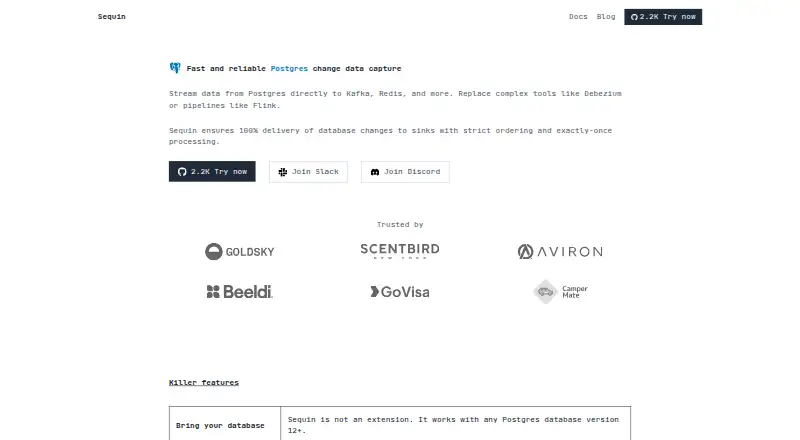
What Sequin is
Sequin streams PostgreSQL changes in real time to destinations such as Kafka, Redis, queues, search indexes, and webhooks. It runs as a Docker image alongside Postgres and can be launched with Docker Compose. Users can filter and transform changes, add data from Postgres, and route messages to destinations including AWS SQS, GCP Pub/Sub, Redis Streams and Strings, NATS, Elasticsearch, Typesense, and Meilisearch. Backfills can start at the beginning of a table or a chosen point, and can replay selected rows. The maker describes delivery with automatic retries, exponential backoff, strict ordering, and exactly-once processing. Sinks can be managed through a console, CLI, YAML configuration, or API. Sequin exposes Prometheus metrics and provides a Grafana dashboard. It is self-hosted and open source under the MIT license; the listed self-hosted plan is free. PostgreSQL 14 or higher is supported, while versions 12 and 13 are soft-supported with limitations. Sequin Cloud shut down on October 23, 2025, and the project continues in maintenance mode with security patches and critical bug fixes.
Good
- Routes changes to messaging, search, and webhook destinations.
- Supports backfills and selected-row replays.
- Sinks can be managed through console, CLI, YAML, or API.
- Provides Prometheus metrics and a Grafana dashboard.
- Open source under the MIT license.
Watch out
- Sequin Cloud shut down on October 23, 2025.
- Self-hosting is the deployment option.
- PostgreSQL 12 and 13 have support limitations.
- Project maintenance is limited to security patches and critical fixes.
Who it suits
Sequin suits teams that need to stream PostgreSQL changes to messaging, search, or webhook destinations and can self-host the service. It may also fit uses such as audit logging, cache synchronization, and search indexing.
Verdict
Sequin offers a self-hosted route for streaming PostgreSQL changes with filtering, routing, and backfills. Its cloud service is no longer available, and the project is in maintenance mode.
Plans and prices
From Sequin's own pricing page, checked 9 Oct 2026.
| Plan | Price | What it gives you |
|---|---|---|
| Self-hosted Sequin | Free | Open-source under MIT license · runs on your own infrastructure |
The facts
Each one read from Sequin's own pages, with the date it was checked.
What it does
- Backfills
- Users can backfill sinks from the beginning or a selected point and replay specific rows.checked 9 Oct 2026
- Cloud availability
- Sequin Cloud subscriptions were canceled and the hosted service was scheduled to shut down on October 23, 2025; the notice recommends self-hosting.checked 9 Oct 2026
- Database support
- The database reference says PostgreSQL 14 or higher is supported and versions 12 and 13 are soft-supported with limitations.checked 4 Oct 2026
- Delivery
- The product describes 100% delivery with automatic retries, strict ordering, and exactly-once processing using idempotency keys.checked 9 Oct 2026
- Deployment
- Sequin runs as a Docker image alongside Postgres and uses Postgres to store sink state.checked 9 Oct 2026
- Destinations
- Documented sinks include Kafka, AWS SQS, GCP Pub/Sub, Redis Streams, NATS, Elasticsearch, Typesense, Meilisearch, and webhooks.checked 9 Oct 2026
- License
- The maker says Sequin is open source under the MIT license.checked 4 Oct 2026
- Management
- Users can manage sinks through a web console, CLI, configuration files, and API.checked 9 Oct 2026
- Monitoring
- Sequin exposes Prometheus metrics and provides a Grafana dashboard.checked 9 Oct 2026
- Observability
- Sequin exposes a Prometheus metrics endpoint and provides a Grafana dashboard.checked 4 Oct 2026
- Open-source status
- The shutdown notice says Sequin is open-source under the MIT license and that the project will continue in maintenance mode with security patches and critical bug fixes.checked 9 Oct 2026
- Postgres versions
- The homepage says Sequin works with any Postgres version 12 or later; the introduction documentation says version 14 or later.checked 9 Oct 2026
- Pricing
- The opened maker pages provide no current plan prices; the Cloud shutdown page says all Cloud subscriptions were canceled.checked 4 Oct 2026
- Processing
- Sequin supports enriching changes with Postgres data, filtering changes, transforming messages, and routing them to destinations.checked 9 Oct 2026
- Product
- Sequin captures changes from Postgres and streams them to destinations such as Kafka, queues, search indexes, and HTTP endpoints.checked 9 Oct 2026
- Security
- The security page describes encryption standards supporting NIST-approved protocols such as TLS and says customers will be notified of incidents without undue delay, and where feasible within 72 hours.checked 9 Oct 2026
- Security setup
- The maker's database connection guide recommends a dedicated production user with connect, select, and replication permissions.checked 4 Oct 2026
- Support
- The documentation offers help through Discord, Slack, GitHub issues, and scheduled calls.checked 9 Oct 2026
- Use cases
- The maker highlights event streaming, audit logging, cache synchronization, and search indexing as use cases.checked 9 Oct 2026
The full review of Sequin
Sequin is a self-hosted change-data capture tool for teams building services around PostgreSQL. It suits operators who want to route database changes into event, cache, and search systems; the trade-off is that Sequin Cloud has shut down, leaving self-hosting as the only deployment path.
Overview
Sequin captures PostgreSQL changes from the database log, takes an initial snapshot, and runs as a Docker image alongside PostgreSQL. Docker Compose can start it, but operating it remains your responsibility. That makes it a better fit for teams comfortable managing infrastructure than for those seeking a hosted pipeline.
The project is open source under the MIT license and is in maintenance mode, with security patches and critical bug fixes planned. Sequin Cloud shut down on October 23, 2025, and its subscriptions were canceled. Sequin remains an option for self-hosting, but not as a managed cloud service.
Key features
Sequin can send changes to Kafka, AWS SQS, GCP Pub/Sub, Redis Streams and Strings, NATS, Elasticsearch, Typesense, Meilisearch, and webhooks. Users can filter and transform messages, enrich changes with PostgreSQL data, and route them to destinations. This gives teams a single tool for event streaming, audit logging, cache synchronization, and search indexing, though its focus is firmly on PostgreSQL change flows.
Backfills can begin at a table's start or a chosen point, and can replay selected rows. That flexibility helps when populating a new sink or recovering a subset of data without treating every replay as a full-table restart.
The maker describes delivery with automatic retries, exponential backoff, strict ordering, and exactly-once processing. Those guarantees are useful for systems where duplicate or out-of-order changes complicate downstream work. Sequin also exposes Prometheus metrics and includes a Grafana dashboard, giving teams tools to monitor a deployment they operate themselves.
Sinks can be managed through a console, CLI, YAML configuration, or API. PostgreSQL 14 and later are supported; versions 12 and 13 are soft-supported with limitations. The maker's database connection guide recommends a dedicated production user with connect, select, and replication permissions.
Pricing
Self-hosted Sequin: free. The plan is open source under the MIT license and runs on your own infrastructure. There is no current Cloud subscription to choose instead: Sequin Cloud has shut down, and its subscriptions were canceled. The free plan avoids a software charge, but the self-hosting model means teams need to provide and operate the infrastructure.
Platforms
Sequin is available for API, Linux, self-hosted, and web environments. Its deployment model is self-hosted, with Docker and Docker Compose as the documented ways to run it alongside PostgreSQL.
Who it's for
Sequin fits teams that already operate PostgreSQL and want to distribute its changes across messaging, cache, search, or webhook destinations. Its filtering, enrichment, routing, and replay options suit workflows that need more than a basic one-way feed. It is a poor fit for teams that require managed hosting or long-term feature development beyond maintenance fixes.
Pros and cons
- Pros: Broad destination support and configurable routing let teams direct PostgreSQL changes to several kinds of downstream systems.
- Pros: Backfills include start-point selection and selected-row replay, useful for initialization and targeted recovery.
- Pros: MIT-licensed and free to run, with Prometheus metrics and a Grafana dashboard for operational visibility.
- Cons: Self-hosting is required since Sequin Cloud has shut down, so teams must operate the deployment themselves.
- Cons: Maintenance mode limits the project to security patches and critical bug fixes, which is a concern for teams depending on active feature development.
- Cons: PostgreSQL 12 and 13 are only soft-supported with limitations; PostgreSQL 14 or later is the supported target.
Alternatives
For other change-data-capture options, browse Change Data Capture Software.
- Canal is a free, Apache-2.0 open-source option for API, Linux, macOS, and self-hosted platforms; choose it if those platform options suit your deployment better.
- Apache Flink CDC is free under Apache License 2.0, with released JARs and connectors for Linux, macOS, self-hosted, and Windows environments; pick it if that packaging and platform range better matches your setup.
- Debezium is a free, Apache-2.0 distributed change-data-capture platform for API, Linux, self-hosted, and Windows; consider it if you want a distributed CDC platform.
- pgstream is a free, Apache-2.0 open-source CDC CLI and Go library for Linux, macOS, and self-hosting; choose it if a CLI or Go library is a better fit.
- dbmazz offers a free open-source engine with a CLI, terminal dashboard, local web UI, and community support; consider it if those interfaces and support model suit your workflow.
- Estuary has free and paid options, including a $100 a month pay-as-you-go plan; choose it if you prefer a freemium offering with a priced monthly tier.
- Striim offers free and paid options, including a developer plan with 25 million events per month; consider it if that stated monthly event allowance fits your needs.
- TiCDC is free, open source, and has no paid plans or usage caps stated; choose it if you want another no-cost CDC option.
Verdict
Choose Sequin if you need to route PostgreSQL changes across varied destinations, want flexible backfills, and can run the software yourself. Its strongest case is the combination of routing controls and replay options at no software cost. Look elsewhere if you need hosted service or active feature development: Cloud is gone, and the project is maintained for security patches and critical fixes.
Getting started
- Install Docker and run Sequin as a Docker image alongside PostgreSQL.
- Start it with Docker Compose.
- Use a PostgreSQL 14-or-later database; versions 12 and 13 are soft-supported with limitations.
- Follow the connection guide’s recommendation to use a dedicated production database user with connect, select, and replication permissions.
- Manage sinks with the console, CLI, YAML configuration, or API.
Limits worth knowing
Sequin is self-hosted, so it runs on your own infrastructure. PostgreSQL versions 12 and 13 are soft-supported with limitations, and the project is in maintenance mode with security patches and critical bug fixes.
Questions
Is Sequin open source?
Yes. Sequin is open source under the MIT license.
What does Sequin cost?
The listed Self-hosted Sequin plan costs nothing and runs on your own infrastructure.
Does Sequin Cloud still operate?
No. Sequin Cloud shut down on October 23, 2025, and the maker directs users to migrate to self-hosting.
Which PostgreSQL versions does it support?
The introduction documentation supports PostgreSQL 14 or later. Versions 12 and 13 are soft-supported with limitations.
What destinations can Sequin send changes to?
Listed destinations include Kafka, AWS SQS, GCP Pub/Sub, Redis Streams and Strings, NATS, Elasticsearch, Typesense, Meilisearch, and webhooks.
How can users monitor Sequin?
Sequin exposes a Prometheus metrics endpoint and provides a Grafana dashboard.
Alternatives to Sequin
- 1
Estuary
Free planWebAPILinuxmacOS7.9$0.50 usage-based - 2
TiCDC
Free planOpen sourceAPILinuxmacOSSelf-hosted7.2Free plan - 3

Google Cloud Datastream
Free planWebAPI6.8From $0.40 a month - 4

PeerDB
Free planWebAPISelf-hosted6.8From $250 a month - 5
Debezium
Free planAPILinuxSelf-hostedWindows6.6Free plan - 6

Decodable
Free planWebAPISelf-hosted6.6From $0.10 a year