dbmazz
dbmazz is a Rust daemon for streaming database changes into a sink.
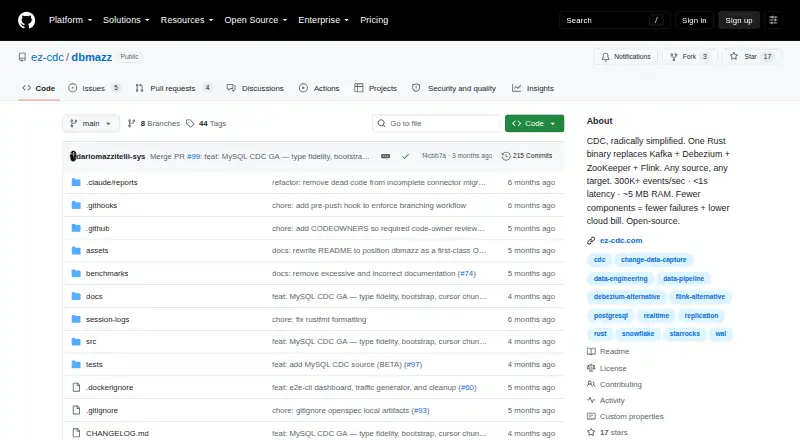
What dbmazz is
dbmazz is a Rust daemon for streaming database changes into a sink. It reads PostgreSQL changes through logical replication and streams inserts, updates, and deletes. The project reports sub-second replication lag and about 11 MB of resident memory per daemon. PostgreSQL and MySQL are listed as sources; stable sinks are StarRocks, PostgreSQL, and Snowflake, while S3/Iceberg is on the roadmap. Each instance handles one replication job. The project provides an ez-cdc CLI quickstart demo and an official Docker image for running the daemon. Its CLI runs on Linux and macOS for amd64 and arm64. The maker lists Prometheus metrics, gRPC reflection, an HTTP control plane, and a live terminal dashboard. It says automatic setup can create publications, replication slots, sink tables, and audit columns. The self-hosted engine is free, and the free BYOC plan deploys in a customer's AWS or GCP account; support and optional PrivateLink connectivity are charged separately. dbmazz uses Elastic License 2.0, which permits commercial and non-commercial use but restricts offering it to third parties as a managed service.
Good
- Free self-hosted engine.
- Streams inserts, updates, and deletes.
- Official Docker image and CLI quickstart demo.
- Lists Prometheus metrics and a terminal dashboard.
Watch out
- Each instance handles one replication job.
- S3/Iceberg is listed as roadmap, not stable.
- Managed-service offering to third parties is restricted.
- BYOC support and optional PrivateLink cost extra.
Who it suits
dbmazz suits teams seeking streaming PostgreSQL change data capture without operating a streaming platform. It is also an option for users who want to self-host or deploy in their AWS or GCP account.
Verdict
dbmazz offers a focused CDC daemon with listed stable sources and sinks, plus self-hosted and BYOC options. Check the one-job-per-instance limit and license restriction against your deployment plans.
Plans and prices
From dbmazz's own pricing page, checked 29 Sep 2026.
| Plan | Price | What it gives you |
|---|---|---|
| BYOC | Free | Deploy into your AWS or GCP account · support and optional PrivateLink connectivity are charged separately · Free |
| Self-host dbmazz | Free | Open-source engine · CLI and terminal dashboard · local web UI · community support · Free forever |
The facts
Each one read from dbmazz's own pages, with the date it was checked.
What it does
- Automatic setup
- The maker says ez-cdc can create publications, replication slots, sink tables, and audit columns automatically.checked 29 Sep 2026
- BYOC and data location
- EZ-CDC says BYOC runs in the customer's AWS or GCP account and that its data stays within that account.checked 29 Sep 2026
- BYOC security features
- The maker lists multi-AZ high availability, autoscaling, load balancing, optional PrivateLink, and data sovereignty for BYOC.checked 29 Sep 2026
- Intended users
- The README describes dbmazz as an option for teams seeking streaming PostgreSQL CDC without operating a streaming platform.checked 29 Sep 2026
- License
- dbmazz uses Elastic License 2.0, which the README describes as allowing commercial and non-commercial use while restricting offering it to third parties as a managed service.checked 29 Sep 2026
- Notable limitation
- The README says each dbmazz instance handles one replication job.checked 29 Sep 2026
- Observability
- The maker lists Prometheus metrics, gRPC reflection, an HTTP control plane, and a live terminal dashboard.checked 29 Sep 2026
- Performance
- The project reports sub-second replication lag and about 11 MB of resident memory per daemon in its README.checked 29 Sep 2026
- Setup
- The project provides an ez-cdc CLI quickstart demo and an official Docker image for running the daemon.checked 29 Sep 2026
- Sources and sinks
- The README lists PostgreSQL and MySQL sources, with StarRocks, PostgreSQL, and Snowflake as stable sinks; S3/Iceberg is listed as roadmap.checked 29 Sep 2026
- Support
- The project points users to GitHub Discussions and Issues, and its documentation lists support by email or GitHub issue.checked 29 Sep 2026
- What it does
- dbmazz is a Rust daemon that reads PostgreSQL changes through logical replication and streams inserts, updates, and deletes to a sink.checked 29 Sep 2026
Where it runs
- CLI platforms
- The project README says its CLI runs on Linux and macOS for amd64 and arm64.checked 29 Sep 2026
The full review of dbmazz
dbmazz is a focused Rust daemon for moving PostgreSQL change events into downstream data systems. It is best suited to teams that want log-based CDC without running a separate streaming platform. Its free, self-hosted deployment and modest reported footprint are compelling, provided your architecture can work within one replication job per instance.
Overview
dbmazz consumes PostgreSQL logical-replication changes and forwards inserts, updates, and deletes to a sink. Initial snapshot support helps bootstrap a destination, while schema evolution keeps subsequent structure changes in scope. The project reports sub-second replication lag and approximately 11 MB of resident memory per daemon; those figures suggest an economical baseline, although production results will vary with workload and topology.
PostgreSQL and MySQL are named as sources, with StarRocks, PostgreSQL, and Snowflake identified as stable sinks. S3/Iceberg is a roadmap item rather than a current destination, so it is not the right choice if object-storage delivery is a present requirement. The central architectural constraint is explicit: one dbmazz instance handles one replication job. Separate pipelines therefore require separate instances and the operational overhead that entails.
Key features
The ez-cdc CLI quickstart gives newcomers a guided route to a demonstration, and an official Docker image suits container-based deployments. Automatic creation of publications, replication slots, sink tables, and audit columns can remove repetitive database preparation when the supported configuration matches your environment.
Operators get Prometheus metrics, gRPC reflection, an HTTP control plane, and a live terminal dashboard. That combination covers conventional metrics scraping as well as interactive inspection and control. Support is community-oriented through GitHub Discussions and Issues, with documentation also pointing to email or a GitHub issue; organizations needing a separately contracted support channel should account for that model.
EZ-CDC's BYOC option places the deployment in the customer's AWS or GCP account, keeping data within that account. The maker lists multi-AZ high availability, autoscaling, load balancing, optional PrivateLink, and data sovereignty for BYOC. These capabilities address teams with cloud-governance or network-isolation requirements, while support and optional PrivateLink connectivity are charged separately.
The Elastic License 2.0 permits commercial and non-commercial use but restricts offering dbmazz to third parties as a managed service. That is a material consideration for service providers and platform vendors, even though internal use is allowed.
Pricing
Self-host dbmazz — free, billed Free forever. This includes the open-source engine, CLI and terminal dashboard, local web UI, and community support. It fits engineering teams comfortable operating their own Linux or macOS infrastructure. The plan avoids subscription cost, but you carry deployment and operations responsibilities, and the Elastic License limits managed-service redistribution.
BYOC — free, billed Free. You deploy into your own AWS or GCP account, with data remaining there. Support and optional PrivateLink connectivity are charged separately, so the headline price does not represent a fully managed support or networking package. BYOC is the better fit when account-level control and sovereignty matter more than having the vendor run the environment.
Platforms
dbmazz is self-hosted on Linux and macOS. The README says the CLI runs on both amd64 and arm64, broadening hardware and cloud-instance options. An official Docker image provides a consistent container deployment path.
Who it's for
Choose dbmazz if you need PostgreSQL CDC, can operate a daemon yourself, and value a focused pipeline rather than a full streaming platform. It is also a sensible fit for teams that want BYOC data residency or a lightweight reported memory footprint. Look elsewhere if you need many jobs consolidated into one process, S3/Iceberg delivery today, or a managed-service license model.
Pros and cons
- Pros: free self-hosted and BYOC options; initial snapshots and schema evolution; stable sinks for StarRocks, PostgreSQL, and Snowflake; automatic setup for key replication objects; Prometheus and interactive operational tooling; Linux and macOS support on amd64 and arm64.
- Cons: one replication job per instance can multiply deployments; S3/Iceberg is not yet a current sink; BYOC support and PrivateLink cost extra; Elastic License 2.0 restricts offering the software as a managed service; support is primarily community-based.
Alternatives
Canal is a free Apache-2.0 project for readers who want a permissively licensed alternative across API, Linux, macOS, and self-hosted environments.
Sequin offers a free MIT-licensed self-hosted plan for teams that prefer that licensing and infrastructure model.
Apache Flink CDC suits teams seeking released JARs and connectors under Apache License 2.0, with Linux, macOS, Windows, and self-hosted coverage.
Debezium is a free Apache-licensed distributed CDC platform when a broader distributed architecture is preferable.
pgstream is a free Apache-2.0 CDC CLI and Go library for teams wanting that implementation style.
Estuary is worth considering when you want hosted and freemium choices, including a $100-per-month pay-as-you-go plan.
Striim provides freemium cloud and developer offerings for readers evaluating a commercial pipeline service.
TiCDC is another free open-source option with no paid plans or usage caps stated on its pages.
Browse the broader Change Data Capture Software category for more options.
Verdict
dbmazz is a strong match for a technically capable team that wants free, self-hosted PostgreSQL CDC, supported sinks, and the option to keep BYOC data inside its own cloud account. Choose it for focused pipelines and straightforward operational tooling. Look elsewhere when multiple jobs per instance, a current S3/Iceberg sink, permissive managed-service redistribution, or vendor-funded support is central to your deployment.
Alternatives to dbmazz
- 1
Estuary
Free planWebAPILinuxmacOS7.9$0.50 usage-based - 2
TiCDC
Free planOpen sourceAPILinuxmacOSSelf-hosted7.2Free plan - 3

Google Cloud Datastream
Free planWebAPI6.8From $0.40 a month - 4

PeerDB
Free planWebAPISelf-hosted6.8From $250 a month - 5
Debezium
Free planAPILinuxSelf-hostedWindows6.6Free plan - 6

Decodable
Free planWebAPISelf-hosted6.6From $0.10 a year