
MySQL
MySQL is an open-source database for web, e-commerce, SaaS, and online transaction processing applications.
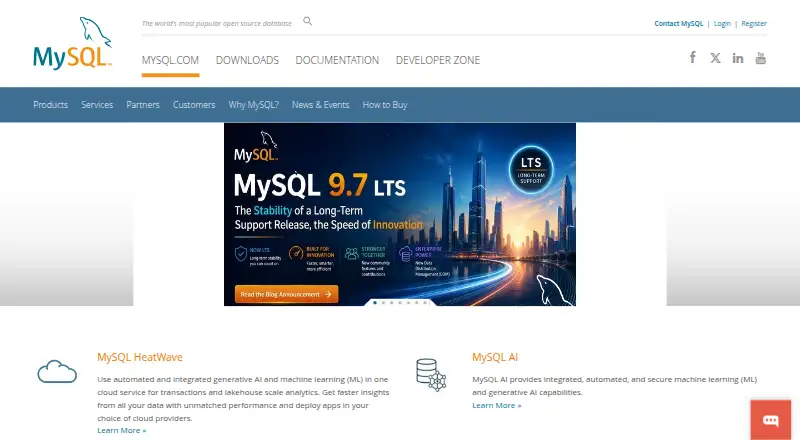
What MySQL is
MySQL is an open-source database for web, e-commerce, SaaS, and online transaction processing applications. Its Community Edition is freely downloadable under the GPL and supports relational SQL and NoSQL development. It is available on more than 20 platforms and operating systems. For transactional work, MySQL is ACID compliant and supports commit, rollback, crash recovery, and row-level locking. Replication supports performance and scalability; Group Replication adds fault tolerance and automated failover, while InnoDB Cluster provides an integrated high-availability option. MySQL Document Store includes X Protocol, XDev API, and MySQL Shell. Developers can use ODBC, JDBC, and .NET connectors, plus MySQL Workbench for visual modeling, SQL development, and administration. Enterprise Edition offers additional security features, including encryption, masking, firewall protection, and auditing, and its technical support provides 24x7 access to support engineers. Paid subscriptions include support and maintenance. Commercial plan prices are not listed here.
Good
- Community Edition is freely downloadable under the GPL.
- Supports SQL and NoSQL application development.
- Available on more than 20 platforms.
- Includes replication and high-availability components.
- Workbench supports modeling, SQL development, and administration.
Watch out
- Commercial subscription prices are not listed.
- Early Access builds may contain bugs or vulnerabilities.
- Early Access builds lack Oracle technical support.
Who it suits
It suits developers and organisations building relational SQL or NoSQL applications, including web, e-commerce, SaaS, and transaction-processing systems. Teams needing commercial security features or support can consider the paid editions.
Verdict
MySQL offers a free community database with broad platform support, transaction features, and replication options. Commercial editions add further security and support capabilities, but prices are not listed.
Plans and prices
From MySQL's own pricing page, checked 22 Sep 2026.
| Plan | Price | What it gives you |
|---|---|---|
| Community Edition | Priced on request | GPL-licensed · SQL and NoSQL applications · Replication and high availability components · Connectors and MySQL Workbench |
| Community Edition | — | GPL-licensed · SQL and NoSQL applications · Replication and high availability components · Connectors and MySQL Workbench |
| Standard Edition | — | 1-4 socket server |
| Standard Edition | Priced on request | 1-4 socket server |
| Enterprise Edition | Priced on request | 1-4 socket server |
| Enterprise Edition | — | 1-4 socket server |
| Cluster Carrier Grade Edition | Priced on request | 1-4 socket server |
| Cluster Carrier Grade Edition | — | 1-4 socket server |
| MySQL Cluster Carrier Grade Edition | Priced on request | commercial Oracle agreement · priced per server · 1–4 or 5+ sockets · 5+ sockets contact sales · Annual Subscription |
| MySQL Enterprise Edition | Priced on request | commercial Oracle agreement · priced per server · 1–4 or 5+ sockets · 5+ sockets contact sales · Annual Subscription |
| MySQL Standard Edition | Priced on request | commercial Oracle agreement · priced per server · 1–4 or 5+ sockets · 5+ sockets contact sales · Annual Subscription |
| MySQL Community Edition | Free | Freely downloadable under the GPL license. · GPL license · community-supported · over 20 platforms |
| MySQL Standard Edition, 1-4 Socket Server | $2,140 a year | Subscription pricing includes support and maintenance. · billed annually at $2,140 per server/year |
| MySQL Standard Edition, 5+ Socket Server | $4,280 a year | Subscription pricing includes support and maintenance. · billed annually at $4,280 per server/year |
| MySQL Enterprise Edition, 1-4 Socket Server | $5,350 a year | Subscription pricing includes support and maintenance. · billed annually at $5,350 per server/year |
| MySQL Enterprise Edition, 5+ Socket Server | $10,700 a year | Subscription pricing includes support and maintenance. · billed annually at $10,700 per server/year |
| MySQL Cluster CGE, 1-4 Socket Server | $10,700 a year | Subscription pricing includes support and maintenance. · billed annually at $10,700 per server/year |
| MySQL Cluster CGE, 5+ Socket Server | $21,400 a year | Subscription pricing includes support and maintenance. · billed annually at $21,400 per server/year |
The facts
Each one read from MySQL's own pages, with the date it was checked.
What it does
- Administration Tools
- MySQL Workbench supports visual modeling, SQL development, and administration.checked 27 Sep 2026
- Backup
- MySQL Enterprise Backup supports online hot backups, full, incremental and partial backups, point-in-time recovery and compression.checked 28 Sep 2026
- Calculator Disclaimer
- Calculator results are examples, provided as is, and actual savings may vary.checked 27 Sep 2026
- Commercial integrations
- Commercial editions are certified with Oracle Enterprise Manager, GoldenGate, Data Integrator, Fusion Middleware, Secure Backup and Audit Vault and Database Firewall.checked 28 Sep 2026
- Community license
- MySQL Community Edition is freely downloadable and licensed under the GNU General Public License.checked 28 Sep 2026
- Community License
- Community Edition is freely downloadable under the GPL license.checked 27 Sep 2026
- Developer tooling
- MySQL provides ODBC, JDBC and .NET connectors plus MySQL Workbench for visual modeling, SQL development and administration.checked 28 Sep 2026
- Document Store
- MySQL Document Store includes X Protocol, XDev API, and MySQL Shell.checked 27 Sep 2026
- Early-access limitation
- Early Access Community Edition builds receive limited validation, may contain bugs or security vulnerabilities, have no Oracle technical support and are not intended for production use.checked 28 Sep 2026
- Enterprise authentication
- MySQL Enterprise Authentication integrates with PAM and Windows Active Directory.checked 28 Sep 2026
- Enterprise security
- MySQL Enterprise Edition provides transparent data-at-rest encryption, encryption and digital-signature features, dynamic data masking, firewall protection and policy-based auditing.checked 28 Sep 2026
- High availability
- MySQL includes Group Replication, InnoDB Cluster and replication features for fault tolerance, failover, scale-out and high availability.checked 28 Sep 2026
- High Availability
- InnoDB Cluster provides an integrated native high-availability solution.checked 27 Sep 2026
- OEM Adoption
- Over 2000 ISVs, OEMs, and VARs rely on MySQL as an embedded database.checked 27 Sep 2026
- Open Source Database
- MySQL describes itself as the world's most popular open source database.checked 27 Sep 2026
- Product history
- The first MySQL version was released in May 1995, and MySQL was founded in 1995.checked 28 Sep 2026
- Product type
- MySQL is an open-source database used for web, e-commerce, SaaS and online transaction processing applications.checked 28 Sep 2026
- Replication Features
- Replication supports performance and scalability; Group Replication adds fault tolerance and automated failover.checked 27 Sep 2026
- Security Advisories
- Community Edition provides access to MySQL Community Edition Security Advisories.checked 27 Sep 2026
- Security Positioning
- Enterprise Edition targets scalability, security, reliability, and uptime.checked 27 Sep 2026
Where it runs
- Application Connectors
- Connectors include ODBC, JDBC, and .NET for applications in multiple languages.checked 27 Sep 2026
- Platform Support
- Community Edition is available on over 20 platforms and operating systems.checked 27 Sep 2026
Money
- Free plan
- Yeschecked 22 Sep 2026
- Free Tier Limits
- The supplied text states platform availability and features but no storage, user, or usage limits.checked 27 Sep 2026
The full review of MySQL
MySQL is an open-source database for web, e-commerce, SaaS and transaction-processing applications. It suits developers and organizations that need a database across varied systems, with a free community edition and a path to commercial support and security tools. Its breadth is a strong fit for established application workloads, while the socket-based terms and custom pricing of paid editions make costs harder to assess in advance.
Overview
Community Edition combines relational SQL with NoSQL application development and is freely downloadable under the GPL license. Its transaction support includes ACID compliance, commit and rollback, crash recovery and row-level locking—useful foundations for applications where consistent updates matter. Replication and high-availability components extend its reach to workloads that need scaling and resilience.
MySQL is available in community and commercial editions, and can be deployed hosted or self-hosted. The Community Edition has no stated storage, user or usage caps in the supplied plan terms, so buyers should not infer a particular capacity limit from the free offering.
Key features
Application development
MySQL Document Store brings X Protocol, the XDev API and MySQL Shell to its SQL and NoSQL capabilities. ODBC, JDBC and .NET connectors let applications in multiple languages connect, while MySQL Workbench supports visual modeling, SQL development and administration. This range makes MySQL practical for teams building and managing applications across different technology stacks.
Replication and availability
Replication supports performance and scalability. Group Replication adds fault tolerance and automated failover, and InnoDB Cluster provides an integrated native high-availability solution. These are meaningful options for services that need continuity, though the available plan terms do not distinguish which edition includes each component.
Commercial security and operations
Enterprise Edition adds transparent data-at-rest encryption, digital signatures, dynamic data masking, firewall protection and policy-based auditing. Its authentication options integrate with PAM and Windows Active Directory. Enterprise Backup supports online hot backups, full, incremental and partial backups, point-in-time recovery and compression; technical support includes 24x7 direct access to support engineers. Paid subscriptions include support and maintenance, making the commercial tier more compelling where operational assurance and security controls justify a contract.
Commercial editions are certified with Oracle Enterprise Manager, GoldenGate, Data Integrator, Fusion Middleware, Secure Backup, and Audit Vault and Database Firewall. Community Edition users can access security advisories. Early Access Community Edition builds are a separate, limited-validation option: they may contain bugs or security vulnerabilities, have no Oracle technical support and are not intended for production.
Pricing
Community Edition is free at no cost and is GPL-licensed, community-supported, and available on over 20 platforms. It is the natural starting point for teams comfortable operating without paid support. A free trial is also offered, but no duration or terms are stated.
Standard Edition, Enterprise Edition and Cluster Carrier Grade Edition are commercial subscriptions with custom pricing. The annual subscriptions use a commercial Oracle agreement and are priced per server, with 1–4 or 5+ socket bands; 5+ socket configurations require contacting sales. Paid subscription pricing includes support and maintenance. Standard Edition is the lower stated commercial tier, while Enterprise is the more suitable choice when its added security, backup and support capabilities matter. Cluster Carrier Grade Edition is another commercial option, but no distinct feature set is stated for it.
The plan terms do not provide prices for the commercial editions, so prospective buyers cannot compare their costs from the stated socket bands alone. The TCO Savings Calculator requires registration; its example comparisons are provided as is, and actual savings may vary.
Platforms
Community Edition supports more than 20 platforms and operating systems, including Linux, Unix, Mac and Windows. The platform listing also includes API access and self-hosted deployment. This breadth is valuable for mixed environments, though it does not by itself settle whether a particular managed hosting arrangement is suitable.
Who it's for
MySQL is a strong fit for developers and organizations building web, e-commerce, SaaS and online transaction-processing applications that need SQL transactions, broad platform support and replication options. It also suits teams that want to start with a free, self-managed edition and may later need enterprise security, backup or direct support. It is less suitable for buyers who need clear commercial pricing before engaging sales, or teams seeking a production-ready early-access build.
Pros and cons
- Pros: Free GPL Community Edition supports SQL and NoSQL development, with ACID transactions and no stated storage, user or usage caps.
- Pros: More than 20 supported platforms, connectors and Workbench make it adaptable across application stacks.
- Pros: Replication, Group Replication and InnoDB Cluster address scaling, failover and high availability.
- Cons: Commercial edition prices are custom, with 5+ socket configurations requiring a sales contact, limiting upfront cost comparisons.
- Cons: Community Edition is community-supported; 24x7 direct engineer access and the extensive enterprise security and backup features are part of commercial offerings.
- Cons: Early Access builds are explicitly unsuitable for production because validation is limited and security issues may occur.
Alternatives
For database observability rather than a database platform, Grafana Cloud Application Observability offers a free tier with 2,232 host hours and a Pro plan billed at $0.025 per host hour plus a $19 monthly platform fee. DBmarlin is another freemium option for readers comparing database performance monitoring tools. PostgreSQL users seeking an open-source monitoring option can consider pgwatch, whose open-source plan supports PostgreSQL versions 14 and later.
Percona Monitoring and Management is a free, open-source database monitoring, management and observability option; its installation infrastructure may have separate costs. Amazon RDS is a paid service with a free-tier offer, for readers comparing a database service rather than MySQL’s own editions. Readers focused on SQL Server tuning can consider AI SQL Tuner Studio; its free plan is limited to SQL Server Developer Edition. AimBetter is a paid per-server option starting at $110 a month. For provisioning or masking production data, Redgate SQL Provision uses capacity tiers, with custom pricing.
Browse Database Software for broader database choices, or compare adjacent categories such as Database Performance Monitoring Software, Database Client Software, Database Security Software, Database Backup Software and Distributed SQL Databases.
Verdict
Choose MySQL if you need a proven, broadly supported database foundation with a free GPL edition, transactional SQL and options for replication and high availability. Its strongest reason to choose is the combination of wide platform reach and a progression from community use to commercial security, backup and support. Look elsewhere if upfront commercial pricing is essential to the decision or if you need a monitoring or database-management tool rather than the database itself.
Getting started
- Visit the MySQL website.
- Choose Community Edition for the GPL-licensed download, or review the commercial subscription editions.
- Select a supported platform; Community Edition is available on over 20 platforms and operating systems.
- Use MySQL Workbench for visual modeling, SQL development, and administration, or connect applications with ODBC, JDBC, or .NET connectors.
Questions
Is MySQL free?
Community Edition is freely downloadable under the GPL license. Its listed plan is free.
Which platforms does MySQL support?
Community Edition is available on over 20 platforms and operating systems, including Linux, Unix, Mac, and Windows.
Does MySQL support SQL and NoSQL?
Yes. Community Edition supports relational SQL and NoSQL application development.
What is included in MySQL Document Store?
It includes X Protocol, XDev API, and MySQL Shell.
What does Enterprise Edition add?
It provides enterprise security features, including encryption, data masking, firewall protection, and policy-based auditing. Enterprise technical support offers 24x7 direct access to MySQL support engineers.
Is MySQL open source?
MySQL describes itself as an open-source database, and Community Edition is available under the GPL license.
Alternatives to MySQL
- 1

Hackolade Studio
Free planWebAPILinuxmacOS7.8Free plan - 2
Schemity
Free planWebAPILinuxmacOS7.7Free plan - 3
Database Workbench
Free planLinuxmacOSWindows7.5€199 one-time - 4

DbSchema
Free planLinuxmacOSWindows7.0From $29.40 a month - 5
pgModeler
Free planLinuxmacOSWindows6.9From $59.90 a month - 6

ChartDB
Free planWebSelf-hosted6.8From $25 a month