Schemity
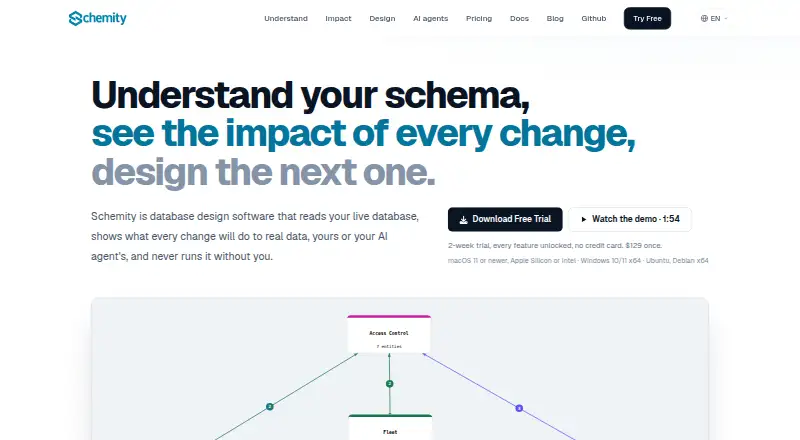
Schemity is database design software that reads a live database and previews schema changes before they are run.
What Schemity is
Schemity is database design software that reads a live database and previews schema changes before they are run. It shows proposed changes and their effects, and only carries out a migration after you click Migrate. Supported databases include PostgreSQL, Supabase, MySQL, MariaDB, SQL Server, and SQLite. Design tools include ERD creation, inferred relationships, SQL and DBML import, check constraints, junction table generation, and schema linting across 26 problem classes. Its local MCP server offers 16 tools for Claude Code, Claude Desktop, Cursor, Codex, OpenCode, and other MCP hosts. The desktop app stores work as plain JSON files on your machine, suitable for version control with Git. It has no cloud backend, accounts, analytics, or telemetry, but sends an automatically generated machine ID and country code for license verification. A two-week desktop trial unlocks all features without a credit card. Afterward, offline design continues to work, while live database features and Context Views pause until a license is active. Lite provides free browser-based design and link sharing; a License costs $129 one-time.
Good
- Previews migration effects before execution.
- Supports six listed database types.
- Stores desktop work as local JSON files.
- Two-week trial unlocks all features without a credit card.
- Lite includes browser design and link sharing for free.
Watch out
- Live database features pause after the trial without a license.
- Context Views also pause after the trial without a license.
- A License costs $129 one-time.
Who it suits
Schemity suits software engineers who want to design database schemas and review proposed changes before applying migrations. Its local MCP server may be useful to people working with the listed MCP-compatible tools.
Verdict
Schemity brings schema design and migration review together, with local file storage and integrations through its MCP server. Note that live database features and Context Views require an active license after the trial.
Plans and prices
From Schemity's own pricing page, checked 4 Oct 2026.
| Plan | Price | What it gives you |
|---|---|---|
| Lite | Free | Browser-based schema design · Share by link · Free |
| Education license | Free | All features unlocked · 1 year of updates included · Request with a .edu address · Free for students and educators |
| Free trial | Free | all desktop features unlocked · no credit card · image exports carry a watermark · 14 days |
| Education | Free | all features · .edu verification required · free forever for students and educators |
| Schemity Lite | Free | design, save, share and export schemas · no live database connections · free browser version |
| Updates renewal | $29 a year | requires an existing license · extends updates for one year · optional annual renewal after the first included year |
| Licensed desktop | $129, paid once | all features · no table, diagram or workspace caps · use on up to 3 machines · one-time purchase; 1 year of updates included |
| License | $129, paid once | All features unlocked · 1 year of updates included · Use forever after updates expire · Optional updates renewal $69/year · $129 one-time |
The facts
Each one read from Schemity's own pages, with the date it was checked.
What it does
- AI assistant
- AI Chat supports bring-your-own provider keys and can use a local Ollama model so model calls can remain on the user's machine.checked 15 Oct 2026
- AI credentials
- The local MCP server keeps its token in the operating-system keychain and does not give an agent database credentials.checked 15 Oct 2026
- AI integration
- A local MCP server exposes sixteen tools for schema reading, impact measurement, drawing and staged organization actions.checked 15 Oct 2026
- AI integrations
- Its local MCP server offers 16 tools and works with Claude Code, Claude Desktop, Cursor, Codex, OpenCode, and any MCP host.checked 4 Oct 2026
- Audience
- The maker describes Schemity as database design software for software engineers and says its creator uses it to design and maintain production schemas.checked 4 Oct 2026
- Capterra pricing record
- Capterra lists a $129 one-time license and a $69-per-year updates add-on, and identifies a free education option.checked 15 Oct 2026
- Context Map
- The Context Map represents domains as nodes and counts foreign-key dependencies between them.checked 15 Oct 2026
- Context views
- Context Views provide focused read-only projections of one shared schema so domains such as billing or authentication can be viewed separately.checked 15 Oct 2026
- Database support
- The site lists PostgreSQL, Supabase, MySQL, MariaDB, SQL Server, and SQLite as supported databases.checked 4 Oct 2026
- Design features
- Features include ERD design, inferred relationships, SQL and DBML import, check constraints, junction table generation, and schema linting across 26 problem classes.checked 4 Oct 2026
- Documentation depth
- The documentation index lists 34 guides covering installation, six database engines, reverse engineering, design, context views, JSON storage, MCP, migrations and exports.checked 15 Oct 2026
- ERD design
- Its canvas models entities, fields and crow's-foot relationships, including 1:N, 1:1 and N:N links with generated junction tables.checked 15 Oct 2026
- Export formats
- Desktop exports include PNG, JPEG, SVG, SQL, Mermaid, DBML, PlantUML, D2, OpenAPI and data dictionaries in HTML, PDF, Markdown or Excel.checked 15 Oct 2026
- Git-native storage
- Workspaces are human-readable JSON folders that can be placed inside a Git repository and reviewed as pull-request diffs.checked 15 Oct 2026
- Impact analysis
- Impact analysis reports potential data loss, failing statements, table locks or rewrites, broken dependents and foreign-key propagation before migration.checked 15 Oct 2026
- Import formats
- The product imports SQL CREATE TABLE statements, full SQL dumps and DBML files.checked 15 Oct 2026
- Licence status
- Schemity is described as proprietary software with a one-time licence rather than an open-source project.checked 15 Oct 2026
- Limit: collaboration
- The maker's comparison states Schemity is deliberately single-designer and lacks real-time multi-user cursors and live collaborative editing.checked 15 Oct 2026
- Limit: no flowchart feature
- The Capterra catalog's feature comparison says Schemity does not offer Flowchart functionality.checked 15 Oct 2026
- Local storage
- Schemity stores work as plain JSON files on the user's machine, which can be version-controlled with Git.checked 4 Oct 2026
The company
- Company location
- Son Tran's public DEV profile identifies Hanoi, Vietnam as his base and describes him as an indie founder who built Schemity.checked 15 Oct 2026
- Company size and funding
- The opened maker pages identify an individual creator but do not state a legal entity, employee count, headquarters outside Hanoi, funding or investors.checked 15 Oct 2026
- Limit: team purchasing
- The pricing page says invoice, purchase-order, offline activation, security review and larger team licensing are not automated and require direct contact.checked 15 Oct 2026
Money
- Limit: post-trial access
- After the trial, offline design remains usable but live database features and Context Views pause until licensing, while only existing workspaces remain fully usable.checked 15 Oct 2026
The full review of Schemity
Schemity is database design software for engineers who need to understand schema changes before applying them. It fits developers who want local, version-controlled design files and a deliberate migration checkpoint. Its one-time license is compelling, but live database work and Context Views stop after the trial without activation.
Overview
Schemity connects to a live database, shows the proposed changes and their effects, and waits for an explicit click on Migrate before executing anything. That makes it better suited to engineers who want to review a migration rather than send changes straight from a model to production. Supported systems are PostgreSQL, Supabase, MySQL, MariaDB, SQL Server and SQLite.
Desktop projects are plain JSON files stored locally, so teams can place them under Git version control. The desktop application has no cloud backend, accounts, analytics or telemetry. It does send an automatically generated machine ID and country code for license verification, which is a limited but relevant consideration for tightly controlled environments.
Key features
Design and migration control
- ERD design and imports: Visual entity-relationship modeling, inferred relationships, and SQL or DBML import support both new designs and existing schemas.
- Schema structure: Check constraints and junction-table generation cover common relational patterns without requiring every element to be drawn manually.
- Linting: Checks across 26 problem classes can expose design issues during modeling, giving engineers a review aid beyond the diagram itself.
- Forward and reverse engineering: Schemity can read an existing database and export SQL for planned structures, making it useful for maintaining as well as creating schemas.
- Version history: Built-in history complements Git-based JSON storage when users need to track design changes.
AI connections and security
The local MCP server provides 16 tools and works with Claude Code, Claude Desktop, Cursor, Codex, OpenCode and other MCP hosts. It listens only on the user's machine, keeps its token in the operating-system keychain, and does not provide an AI agent with database credentials. That is a practical route to assisted schema work for teams that want AI access without handing credentials to the agent.
Pricing
| Plan | Price | What it includes |
|---|---|---|
| Lite | free | Browser-based schema design and share-by-link. |
| Education license | free | All features, one year of updates; request with a .edu address. |
| License | $129, paid once | All features, one year of updates; use forever after updates expire; optional updates renewal at 69 USD per year. |
The two-week desktop trial unlocks every feature and requires no credit card. Once it ends, offline design continues, but live database features and Context Views pause until a license is active. Lite is therefore best for browser-only modeling and link sharing, not ongoing live-database work. The education license is the strongest fit for eligible students and educators. The $129 License suits individual engineers or teams that prefer a perpetual version; the trade-off is that continued updates cost $69 per year, while the initial purchase remains usable after updates expire. Team buyers can contact the creator about invoices, offline activation, security review and volume licensing.
Platforms
Schemity is offered on Linux, macOS, Windows and the web. Deployment spans web and desktop, so browser-based sharing can coexist with local desktop projects.
Who it's for
Schemity is aimed at software engineers designing and maintaining production schemas. It is a strong choice for developers working across the listed relational databases who want migration impact previews, local files and an approval step before execution. It is less suitable if browser-only collaboration is the priority, if you need live features after the trial without buying a license, or if your database platform is outside its supported list.
Pros and cons
Pros
- Migration previews and click-to-run execution keep review separate from applying changes.
- Plain local JSON files work naturally with Git-based version control.
- Six named database systems, reverse and forward engineering, SQL export and 26 linting classes cover a broad engineering workflow.
- Local MCP integration supports several major AI clients without exposing database credentials.
- A perpetual $129 license avoids mandatory ongoing subscription payments for the licensed version.
Cons
- The free Lite plan is browser-based and limited to design and link sharing.
- Live database features and Context Views require an active license after 14 days.
- Desktop license verification still transmits a machine ID and country code.
- Updates beyond the first year require an optional $69-per-year renewal.
Alternatives
MySQL is the better pick when you need a database platform itself, including SQL and NoSQL applications, replication and high-availability components, rather than a schema-design review tool.
Hackolade Studio suits modelers who want a community tier capped at 50 model objects or a 14-day Workgroup trial.
DbSchema is worth choosing when its Pro and Architect packaging, including saved design files and schema synchronization, matches your workflow.
pgModeler is an alternative for PostgreSQL-focused users comparing single-user terms with team lifetime licensing.
Database Workbench fits users seeking Basic, Professional or Enterprise editions for at least one database system on Linux or Windows.
SQL Power Architect is a free GPL v.3 option for users comfortable with Java Runtime 8.
ChartDB is preferable for self-hosted or web-based work with a free tier capped at one user, one database, 10 tables per diagram and two private diagrams.
DB Designer is the simpler web choice when a free Starter plan with two models and 10 tables per model is enough.
Verdict
Choose Schemity if you are an engineer who needs live-schema inspection, migration impact review and local, Git-friendly design files, especially with one of its supported databases. The main reason to look elsewhere is the post-trial licensing boundary: serious live work requires activation, while browser-only users may find Lite sufficient.
Alternatives to Schemity
- 1

MySQL
Free planAPILinuxmacOSSelf-hosted7.9Free plan - 2

Hackolade Studio
Free planWebAPILinuxmacOS7.8Free plan - 3
Database Workbench
Free planLinuxmacOSWindows7.5€199 one-time - 4

DbSchema
Free planLinuxmacOSWindows7.0From $29.40 a month - 5
pgModeler
Free planLinuxmacOSWindows6.9From $59.90 a month - 6

ChartDB
Free planWebSelf-hosted6.8From $25 a month