pgModeler
pgModeler is a desktop PostgreSQL schema engineering tool for Linux, macOS, and Windows.
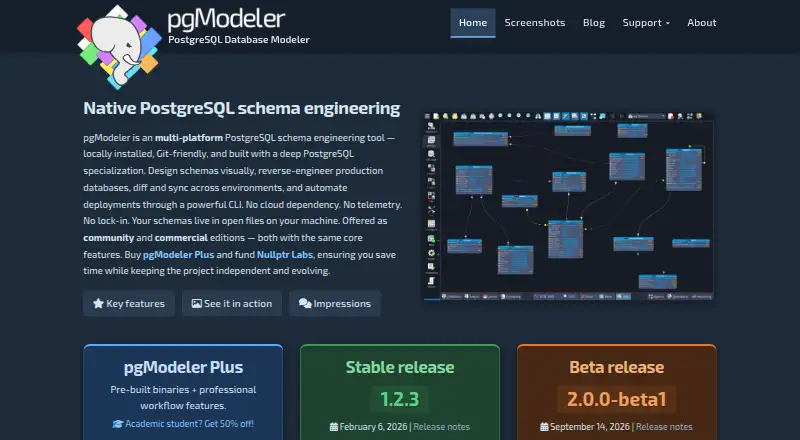
What pgModeler is
pgModeler is a desktop PostgreSQL schema engineering tool for Linux, macOS, and Windows. It supports visual schema design, reverse engineering, schema comparison and synchronization, and command-line deployment automation. Its relationship engine can propagate foreign-key columns, constraints, and indexes when tables are linked, and the software supports more than 30 PostgreSQL object types. Models can be exported as SQL, PNG, SVG, HTML data dictionaries, or directly to a PostgreSQL server. The command-line interface can export DDL, compare and validate models, and automate deployments in CI/CD workflows. Models use human-readable XML, while Plus adds a Git-based versioning workflow. The tool runs locally without an account, cloud dependency, or mandatory internet connection. The community edition is GPL v3 and free forever; Plus provides pre-built binaries and additional workflow features. Connection passwords are stored in plain text in the settings directory.
Good
- Available for Linux, macOS, and Windows.
- Supports more than 30 PostgreSQL object types.
- Exports models to SQL, images, and HTML data dictionaries.
- CLI supports validation and deployment automation.
- Community edition is free forever.
Watch out
- Connection passwords are stored in plain text.
- The listed Plus six-month plan is $59.90 per month.
- Plus features are separate from the community edition.
Who it suits
pgModeler suits PostgreSQL users who want to design, inspect, compare, or deploy schemas from a desktop tool. Its local operation may suit people who do not want hosted schema infrastructure.
Verdict
pgModeler combines visual schema work with reverse engineering, synchronization, and command-line deployment. Consider the documented password-storage limitation when configuring database connections.
Plans and prices
From pgModeler's own pricing page, checked 20 Sep 2026.
| Plan | Price | What it gives you |
|---|---|---|
| Single user · 6 months | Priced on request | 1 seat · 1 platform |
| Single user · 12 months | Priced on request | 1 seat · 1 platform |
| Team lifetime · Perpetual | Priced on request | 2 seats |
| pgModeler Community | Free | source code · free forever |
| pgModeler Plus · Single user · 6 months | $59.90 a month | 1 seat · single platform · from $59.90/6 months |
| pgModeler Plus · Team lifetime | — | 2 seats · Perpetual |
| pgModeler Plus · Single user · 12 months | — | 1 seat · single platform · 12 months |
The facts
Each one read from pgModeler's own pages, with the date it was checked.
What it does
- CLI
- The command-line interface can export DDL, run diffs, validate models, and automate deployments in CI/CD workflows.checked 30 Sep 2026
- Diff and sync
- pgModeler Plus compares a model with a live server and generates the required ALTER, DROP, and CREATE statements for synchronization.checked 30 Sep 2026
- Exports
- Models can be exported as SQL, PNG, SVG, HTML data dictionaries, or directly to a PostgreSQL server.checked 30 Sep 2026
- License
- The community software is distributed under GPL v3, while Plus supplies pre-built binaries and professional workflow features.checked 30 Sep 2026
- Local operation
- pgModeler runs entirely on the user's machine with no account, cloud dependency, mandatory internet connection, or hosted schema infrastructure.checked 30 Sep 2026
- Modeling
- The relationship engine automatically propagates foreign-key columns, constraints, and indexes when tables are linked.checked 30 Sep 2026
- PostgreSQL scope
- It supports more than 30 PostgreSQL object types, including domains, custom types, operators, collations, procedural languages, event triggers, foreign data wrappers, and extensions.checked 30 Sep 2026
- Purpose
- pgModeler is a locally installed, multi-platform PostgreSQL schema engineering tool for visual design, reverse engineering, schema diff and synchronization, and CLI deployment automation.checked 30 Sep 2026
- Remote access
- pgModeler Plus includes SSH tunneling for secure remote PostgreSQL connections without VPN configuration.checked 30 Sep 2026
- Reverse engineering
- pgModeler Plus can connect to a live PostgreSQL server and reconstruct a full schema model.checked 30 Sep 2026
- Security
- Connections support SSL modes, client certificates, Kerberos server settings, and GSSAPI authentication.checked 30 Sep 2026
- Security limitation
- The documentation warns that connection passwords are stored in plain text in the settings directory.checked 30 Sep 2026
- Support
- The project directs feature requests and bug reports to its GitHub issues page.checked 30 Sep 2026
- Version control
- The tool stores models as open, human-readable XML and Plus provides a Git-powered versioning workflow inside the interface.checked 30 Sep 2026
The company
- Founded
- 2006checked 28 Sep 2026
- Headquarters
- Palmas, Tocantins, Brazilchecked 28 Sep 2026
The full review of pgModeler
pgModeler is a desktop schema-engineering tool built specifically for PostgreSQL. It suits developers who want to design schemas visually while keeping the model and deployment workflow close to their own machine. Its strongest case is the mix of detailed PostgreSQL modeling and automation; the plain-text storage of connection passwords deserves attention.
Overview
pgModeler covers visual design, forward engineering, reverse engineering, schema comparison, and deployment. Its relationship engine propagates foreign-key columns, constraints, and indexes when tables are linked, cutting down repetitive setup and helping keep relationships represented in the model.
More than 30 PostgreSQL object types are supported, including domains, custom types, operators, collations, procedural languages, event triggers, foreign data wrappers, and extensions. That breadth makes it a sensible choice for PostgreSQL schemas that extend beyond tables and routine relationships. It is not a general-purpose database modeling tool: PostgreSQL is its supported database.
The application runs locally without an account, cloud dependency, mandatory internet connection, or hosted schema infrastructure. Models use human-readable XML, which provides a practical basis for version control; Plus adds a Git-powered workflow within the interface. This local-first approach favors control over a hosted environment, but it is not the same as a cloud collaboration workspace.
Key features
Model exports include SQL, PNG, SVG, and HTML data dictionaries, as well as direct export to a PostgreSQL server. That range covers both deployment and sharing model output in visual or reference formats.
Live-server workflows are part of pgModeler Plus. It can reconstruct a full schema from a live PostgreSQL server, then compare a model with the server and generate the ALTER, DROP, and CREATE statements needed for synchronization. These capabilities make Plus more appropriate than Community for developers maintaining an existing database, though they depend on choosing a paid workflow.
The command-line interface can export DDL, run diffs, validate models, and automate deployments in CI/CD workflows. For teams that already deploy through pipelines, this brings model work into automation rather than limiting it to the graphical application.
Connection security options include SSL modes, client certificates, Kerberos server settings, and GSSAPI authentication. Plus also includes SSH tunneling for secure remote PostgreSQL connections without VPN configuration. A material caveat: connection passwords are stored in plain text in the settings directory, so users should account for that when configuring access.
Pricing
pgModeler uses a freemium model. The Community edition is free forever at no cost and provides source code under GPL v3. It is the starting point for users who want the community software without a subscription; Plus supplies pre-built binaries and professional workflow features.
pgModeler Plus Single user · 6 months costs $59.90 a month, billed from $59.90/6 months, for 1 seat on a single platform. It is the priced option for an individual who wants Plus workflows on one platform. Single user · 12 months is billed 12 months for 1 seat on a single platform, with custom pricing. Team lifetime is billed Perpetual for 2 seats, also with custom pricing. The plan labels give seat and platform limits, but do not establish additional allowances. A 3-day trial is offered.
The trade-off is straightforward: Community costs nothing and is open-source, while Plus is the route to the stated live-server reverse engineering, diff and sync, SSH tunneling, and in-interface Git workflow. Buyers should weigh the short trial and the 6-month plan's stated billing term against the recurring price.
Platforms
pgModeler is a locally installed desktop application for Linux, macOS, and Windows. That cross-platform availability suits teams working across those systems, while its local operation avoids reliance on a hosted service.
Who it's for
Choose pgModeler if PostgreSQL is your database and you want a detailed visual model that can produce SQL, support live schema maintenance through Plus, or feed command-line deployment automation. It is especially compelling when less common PostgreSQL object types matter or when a local, human-readable model is preferable to hosted schema infrastructure.
Look elsewhere if you need support for other database systems or want collaboration centered on a hosted workspace. The Git workflow in Plus and two-seat lifetime plan address some versioning and team needs, but do not make pgModeler a cloud-first collaboration product.
Pros and cons
- Pros: Broad PostgreSQL object coverage supports schemas with specialized database features, not only tables and relationships.
- Pros: SQL, image, SVG, and HTML exports serve deployment and documentation needs, while CLI commands extend the workflow into CI/CD.
- Pros: Local operation and readable XML keep models on the user's machine and accessible to version-control workflows.
- Cons: PostgreSQL-only support rules it out for teams modeling other database systems.
- Cons: Connection passwords are stored in plain text in the settings directory, a meaningful concern when storing credentials locally.
- Cons: The 3-day trial is brief, and custom pricing for the 12-month and perpetual plans makes their cost harder to compare.
Alternatives
For a broader set of database design choices, browse Database Design Tools.
- MySQL is another option to consider when choosing database software; its Community Edition is GPL-licensed and covers SQL and NoSQL applications, with replication and high-availability components and connectors.
- Hackolade Studio may suit readers looking for a schema-modeling alternative with a free Community Edition capped at 50 model objects per model.
- DbSchema is worth considering when its Pro plan's design-file saving and schema synchronization are a better fit.
- Schemity may fit users who prefer browser-based schema design and sharing by link through its free Lite plan.
- Database Workbench is another freemium alternative for readers comparing database-system options.
- SQL Power Architect is a free GPL v.3 alternative for readers comfortable with Java Runtime 8 for the listed downloads.
- ChartDB is an option for browser or self-hosted use, though its free plan is capped at 1 user, 1 database, 10 tables per diagram, and 2 private diagrams.
- DB Designer suits readers who want a web-based option; its free Starter plan allows 2 database models and 10 tables per model.
Verdict
pgModeler is a strong pick for PostgreSQL developers who want deep schema modeling, local control, and a path from design to automated deployment. Choose it for the specialized PostgreSQL coverage and Plus live-server workflows; look elsewhere if you need a multi-database tool, and handle the plain-text password storage carefully.
Alternatives to pgModeler
- 1

MySQL
Free planAPILinuxmacOSSelf-hosted7.9Free plan - 2

Hackolade Studio
Free planWebAPILinuxmacOS7.8Free plan - 3

DbSchema
Free planLinuxmacOSWindows7.0From $29.40 a month - 4

ChartDB
Free planWebSelf-hosted6.8From $25 a month - 5
DrawSQL
Free planWebAPI6.8From $19 a month - 6

dbdiagram.io
Free planWebAPIExtension6.7From $20 a month