SymmetricDS
SymmetricDS replicates, moves, integrates, and transforms data between more than 80 sources and targets.
What SymmetricDS is
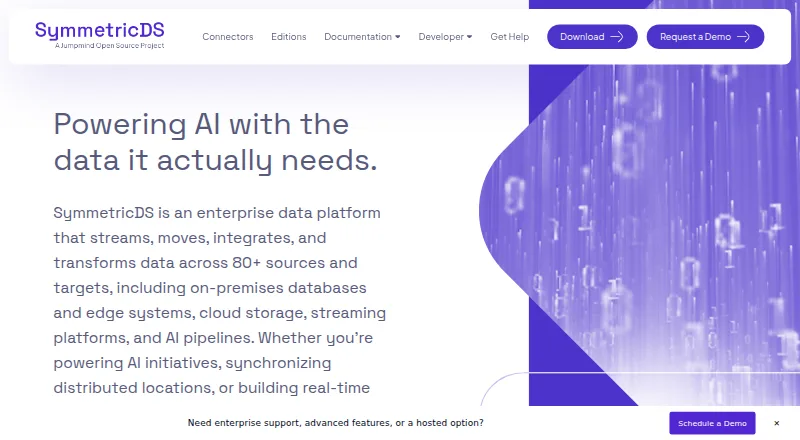
SymmetricDS replicates, moves, integrates, and transforms data between more than 80 sources and targets. It supports asynchronous scheduled or near-real-time synchronization, including multi-primary and filtered replication. When outages interrupt delivery, it queues changes and retries them until records reach their destinations. Pipelines can filter, subset, enrich, and map data during extraction or loading. Connectors include databases and services such as Oracle, PostgreSQL, MySQL, Kafka, Amazon S3, BigQuery, Snowflake, REST, and file systems. Deployment options include on-premises, cloud virtual machines, containers, Docker, Kubernetes, and mobile devices. The free Community edition is licensed under AGPL version 3.0 and is described as suited to developers and projects needing trigger-based replication. SymmetricDS requires Java 17 or newer. Pro adds a web console, clustering, bulk loaders, monitoring, data comparison and repair, and additional connectors. A 30-day Pro trial provides access to all features; subscription prices for Standard and Enterprise are not stated.
Good
- Supports multi-primary and filtered synchronization.
- Retries queued changes after network outages.
- Pipelines can transform data during extraction or loading.
- Offers on-premises, cloud, container, and mobile deployment.
- Community edition is free software under AGPL v3.0.
Watch out
- Requires Java 17 or newer.
- Standard and Enterprise prices are not stated.
- Community support is through forums, Discord, and Stack Overflow.
Who it suits
The Community edition may suit developers and projects that need trigger-based replication. Teams needing Pro capabilities or commercial support can consider the paid editions and trial.
Verdict
SymmetricDS provides multiple replication patterns, transformation options, and deployment choices. Check the Java requirement, edition capabilities, and support options for your project.
Plans and prices
From SymmetricDS's own pricing page, checked 15 Oct 2026.
| Plan | Price | What it gives you |
|---|---|---|
| Community | Free | AGPL v3 · 15-minute sync intervals · trigger-based CDC · 40+ database platforms · community forums and Discord · free forever |
| SymmetricDS Pro | Priced on request | Free trial listed · commercial edition · pricing available on request · starting price shown by Software Advice |
| Enterprise | Priced on request | Commercial subscription · over 100 nodes · 1-second sync · compare-and-repair · 24/7 phone and email support · 10 support contacts |
| Standard | Priced on request | Commercial subscription · 100-node maximum · 1-minute sync · web console · log/time-based CDC · clustering · bulk loaders · business-hours email support |
The facts
Each one read from SymmetricDS's own pages, with the date it was checked.
What it does
- API and SDKs
- Published extension and embedding APIs support custom runtime behavior and application embedding; Pro adds REST remote management, while JMX and command-line management are available.checked 15 Oct 2026
- Change capture
- Community uses database triggers for change capture, while Pro adds log mining, change tracking, and logical streaming methods.checked 15 Oct 2026
- Cloud targets
- FAQ documentation names Amazon S3, Azure Blob Storage, Google Cloud Storage, MinIO, Kafka, AWS SQS, and RabbitMQ as supported integration targets.checked 15 Oct 2026
- Conflict handling
- Multi-primary deployments can detect conflicts and resolve them automatically, by configured winner rules, or manually.checked 15 Oct 2026
- Connectors
- Listed connectors include Oracle, SQL Server, MySQL, PostgreSQL, MariaDB, DB2, SQLite, Snowflake, BigQuery, MongoDB, Cassandra, and Kafka.checked 15 Oct 2026
- Data handling
- Pipelines can filter, subset, enrich, and map data during extraction or loading.checked 29 Sep 2026
- Deployment
- Deployments can run on premises, cloud virtual machines, containers, Docker, Kubernetes, or mobile devices.checked 15 Oct 2026
- Documentation depth
- Documentation provides quick starts, user guides, configuration references, how-to articles, FAQs, API/developer material, and versioned changelogs.checked 15 Oct 2026
- Independent developer description
- Reddit’s developer AMA describes SymmetricDS as Java-based, multi-platform, transaction-aware, extensible through Spring, embeddable on Android, and supporting PostgreSQL, MySQL/MariaDB, SQL Server, BigQuery, Snowflake, and SQLite.checked 15 Oct 2026
- Initial loads
- The platform supports full or partial initial data loads and bulk loaders for large migrations.checked 15 Oct 2026
- Integrations
- Connectors include databases and services such as Oracle, PostgreSQL, MySQL, Kafka, Amazon S3, BigQuery, Snowflake, REST, and file systems.checked 29 Sep 2026
- Intended users
- The Community edition is described as suited to developers and projects needing reliable trigger-based replication.checked 29 Sep 2026
- Licence
- The Community product is licensed under GNU Affero General Public License version 3.0; Pro uses a commercial Jumpmind licence.checked 15 Oct 2026
- License
- The Community edition is free software under the GNU Affero General Public License version 3.0, and a commercial license is available with Pro for distribution with commercial software.checked 29 Sep 2026
- Limit: documentation and scale complaints
- A SourceForge reviewer described the web product as buggy at high batch volume and criticized incomplete documentation and difficult setup.checked 15 Oct 2026
- Limit: installation difficulty
- A Capterra reviewer said production installation was difficult.checked 15 Oct 2026
- Limit: trigger overhead
- A Software Advice reviewer raised concern that trigger-based capture creates additional synchronization tables and triggers in application databases.checked 15 Oct 2026
- Mobile embedding
- Embedding libraries are documented for Java, Android, iOS, and native C in Pro scenarios.checked 15 Oct 2026
- Notable news: 3.15 release
- Jumpmind announced SymmetricDS 3.15 on December 12, 2023, reporting deployments across 70,000 databases and 15,000 locations and throughput of up to 20 million changes per hour.checked 15 Oct 2026
- Notable news: 3.16.5 release
- The 3.16.5 release announcement lists eight Community improvements, five Community bug fixes, and Pro enhancements for SSL certificate setup, monitoring, PostgreSQL WAL backlogs, and DDL-trigger cleanup.checked 15 Oct 2026
The company
- Company facts
- LinkedIn lists Jumpmind as founded in 2008, headquartered in Columbus, Ohio, with 51–200 employees.checked 15 Oct 2026
- Company legal name
- LinkedIn identifies the maker as Jumpmind, a privately held software-development company.checked 15 Oct 2026
- Founded
- 2008checked 23 Sep 2026
- Maker
- The site says SymmetricDS is developed by Jumpmind.checked 29 Sep 2026
The full review of SymmetricDS
Overview
SymmetricDS is a data replication and integration platform for moving information between databases, services, and other data systems. It suits teams that need multi-way synchronization across varied environments, particularly developers who can manage a Java-based deployment. Its strongest case is flexible, recoverable replication; its trade-offs are a Java 17 minimum and a split between a capable free edition and paid operational features.
Developed by Jumpmind, SymmetricDS works with more than 80 sources and targets, including databases, Kafka, Amazon S3, BigQuery, Snowflake, REST, and file systems. It can run on a schedule or near real time, synchronize in multiple directions, and filter which records move. Queued changes retry automatically after network outages, a practical safeguard for connections that are not consistently available.
Key features
- Replication and change capture: Trigger-based capture supports scheduled or near-real-time delivery, including multi-primary synchronization. That flexibility suits systems where more than one endpoint needs to write data, but sync frequency depends on the edition.
- Transformation pipelines: Data can be filtered, subsetted, enriched, and mapped during extraction or loading. This lets teams shape data in transit rather than treating replication as a straight copy.
- Broad connectivity: Supported databases include Oracle, SQL Server, MySQL, PostgreSQL, MariaDB, DB2, SQLite, H2, Firebird, Informix, Sybase, Greenplum, Redshift, BigQuery, Snowflake, MongoDB, and Cassandra, among others. Connectors also cover Kafka, Amazon S3, REST, and file systems.
- Pro operations and security: SymmetricDS Pro adds a web console, clustering, bulk loaders, monitoring, data comparison and repair, and additional connectors. Its security features include encrypted resources, role-based access control, ACL, two-factor authentication, single sign-on, and event logging. These capabilities make Pro the more suitable choice when central management, high availability, or access controls matter.
- Deployment choice: Installations can run on-premises, in cloud virtual machines, containers, Docker, Kubernetes, or mobile devices. The platform requires Java 17 or newer, which is a material prerequisite for the environments it supports.
The Community edition is free software under the GNU Affero General Public License version 3.0. A commercial license is available with Pro for teams distributing the software with commercial products.
Pricing
SymmetricDS has a free Community edition and a 30-day trial of SymmetricDS Pro with full access to its features. Standard and Enterprise subscription prices are custom pricing.
- Community — free: Free forever under AGPL v3, with 15-minute sync intervals, trigger-based change data capture, support for 40+ database platforms, and community forums and Discord chat. It is a sensible starting point for developers and projects needing trigger-based replication, but the 15-minute interval is a constraint for tighter synchronization needs.
- Standard — custom pricing: Adds one-minute sync intervals, a web management console, log-based and time-based change capture, monitors and notifications, clustering and high availability, and bulk loaders. It includes business-hours email support with two support contacts. This tier fits teams that need more frequent updates and operational oversight without Enterprise's stated response coverage.
- Enterprise — custom pricing: Includes everything in Standard, raises sync frequency to one second, adds Compare and Repair, and provides 24/7 phone and email support with 10 support contacts. It is aimed at deployments where rapid synchronization, repair tooling, and round-the-clock assistance justify a higher subscription tier.
Platforms
SymmetricDS lists Android, iOS, Linux, macOS, Windows, web, API, and self-hosted platforms. Its deployment options also include on-premises, cloud virtual machines, containers, Docker, Kubernetes, and mobile devices. The Java 17-or-newer requirement should be checked against the intended environment before committing to a deployment.
Who it's for
Community is best suited to developers and projects that can operate trigger-based replication themselves and accept 15-minute sync intervals. Standard is a better fit when teams need a management console, monitoring, clustering, bulk loading, and one-minute intervals. Enterprise makes more sense when one-second sync, comparison and repair tools, and 24/7 support are central requirements. Organizations unwilling to manage a Java-based deployment or needing a different synchronization model should consider other options.
Pros and cons
- Pro: Multi-way replication, filtering, and transformation support varied data flows rather than only one-directional copying.
- Pro: Automatic queuing and retries help keep changes moving after network interruptions.
- Pro: The free edition supports 40+ database platforms, giving developers a no-cost route to trigger-based replication.
- Con: Community sync intervals are 15 minutes, so projects that need faster updates must move to a paid subscription.
- Con: The Java 17 minimum narrows the environments suitable for deployment.
- Con: The web console, clustering, monitoring, bulk loaders, and advanced security features sit in Pro rather than the free edition.
Alternatives
For broader discovery, browse Database Replication Software and Data Replication Software.
- DBConvert Streams is another freemium option with a free plan and free trial; consider it if its listed IDE, browser tools, federated queries over two sources, and daily AI-question allowance better match the work.
- dsync is a free option with a forever-free open-source plan for small projects and testing, plus best-effort support and a commercial-support add-on; choose it if that scope and support model fit.
- NineData offers a free Community plan for on-premise deployment, capped at 10 data sources and 10 replication tasks with single-node Docker deployment; it may suit a small, bounded setup.
- Artie offers a free plan capped at 1M billable rows per month and two active pipelines, with backfills and Slack Community support; it is worth considering when those limits fit the workload.
- Google Cloud Datastream has a free tier allowing 100 GiB of CDC data per month per billing account for AlloyDB and Spanner sources to BigQuery; choose it if that source-to-target path and quota suit the project.
- Oracle Database offers its AI Database 26ai at no cost with core database capabilities; it is a distinct option for readers seeking that database rather than a general replication platform.
- PeerDB offers a free open-source plan for individuals with Docker setup, CDC, streaming query, and query-layer features; it may be a better fit for that narrower individual use case.
- Trusted Postgres Architect is a free, Linux and self-hosted option; consider it when that platform scope is appropriate.
Verdict
Choose SymmetricDS if you need flexible, multi-way replication across a broad mix of systems and can work within its Java requirement. The free Community edition is a useful entry point for trigger-based projects, while Pro supplies the faster intervals and management, resilience, and support features larger deployments may need. Look elsewhere if 15-minute free sync is too slow, Pro capabilities are outside budget, or Java 17 is unsuitable for your environment.
Getting started
- Visit https://symmetricds.org/
- Choose the Community edition or the 30-day SymmetricDS Pro trial.
- Prepare a system with Java 17 or newer.
- Select a deployment option such as on-premises, a cloud virtual machine, Docker, or Kubernetes.
- Connect the relevant sources and targets using the available connectors.
Limits worth knowing
The free Community plan has 15-minute sync intervals.
Questions
Is SymmetricDS free?
Yes. Community is free forever under the AGPL v3 license.
What does Community include?
It includes 15-minute sync intervals, trigger-based change data capture, support for more than 40 database platforms, and community forums and Discord chat.
What platforms and deployments does it support?
Listed platforms include Android, iOS, Linux, macOS, Windows, web, API, and self-hosted. Deployment options include on-premises, cloud virtual machines, containers, Docker, Kubernetes, and mobile devices.
Is there a trial?
Yes. The site offers a 30-day SymmetricDS Pro trial with access to all features.
Who makes SymmetricDS?
SymmetricDS is developed by Jumpmind.
What does Pro add?
Pro adds a web console, clustering, bulk loaders, data comparison and repair, monitoring, additional connectors, and security features including role-based access control and single sign-on.
Alternatives to SymmetricDS
- 1
NineData
Free planWebAPILinuxSelf-hosted7.6From $30 a month - 2

DBConvert Streams
Free planWebAPIExtensionLinux7.2From $9 a month - 3
Google Cloud Datastream
Free planWebAPI6.8From $0.40 a month - 4
PeerDB
Free planWebAPISelf-hosted6.8From $250 a month - 5
DBSync
Free planWebAPISelf-hosted6.7From $999 a month - 6

Artie
Free planWebAPISelf-hosted6.6From $500 a month