
Trusted Postgres Architect
Trusted Postgres Architect (TPA) is an open-source orchestration tool for deploying and managing Postgres clusters.
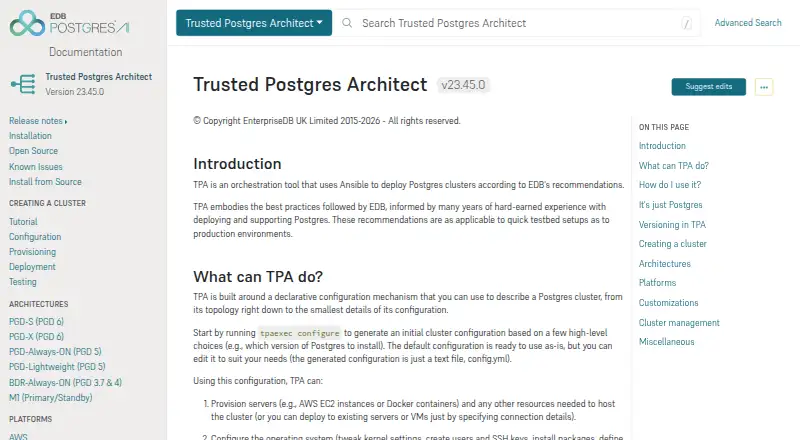
What Trusted Postgres Architect is
Trusted Postgres Architect (TPA) is an open-source orchestration tool for deploying and managing Postgres clusters. It uses Ansible and declarative YAML, letting users specify cluster topology and configuration. TPA can provision AWS EC2 instances or Docker containers, or work with existing servers and virtual machines when connection details are provided. It installs and configures Postgres and related components, including replication and backups; depending on the architecture, these may include PGD, Barman, PgBouncer, repmgr, and extensions. TPA can run tests tailored to the cluster architecture and platform, apply configuration changes, perform switchovers, and carry out minor-version upgrades described as zero-downtime. Supported database versions listed in its configuration documentation include PostgreSQL, EDB Postgres Extended, and EDB Postgres Advanced Server versions 13 through 18. STIG and CIS options are available, but do not guarantee compliance with those standards. TPA is free and intended for self-hosted Linux deployments.
Good
- Free and open source.
- Can provision EC2 instances and Docker containers.
- Includes replication and backup configuration.
- Supports cluster changes, switchovers, and minor upgrades.
- Encrypts sensitive variables with a cluster-specific Vault password.
Watch out
- Does not support major-version upgrades through tpaexec upgrade.
- Automation Platform integration is limited to bare-metal deployments.
- STIG and CIS options do not guarantee compliance.
Who it suits
TPA suits teams that want to deploy and manage Postgres clusters on Linux using EDB recommendations, whether setting up testbeds or production environments. It also fits users who want to customize deployment steps with Ansible commands, tests, or hooks.
Verdict
TPA provides declarative deployment and management for Postgres clusters, with options for provisioning, testing, and customization. Plan for major-version upgrades separately, since its upgrade command does not support them.
Plans and prices
From Trusted Postgres Architect's own pricing page, checked 30 Sep 2026.
| Plan | Price | What it gives you |
|---|---|---|
| Trusted Postgres Architect | Free | No price or plan limits stated on the opened product pages |
The facts
Each one read from Trusted Postgres Architect's own pages, with the date it was checked.
Where it runs
- Automation Platform integration
- TPA supports deploy and upgrade steps through Red Hat Ansible Automation Platform, with support limited to bare-metal platforms.checked 30 Sep 2026
- Platforms
- The documentation lists AWS, bare metal, and Docker as TPA platforms and says clusters can span multiple platforms.checked 30 Sep 2026
What it does
- Cluster management
- TPA supports configuration changes, switchovers, and minor-version upgrades described as zero-downtime.checked 30 Sep 2026
- Components
- Depending on the architecture, associated components include PGD, Barman, PgBouncer, repmgr, and Postgres extensions.checked 30 Sep 2026
- Configuration
- It uses declarative YAML configuration to describe a cluster from its topology through configuration details.checked 30 Sep 2026
- Credential protection
- TPA generates a cluster-specific Ansible Vault password to encrypt sensitive variables, and the documented system keyring option stores that password in a system keyring backend.checked 30 Sep 2026
- Deployment
- TPA installs and configures Postgres and associated components, including replication and backups.checked 30 Sep 2026
- Extensibility
- Users can add custom Ansible commands, tests, and deployment hook scripts.checked 30 Sep 2026
- Intended users
- EDB describes TPA recommendations as suitable for both quick testbed setups and production environments.checked 30 Sep 2026
- Provisioning
- TPA can provision AWS EC2 instances and Docker containers or use existing servers and virtual machines when connection details are supplied.checked 30 Sep 2026
- Purpose
- TPA is an Ansible-based orchestration tool that deploys Postgres clusters according to EDB recommendations.checked 30 Sep 2026
- Security
- TPA offers STIG and CIS configuration options, but EDB says these do not guarantee that a cluster fulfils the relevant standard.checked 30 Sep 2026
- Supported database versions
- The configure documentation lists PostgreSQL, EDB Postgres Extended, and EDB Postgres Advanced Server versions 13 through 18.checked 30 Sep 2026
- Testing
- TPA runs architecture and platform-specific tests against a deployed cluster.checked 30 Sep 2026
- Upgrade limitation
- The upgrade documentation says TPA does not support major-version upgrades of Postgres through the `tpaexec upgrade` command.checked 30 Sep 2026
The company
- Founded
- 2004checked 28 Sep 2026
- Headquarters
- Wilmington, Delaware, United Stateschecked 28 Sep 2026
- Maker
- EDB's 2025 blog says the company was founded in 2004 and gives its mailing address as Wilmington, Delaware.checked 30 Sep 2026
Alternatives to Trusted Postgres Architect
- 1

IBM Db2
Free planWebAPILinuxSelf-hosted7.4From $630 a month - 2

Neo4j
Free planSelf-hosted7.0From $65 a month - 3

ClusterControl
Free planWebAPILinuxSelf-hosted6.8From €250 a month - 4

YugabyteDB Anywhere
Free planWebAPILinuxSelf-hosted6.5Free plan - 5

DbNinja
Free planWebLinuxmacOSSelf-hosted6.4Free plan - 6
Oracle Maestro
Windows6.4$129 one-time