
Neo4j
Neo4j is a property graph database for storing and querying connected data.
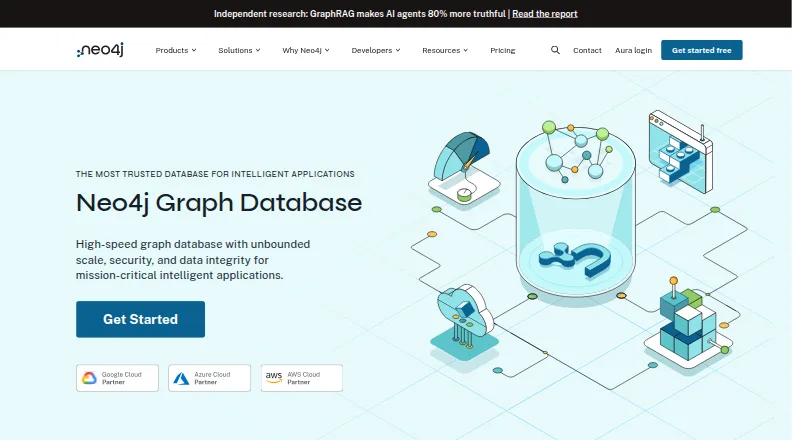
What Neo4j is
Neo4j is a property graph database for storing and querying connected data. It supports Cypher and GQL, ACID transactions, graph algorithms, replication, and vector search. Deployment options include self-hosted, hybrid, multi-cloud, and managed cloud, though the listed platform is self-hosted. Neo4j offers language drivers, GraphQL and Cypher tools, visualization tools, and connectors for Confluent Cloud, Apache Kafka, cloud data warehouses, and BI tools. AuraDB Free costs nothing and requires no payment method, but includes one database instance, single-zone deployment, and no availability SLA. AuraDB Professional is listed at $65 a month, with a 14-day free trial available; AuraDB Business Critical is listed at $146 a month and includes a three-zone cluster and a 99.95% uptime SLA. AuraDB includes encryption at rest and in transit, while security controls include role-based access. Neo4j Ops Manager provides centralized administration and monitoring. Support options range from best effort to 24x7 premium support with a one-hour response.
Good
- Supports Cypher, GQL, and ACID transactions.
- Free tier requires no payment method.
- AuraDB includes encryption at rest and in transit.
- Business Critical includes a 99.95% uptime SLA.
Watch out
- Free tier is limited to one database instance.
- Free tier has no availability SLA.
- Business Critical is listed at $146 a month.
Who it suits
Neo4j suits teams that need to model connected data as a property graph and query it with Cypher or GQL. Its multiple deployment choices and developer tools can serve organizations managing graph databases across different environments.
Verdict
Neo4j combines graph data modeling with query languages, transactions, and multiple deployment choices. Its free tier is limited, while paid plans add options such as a trial and a high-availability cluster.
Plans and prices
From Neo4j's own pricing page, checked 28 Sep 2026.
| Plan | Price | What it gives you |
|---|---|---|
| AuraDB Free | Free | No credit card or other payment method required · Free managed graph database plan · No credit card required · Access to graph tools · billed monthly |
| AuraDB Professional | $65 a month | Minimum 1GB cluster; 14-day free trial available · 1GB minimum cluster · 2GB storage at 1GB memory · 128GB maximum memory per database instance · Minimum 1GB cluster |
| AuraDB Business Critical | $146 a month | Minimum 2GB cluster · 2GB minimum cluster · 4GB storage at 2GB memory · 99.95% uptime SLA · Minimum 2GB cluster |
| AuraDB Virtual Dedicated Cloud | Priced on request | Dedicated environment; contact sales · Dedicated environment · VPC isolation · Enhanced 24x7 support |
The facts
Each one read from Neo4j's own pages, with the date it was checked.
What it does
- Backup retention
- Business Critical includes daily backups with 30-day retention and hourly point-in-time restore.checked 28 Sep 2026
- Centralized administration
- Neo4j Ops Manager administers and monitors all Neo4j deployments from one location.checked 28 Sep 2026
- Community size
- GraphAcademy says it has more than 100,000 Neo4j experts.checked 28 Sep 2026
- Data integrations
- Connectors support Confluent Cloud, Apache Kafka, cloud data warehouses, and popular BI tools.checked 28 Sep 2026
- Deployment options
- Neo4j supports self-hosted, hybrid, multi-cloud, and fully managed cloud deployment.checked 28 Sep 2026
- Developer tools
- Neo4j provides native language drivers, a GraphQL Library, Cypher tools, and visualization tools.checked 28 Sep 2026
- Encryption coverage
- AuraDB includes encryption at rest and in transit.checked 28 Sep 2026
- High availability
- Business Critical includes a highly available three-zone cluster and a 99.95% uptime SLA.checked 28 Sep 2026
- Horizontal scaling
- Databases can scale horizontally to more than 100 TB without application or query changes.checked 28 Sep 2026
- Paid from
- 65checked 22 Sep 2026
- Pause savings
- Pausing an unused database can save 80% of running costs.checked 28 Sep 2026
- Pricing model
- Pricing is based on provisioned database capacity with hourly metering.checked 28 Sep 2026
- Query performance
- The property graph data model enables queries to run 1000x faster than relational databases.checked 28 Sep 2026
- Security controls
- Neo4j provides schema-based security, role-based access control, and data privacy measures.checked 28 Sep 2026
- Support levels
- Support ranges from best effort to 24x7 premium support with a one-hour response.checked 28 Sep 2026
- Vector search
- Yeschecked 22 Sep 2026
The company
- Founded
- 2007checked 23 Sep 2026
- Headquarters
- San Mateo, California, United Stateschecked 23 Sep 2026
Money
- Free database limits
- Free includes one database instance, single-zone deployment, and no service availability SLA.checked 28 Sep 2026
- Free payment requirement
- The free tier requires no credit card or other payment method.checked 28 Sep 2026
- Free plan
- Yeschecked 22 Sep 2026
- Free tier
- AuraDB Free is available at no cost.checked 28 Sep 2026
- Trial period
- AuraDB Professional offers a 14-day free trial.checked 28 Sep 2026
The full review of Neo4j
Overview
Neo4j is a property-graph database for software teams whose applications depend on navigating relationships between data. It suits developers who need graph queries and want a choice of self-managed or managed-cloud deployment. Its breadth is a strength, but the free managed tier is small and production-grade availability costs extra.
Key features
Cypher and GQL query languages sit alongside ACID transactions, replication, graph algorithms, and vector search. That makes Neo4j a strong candidate when connected data is central to the application; if ordinary relational queries are sufficient, its graph-specific toolkit may be unnecessary. Neo4j claims its property-graph model can make queries 1000x faster than relational databases, but actual performance depends on the workload.
Teams can deploy Neo4j themselves, in hybrid or multi-cloud setups, or through managed cloud. Horizontal scaling beyond 100 TB without application or query changes gives large deployments room to grow without requiring those changes as they expand. Security controls include schema-based security, role-based access, and data privacy measures; AuraDB adds encryption at rest and in transit.
Developer support includes native language drivers, a GraphQL Library, Cypher tools, and visualization tools. Neo4j Ops Manager centralizes administration and monitoring, while connectors integrate with Confluent Cloud, Apache Kafka, cloud data warehouses, and popular BI tools. Support ranges from best effort to 24x7 premium support with a one-hour response, so teams can choose a level suited to their operational needs.
Pricing
AuraDB Free costs nothing and requires no payment method. It includes one database instance, single-zone deployment, and no service availability SLA. That makes it a sensible starting point for evaluation or modest work where downtime guarantees are not required, but not a substitute for a highly available production setup.
AuraDB Professional costs $65 a month, with a 1GB minimum cluster. At 1GB memory, it includes 2GB storage; each database instance supports up to 128GB memory. A 14-day free trial is available. This is the paid step up for teams that need more capacity than Free, though the entry cluster minimum sets a floor on spend.
AuraDB Business Critical costs $146 a month, with a 2GB minimum cluster. At 2GB memory, it includes 4GB storage, a highly available three-zone cluster, and a 99.95% uptime SLA. Daily backups are retained for 30 days, with hourly point-in-time restore. This plan is the clearer fit for services where availability and recovery matter; it costs more and starts at a larger cluster than Professional.
AuraDB Virtual Dedicated Cloud has custom pricing. It provides a dedicated environment, VPC isolation, and enhanced 24x7 support, making it the option to consider when those deployment and support terms are needed. Pausing an unused database can save 80% of running costs.
Platforms
Neo4j supports self-hosted deployment as well as hybrid, multi-cloud, and fully managed cloud options. The range suits organizations with varied infrastructure requirements, though teams choosing self-hosting take on the responsibility of operating their own deployment.
Who it's for
Neo4j is best for development and data teams modeling connected information, especially when graph algorithms, vector search, or relationship-focused queries are important. The free tier lowers the barrier to starting without payment details, and GraphAcademy serves a community of more than 100,000 Neo4j experts. Teams that need an uptime commitment should budget for Business Critical; projects that do not benefit from graph modeling are better served by a database matched to their simpler needs.
Pros and cons
- Pros: Cypher and GQL, ACID transactions, replication, graph algorithms, and vector search provide a broad graph-focused toolkit.
- Pros: Self-hosted through managed-cloud deployment choices, plus horizontal scaling beyond 100 TB without application or query changes, support different operating models and growth needs.
- Pros: Business Critical combines a three-zone cluster, 99.95% uptime SLA, and defined backup retention and restore intervals.
- Cons: Free is limited to one single-zone instance and has no availability SLA, so it is poorly suited to workloads that require guaranteed uptime.
- Cons: Professional and Business Critical have minimum cluster sizes, while the latter's 2GB minimum and higher price make its availability features a meaningful cost step up.
Alternatives
For another freemium graph database with an open-source, full in-memory Community Edition and ACID transactions with on-disk persistence, consider Memgraph. TigerGraph offers a free trial with workspaces up to 32 vCPUs and 256GB RAM, which may suit readers comparing trial workspace capacity. ArcadeDB has a forever-free Community plan with its full feature set. TypeDB offers a managed Explore plan with 10 GB storage, 8 GB RAM, and 2 vCPUs. GraphDB Free includes five repositories and one parallel query. AllegroGraph offers a free plan capped at 5 Million Triples. LadybugDB is a free option with an MIT open-source license. OrientDB is another free database with a Community distribution.
Verdict
Choose Neo4j when connected data deserves a graph model and you want a path from a no-cost starting point to managed deployments with explicit high-availability and recovery provisions. Its strongest case is the combination of graph-focused query and developer tools with flexible deployment; its main drawback is that the free plan offers neither multi-zone availability nor an SLA, while production guarantees require a larger paid tier. If graph queries are not central, or a free tier must carry an uptime commitment, look elsewhere.
Alternatives to Neo4j
- 1

IBM Db2
Free planWebAPILinuxSelf-hosted7.4From $630 a month - 2

ClusterControl
Free planWebAPILinuxSelf-hosted6.8From €250 a month - 3

YugabyteDB Anywhere
Free planWebAPILinuxSelf-hosted6.5Free plan - 4

DbNinja
Free planWebLinuxmacOSSelf-hosted6.4Free plan - 5
Oracle Maestro
Windows6.4$129 one-time - 6

pgAdmin
Free planWebLinuxmacOSSelf-hosted6.4Free plan