
YugabyteDB Anywhere
YugabyteDB Anywhere (YBA) is a self-managed database-as-a-service for deploying and operating YugabyteDB universes.
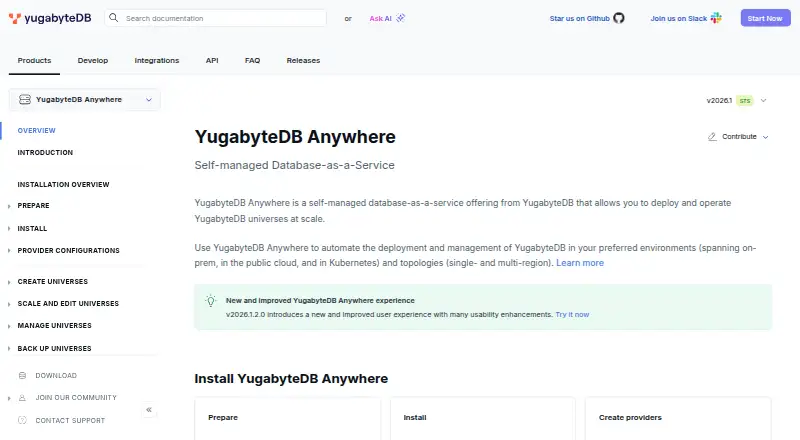
What YugabyteDB Anywhere is
YugabyteDB Anywhere (YBA) is a self-managed database-as-a-service for deploying and operating YugabyteDB universes. It supports the YSQL and YCQL interfaces and can run on on-premises Linux hosts, public clouds including AWS, Azure, GCP, and OCI, or Kubernetes. Deployments can span multiple regions, availability zones, and cloud providers. Teams can operate databases through a GUI, REST APIs, or Terraform provider; documentation also lists a CLI and Kubernetes Operator. Operations include horizontal and vertical scaling, upgrades, configuration changes, OS patching, backups, and point-in-time recovery. For disaster recovery, xCluster deployments support asynchronous replication between two universes. Security features include encryption in transit and at rest, LDAP and OIDC authentication, role-based access, and TLS certificate options. Both internet-connected and air-gapped deployments are supported. A free evaluation license lasts up to 32 consecutive calendar days; production use requires a commercial license, with pricing on request. One universe has a primary cluster and may include one attached read replica cluster.
Good
- Supports on-premises Linux, public clouds, and Kubernetes.
- Includes scaling, backups, and point-in-time recovery.
- Offers GUI, REST API, and Terraform operations.
- Supports air-gapped deployments.
- Evaluation license is free for up to 32 consecutive calendar days.
Watch out
- No free plan is listed.
- Production use requires a commercial license.
- One universe allows only one primary and one optional read replica cluster.
Who it suits
YBA suits teams operating YugabyteDB across on-premises infrastructure, public clouds, or Kubernetes. It is relevant to organizations that need multi-region deployment, disaster recovery, or air-gapped operation.
Verdict
YBA provides deployment and operational controls for YugabyteDB across varied environments, with options for replication, recovery, and access management. Production use requires a commercial license, and pricing is available on request.
Plans and prices
From YugabyteDB Anywhere's own pricing page, checked 1 Oct 2026.
| Plan | Price | What it gives you |
|---|---|---|
| Evaluation license | Free | up to 32 consecutive calendar days |
| Commercial production license | Priced on request | required for production use |
The facts
Each one read from YugabyteDB Anywhere's own pages, with the date it was checked.
What it does
- Access control
- YBA uses role-based access control for UI and REST API access and supports built-in and custom roles.checked 1 Oct 2026
- Automation
- YBA operations can be performed through a GUI, REST APIs or a Terraform provider, and the documentation also lists a CLI and Kubernetes Operator.checked 1 Oct 2026
- Certificate security
- YBA supports node-to-node and client-to-node TLS with self-signed, custom, CA, HashiCorp Vault and cert-manager certificate options.checked 1 Oct 2026
- Compliance
- Yugabyte says its security program is based on ISO 27001 and audited under SSAE18 SOC 2 standards, with reports including SOC 2, PCI DSS, ISO 9001 and ISO 22301.checked 1 Oct 2026
- Deployment environments
- YBA supports on-premises Linux hosts, public clouds including AWS, Azure, GCP and OCI, and Kubernetes.checked 1 Oct 2026
- Disaster recovery
- YBA supports xCluster deployments with asynchronous replication between two universes for disaster recovery.checked 1 Oct 2026
- Operations
- YBA supports online horizontal and vertical scaling, database upgrades, configuration changes, OS patching, backups and point-in-time recovery.checked 1 Oct 2026
- Product type
- YugabyteDB Anywhere is a self-managed database-as-a-service for deploying and operating YugabyteDB universes at scale.checked 1 Oct 2026
- Resilience
- YBA supports clusters designed to tolerate node, availability-zone, region and cloud-provider failures.checked 1 Oct 2026
- Security controls
- YBA supports encryption in transit, encryption at rest with major KMS providers, LDAP and OIDC authentication, and high availability for YBA itself.checked 1 Oct 2026
- Support and training
- Yugabyte provides Yugabyte University courses for YBA operations and links to support and community resources.checked 1 Oct 2026
- Topologies
- YBA can deploy multi-region, multi-zone and multi-cloud universes.checked 1 Oct 2026
- Universe limit
- A YBA universe contains one primary cluster and can optionally include one attached read replica cluster.checked 1 Oct 2026
Where it runs
- Air-gapped use
- YBA supports both Internet-connected and air-gapped deployments.checked 1 Oct 2026
The company
- Founded
- 2016checked 28 Sep 2026
The full review of YugabyteDB Anywhere
Overview
YugabyteDB Anywhere (YBA) is a self-managed control plane for deploying and running YugabyteDB databases across datacenters, clouds, and Kubernetes. It is aimed at platform and database teams that need repeatable control of distributed SQL infrastructure rather than a simple database browser. The central choice is breadth: YBA brings provisioning, resilience, recovery, security, and automation into one operating layer, but it is designed specifically for YugabyteDB and production requires a commercial license.
Key features
YBA provisions YugabyteDB on on-premises Linux hosts, AWS, Azure, GCP, OCI, and Kubernetes. Multi-region, multi-zone, and multi-cloud topologies let architects place data around latency and continuity requirements. Clusters can be designed to withstand node, availability-zone, region, or cloud-provider failures, which is meaningful for services with stringent uptime objectives but unnecessary overhead for a single-site deployment.
Daily administration covers online horizontal and vertical scaling, upgrades, configuration changes, operating-system patching, backups, and point-in-time recovery. Administrators can use the graphical interface, REST APIs, or Terraform provider, with a CLI and Kubernetes Operator also documented. That range supports both interactive work and infrastructure-as-code pipelines. Automated provisioning and high-availability management reduce repetitive setup, while audit logging, role-based access for the UI and API, and built-in or custom roles help separate duties.
Disaster recovery uses xCluster asynchronous replication between two universes. A universe contains one primary cluster and can optionally include one attached read-replica cluster, a boundary worth considering when planning read scale or recovery layouts. YBA itself can run with high availability, and it supports Internet-connected or air-gapped installations.
Security controls include encryption in transit, encryption at rest with major key-management providers, LDAP and OIDC authentication, and node-to-node or client-to-node TLS. Certificate choices include self-signed, custom, certificate-authority, HashiCorp Vault, and cert-manager options. Yugabyte describes a security program based on ISO 27001 and audited under SSAE18 SOC 2 standards, with reports including SOC 2, PCI DSS, ISO 9001, and ISO 22301. Yugabyte University courses and support and community resources provide an onboarding path for operators.
Pricing
The Evaluation license costs free for up to 32 consecutive calendar days. That is enough for a time-boxed proof of concept, not an ongoing free tier: there is no free plan and the evaluation has a hard duration cap.
The Commercial production license is required for production use and uses custom pricing. Teams should therefore budget for a sales-led decision rather than comparing a published per-seat or per-node rate. The commercial term is the appropriate route for live, supported deployments; the evaluation license is best reserved for validating topology, automation, and operational fit before that commitment.
Platforms
YBA is available through a web interface and API on Linux and self-hosted installations. Its hybrid deployment model spans local infrastructure, public clouds, and Kubernetes, while YugabyteDB is exposed through both YSQL and YCQL.
Who it's for
Choose YBA when your organization runs YugabyteDB across multiple failure domains and needs one control plane for provisioning, upgrades, scaling, backups, recovery, access policy, and automated delivery. It is particularly suitable for platform teams operating regulated or air-gapped environments, multi-cloud estates, or services where asynchronous cross-universe recovery is part of the design.
It is a poor fit if you need a neutral administrator for several unrelated database engines, a permanently free management product, or only a small single-cluster installation whose operational needs do not justify a dedicated control plane.
Pros and cons
Pros
- Broad deployment reach: on-premises Linux, four named public clouds, and Kubernetes support one operating model across varied infrastructure.
- Serious continuity tooling: failure-aware topologies, xCluster replication, backups, and point-in-time recovery address both availability and disaster recovery.
- Automation and governance: GUI, REST, Terraform, CLI, and Kubernetes tooling pair with RBAC, audit logging, authentication integrations, and TLS certificate options.
- Air-gapped operation: teams with restricted connectivity are not forced into an Internet-dependent deployment.
Cons
- Database-specific scope: YBA operates YugabyteDB universes, so it does not replace a general manager for mixed database estates.
- Paid production entry: the 32-day evaluation is temporary and production pricing is custom, making long-term cost harder to assess upfront.
- Universe structure limits: each universe has one primary and at most one attached read replica, which may constrain designs requiring more replica groups.
Alternatives
For a wider database-administration directory, see Database Administration Tools. Teams comparing distributed SQL products can browse Distributed SQL Databases; broader data models are covered by Multimodel Databases, while geographic workloads may suit Spatial Databases.
DbNinja is a freemium, web and self-hosted option with a free personal-use plan, making it a better starting point for lighter administration without YBA's commercial production commitment.
ClusterControl offers a free Community plan for deployment and monitoring plus a 250.00 EUR-per-month Self-serve plan, so choose it when you want a freemium operations product rather than YugabyteDB-specific control.
OpenEverest is free and open source with no licensing fees, fitting teams that prioritize customization and zero software cost.
pgAdmin is a free, open-source PostgreSQL administration tool; Adminer is free for commercial and non-commercial use; phpLiteAdmin is a free PHP-based SQLite interface; and phpMyAdmin is free web administration for MySQL and MariaDB. These are better choices when your database engine and needs match their narrower scope.
Trusted Postgres Architect is another free Linux, self-hosted option for teams focused on PostgreSQL architecture.
Verdict
YugabyteDB Anywhere is the right choice for organizations standardizing distributed YugabyteDB across multiple clouds, regions, or isolated environments and willing to license a production control plane. Its strongest reason to choose it is the combination of topology-aware resilience, recovery, security, and automation in one YugabyteDB-focused system. Look elsewhere if you need a free or engine-agnostic administrator, or if a small deployment cannot justify custom commercial pricing.
Alternatives to YugabyteDB Anywhere
- 1

IBM Db2
Free planWebAPILinuxSelf-hosted7.4From $630 a month - 2

Neo4j
Free planSelf-hosted7.0From $65 a month - 3

ClusterControl
Free planWebAPILinuxSelf-hosted6.8From €250 a month - 4

DbNinja
Free planWebLinuxmacOSSelf-hosted6.4Free plan - 5
Oracle Maestro
Windows6.4$129 one-time - 6

pgAdmin
Free planWebLinuxmacOSSelf-hosted6.4Free plan