
ArcadeDB
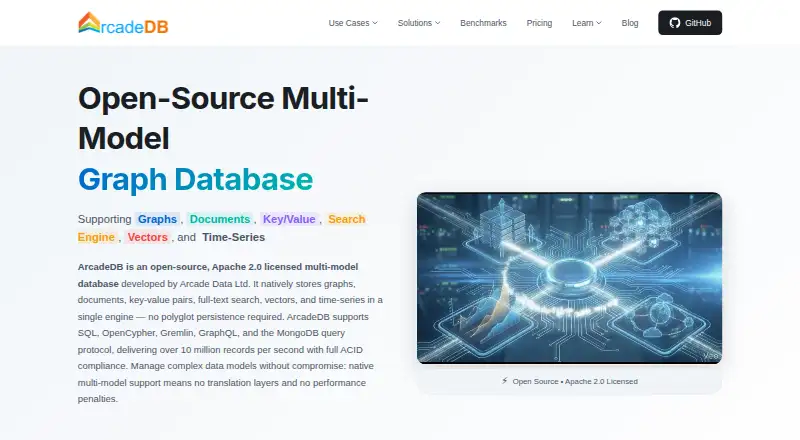
ArcadeDB is an open-source database that stores graph, document, key-value, full-text search, vector, and time-series data in one engine.
What ArcadeDB is
ArcadeDB is an open-source database that stores graph, document, key-value, full-text search, vector, and time-series data in one engine. The database is free for any use under the Apache 2.0 license, with no usage limits or feature restrictions, and it states that it supports full ACID transactions in single-node and distributed deployments. Developers can query it with SQL, OpenCypher 25, Gremlin, GraphQL, MongoDB query language, or a native Java API. It can run embedded in Java applications or as a standalone server, with installation options including Docker, a GitHub binary, Maven, and Kubernetes. ArcadeDB Server supports HTTP/JSON and compatibility with Postgres wire protocol, Redis, and MongoDB protocols. Built-in importers support Neo4j and OrientDB; the maker says Raft consensus maintains consistency across multiple servers. The Community plan includes forums, GitHub Issues, public documentation, and tutorials. A separate Studio AI Assistant license is listed at $19.99 a month.
Good
- Six data models in one engine
- Free under Apache 2.0 with no usage limits
- ACID transactions for single-node and distributed deployments
- Multiple query languages and a Java API
- Importers for Neo4j and OrientDB
Watch out
- Support coverage and response targets vary by plan
Who it suits
It suits developers who need several data models in one database or need graph, document, vector, and time-series capabilities together. Teams wanting support with stated response targets can consider the paid subscriptions.
Verdict
ArcadeDB offers broad data-model and query-language support, while the core database remains free without feature restrictions. Paid plans are for support and carry per-server monthly charges; response commitments vary by tier.
Plans and prices
From ArcadeDB's own pricing page, checked 15 Oct 2026.
| Plan | Price | What it gives you |
|---|---|---|
| Community | Free | full database and features · community/forum support · documentation and tutorials · forever |
| Silver | $299 a month | 4-hour S1 response during business hours · email support · priority queue · backport patches · extended coverage · monthly per server |
| Gold | $599 a month | 1-hour S1 response · 8am–8pm CET coverage · guaranteed backports · escalation · quarterly review · 24/7 coverage · monthly per server |
| Platinum | $1,499 a month | 30-minute S1 response · 24/7/365 critical coverage · dedicated technical account manager · guaranteed RCA · annual architecture/performance audit · monthly per server |
| Studio AI Assistant | $19.99 a month | $20 of included AI usage per month · natural-language SQL/Gremlin/Cypher · schema exploration · optimization help · contextual documentation · monthly per license |
The facts
Each one read from ArcadeDB's own pages, with the date it was checked.
What it does
- AI integrations
- The GraphRAG documentation describes combining graph traversal, vector similarity, BM25 or SPLADE sparse retrieval and hybrid fusion.checked 15 Oct 2026
- Community support
- The free Community plan lists community forums, GitHub Issues, public documentation, and tutorials.checked 28 Sep 2026
- Compatibility
- ArcadeDB Server supports HTTP/JSON and is compatible with the Postgres wire protocol, Redis, and MongoDB protocols.checked 28 Sep 2026
- Deployment
- ArcadeDB can run embedded in Java applications or as a standalone server and can be installed using Docker, a GitHub binary, Maven, or Kubernetes.checked 28 Sep 2026
- Deployment choices
- ArcadeDB can run as a Java embedded database, Docker container, Kubernetes Helm deployment or on-premise binary server.checked 15 Oct 2026
- Document and key-value models
- Documents and key-value records are supported natively alongside graph records.checked 15 Oct 2026
- Documentation depth
- The documentation includes fundamentals, SQL, graph queries, vector/RAG, migration courses, API references and operations guides.checked 15 Oct 2026
- Embedded-mode limitation
- Embedded deployments do not provide security controls automatically, so the host application must supply them.checked 15 Oct 2026
- Full-text search
- ArcadeDB uses BM25 ranking for full-text indexes and can combine keyword and vector retrieval.checked 15 Oct 2026
- Grafana integration
- The Grafana plugin supports time-series visual building, SQL/Cypher/Gremlin modes, node-graph visualization, alerting and template variables.checked 15 Oct 2026
- Graph database
- The engine provides native graph storage and traversal, including built-in graph algorithms.checked 15 Oct 2026
- High availability
- Distributed deployments use Raft consensus to maintain consistency across servers.checked 15 Oct 2026
- Latest release
- The changelog identifies version 26.10.1, dated October 5, 2026, with high-availability hardening, query fixes, PostgreSQL TLS and security advisories.checked 15 Oct 2026
- License
- ArcadeDB is distributed under the Apache License 2.0 and the maker states that all features remain under that license.checked 15 Oct 2026
- MCP extensibility
- A built-in MCP server offers schema, query, vector, full-text, hybrid-search and upsert tools over HTTP JSON-RPC or stdio.checked 15 Oct 2026
- Migration
- The product includes built-in importers for Neo4j and OrientDB.checked 28 Sep 2026
- Paid from
- 299checked 22 Sep 2026
- Performance claim
- The maker claims throughput above 10 million records per second and reports 44 of 44 Jepsen consistency tests passing.checked 15 Oct 2026
The company
- Company
- The maker identifies Arcade Data Ltd as a private company that leads development of the ArcadeDB open-source project.checked 28 Sep 2026
- Company size on LinkedIn
- LinkedIn classifies Arcade Data Ltd as privately held, headquartered in London, with 2–10 employees.checked 15 Oct 2026
- Headquarters
- London, United Kingdomchecked 23 Sep 2026
- Legal company history
- UK Companies House records Arcade Data Ltd as company 10981105, incorporated on September 26, 2017, with a London registered office.checked 15 Oct 2026
Money
- Free plan
- Yeschecked 22 Sep 2026
- License and cost
- The full database is free for any usage under the Apache 2.0 license, with no usage limits or feature gating.checked 28 Sep 2026
The full review of ArcadeDB
ArcadeDB is an open-source database engine that brings several data models and query languages into one system. It suits teams building graph-heavy, analytics, or AI-related applications that want to run their own database. The core product is free without usage caps; paid plans buy support commitments, not extra database features.
Overview
ArcadeDB can store graph, document, key-value, full-text search, vector, and time-series data in one engine. That breadth can reduce the need to coordinate separate database systems, especially for projects that combine connected data with search or analytics. The trade-off is that a focused database may be a better fit when an application has just one narrow workload.
The project is led by Arcade Data Ltd, a private company based in London. Its stated use cases range from knowledge graphs, fraud detection, and recommendations to real-time analytics, customer 360, supply-chain analytics, GraphRAG, and AI/ML feature stores.
Explore Multimodel Databases, Graph Databases, and Database Software for related categories.
Key features
- Multiple data models: Graph algorithms and vector search sit alongside document, key-value, full-text, and time-series storage. This combination is useful when an application needs to relate records and search across different kinds of data without splitting them between engines.
- Several query options: ArcadeDB supports SQL, OpenCypher 25, Gremlin, GraphQL, MongoDB query language, and a native Java API. The range can ease adoption across teams and existing applications, though it also means teams should settle on consistent query practices.
- Transactions and distributed operation: The database provides ACID transactions for single-node and distributed deployments, and uses Raft consensus to maintain consistency across servers. Its persistent write-ahead journal and rollback of uncommitted work after a crash are relevant safeguards for transactional workloads.
- Flexible deployment and compatibility: It can run embedded in Java applications or as a standalone server, with installation options including Docker, GitHub binary, Maven, and Kubernetes. HTTP/JSON support and compatibility with Postgres wire, Redis, and MongoDB protocols broaden integration choices.
- Migration support: Built-in importers for Neo4j and OrientDB give teams moving from either system a more direct starting point.
Pricing
The full database is free for any usage under the Apache 2.0 license, with no usage limits or feature gating. That makes Community unusually straightforward for teams that can rely on community help; the paid tiers matter when response commitments, patch handling, or escalation are operational requirements. Support prices are charged per server each month, so costs rise with server count.
| Plan | Price | What it includes |
|---|---|---|
| Community | free, billed forever | Full ArcadeDB feature set, community forum, GitHub Issues, public documentation, and tutorials. |
| Silver | $299 a month, billed monthly per server | Email support, priority issue queue, backport patches, a 4-hour S1 response during business hours, and one Studio AI Assistant license. |
| Gold | $599 a month, billed monthly per server | One-hour S1 response, 8am–8pm CET coverage, 24/7 coverage, guaranteed backport patches, escalation management, and one Studio AI Assistant license. |
| Platinum | $1,499 a month, billed monthly per server | 30-minute S1 response, 24/7/365 critical coverage, a dedicated technical account manager, S1/S2 root-cause analysis, an annual architecture and performance audit, and one Studio AI Assistant license. |
| Studio AI Assistant | $19.99 a month, billed monthly per license | Natural-language query assistance, schema exploration, query optimization suggestions, and context-aware documentation. |
Silver is the entry point for teams that want a defined response target and patch backports without paying for higher-tier escalation or round-the-clock coverage. Gold adds guaranteed backports and escalation management, while Platinum is aimed at teams that need critical coverage and an ongoing technical relationship. The separate Studio AI Assistant license offers query and schema help, but it does not unlock additional database capabilities.
Platforms
ArcadeDB supports API, Linux, macOS, self-hosted, web, and Windows environments. The latest release, 26.9.1, provides Linux, macOS, and Windows downloads.
Who it's for
ArcadeDB is a strong fit for teams consolidating graph, search, vector, and other data models, particularly when they need transactions, distributed deployments, or several query languages. Its free, unrestricted core also suits organizations able to operate the database themselves. Teams that require guaranteed support should budget for per-server subscriptions; those seeking a managed service are not specifically addressed by these deployment options.
Pros and cons
Pros
- Unrestricted free core: Apache 2.0 licensing and no usage or feature limits let teams use the full database without a paid tier.
- Broad model and query coverage: Combining six data types with multiple query languages can avoid maintaining separate systems for mixed workloads.
- Deployment and migration flexibility: Embedded and standalone modes, multiple installation routes, protocol compatibility, and Neo4j and OrientDB importers give teams several paths to adoption.
Cons
- Support can become a substantial operating cost: Paid support is billed per server per month, and higher response commitments start at $599 a month.
- Community support has no stated response commitment: Teams that need predictable incident response must move beyond the free plan.
- The product's breadth may be unnecessary for narrow workloads: A specialized database may be a better choice if an application needs only one data model.
Alternatives
- LadybugDB is a free option with an MIT-licensed codebase and pre-compiled binaries; consider it when that licensing model is a better fit.
- Memgraph offers a free, open-source in-memory graph database with ACID transactions and on-disk persistence; it is worth considering for a graph-focused workload.
- NebulaGraph has a free Apache 2.0 open-source edition with a subset of core features; choose it if that edition's scope fits.
- AllegroGraph has a free tier capped at 5 million triples and a customized-quote Enterprise plan; it may suit projects that fit that free cap or want a quoted enterprise tier.
- OrientDB offers a free Community distribution and Basic support at €1,000 a month; consider it if that distribution or support option fits your needs.
- TypeDB offers a managed Explore tier with 10 GB storage, 8 GB RAM, and 2 vCPUs; it is an option for teams seeking a managed dedicated database with those resources.
- Eclipse RDF4J is a free open-source Java framework whose latest release requires Java 25 or newer; consider it when a Java framework is the preferred form.
- GraphDB has a free tier with one parallel query and five repositories; it may work for projects whose needs fit those limits.
Verdict
Choose ArcadeDB if your application needs several data models, broad query-language support, and the option to run a full-featured database without license or usage caps. Its strongest case is the combination of that unrestricted core with flexible deployment and transactional, distributed operation. Look elsewhere if you need a narrower specialist or cannot operate the database without support commitments priced per server.
Getting started
- Visit https://arcadedb.com/.
- Choose an installation route: Docker, GitHub binary, Maven, or Kubernetes.
- Run ArcadeDB embedded in a Java application or as a standalone server.
- Use the free Community plan, or review paid support subscriptions if guaranteed response times are needed.
Limits worth knowing
The Community plan is free forever and includes the full ArcadeDB feature set, without usage limits or feature gating. Its listed support is community-based; guaranteed response-time SLAs are included with paid support subscriptions, with targets and coverage varying by plan.
Questions
Is ArcadeDB free?
Yes. The Community plan is 0.00 USD, billed forever, and the full database is free for any usage under Apache 2.0 without usage limits or feature gating.
What do the paid plans cost?
Silver is $299 a month per server, Gold is $599 a month per server, and Platinum is $1,499 a month per server. Studio AI Assistant is $19.99 a month per license.
Which query languages and APIs does it support?
ArcadeDB supports SQL, OpenCypher 25, Gremlin, GraphQL, MongoDB query language, and a native Java API.
How can ArcadeDB be deployed?
It can run embedded in Java applications or as a standalone server. Installation options include Docker, a GitHub binary, Maven, and Kubernetes.
What support does the Community plan include?
It lists community forums, GitHub Issues, public documentation, and tutorials. Paid support subscriptions include guaranteed response-time SLAs.
Who makes ArcadeDB?
ArcadeDB is made by ArcadeDB, headquartered in London, United Kingdom. Arcade Data Ltd is identified as the private company leading development of the open-source project.
Alternatives to ArcadeDB
- 1
NebulaGraph
Free planOpen sourceWebAPILinuxmacOS8.1Free plan - 2
Eclipse RDF4J
Free planOpen sourceWebAPILinuxmacOS7.6Free plan - 3

Sparksee
Free planAndroidiOSAPILinux7.6Free plan - 4

FalkorDB
Free planWebAPILinuxSelf-hosted7.5From $73 a month - 5
LadybugDB
Free planAndroidiOSWebAPI7.4Free plan - 6
AllegroGraph
Free planWebAPILinuxmacOS7.3Free plan