Eclipse RDF4J
Eclipse RDF4J is an open-source Java framework for parsing, storing, querying, and reasoning over RDF data.
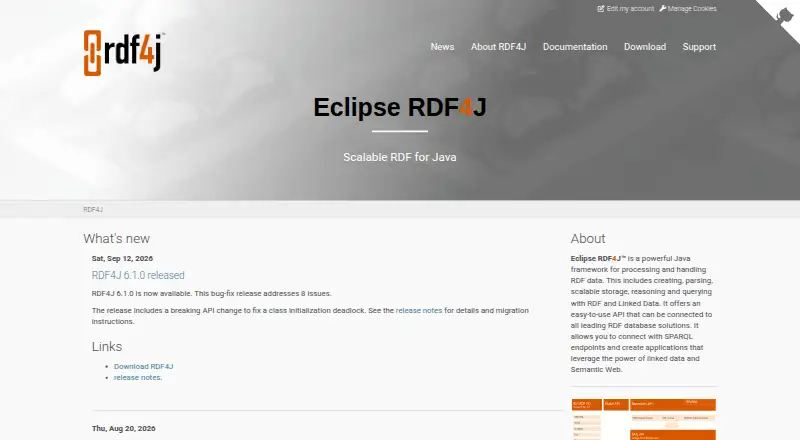
What Eclipse RDF4J is
Eclipse RDF4J is an open-source Java framework for parsing, storing, querying, and reasoning over RDF data. It supports SPARQL 1.1 query and update, and its API can reach remote RDF repositories as well as local ones. Supported formats include RDF/XML, Turtle, N-Triples, N-Quads, JSON-LD, TriG, and TriX. Storage options include a transactional in-memory store with optional disk persistence and a transactional Native Store intended for medium-sized datasets around 100 million triples. Extensions add full-text search, RDFS inferencing, rule-based reasoning, SHACL and SPIN validation, and geospatial queries. The SDK bundles libraries, Server, Workbench, Console, and Javadoc API; Workbench includes a web SPARQL editor. Developers can obtain it as Maven artifacts, an SDK zip, or onejar. RDF4J is free under the Eclipse Distribution License 1.0. The latest stable release, 6.1.0, requires Java 25 or newer. Its core databases are mainly intended for small to medium-sized datasets; third-party stores may provide more scalability or additional features.
Good
- Supports SPARQL 1.1 query and update.
- Handles a broad range of RDF formats.
- Offers transactional in-memory and Native Store options.
- SDK includes Server, Workbench, Console, and Javadoc API.
Watch out
- Latest stable release requires Java 25 or newer.
- Core databases mainly target small to medium-sized datasets.
Who it suits
It suits Java developers building applications with RDF, Linked Data, SPARQL endpoints, or Semantic Web data. Consider its stated dataset focus and Java runtime requirement when choosing a store.
Verdict
RDF4J brings RDF parsing, storage, querying, and reasoning into a Java framework, with several store and developer-tool options. Its core databases are aimed mainly at small to medium-sized datasets, and the latest stable release requires Java 25 or newer.
Plans and prices
From Eclipse RDF4J's own pricing page, checked 15 Oct 2026.
| Plan | Price | What it gives you |
|---|---|---|
| Eclipse RDF4J | Free | Open-source Java framework · self-hosted libraries, server, workbench and console |
The facts
Each one read from Eclipse RDF4J's own pages, with the date it was checked.
What it does
- API and SDK
- RDF4J is distributed as Maven modules, an SDK archive, a onejar and generated JavaDoc API documentation.checked 15 Oct 2026
- Developer setup
- The project documents Maven BOM and dependency setup and offers a onejar alternative for classpath use.checked 15 Oct 2026
- Developer tools
- The RDF4J SDK bundles libraries, Server, Workbench, Console, and Javadoc API; the Workbench provides a web interface with a SPARQL editor.checked 30 Sep 2026
- Distribution
- RDF4J can be retrieved as Maven artifacts or downloaded as an SDK zip or onejar.checked 30 Sep 2026
- Documentation depth
- Documentation includes getting-started tutorials, programming guides, reference material, tool manuals, release notes and JavaDoc links.checked 15 Oct 2026
- Elasticsearch limitation
- The ElasticsearchStore is experimental, may be incompatible with future releases, lacks write-ahead logging and has weaker transaction isolation than other stores.checked 15 Oct 2026
- Independent catalog listing
- Open Knowledge Graphs lists RDF4J as a developer library and records version 5.3.2 dated June 29, 2026.checked 15 Oct 2026
- Independent license listing
- Open Knowledge Graphs labels RDF4J as using a 3-clause BSD license, which differs from RDF4J's official EDL 1.0 statement.checked 15 Oct 2026
- Independent limit: feature breadth
- A Reddit commenter said Jena is more feature-rich, especially for OWL and ontology work, than RDF4J.checked 15 Oct 2026
- Independent praise: ease of use
- Another Reddit commenter reported that RDF4J was slightly easier to use for loading Turtle and operating on models directly in Java.checked 15 Oct 2026
- Independent praise: Sail API
- A Reddit production user said they particularly liked the design of RDF4J's Sail API.checked 15 Oct 2026
- Integrations
- Documented compatible systems include GraphDB, Halyard, Stardog, Amazon Neptune, Blazegraph, Oracle RDF, MarkLogic, Strabon and Virtuoso.checked 15 Oct 2026
- Intended users
- The site presents RDF4J as a framework for Java developers building applications with RDF, Linked Data, SPARQL endpoints, and Semantic Web data.checked 30 Sep 2026
- License
- The project states that Eclipse RDF4J is licensed under the Eclipse Distribution License version 1.0.checked 15 Oct 2026
- Limitations
- The project describes its core databases as mainly intended for small to medium-sized datasets and says third-party stores may offer better scalability or extended features.checked 30 Sep 2026
- Limit: less-technical UX
- A Gartner Peer Insights reviewer questioned whether the RDF4J-based GraphDB UX could be adapted for less technical staff and all use cases.checked 15 Oct 2026
- Major release changes
- RDF4J 6.0.0 added broad RDF 1.2 and SPARQL 1.2 support, moved to Java 25 and Jakarta, and improved HTTP, storage, federation, query execution, security and deployment.checked 15 Oct 2026
- Maven metadata
- Maven Central describes RDF4J as an extensible Java framework for RDF and SPARQL, with inception year 2015 and Eclipse Foundation as organization.checked 15 Oct 2026
- Memory Store
- The Memory Store is transactional, runs in RAM and can optionally synchronize persistence to disk.checked 15 Oct 2026
The company
- Founded
- 2015checked 28 Sep 2026
- Maker founded
- LinkedIn lists the Eclipse Foundation as founded in 2004.checked 15 Oct 2026
- Maker headquarters
- LinkedIn lists the Eclipse Foundation headquarters in Brussels.checked 15 Oct 2026
- Maker legal name
- The Eclipse Foundation AISBL is the nonprofit organization hosting the RDF4J project.checked 15 Oct 2026
- Maker size
- LinkedIn lists the Eclipse Foundation company size as 51–200 employees.checked 15 Oct 2026
The full review of Eclipse RDF4J
Overview
Eclipse RDF4J is a Java framework for building applications that parse, store, query, and reason over RDF data. It suits developers working with Linked Data, SPARQL endpoints, or Semantic Web data who want to assemble those capabilities into their own Java software. Its breadth of RDF tooling is a strong fit for that work, but its core stores are aimed mainly at small to medium-sized datasets.
Key features
RDF handling and SPARQL
RDF4J handles formats including RDF/XML, Turtle, N-Triples, N-Quads, JSON-LD, TriG, and TriX. It supports SPARQL query and update, and gives applications access to remote repositories through the same API used for local ones. Support for federated queries adds flexibility when data sits across repositories. That common interface can simplify application code, though RDF4J remains a framework to build with rather than a turnkey database product.
Stores, reasoning, and validation
The transactional in-memory store can persist data to disk; the transactional Native Store targets medium-sized datasets of around 100 million triples. Extensions add full-text search, RDFS inferencing, rule-based reasoning, SHACL and SPIN validation, and geospatial queries. That range makes RDF4J useful for applications that need more than basic parsing and retrieval. For larger-scale workloads or extended capabilities, the project points to third-party stores, including GraphDB, Halyard, Stardog, Amazon Neptune, Oracle RDF Graph Adapter, MarkLogic, and Virtuoso.
Developer toolkit
The SDK bundles libraries, Server, Workbench, Console, and Javadoc API. Workbench offers a web interface with a SPARQL editor, while distribution through Maven artifacts, an SDK zip, or onejar gives developers several ways to bring the components into a project. The latest stable release, RDF4J 6.1.0, requires Java 25 or newer, a significant runtime constraint for teams on older Java versions.
Pricing
Eclipse RDF4J: free. The open-source framework is distributed under the Eclipse Distribution License, version 1.0. There is no paid tier or free-trial term to weigh against the free offering; users take on the work of integrating and deploying the framework themselves. Self-hosted deployment and a Java 25-or-newer runtime are the practical considerations.
Platforms
RDF4J is listed for API, Linux, macOS, Windows, web, and self-hosted use. Its distribution as Java libraries and SDK packages makes it most relevant to developers incorporating it into applications or running its server components, rather than people seeking a standalone consumer app.
Who it's for
Choose RDF4J if you are building Java software around RDF and want parsing, repository access, querying, storage, and optional reasoning or validation extensions in one framework. It is less suitable if you need a ready-to-run database with core storage designed for very large datasets; in that case, evaluate a third-party store or another product built around your scale and deployment needs.
Pros and cons
- Pro: Broad RDF format coverage and a shared API for local and remote repositories suit applications drawing on multiple RDF sources.
- Pro: Transactional stores, reasoning, validation, full-text search, and geospatial extensions support varied RDF application needs.
- Pro: The open-source distribution costs nothing and includes a developer toolkit with a web-based SPARQL editor.
- Con: Core databases target mainly small to medium-sized datasets, so larger deployments may need a third-party store.
- Con: The latest stable release requires Java 25 or newer, which rules it out for projects that cannot move to that runtime.
- Con: As a framework, it expects Java development and deployment work rather than providing a finished database experience out of the box.
Alternatives
For a broader comparison, see RDF Databases, Knowledge Graph Software, and Graph Databases.
- Fluree DB is another free open-source option for locally run or self-hosted RDF work, with native JSON-LD and SPARQL in its open-source plan.
- GraphDB is worth considering if a freemium RDF database suits better; its free tier requires a license for GraphDB 11+ and limits parallel queries and repositories.
- RDFox may fit teams that want a commercial license path, though its free evaluation license is limited to 30 days and non-commercial use.
- Apache Jena Fuseki is a free, self-hosted server option under Apache License 2.0.
- Stardog offers a free tier with a renewable one-year license, up to 1 million stored edges, and three databases.
- Tentris offers a community plan with single-core licensing, in-memory storage, community support, and SPARQL 1.1 and RDF 1.1 support.
- AllegroGraph may suit users whose needs fit its free edition, which has no expiration date and caps storage at 5,000,000 triples.
- Dydra has a basic free-use option with limited resources and caps of five queries per second and 1 million statements per repository for public evaluation accounts.
Verdict
Eclipse RDF4J is a strong choice for Java developers who need an open-source toolkit for RDF applications and value the combination of repository access, SPARQL, stores, and reasoning extensions. Its main drawback is that core storage is not aimed at large-scale workloads, and the Java 25 requirement may be a blocker; look to a third-party store or another database if either constraint conflicts with your project.
Getting started
- Visit the RDF4J website.
- Use Maven artifacts or download the SDK zip or onejar.
- Use the SDK's libraries, Server, Workbench, Console, or Javadoc API as needed.
- Use Java 25 or newer for the latest stable release.
Limits worth knowing
The latest stable release requires Java 25 or newer. RDF4J describes its core databases as mainly intended for small to medium-sized datasets; third-party stores may provide greater scalability or extended features.
Questions
How much does Eclipse RDF4J cost?
The listed plan costs nothing. RDF4J is open source under the Eclipse Distribution License 1.0.
What Java version does the latest stable release require?
RDF4J 6.1.0 requires Java 25 or newer.
Which RDF formats does RDF4J support?
Listed formats include RDF/XML, Turtle, N-Triples, N-Quads, JSON-LD, TriG, and TriX.
How can developers obtain RDF4J?
It is available as Maven artifacts or as an SDK zip or onejar.
Does RDF4J work with remote repositories?
Yes. Its API can access remote RDF repositories in the same way as local repositories.
What is the main dataset limitation?
The project describes its core databases as mainly intended for small to medium-sized datasets. Third-party stores may offer greater scalability or extended features.
Alternatives to Eclipse RDF4J
- 1

ArcadeDB
Free planOpen sourceWebAPILinuxmacOS8.3From $19.99 a month - 2

NebulaGraph
Free planOpen sourceWebAPILinuxmacOS8.1Free plan - 3

Sparksee
Free planAndroidiOSAPILinux7.6Free plan - 4

FalkorDB
Free planWebAPILinuxSelf-hosted7.5From $73 a month - 5
LadybugDB
Free planAndroidiOSWebAPI7.4Free plan - 6
AllegroGraph
Free planWebAPILinuxmacOS7.3Free plan