NebulaGraph
NebulaGraph is a distributed graph database for storing and querying complex connected data.
What NebulaGraph is
NebulaGraph is a distributed graph database for storing and querying complex connected data. It is designed for scalability and performance, and the project says it can handle graphs with trillions of edges and vertices. It supports nGQL and openCypher compatibility, with native ISO-GQL support in Enterprise v5.0. The database also includes native vector search for combining graph structures with unstructured data. Deployment options include on-premises, public cloud, and hybrid environments; NebulaGraph Cloud can run clusters on Microsoft Azure, AWS, and Google Cloud Platform. Ecosystem tools include Java, Python, C++, and Go clients, plus Spark and Flink connectors. NebulaGraph Studio is a browser-based tool for schema creation, data import, query writing, and graph exploration. Cloud security options include Private Link and role-based graph-space access. The open-source edition is free under the Apache 2.0 license. A 14-day Cloud trial includes one instance with 2 vCPUs, 4 GB RAM, and 10 GB storage, without requiring payment information.
Good
- Supports nGQL and openCypher compatibility.
- Native vector search combines graph and unstructured data.
- Cloud clusters can use Azure, AWS, or Google Cloud.
- Open-source edition is free under Apache 2.0.
- Cloud trial does not require payment information.
Watch out
- Open-source edition includes a subset of core features.
- Standard Cloud plan has no high availability.
- ACID transactions are not supported.
- Cloud trial lasts 14 days and includes one instance.
Who it suits
NebulaGraph may suit teams working with connected data for applications such as recommendation engines, fraud detection, knowledge graphs, or network analysis. Its deployment choices also suit teams considering on-premises, cloud, or hybrid setups.
Verdict
NebulaGraph combines graph querying, vector search, and multiple deployment options. Consider the specific edition and Cloud plan limits, especially where high availability or transaction support matters.
Plans and prices
From NebulaGraph's own pricing page, checked 15 Oct 2026.
| Plan | Price | What it gives you |
|---|---|---|
| Open-source Edition | Free | subset of core features · community collaboration and support |
| NebulaGraph Cloud Standard | Priced on request | single node up to 8 vCPUs, 64 GB RAM and 320 GB storage · no high availability · pay-as-you-go per hour; node, storage and transfer charges |
| NebulaGraph Cloud Professional | Priced on request | up to 10 query nodes and 10 storage nodes · high availability · faster technical support · pay-as-you-go per hour; storage-node, query-node, disk and transfer charges |
| Enterprise Edition | Priced on request | enhanced performance · enterprise-grade stability and security · premium support · contact sales |
The facts
Each one read from NebulaGraph's own pages, with the date it was checked.
What it does
- Additional clients
- PHP, Node.js, .NET, JDBC and several ORM clients are available but carry no uptime guarantee in the documentation.checked 15 Oct 2026
- API and SDKs
- Official clients are available for C++, Java, Python, Go and a native console; Java is the only client documented as thread-safe.checked 15 Oct 2026
- Availability
- NebulaGraph Cloud uses Raft for redundant backups across multiple server rooms in the same city.checked 30 Sep 2026
- Cloud providers
- NebulaGraph Cloud can deploy clusters on Microsoft Azure, AWS, and Google Cloud Platform.checked 30 Sep 2026
- Cloud security
- Cloud access controls can assign permissions by user, role, graph, space or query.checked 15 Oct 2026
- Cloud service
- NebulaGraph Cloud is a fully managed service with no-code setup, built-in demos, visual exploration and pay-as-you-go billing.checked 15 Oct 2026
- Consistency
- Storage replication and high availability use the Raft consensus protocol.checked 15 Oct 2026
- Data import
- The database supports diverse data formats and integration with existing ingestion pipelines.checked 15 Oct 2026
- Deployment
- The maker supports on-premises, public-cloud and hybrid deployment models.checked 15 Oct 2026
- Distributed architecture
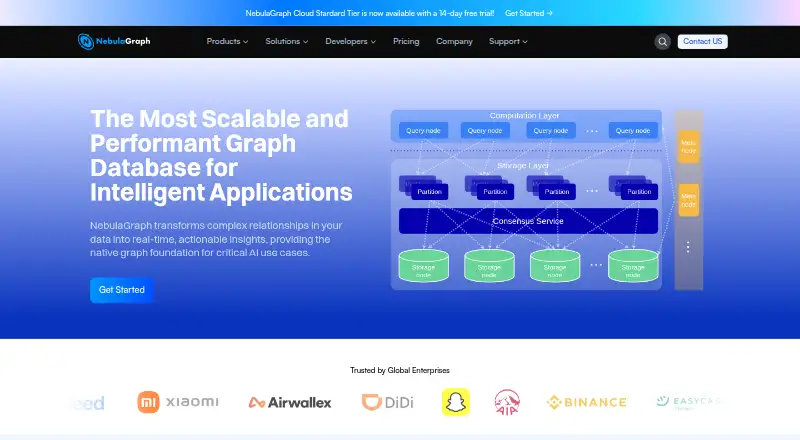
- The system separates Graph, Storage and Meta services so compute and storage can scale independently.checked 15 Oct 2026
- Documentation depth
- The documentation covers architecture, deployment, nGQL, clients, ecosystem tools, operations, FAQs and release notes, and the 3.8.0 manual was revised September 24, 2026.checked 15 Oct 2026
- Flink integration
- The official Flink connector supports NebulaGraph 2.0 and 3.0 and requires Java 8 or newer.checked 15 Oct 2026
- Funding
- Vesoft’s news page reports an $8 million Series pre-A round led by Redpoint China Ventures on June 15, 2020.checked 15 Oct 2026
- Graph algorithms
- NebulaGraph advertises more than 50 graph algorithms and separate analytics capabilities.checked 15 Oct 2026
- Graph model
- NebulaGraph stores entities as vertices and relationships as typed edges with properties.checked 15 Oct 2026
- Graph scale
- NebulaGraph states that it can store and process graphs with trillions of edges and vertices.checked 30 Sep 2026
Money
- Cloud trial
- The cloud trial provides one 2-vCPU, 4-GB RAM and 10-GB storage instance for 14 days without payment information.checked 15 Oct 2026
- Free trial limits
- The 14-day NebulaGraph Cloud trial includes one database instance with 2 vCPUs, 4 GB RAM, and 10 GB storage, and requires no payment information.checked 30 Sep 2026
The company
- Company founding
- Vesoft says it was founded in October 2018.checked 15 Oct 2026
- Company headquarters
- Vesoft says it is headquartered in Cupertino, California.checked 15 Oct 2026
- Company legal name
- Crunchbase lists the legal name as Vesoft Inc and Nebula Graph as an alternate name.checked 15 Oct 2026
- Company size
- Crunchbase lists Vesoft in the 101–250 employee range.checked 15 Oct 2026
- Founded
- 2018checked 28 Sep 2026
- Headquarters
- Cupertino, California, United Stateschecked 28 Sep 2026
The full review of NebulaGraph
NebulaGraph is a distributed graph database for teams working with complex, highly connected data. It suits developers and organizations that need self-hosted or cloud deployment, graph algorithms, and vector search in one platform. The free edition is a sensible starting point, while production cloud users must choose carefully between Standard’s single-node limits and Professional’s high-availability design.
Overview
NebulaGraph is built for graph workloads that demand scale and fast responses, with the company describing millisecond querying and support for graphs containing trillions of vertices and edges. That makes it relevant to recommendation engines, social networks, fraud detection, cybersecurity, network analysis, knowledge graphs, and supply-chain systems. The claimed scale is compelling for large relationship-heavy datasets, but the practical ceiling depends on the edition and deployment architecture you select.
Query support covers nGQL and compatibility with openCypher. Native ISO-GQL arrives in Enterprise v5.0, so organizations standardizing on that language need the custom-priced Enterprise edition. Native vector search is included in NebulaGraph Database, combining graph relationships with unstructured data for AI-oriented data fusion rather than forcing separate graph and vector systems.
Key features
Graph algorithms are supported, and official clients for Java, Python, C++, and Go give application teams several integration paths. Spark and Flink connectors connect graph processing with established data-engineering pipelines. NebulaGraph Studio is a web tool for defining schemas, importing data, writing nGQL queries, and exploring graph structures; it is particularly useful for teams that need a visual companion to database administration and investigation.
Deployment is unusually broad. NebulaGraph can run on premises, in public clouds, or in hybrid environments, including macOS and Windows setups. NebulaGraph Cloud provisions clusters on Microsoft Azure, AWS, and Google Cloud Platform. Cloud customers also get Private Link for private network access and role-based permissions for graph spaces. Raft-based redundant backups across server rooms in the same city, snapshots for point-in-time restoration, and automatic replacement of failed instances address operational resilience, although the level of availability still depends on the plan.
Pricing
The Open-source Edition costs free. It provides a subset of core features, community collaboration and support, and an Apache 2.0 license. This is the best fit for self-managed projects that can accept community-led support and do not require the complete commercial feature set.
NebulaGraph Cloud offers a 14-day trial without payment information. The trial includes one database instance with 2 vCPUs, 4 GB of RAM, and 10 GB of storage, making it useful for evaluation but too small to represent a large production graph. The included storage figure is 10 GB.
Cloud Standard costs $0.05 per contact, billed pay-as-you-go. A single node can use up to 8 vCPUs, 64 GB of RAM, and 320 GB of storage. Private endpoint and IP allow-list controls are included, but there is no high availability. It suits smaller or non-critical deployments where a single-node design is acceptable.
Cloud Professional also costs $0.05 per contact, billed pay-as-you-go. It supports up to 10 query nodes and 10 storage nodes, adds high availability, and includes private endpoint and IP allow-list controls. Technical support has a faster response time than Standard, making this the more appropriate cloud tier for operationally important services.
Enterprise Edition uses custom pricing and adds enhanced performance, enterprise-grade stability and security, premium support, and native ISO-GQL support in version 5.0. Buyers should choose it when those requirements outweigh the simplicity of the open-source edition or standard cloud tier.
Platforms
NebulaGraph is available through API, Linux, macOS, self-hosted deployments, web tools, and Windows. That combination supports local development, controlled infrastructure, and managed cloud operation without tying every team to one operating system or hosting model.
Who it's for
NebulaGraph is a strong candidate for engineering teams building graph-centric products, especially recommendation, fraud, cybersecurity, knowledge-graph, network-analysis, and supply-chain applications. It is also well suited to organizations that need to combine connected data with vector search or move between on-premises, public-cloud, and hybrid deployment.
It is less suitable when ACID transactions are a core requirement: NebulaGraph does not provide them. Teams needing guaranteed transactional behavior should evaluate a different database before committing to a graph-first architecture.
Pros and cons
Pros
- Distributed design targets very large graphs and complex queries.
- Native vector search supports graph and unstructured-data fusion.
- Deployment spans self-hosted, public-cloud, hybrid, macOS, and Windows environments.
- Professional adds high availability, while Cloud security controls include Private Link and role-based access.
- Java, Python, C++, Go, Spark, and Flink integrations broaden application and pipeline options.
Cons
- ACID transactions are not supported, ruling it out for transaction-centered workloads.
- Cloud Standard has no high availability and is limited to a single node.
- ISO-GQL support is confined to the custom-priced Enterprise v5.0 edition.
- The free edition offers only a subset of core features and relies on community support.
- The 14-day trial’s one small instance is suited to validation, not realistic scale testing.
Alternatives
LadybugDB is a free, MIT-licensed option with binaries across mobile, desktop, web, and self-hosted platforms, but it has no free trial.
ArcadeDB offers a forever-free Community plan with its full feature set and community support, making it a straightforward choice for teams wanting a broad free distribution.
Sparksee provides a free academic licence and a free trial, which may suit education-focused evaluation.
Memgraph is worth considering when ACID transactions and on-disk persistence are priorities in a free community edition.
AllegroGraph offers a free tier capped at 5 million triples and a customizable enterprise option.
Apache HugeGraph is a free, self-hosted open-source graph database and related component suite.
OrientDB provides a free Community distribution, with basic support priced at €1,000 a month.
TypeDB offers a managed Explore plan with 10 GB storage, 8 GB RAM, and 2 vCPUs, plus paid Launch capacity.
Browse the Graph Databases category for further options.
Verdict
Choose NebulaGraph for graph-heavy applications that need flexible deployment, very large-scale ambitions, vector search, and a path from free self-hosting to managed cloud. The main reason to look elsewhere is the absence of ACID transactions, while cloud buyers should pay for Professional or Enterprise when availability, support, or ISO-GQL is essential.
Alternatives to NebulaGraph
- 1

ArcadeDB
Free planOpen sourceWebAPILinuxmacOS8.3From $19.99 a month - 2
Eclipse RDF4J
Free planOpen sourceWebAPILinuxmacOS7.6Free plan - 3

Sparksee
Free planAndroidiOSAPILinux7.6Free plan - 4
FalkorDB
Free planWebAPILinuxSelf-hosted7.5From $73 a month - 5
LadybugDB
Free planAndroidiOSWebAPI7.4Free plan - 6
AllegroGraph
Free planWebAPILinuxmacOS7.3Free plan