
Sparksee
Sparksee is an embeddable graph database management system for representing and analysing relationships among entities.
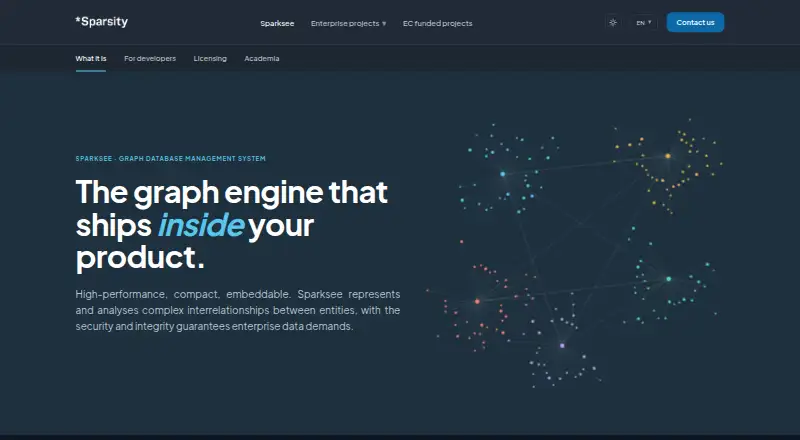
What Sparksee is
Sparksee is an embeddable graph database management system for representing and analysing relationships among entities. It runs inside an application process against a database file, so deployment does not require a cluster or query server. The maker says its compact bitmap-based graph representation supports graph computations in mobile and embedded environments. Built-in algorithms cover traversal, shortest paths, connectivity, community detection, and PageRank. Its API supports graph import and export, scripting, and Sparksee Cypher queries, while Sparksee Algebra is also listed as a query language. Developer references cover .NET, Java, C++, Objective-C, Python, and openCypher. The product offers disk-level encryption and database recovery after corruption. Keeping data on a user’s device can support privacy-preserving apps and reduce reliance on cloud connectivity. Sparksee supports ACID transactions and is available for Android, iOS, Linux, macOS, and Windows, as well as through an API and self-hosted deployment. A free academic licence requires a valid school or university ID and manual review; a trial is also available. Commercial licence terms are set on request according to company and deployment details.
Good
- Runs against a database file without a query server.
- Includes traversal, shortest path, and PageRank algorithms.
- Offers disk-level encryption and corruption recovery.
- Supports ACID transactions.
- API references cover six developer languages or query options.
Watch out
- No fixed commercial licence price is published.
- Academic licence requires valid ID and manual validation.
- Commercial terms depend on company and deployment details.
Who it suits
Sparksee suits developers building graph-powered mobile, embedded, or self-hosted applications who want graph algorithms and local database storage. Academic users may qualify for a free licence, while commercial buyers need to request deployment-specific terms.
Verdict
Sparksee provides an embeddable graph database with algorithms, query options, and local-storage capabilities. Its free academic route is conditional, and commercial teams should expect to request a tailored licence.
Plans and prices
From Sparksee's own pricing page, checked 15 Oct 2026.
| Plan | Price | What it gives you |
|---|---|---|
| Academic licence | Free | Academic use · valid university or school ID · Free to use for teachers, PhD students and university research groups; manual validation required |
| Free trial | — | Trial build · sample project · platform and API-language selection · 1-month subscription for free |
| Industry | Priced on request | Enterprise real-time graph applications · terms sized by deployment · Request licence |
| Startup | Priced on request | For SMEs · first 10 startups get a 3-year licence waiver · Request licence |
The facts
Each one read from Sparksee's own pages, with the date it was checked.
What it does
- Algorithms
- Built-in graph algorithms are provided as out-of-the-box tooling for application development.checked 15 Oct 2026
- API capabilities
- The API documentation covers database construction, node and edge operations, attributes, collections, import/export, scripting and graph algorithms.checked 15 Oct 2026
- Bitmap architecture
- The maker says bitmap-based structures support compact storage and high-performance graph computation in embedded and mobile environments.checked 15 Oct 2026
- Connectivity resilience
- Local graph processing lets mobile analytics continue when cloud connectivity is poor or unavailable.checked 15 Oct 2026
- Data and queries
- The API supports graph data import and export, scripting, and Sparksee Cypher queries, described as an implementation of openCypher with particularities.checked 7 Oct 2026
- Deployment
- Sparksee runs from an application process against a database file, with no cluster or query server to provision.checked 7 Oct 2026
- Deployment classification
- GDB-Engines classifies Sparksee as self-hosted while also supporting embedding in an application.checked 15 Oct 2026
- Documentation depth
- Sparsity publishes a starting guide, complete user manual, high-availability material and language-specific reference guides in PDF and browsable HTML.checked 15 Oct 2026
- Embedded deployment
- The engine runs inside an application process against a database file, without requiring a cluster or query server.checked 15 Oct 2026
- Encryption
- Disk-level encryption is provided to protect data if a device is lost, stolen or sold.checked 15 Oct 2026
- Engineering standards
- The developer page states that Sparsity works with ASPICE and MISRA standards.checked 15 Oct 2026
- Graph export integration
- The API documentation describes export to Graphviz and GraphML and discusses third-party Blueprints integration.checked 15 Oct 2026
- Graph model
- Sparksee models data as a labelled, attributed multigraph with directed or undirected edges, typed objects, attributes and loops.checked 15 Oct 2026
- History
- Wikipedia records development beginning in 2006, a first release in 2008, the DEX name change to Sparksee in February 2014 and version 6.0 in 2021.checked 15 Oct 2026
- Independent benchmark limit
- The same study found certain incoming-edge queries on Freebase samples exhausted available RAM and swap space in Sparksee, linked by the authors to a Gremlin implementation problem.checked 15 Oct 2026
- Independent benchmark praise
- A microbenchmark study reported Sparksee among the fastest systems for insert, update and delete operations, generally completing them below 100 milliseconds.checked 15 Oct 2026
- Independent database profile
- DBDB.io describes Sparksee as a native bitmap-based graph database with full ACID transactions, used especially for social-network analysis.checked 15 Oct 2026
- Installation
- Packages are downloaded and unpacked without a general installer, except for an Objective-C MacOS framework installer; Java packages can also be obtained through Apache Maven.checked 15 Oct 2026
- Language bindings
- Documented bindings are available for .NET, Java, C++, Objective-C and Python, with an openCypher reference.checked 15 Oct 2026
- Latency
- Local graph computation is intended to reduce response latency by avoiding a remote server round trip.checked 15 Oct 2026
- Licence model
- Sparksee is distributed under proprietary licensing with free academic, evaluation and certain startup arrangements rather than an open-source licence.checked 15 Oct 2026
The company
- Company activities
- The company LinkedIn page says Sparsity collaborates on EU-funded projects including LDBC, SoMatch and CoherentPaaS.checked 15 Oct 2026
- Company facts
- Crunchbase describes Sparsity Technologies as a private Barcelona spin-off from UPC-Barcelonatech, founded in 2010 by Josep Lluis Larriba Pey, with a listed headcount range of 1–10.checked 15 Oct 2026
- Headquarters
- Barcelona, Spainchecked 28 Sep 2026
The full review of Sparksee
Sparksee is an embedded graph database for developers building apps around connected data. It is best suited to mobile and embedded software that needs graph analysis near its data. Its on-device design is compelling; commercial licensing takes a tailored request.
Overview
Sparksee runs in an application process and works with a database file, without a cluster or query server to provision. That keeps the database close to the app and can reduce reliance on cloud connectivity, a useful fit for software that stores or analyzes data on a device. It is not a separately provisioned graph service, so teams looking for a remote database server should consider another approach.
The maker describes compact bitmap-based graph representations designed for high-performance graph computation in mobile and embedded settings. That focus aligns with constrained, local deployments, though the right choice still depends on how well the specific workload fits an embedded database.
Key features
Built-in algorithms cover traversal, shortest path, connectivity, community detection, and PageRank. Having these operations available within the database can save app developers from implementing common graph analysis themselves. ACID transactions support transactional data handling, while import and export, scripting, and two query options—Sparksee Cypher (SCL) and Sparksee Algebra—give teams several ways to work with graph data.
SCL implements openCypher with particularities. That makes it a relevant option for teams already working with Cypher, but differences from openCypher matter when compatibility is a requirement. API references cover .NET, Java, C++, Objective-C, and Python, giving developers in those ecosystems documented integration paths.
Disk-level encryption is intended to protect data if a device is lost, stolen, or sold, and Sparksee can recover a database after corruption. Local storage can also support apps that keep user data on-device and limit dependence on cloud connectivity. These are useful capabilities for device-based deployments, but they do not make the product a general-purpose cloud security or backup service.
Pricing
Sparksee is freemium, with an academic route and commercial licences priced on request. The academic licence costs nothing for teachers, PhD students, and university research group members. Applicants must provide a valid university or school ID, and the application requires manual validation, so it is a conditional option rather than an unrestricted free tier.
The Startup plan has custom pricing and is intended for SMEs building apps. The first 10 startups using Sparksee in an app receive a three-year licence waiver. The Industry plan also has custom pricing, with terms sized to company size and deployment for enterprise-level, real-time graph applications. Commercial pricing depends on deployment details, including target platforms and whether the engine ships to customers, so teams should expect to request a licence with their intended distribution model in hand. A free trial is available; trial applicants receive a build and access to an engineer for modelling questions.
Platforms
Sparksee supports Android, iOS, Linux, macOS, and Windows, as well as API and self-hosted deployments. That range fits cross-platform app development and software deployed on infrastructure a team manages itself. The language references for .NET, Java, C++, Objective-C, and Python add options for integrating the engine into those development stacks.
Who it's for
Sparksee is a strong candidate for developers embedding graph storage and analysis in mobile or other device-based applications, especially when local data handling and reduced cloud dependence matter. Academic researchers and eligible educators can apply for the free licence. SMEs may benefit from the startup waiver if they are among the first 10 qualifying users. Enterprises with deployment-specific needs can request per-deployment terms.
It is a weaker fit for teams that need a standalone remote graph service, or commercial buyers who need predictable published pricing before evaluating a product. The academic licence also does not serve general commercial use.
Pros and cons
- Pro: Embedded, file-based operation avoids provisioning a cluster or query server, suiting applications that need local graph storage.
- Pro: Built-in traversal, shortest path, connectivity, community detection, and PageRank provide a useful range of graph analysis.
- Pro: Disk-level encryption and database recovery address device loss and corruption concerns in local deployments.
- Pro: Academic users can apply for a free licence, subject to eligibility and manual validation.
- Con: Commercial pricing is custom and depends on deployment, making cost harder to compare before requesting terms.
- Con: Sparksee Cypher has particularities relative to openCypher, which may require adaptation for teams counting on exact compatibility.
- Con: Its embedded architecture does not provide a separately provisioned graph server for remote access.
Alternatives
Choose LadybugDB if an MIT-licensed graph database with free source code and precompiled binaries suits your project better. ArcadeDB offers a free Community plan with its full feature set, making it worth considering when that plan matches your needs. Memgraph is another free option, with an open-source in-memory graph database, ACID transactions, and on-disk persistence.
NebulaGraph provides an Apache 2.0 open-source edition with a subset of core features. AllegroGraph may suit projects that fit within its free tier of up to 5 million triples. Apache HugeGraph is a free, self-hosted graph database with related components. OrientDB has a free Community distribution and a Basic support plan priced at €1,000 a month. TypeDB is an alternative to compare for teams considering its managed Explore plan, which includes 10 GB storage, 8 GB RAM, and 2 vCPUs.
Browse more options in Graph Databases or Mobile Databases.
Verdict
Choose Sparksee when you need graph storage and analysis embedded in a mobile or device-based application, and its algorithms, local operation, and supported language bindings fit your stack. Its main advantage is keeping graph work within the app and near the data. Look elsewhere if you need a remote graph service or want a fixed commercial price before contacting the vendor.
Alternatives to Sparksee
- 1

ArcadeDB
Free planOpen sourceWebAPILinuxmacOS8.3From $19.99 a month - 2

NebulaGraph
Free planOpen sourceWebAPILinuxmacOS8.1Free plan - 3
Eclipse RDF4J
Free planOpen sourceWebAPILinuxmacOS7.6Free plan - 4

FalkorDB
Free planWebAPILinuxSelf-hosted7.5From $73 a month - 5
LadybugDB
Free planAndroidiOSWebAPI7.4Free plan - 6
AllegroGraph
Free planWebAPILinuxmacOS7.3Free plan