LadybugDB
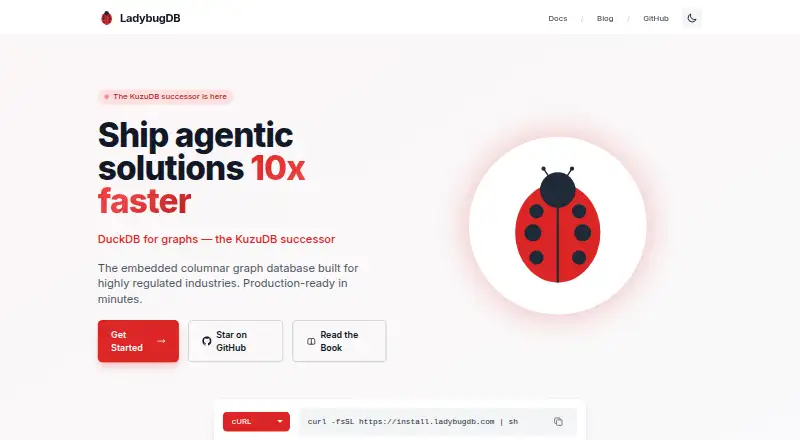
LadybugDB is an embedded columnar graph database intended for analytical workloads and agentic applications.
What LadybugDB is
LadybugDB is an embedded columnar graph database intended for analytical workloads and agentic applications. It uses the Cypher query language with a structured property graph model, and can run on disk or in memory. In-memory data is not saved and is lost when the process ends. The database combines columnar disk storage, vectorized and factorized query processing, multi-core parallelism, and join algorithms. Its transactions are atomic, durable, and serializable. Source code and precompiled binaries are available under the MIT License, which permits commercial and proprietary applications. Imports support Parquet, CSV, JSON, NumPy, Pandas and Polars DataFrames, and PyArrow Tables. Client APIs are listed for Python, Node.js, Java, Rust, Go, Swift, C, and C++. Ladybug Explorer provides a browser interface for querying and visualizing a database, and the MCP Server exposes a database as a tool for LLMs and agents. Concurrent access is limited to one read-write Database object or multiple read-only objects; processes that need concurrent writes should use an API server pattern.
Good
- MIT License permits commercial and proprietary applications.
- Supports Cypher with a structured property graph model.
- Client APIs cover eight listed programming languages.
- Imports include Parquet, CSV, and JSON.
- Browser-based Explorer supports querying and visualization.
Watch out
- In-memory data is lost when the process ends.
- Concurrent access permits only one read-write Database object.
- Community support is available; enterprise support contracts are commercial.
Who it suits
LadybugDB may suit developers building graph-based analytical or agentic applications who want Cypher and a choice of client APIs. Its in-memory mode is relevant when data need not persist after the process ends.
Verdict
LadybugDB offers an embedded graph database with multiple language APIs and data import options. Its memory persistence and concurrent-write model are important constraints to consider for an application.
Plans and prices
From LadybugDB's own pricing page, checked 3 Oct 2026.
| Plan | Price | What it gives you |
|---|---|---|
| MIT open-source license | Free | MIT-licensed source code and pre-compiled binaries; commercial and proprietary applications permitted |
The facts
Each one read from LadybugDB's own pages, with the date it was checked.
What it does
- Agent integration
- The Ladybug MCP Server exposes a Ladybug database as a tool that can be used by LLMs and agents.checked 3 Oct 2026
- Client APIs
- Official client APIs are listed for Python, Node.js, Java, Rust, Go, Swift, C, and C++.checked 2 Oct 2026
- Concurrency limit
- The documented concurrency model allows one read-write Database object or multiple read-only Database objects for a database.checked 3 Oct 2026
- Data formats
- Bulk imports support Parquet, CSV, JSON, NumPy, Pandas or Polars DataFrames, and PyArrow Tables.checked 3 Oct 2026
- Deployment
- Ladybug runs embedded in an application process and does not require managing a separate database server.checked 3 Oct 2026
- Extensions
- Official extensions include support for ADBC sources, Azure storage, Delta Lake, DuckDB, full-text search, Iceberg, JSON, Neo4j migration, PostgreSQL, SQLite, Unity Catalog, and vector similarity search.checked 2 Oct 2026
- Integrations
- The documentation describes integrations with Snowflake and PostgreSQL, and attaching to DuckDB, SQLite, Iceberg, Delta Lake, and Unity Catalog sources.checked 3 Oct 2026
- Language APIs
- Installation options include Python, Node.js, Java, Rust, Go, Swift, C, and C++ APIs, as well as a command-line interface.checked 3 Oct 2026
- License
- All source code and precompiled binaries are distributed under the MIT License.checked 3 Oct 2026
- Product
- Ladybug is an embedded graph database optimized for complex analytical workloads on very large graphs.checked 3 Oct 2026
- Query language
- It uses a property graph data model and Cypher query language.checked 3 Oct 2026
- Security claims
- The product site characterizes LadybugDB as built for highly regulated industries but does not state a specific security certification or compliance standard on that page.checked 2 Oct 2026
- Storage and execution
- Its core features include columnar disk storage, vectorized and factorized query processing, efficient join algorithms, and multi-core query parallelism.checked 3 Oct 2026
- Support
- The site lists community support and says commercial enterprise support contracts are available.checked 3 Oct 2026
- Transactions
- Ladybug supports serializable ACID transactions.checked 3 Oct 2026
- Web tools
- Ladybug Explorer is described as a web-based interface for querying and visualizing a database, and a Ladybug MCP Server exposes a database as a tool for LLMs and agents.checked 2 Oct 2026
Where it runs
- Browser interface
- Ladybug Explorer is a web-based GUI for exploring and querying a Ladybug database in a browser.checked 3 Oct 2026
- Platforms
- The CLI and C/C++ APIs have precompiled binaries for macOS, Linux, and Windows; Swift also supports iOS, and Java supports Android ARMv8-A.checked 3 Oct 2026
The company
- Maker details
- The pages reviewed identify the project as LadybugDB and its developers but do not state a headquarters or founding date.checked 3 Oct 2026
The full review of LadybugDB
LadybugDB is an embedded database for querying property graphs with Cypher, with analytical processing and agent integrations in view. It suits developers who want graph queries inside an application and are comfortable managing its concurrency model. The core software is MIT-licensed and free, but in-memory databases disappear when the process ends.
Overview
Unlike a database that must always be accessed as a separate service, LadybugDB can run embedded in on-disk or in-memory mode. Its columnar storage and query engine target analytical workloads, while graph algorithms and vector similarity search extend it beyond basic graph querying. This makes it a focused option for applications that need analytical graph operations rather than a general-purpose managed database.
The MIT License permits commercial and proprietary applications. Community support is available, with commercial enterprise support contracts for teams that need them. Although the product is characterized as suitable for highly regulated industries, that claim is not accompanied by a named certification or compliance standard.
Key features
Cypher and analytical execution
LadybugDB uses Cypher over a structured property graph. Columnar disk storage, vectorized and factorized query processing, multi-core parallelism, and join algorithms are designed to support analytical work over connected data. These capabilities make it more compelling for workloads that need graph structure and analysis together than for an application seeking only a simple embedded store.
Imports and integrations
Bulk imports accept Parquet, CSV, JSON, NumPy, Pandas and Polars DataFrames, and PyArrow Tables. That range gives teams several paths to bring existing analytical data into a graph. Official extensions cover ADBC sources, Azure storage, Delta Lake, DuckDB, full-text search, Iceberg, JSON, Neo4j migration, PostgreSQL, SQLite, Unity Catalog, and vector similarity search. Snowflake Native App and a PostgreSQL extension for running Cypher against host-platform tables provide additional integration options.
APIs and browser tools
Official APIs are available for Python, Node.js, Java, Rust, Go, Swift, C, and C++, alongside a command-line interface. Ladybug Explorer adds a browser-based GUI for querying and visualizing a database. The Ladybug MCP Server exposes a database as a tool for LLMs and agents, making agent-oriented integration possible without changing the underlying graph model.
Transactions and concurrency
Transactions are atomic, durable, and serializable, providing ACID guarantees. The concurrency model is more restrictive than those transaction properties alone might suggest: one read-write Database object, or multiple read-only objects, can access the same database concurrently. Applications with multiple processes that need writes should use an API server pattern. This is a meaningful architectural constraint, especially for deployments expecting concurrent writers.
Pricing
LadybugDB's MIT open-source license plan costs nothing. It includes MIT-licensed source code and pre-compiled binaries, and permits commercial and proprietary use. There is no free trial because the product is free rather than a time-limited trial. No paid self-serve plan is described; commercial enterprise support contracts are available for organizations seeking paid support.
This is a strong fit for developers who can operate the database themselves and are comfortable relying on community support. The trade-off is that free software does not include a stated enterprise support entitlement; teams that require contracted support should consider the enterprise option.
Platforms
LadybugDB is listed for Android, iOS, Linux, macOS, Windows, web, API, and self-hosted use. Its language APIs and browser Explorer offer distinct ways to work with the database, while deployment can be on disk or in memory. In-memory mode is suitable only when losing the data at process exit is acceptable; use on-disk mode when data must persist.
Who it's for
LadybugDB is best suited to developers building analytical applications around connected data, especially those who want Cypher, a choice of language APIs, broad bulk-import formats, or an agent-facing MCP tool. Its commercial-use license keeps it viable for proprietary applications. It is a weaker fit for systems requiring multiple processes to write directly to the same database, or for teams that need a specified security certification.
Pros and cons
- Pros: MIT-licensed source and binaries permit commercial and proprietary deployment without a software fee.
- Pros: Cypher, graph algorithms, and vector similarity search bring graph-oriented and vector capabilities into an analytical database.
- Pros: Eight official language APIs, multiple import formats, and a browser GUI give developers several ways to integrate and inspect data.
- Cons: In-memory data is lost when the process ends, so it cannot serve as durable storage.
- Cons: Concurrent access supports only one read-write Database object; multi-process writers need an API server pattern.
- Cons: A regulated-industry positioning is not backed by a named certification or compliance standard.
Alternatives
For a broader comparison, browse Graph Databases and Embedded Databases.
- ArcadeDB is worth comparing if you want a freemium database with a free Community plan and its full feature set.
- Memgraph may suit readers who prefer a full in-memory graph database with on-disk persistence and ACID transactions in its free Community Edition.
- NebulaGraph is another free open-source graph database option, with an Open-source Edition described as a subset of core features.
- AllegroGraph is an alternative if a free tier capped at 5 Million Triples fits the workload, with an Enterprise option on customized pricing.
- OrientDB offers a free Community distribution and a separate Basic support plan priced at €1,000 a month.
- TypeDB may be preferable for a managed dedicated database: its free Explore plan includes 10 GB storage, 8 GB RAM, and 2 vCPUs.
- Eclipse RDF4J is a free open-source Java framework, with its latest release requiring Java 25 or newer.
- GraphDB offers a free tier with one query in parallel and five repositories, subject to a free license requirement for version 11 and later.
Verdict
Choose LadybugDB if you want a free, commercially usable embedded graph database that pairs Cypher with analytical execution, multiple language APIs, and agent tooling. Its chief advantages are the permissive license and integration breadth; its chief reasons to look elsewhere are the narrow concurrent-write model and the lack of a named security certification.
Getting started
- Visit the LadybugDB website.
- Choose an installation route: a listed language API or the command-line interface.
- Select on-disk or in-memory operation, keeping in mind that in-memory data is not persisted.
- Import supported data such as Parquet, CSV, or JSON, or use an available client API.
- Use Cypher to query the property graph, or open Ladybug Explorer in a browser.
- For integrations, consider the listed extensions, Snowflake Native App, or PostgreSQL extension.
Limits worth knowing
The free plan is distributed under the MIT License. In-memory data is not persisted and is lost when its process ends. Concurrent access supports one read-write Database object or multiple read-only objects; multiple processes requiring writes should use an API server pattern.
Questions
How much does LadybugDB cost?
The listed MIT open-source license plan is free.
Is LadybugDB open source?
Its source code and precompiled binaries are distributed under the MIT License, which permits commercial and proprietary applications.
Which query language does it use?
LadybugDB uses Cypher with a structured property graph model.
Which programming languages have official client APIs?
Official APIs are listed for Python, Node.js, Java, Rust, Go, Swift, C, and C++.
Can it search vectors?
An official extension provides vector similarity search.
How does concurrent access work?
The documented options are one read-write Database object or multiple read-only Database objects accessing the same database. Multiple processes that need writes should use an API server pattern.
Alternatives to LadybugDB
- 1

ArcadeDB
Free planOpen sourceWebAPILinuxmacOS8.3From $19.99 a month - 2

NebulaGraph
Free planOpen sourceWebAPILinuxmacOS8.1Free plan - 3
Eclipse RDF4J
Free planOpen sourceWebAPILinuxmacOS7.6Free plan - 4

Sparksee
Free planAndroidiOSAPILinux7.6Free plan - 5
FalkorDB
Free planWebAPILinuxSelf-hosted7.5From $73 a month - 6
AllegroGraph
Free planWebAPILinuxmacOS7.3Free plan