
GraphDB
GraphDB is an RDF and SPARQL semantic graph database for storing data and running inferencing in the Graphwise AI Platform.
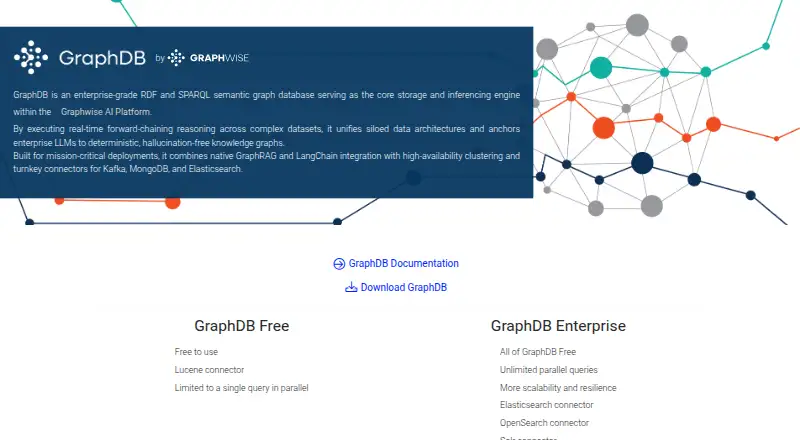
What GraphDB is
GraphDB is an RDF and SPARQL semantic graph database for storing data and running inferencing in the Graphwise AI Platform. It performs real-time forward-chaining reasoning across datasets and supports SPARQL 1.1, RDF4J compatibility, RDFS and OWL 2 RL and QL rulesets, federated queries, and RDF-star. Its product page describes native GraphRAG and LangChain integration. GraphDB can run as a desktop or standalone server, be self-hosted, or be deployed on AWS and Azure. Downloads are listed for Windows, macOS, Linux, and a platform-independent distribution. GraphDB Free includes a Lucene connector, one parallel query, and up to five repositories; GraphDB 11 and later requires a free license. Enterprise adds multiple cores, unlimited repositories, high-availability clustering, and connectors for Elasticsearch, OpenSearch, Solr, and Kafka. Enterprise licensing is per server CPU core, with each cluster node licensed separately. Free use costs nothing; Enterprise pricing is on request.
Good
- Real-time reasoning works across datasets.
- Supports SPARQL 1.1 and RDF-star.
- Available on AWS and Azure.
- Free plan includes a Lucene connector.
- Enterprise includes SLA support.
Watch out
- Free allows one parallel query.
- Free is limited to five repositories.
- GraphDB Free is on-premise only.
- Enterprise pricing is available on request.
Who it suits
GraphDB suits teams building semantic data systems that need RDF storage, SPARQL queries, or inferencing. Free is an option for users who can work within its query and repository limits; Enterprise is intended for mission-critical deployments and enterprise AI applications.
Verdict
GraphDB combines RDF storage, querying, and reasoning with desktop, server, and cloud deployment options. Choose the edition based on repository and query needs, and note that Enterprise licensing is per core and per cluster node.
Plans and prices
From GraphDB's own pricing page, checked 29 Sep 2026.
| Plan | Price | What it gives you |
|---|---|---|
| GraphDB Free | Free | Lucene connector · one query in parallel · five repositories · on-premise only · community support · Free to use; GraphDB 11+ requires a free license |
| GraphDB Enterprise | Priced on request | Multiple cores · unlimited repositories · connectors for Elasticsearch, OpenSearch, Solr and Kafka · high-availability cluster · SLA support · License offered per server CPU core; contact sales for pricing |
The facts
Each one read from GraphDB's own pages, with the date it was checked.
What it does
- AI features
- The product page describes native GraphRAG and LangChain integration.checked 29 Sep 2026
- Connectors
- GraphDB Enterprise includes Elasticsearch, OpenSearch, Solr, and Kafka connectors; GraphDB Free includes Lucene.checked 29 Sep 2026
- Core standards
- GraphDB supports full SPARQL 1.1, RDF4J compatibility, and rulesets for RDFS and OWL 2 RL and QL.checked 29 Sep 2026
- Deployment
- GraphDB can run as a desktop or standalone server application and is also available on AWS and Azure.checked 29 Sep 2026
- Downloads
- The product download page lists Windows MSI, macOS Apple Silicon and Intel DMG, Linux RPM and DEB, and a platform-independent distribution.checked 29 Sep 2026
- Edition limits
- GraphDB Free is limited to one parallel query and five repositories; Enterprise supports multiple cores and unlimited repositories.checked 29 Sep 2026
- Enterprise licensing
- Enterprise licensing is per server CPU core, and each cluster node must be licensed separately.checked 29 Sep 2026
- Intended users
- The maker describes GraphDB as built for mission-critical deployments and enterprise AI applications.checked 29 Sep 2026
- Product
- GraphDB is an RDF and SPARQL semantic graph database used for storage and inferencing in the Graphwise AI Platform.checked 29 Sep 2026
- Reasoning
- GraphDB performs real-time forward-chaining reasoning across datasets.checked 29 Sep 2026
- Security
- GraphDB documents role and access controls, local, LDAP and OAuth user databases, Basic, GDB, OpenID and Kerberos authentication, SSL/TLS encryption in transit, and security auditing.checked 29 Sep 2026
- Support
- The edition comparison lists community support for Free and SLA support for Enterprise.checked 29 Sep 2026
The company
- Company history
- Ontotext says it started as an R&D lab within Sirma Group in 2000.checked 29 Sep 2026
- Headquarters
- The company privacy policy lists ONTOTEXT AD, doing business as Graphwise, with headquarters in Sofia, Bulgaria.checked 29 Sep 2026
The full review of GraphDB
GraphDB is a semantic graph database for teams that store RDF data and query or reason over it with SPARQL. It suits organizations building standards-based data systems and enterprise AI applications. Its appeal is broad RDF support across deployment options; its main trade-off is a tightly capped free edition and custom-priced, per-core Enterprise licensing.
Overview
GraphDB combines RDF storage with full SPARQL 1.1 querying, federated queries, RDF-star, and real-time forward-chaining reasoning across datasets. Compatibility with RDF4J and rulesets for RDFS and OWL 2 RL and QL make it a substantial choice for semantic data work, rather than a general-purpose graph database aimed at the simplest workloads.
It is part of the Graphwise AI Platform, and its product page describes native GraphRAG and LangChain integration. That makes it relevant to teams connecting graph data to AI workflows, though the integration alone does not remove the need to assess edition limits and deployment requirements.
Key features
Standards, formats, and inference
GraphDB supports a wide range of RDF formats: Turtle, Turtle-star, TriG, TriG-star, N3, N-Triples, N-Quads, JSON-LD, NDJSON-LD, RDF/JSON, RDF/XML, TriX, and BinaryRDF. That breadth, alongside SPARQL 1.1 and RDF4J compatibility, gives teams flexibility when working with RDF-based systems. Its RDFS and OWL 2 RL and QL rulesets and real-time reasoning are a better fit for applications that need inferences across datasets than for users seeking only a basic repository.
Connectors and security
Free includes a Lucene connector. Enterprise adds Elasticsearch, OpenSearch, Solr, and Kafka connectors, which is a meaningful step up for teams that need those integrations. GraphDB documents role and access controls, local, LDAP, and OAuth user databases, Basic, GDB, OpenID, and Kerberos authentication, SSL/TLS encryption in transit, and security auditing. These controls suit managed deployments with security requirements, while the connector gap is one more reason Free may not meet broader production needs.
Pricing
GraphDB Free
GraphDB Free costs nothing. It includes one parallel query, five repositories, the Lucene connector, on-premise deployment, and community support. GraphDB 11+ requires a free license. The edition is useful for evaluation or smaller installations, but the one-query limit can constrain concurrent work and five repositories may be insufficient for teams running several separate datasets.
GraphDB Enterprise
GraphDB Enterprise has custom pricing, with licensing offered per server CPU core and each cluster node licensed separately. It supports multiple cores and unlimited repositories, adds Elasticsearch, OpenSearch, Solr, and Kafka connectors, and includes a high-availability cluster and SLA support. It is the more appropriate edition for larger or mission-critical deployments, but per-core and per-node licensing makes infrastructure scale directly relevant to cost.
Platforms
GraphDB runs as a desktop or standalone server application and is also available on AWS and Azure. Downloads include Windows MSI, macOS Apple Silicon and Intel DMG, Linux RPM and DEB, and a platform-independent distribution. Its platform support spans API, Linux, macOS, self-hosted, web, and Windows; hybrid deployment is also supported. The range gives teams room to choose local, server, or cloud setups, though Free itself is on-premise only.
Who it's for
GraphDB is best suited to teams that need RDF and SPARQL standards, inference, and room to move from a limited on-premise edition to Enterprise capabilities. Its AI integrations also make it worth considering for enterprise AI applications built around graph data. It is a weaker fit for users who need many concurrent queries or repositories without Enterprise licensing, or who do not need semantic reasoning and the surrounding standards support.
Pros and cons
- Pros: Broad RDF format coverage, SPARQL 1.1, RDF-star, federated queries, and RDF4J compatibility support standards-focused data work.
- Pros: Real-time reasoning and RDFS and OWL rulesets support applications that need derived knowledge across datasets.
- Pros: Desktop, standalone server, AWS, Azure, and hybrid options accommodate different deployment approaches.
- Cons: Free permits only one parallel query and five repositories, limiting shared or multi-dataset use.
- Cons: Free is on-premise only and has community support; SLA support and high availability require Enterprise.
- Cons: Enterprise licensing is per CPU core and cluster node, so larger deployments require careful cost planning.
Alternatives
RDF Databases and Graph Databases are useful category comparisons for readers weighing other tools.
- Stardog is worth comparing if a free option with up to 1 million stored edges and three databases is a better fit; its free license renews annually and excludes high availability.
- Fluree DB offers an open-source option with native JSON-LD and SPARQL that can run locally or self-hosted.
- Eclipse RDF4J is a free open-source Java framework; its latest release requires Java 25 or newer.
- AllegroGraph may suit users whose free-edition ceiling of 5,000,000 triples meets their needs.
- Apache Jena Fuseki is a free self-hosted server under the Apache License 2.0.
- RDFox offers a 30-day evaluation license for non-commercial use and a commercial license.
- Tentris has a single-core community option with in-memory storage, transactions, and SPARQL 1.1 and RDF 1.1 support.
- Corese is another free option to consider.
Verdict
Choose GraphDB if your work depends on RDF standards, inference, and deployment flexibility, especially when Enterprise connectors, high availability, and SLA support matter. Its strongest reason to choose is the combination of broad semantic capabilities and a path to larger deployments. Look elsewhere if the Free edition's one-query and five-repository caps are too restrictive and per-core Enterprise licensing does not fit your budget or infrastructure.
Getting started
- Visit graphdb.ontotext.com and choose the Free or Enterprise edition.
- For Free, obtain a free license when using GraphDB 11 or later.
- Download the Windows MSI, macOS DMG, Linux RPM or DEB, or platform-independent distribution.
- Run GraphDB as a desktop or standalone server application, or deploy it on AWS or Azure.
- For Enterprise pricing and licensing, contact sales.
Limits worth knowing
GraphDB Free allows one parallel query and five repositories, is on-premise only, and includes community support. Enterprise pricing is on request; licensing is per server CPU core, with each cluster node licensed separately.
Questions
Is GraphDB free?
GraphDB Free is available at no cost. GraphDB 11 and later requires a free license.
What are the Free edition’s limits?
Free allows one parallel query and five repositories, is on-premise only, and includes community support.
What platforms and deployments does GraphDB support?
Downloads are available for Windows, macOS, Linux, and a platform-independent distribution. GraphDB can run as a desktop or standalone server application and is also available on AWS and Azure.
What does Enterprise add?
Enterprise supports multiple cores and unlimited repositories, and includes Elasticsearch, OpenSearch, Solr, and Kafka connectors, high-availability clustering, and SLA support.
How is Enterprise priced?
Pricing is available from sales on request. The license is per server CPU core, and each cluster node must be licensed separately.
Who makes GraphDB?
GraphDB is a product used in the Graphwise AI Platform. Its maker, Ontotext, says it began as an R&D lab within Sirma Group in 2000.
Alternatives to GraphDB
- 1
Virtuoso Universal Server
Open sourceWebAPILinuxmacOS7.9From $99.99 a year - 2

RDFox
Free planWebAPILinuxmacOS7.8Free plan - 3

Stardog
Free planAndroidiOSWebAPI7.7Free plan - 4
Eclipse RDF4J
Free planOpen sourceWebAPILinuxmacOS7.6Free plan - 5
Apache Jena Fuseki
Free planOpen sourceWebAPILinuxSelf-hosted7.5Free plan - 6

Fluree DB
Free planWebAPILinuxmacOS6.5Free plan