Corese
Corese is a free platform for creating, manipulating, querying, reasoning over, and validating RDF data and knowledge graphs.
What Corese is
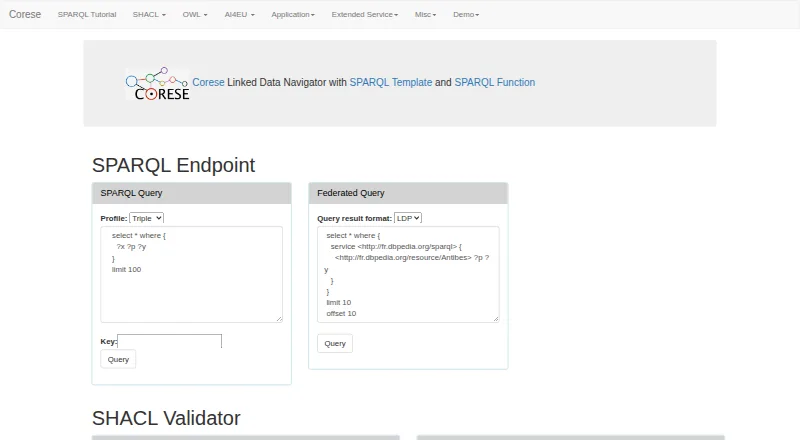
Corese is a free platform for creating, manipulating, querying, reasoning over, and validating RDF data and knowledge graphs. Its web server provides a SPARQL endpoint and SHACL validator, along with federated query tools and Linked Data navigation using SPARQL templates and functions. A web tutorial lets users select queries, inspect patterns and datasets, and submit queries to the server. CORESE-Core is a Java library for Semantic Web research and projects, implementing and extending standards including RDF, RDFS, SPARQL 1.1 Query and Update, OWL RL, and SHACL. It also provides STTL, SPARQL Rule, and LDScript extensions. Available interfaces include a graphical interface, command line, Java library, server, and beta Python wrapper. Storage integrations include Jena and RDF4J, while releases are distributed through Maven, Docker, Flathub, and Pip. The server can be run as a Docker container or downloaded as a JAR for self-hosted SPARQL endpoints. The Wimmics Corese repository was archived in July 2026, with development and maintenance moved to the Corese-stack organization.
Good
- Provides SPARQL endpoint and SHACL validator
- Supports federated SPARQL queries
- Java library implements and extends W3C standards
- Lists Jena and RDF4J storage integrations
- Self-hosted server available as Docker container or JAR
Watch out
- Wimmics repository is archived
- Python wrapper is beta
- No support plan or response time is stated
Who it suits
Corese may suit Java developers and researchers working with Semantic Web standards or RDF knowledge graphs. Its server, command-line, and web interfaces offer different ways to query and manage RDF data.
Verdict
Corese offers RDF tooling through a library, server, and several interfaces, with standards support and self-hosting options. Note that maintenance moved from the archived Wimmics repository to Corese-stack.
The facts
Each one read from Corese's own pages, with the date it was checked.
What it does
- Distribution
- Corese releases are distributed through Maven, Docker, Flathub, and Pip.checked 29 Sep 2026
- Extensions
- Corese also implements STTL SPARQL, SPARQL Rule, and LDScript extensions.checked 29 Sep 2026
- Federated queries
- The web server includes a federated query interface for SPARQL queries.checked 28 Sep 2026
- Intended use
- Inria describes Corese as a platform for managing and exploiting knowledge graphs in complex environments.checked 28 Sep 2026
- Intended users
- The Corese-Core README describes integrating the Java library into Java projects using Maven, Gradle, or a JAR.checked 29 Sep 2026
- Interfaces
- The project provides a Java library, SPARQL server, graphical interface, command-line interface, and a beta Python wrapper.checked 29 Sep 2026
- Library
- CORESE-Core is described as a library for research into Semantic Web standards and the algorithms they require.checked 28 Sep 2026
- Linked Data
- The web server offers Linked Data navigators using SPARQL templates and SPARQL functions.checked 28 Sep 2026
- Project status
- The Wimmics Corese repository was archived on July 3, 2026, and says further development and maintenance moved to the Corese-stack GitHub organization.checked 29 Sep 2026
- Purpose
- Corese is a software platform for creating, manipulating, parsing, serializing, querying, reasoning over, and validating RDF data.checked 29 Sep 2026
- Security
- The opened project pages do not state security certifications or compliance claims.checked 29 Sep 2026
- Self-hosted server
- Corese-server can be run as a Docker container or downloaded as a JAR to create and manage SPARQL endpoints.checked 29 Sep 2026
- Standards
- Corese implements RDF, RDFS, SPARQL 1.1 Query and Update, OWL RL, and SHACL.checked 29 Sep 2026
- Storage integrations
- The project lists Jena and RDF4J storage integrations.checked 29 Sep 2026
- Support
- The project directs support questions and feature discussions to its GitHub discussion forum and invites issue reports and pull requests.checked 29 Sep 2026
- Supported standards
- CORESE-Core implements and extends W3C standards including RDF, RDFS, SPARQL 1.1 Query and Update, OWL RL, and SHACL.checked 28 Sep 2026
- Tutorial
- A web tutorial lets users select SPARQL queries, inspect query patterns and datasets, and submit queries to the server.checked 28 Sep 2026
The company
- Founded
- 1999checked 28 Sep 2026
Where it runs
- Linux and macOS
- The Corese-Command installation script is provided for Linux and macOS.checked 29 Sep 2026
The full review of Corese
Corese is a Semantic Web toolkit for working with RDF data and knowledge graphs, best suited to developers and researchers who need standards-based Java tooling or a self-hosted SPARQL service. Its breadth of interfaces and RDF support is a strong fit for technical teams, though its maintenance transition is worth weighing before adoption.
Overview
Corese combines a Java library, server, graphical interface, command-line interface, and beta Python wrapper rather than centering on a single application. The library is geared toward Semantic Web standards and the algorithms behind them; Java developers can integrate it through Maven, Gradle, or a JAR.
The project dates to 1999. The Wimmics Corese repository was archived on July 3, 2026, with ongoing development and maintenance moved to the Corese-stack GitHub organization. That transition makes it important to follow the active project home when evaluating future updates.
Key features
Standards and RDF workflows
CORESE-Core implements and extends RDF, RDFS, SPARQL 1.1 Query and Update, OWL RL, and SHACL. It also adds STTL, SPARQL Rule, and LDScript. Support for reasoning and RDF-star broadens its use for knowledge-graph work, while its listed formats—RDF/XML, Turtle, TriG, JSON-LD, N-Triples, N-Quads, and RDFa—cover a wide range of RDF data exchange needs.
Server and query tools
Corese-server can run as a Docker container or as a JAR, letting teams create and manage their own SPARQL endpoints. The web server includes a federated-query interface, Linked Data navigators built around SPARQL templates and functions, and a SHACL validator. These tools make Corese useful not just as a library, but as a way to expose and inspect graph data.
Learning and integration
The web tutorial lets users choose SPARQL queries, inspect their patterns and datasets, and submit queries to the server. Jena and RDF4J storage integrations offer options for connecting the project to existing RDF storage setups. Releases are distributed through Maven, Docker, Flathub, and Pip; the Corese-Command installation script is for Linux and macOS.
Pricing
Corese is free, with a free plan and no paid tier stated. That makes it an option for teams seeking RDF tooling without a software charge, but support expectations should remain measured: the project pages provide a tutorial and query interface, not a stated support plan or response time.
Platforms
Corese supports API, Linux, macOS, self-hosted, web, and Windows use. Its multiple interfaces provide several ways to work with it, while the beta status of the Python wrapper is a reason to prefer the Java library or established server and command-line options for more settled workflows.
Who it's for
Corese suits Java developers building Semantic Web capabilities into applications, researchers working with standards and graph algorithms, and technical teams that want to host SPARQL endpoints themselves. Its standards coverage and validation tools are relevant where RDF structure and query behavior matter. It is a less natural choice for readers seeking a managed service with a stated support commitment or security certification claims.
Pros and cons
- Pros: Broad RDF and W3C standards support, plus reasoning and RDF-star capabilities, suits varied knowledge-graph work.
- Pros: A server, library, command-line and graphical interfaces, and beta Python wrapper accommodate different technical workflows.
- Pros: Federated SPARQL queries, Linked Data navigation, and SHACL validation extend the server beyond a basic endpoint.
- Cons: The Wimmics repository is archived and maintenance has shifted to Corese-stack, a transition to account for when planning adoption.
- Cons: The Python wrapper is beta, so it is a less settled route than the Java library or server.
- Cons: No support response time or security certification claims are stated, which may matter to organizations with formal operational requirements.
Alternatives
For a free Java framework with a stated latest-release requirement of Java 25 or newer, consider Eclipse RDF4J. Choose Fluree DB if its open-source offering, native JSON-LD and SPARQL, and local or self-hosted operation better fit your needs. GraphDB is another free option, with its free edition constrained to one parallel query and five repositories, and requiring a free license for version 11 and later.
RDFox may fit a commercial evaluation: its free evaluation license lasts 30 days and is for non-commercial use, while its commercial license is paid. Choose Apache Jena Fuseki for a free, self-hosted server under Apache License 2.0. Stardog offers a free tier with a renewable one-year license, up to one million stored edges, three databases, and community support. Tentris is worth considering for a single-core, in-memory community edition with SPARQL 1.1, RDF 1.1, and transactions. Virtuoso Universal Server offers one-time Personal and Developer plans; its Personal plan costs 99.99 USD once and allows two concurrent users and two CPU cores on Linux, Windows, or macOS.
Verdict
Choose Corese if you need a free, standards-rich RDF toolkit that can span Java development, SPARQL serving, validation, and self-hosting. Its broad interfaces and graph capabilities are the main reason to pick it; look elsewhere if a beta Python interface, the maintenance transition, or the absence of stated support commitments is a poor fit for your team.
Alternatives to Corese
- 1
Virtuoso Universal Server
Open sourceWebAPILinuxmacOS7.9From $99.99 a year - 2

RDFox
Free planWebAPILinuxmacOS7.8Free plan - 3

Stardog
Free planAndroidiOSWebAPI7.7Free plan - 4
Eclipse RDF4J
Free planOpen sourceWebAPILinuxmacOS7.6Free plan - 5
Apache Jena Fuseki
Free planOpen sourceWebAPILinuxSelf-hosted7.5Free plan - 6

GraphDB
Free planWebAPILinuxmacOS6.6Free plan