
RDFox
RDFox is a main-memory data store for centralized RDF graphs, queried with SPARQL 1.1.
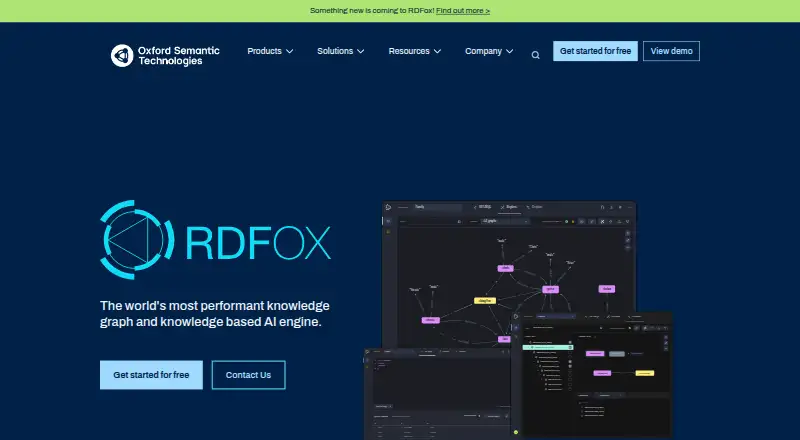
What RDFox is
RDFox is a main-memory data store for centralized RDF graphs, queried with SPARQL 1.1. It supports rules and ontological axioms represented with Datalog, OWL 2, and SWRL, and updates rule consequences as data changes. The product supports RDF, SPARQL 1.1, Datalog, SWRL, OWL 2 RL, and SHACL. It can be integrated into Java applications through a native API or operated as a standalone server through a REST API. Import and export formats include CSV, JSON, N-Triples, Turtle, TriG, and OWL 2 Functional-Style Syntax. RDFox can replicate knowledge and data changes across multiple servers to maintain service during an outage. Oxford Semantic Technologies describes deployments in cloud, on-premises, on-device, and edge environments; supported operating systems are Linux, macOS, and Windows. RDFox v7.0 added encryption at rest and mutual-TLS client-certificate authentication for endpoint and remote-shell requests. Version 7.1 supports OpenID Connect single sign-on. Pricing is available on request. A 30-day evaluation license is free for evaluation and non-commercial use; commercial use requires a license key.
Good
- Supports SPARQL 1.1, Datalog, SWRL, OWL 2 RL, and SHACL.
- Offers native Java and standalone REST APIs.
- Replicates data changes across multiple servers.
- Supports Linux, macOS, and Windows.
Watch out
- Commercial license pricing is available on request.
- Free evaluation license lasts 30 days.
- Evaluation license is for non-commercial use only.
Who it suits
RDFox may suit teams building RDF knowledge-graph systems that need rule-based reasoning, APIs, or deployment across different environments. Its evaluation license is limited to evaluation and non-commercial use.
Verdict
RDFox combines RDF storage, rule-based reasoning, and multiple deployment and integration options. Teams considering commercial use will need to request pricing and a license key.
Plans and prices
From RDFox's own pricing page, checked 15 Oct 2026.
| Plan | Price | What it gives you |
|---|---|---|
| Free evaluation | Free | Free trial access requested through a form · valid license key required |
| RDFox free evaluation license | Free | 30-day trial · evaluation only · non-commercial use |
| AWS Marketplace RDFox | Priced on request | Usage based · ECS/EKS/ECS Anywhere/EKS Anywhere · non-production listing · AWS infrastructure billed separately · $4.11 per container hour |
| RDFox commercial license | Priced on request | License key required · production licensing negotiated · Pricing not published; contact Oxford Semantic Technologies |
The facts
Each one read from RDFox's own pages, with the date it was checked.
What it does
- APIs
- RDFox exposes REST and Java APIs, plus a command-line shell and native Java integration.checked 15 Oct 2026
- AWS availability
- RDFox is offered as a container image through AWS Marketplace for Amazon ECS, EKS, ECS Anywhere and EKS Anywhere.checked 15 Oct 2026
- Containers
- Official RDFox Docker images are designed to run without superuser capabilities.checked 1 Oct 2026
- Data exchange
- The product imports and exports formats including CSV, JSON, N-Triples, Turtle, TriG and OWL 2 Functional-Style Syntax.checked 1 Oct 2026
- Data formats
- Official product pages list CSV, JSON, N-Triples, Turtle, TriG and OWL 2 Functional-Style Syntax among import and export formats.checked 15 Oct 2026
- Data integrations
- Documentation describes delimited files, ODBC relational databases, Apache Lucene and Apache Solr data sources.checked 15 Oct 2026
- Deployment
- RDFox can run on a single machine or as a cluster distributing processing across multiple machines.checked 15 Oct 2026
- Developer APIs
- GetApp lists .NET, Java and Python developer APIs and an ODBC driver for BI tools such as Tableau.checked 15 Oct 2026
- Docker
- Official Docker images are published as oxfordsemantic/rdfox and are designed to run without superuser capabilities.checked 15 Oct 2026
- Documentation depth
- The documentation includes user guides, REST and Java API references, Javadoc, shell instructions, operations manuals, high availability and Docker deployment chapters.checked 15 Oct 2026
- High availability
- RDFox can replicate knowledge and data changes across multiple servers for service continuity during an outage.checked 15 Oct 2026
- Incremental reasoning
- Rule consequences are updated as data changes without restarting or recomputing the entire graph.checked 15 Oct 2026
- Integrations
- RDFox was made available on AWS Marketplace through a DataLens partnership with pay-as-you-go deployment and connectors for SQL, CSV, XML, JSON, REST and unstructured data.checked 1 Oct 2026
- Knowledge graph standards
- Its RDF triple store supports SPARQL 1.1, Datalog, SWRL, OWL 2 RL and SHACL.checked 1 Oct 2026
- License model
- Running RDFox or JRDFox requires an in-date license key issued by Oxford Semantic Technologies.checked 15 Oct 2026
- Limit: concurrency
- One G2 reviewer reports encountering concurrency issues in a project and stopping database upgrades during evaluation.checked 15 Oct 2026
- Limit: documentation
- G2 reviewers say the documentation is technical and would benefit from more concrete command examples, background and tutorial videos.checked 15 Oct 2026
- Limit: standards and query gaps
- G2 reviewers request JSON-LD, SPARQL SERVICE federated queries, DESCRIBE, graph-analysis functions and stronger consistency checking.checked 15 Oct 2026
The company
- Company
- Oxford Semantic Technologies is an Oxford University spin-out acquired by Samsung Electronics in 2024.checked 1 Oct 2026
- Company origin
- Oxford Semantic Technologies was founded in 2017 as a University of Oxford spin-out; work on RDFox began in 2011.checked 15 Oct 2026
- Company ownership
- The company’s About page states that Samsung Electronics acquired Oxford Semantic Technologies in 2024.checked 15 Oct 2026
- Founded
- 2017checked 28 Sep 2026
- Headquarters
- Oxford, United Kingdomchecked 28 Sep 2026
- Headquarters and size
- LinkedIn lists headquarters at 2 Littlegate Street, Oxford, Oxfordshire OX1 1QT, and company size of 11–50 employees.checked 15 Oct 2026
The full review of RDFox
Overview
RDFox is an in-memory store for RDF graphs, pairing SPARQL queries with rule-based reasoning. It is best suited to teams building knowledge-graph applications where new data must quickly update inferred relationships. Its strongest case is fast incremental reasoning; its commercial-license cost requires a direct conversation with Oxford Semantic Technologies.
Key features
RDFox brings graph storage and SPARQL 1.1 querying together with rules and ontological axioms expressed through Datalog, OWL 2 and SWRL. It also supports OWL 2 RL and SHACL. This makes it more than a place to store and retrieve triples: applications can derive consequences from graph data and work with supported knowledge-graph standards.
Incremental reasoning is the clearest differentiator. RDFox updates rule consequences as data changes and can process 2–3 million new-fact inferences per second. That capability suits workloads where incoming facts need to affect the knowledge model promptly; teams should still assess the stated rate against their own rules and data.
Java applications can use a native API, while a RESTful API supports operating RDFox as a standalone server. Import and export support includes CSV, JSON, N-Triples, Turtle, N-Quads, TriG, Datalog and OWL 2 Functional-Style Syntax. Replication across multiple servers helps keep knowledge and data changes available during an outage.
Deployment can be on cloud, on-premises, on-device or at the edge, and RDFox runs on Linux, macOS and Windows. Docker images are designed to run without superuser capabilities. Security capabilities include encryption at rest, mutual TLS client-certificate authentication for endpoint and remote-shell requests, and OpenID Connect single sign-on, including integration with external identity systems such as Microsoft Entra. Encrypted data import and export is supported through Java APIs.
A DataLens partnership made RDFox available through AWS Marketplace with pay-as-you-go deployment and connectors for SQL, CSV, XML, JSON, REST and unstructured data. Oxford Semantic Technologies aims to respond to contact messages within two working days and provides a community Slack channel. The company, founded in 2017 as an Oxford University spin-out, was acquired by Samsung Electronics in 2024.
Pricing
| Plan | Price | Terms |
|---|---|---|
| RDFox free evaluation license | free | 30-day trial; evaluation only; non-commercial use |
| RDFox commercial license | Custom pricing | License key required; contact Oxford Semantic Technologies |
The free license gives teams a month to evaluate RDFox, but it does not permit commercial use. Commercial deployment requires a license key and custom pricing, so it is a poor fit for buyers who need a known per-seat or fixed subscription cost before choosing a system.
Platforms
RDFox supports Linux, macOS and Windows, with API, web and self-hosted options. Its cloud, on-premises, on-device and edge deployment choices accommodate different infrastructure needs, while the Java and REST APIs offer distinct integration paths.
Who it's for
RDFox is a strong candidate for engineering teams building RDF-based applications that need SPARQL querying, standards-based reasoning and frequent updates to inferred knowledge. Its deployment range, replication and integration options are relevant when a graph service must fit existing infrastructure or maintain availability across servers. It is less suitable for an individual or organization seeking unrestricted free commercial use, or for a buyer who must compare transparent license prices before engaging a vendor.
Pros and cons
Pros
- Fast incremental reasoning: Updates to data can flow through rule consequences in real time, with a stated capacity of 2–3 million new-fact inferences per second.
- Broad standards and format support: SPARQL 1.1, Datalog, SWRL, OWL 2 RL and SHACL support varied graph and reasoning workflows.
- Flexible deployment and integration: Linux, macOS and Windows support, multiple deployment settings, and native Java and RESTful APIs give teams several ways to fit RDFox into an application stack.
- Availability and security options: Multi-server replication, encryption at rest, mutual TLS and OpenID Connect address service continuity and access controls.
Cons
- Commercial pricing is not fixed upfront: Buyers must request a quote and obtain a license key, making early cost comparisons harder.
- The free license is only for evaluation: Its 30-day term and non-commercial restriction rule it out as a permanent free option for production use.
Alternatives
Knowledge Graph Software and RDF Databases provide broader category comparisons.
- AllegroGraph is worth considering if a free plan capped at 5 million triples or an enterprise option with customized pricing better matches the project.
- GraphDB is another free-plan option; its free edition is single-core, with a valid license required from GraphDB 11.0.0, while enterprise pricing is custom.
- Protégé is a free, open-source choice for OWL 2 ontology work on desktop or the web.
- RDF Studio offers a free semantic data workspace with no stated price or usage limits.
- TypeDB may suit teams seeking a managed dedicated database server; its Explore plan includes 10 GB storage, 8 GB RAM and 2 vCPUs.
- Eclipse RDF4J is a free, open-source Java framework; its latest release requires Java 25 or newer.
- QLever is a free option released under the Apache 2.0 license.
- Stardog is another option to compare for graph database needs.
Verdict
Choose RDFox if your team needs RDF storage with fast, continuously updated reasoning, and values multiple deployment and integration routes. Its technical strengths are clearest for applications where fresh facts must quickly change inferred knowledge. Look elsewhere if commercial cost transparency or a free production license is essential: evaluation is limited to 30 days and commercial use requires a custom quote and license key.
Getting started
- Open the RDFox website
- Request a commercial license from Oxford Semantic Technologies
- Use the 30-day free evaluation license for evaluation or non-commercial use
- Deploy on Linux, macOS or Windows, or in cloud, on-premises, on-device or edge environments
- Connect Java applications through the native API or operate a standalone server with REST
Limits worth knowing
The free RDFox evaluation license lasts 30 days and is restricted to evaluation and non-commercial use. Commercial use requires a license key and contact with Oxford Semantic Technologies.
Questions
Is RDFox free?
A free evaluation license costs 0.00 USD and lasts 30 days for evaluation and non-commercial use. Commercial pricing is available by request.
Which platforms does RDFox support?
RDFox runs on Linux, macOS and Windows, with deployments described for cloud, on-premises, on-device and edge environments.
Which query language does it use?
RDFox queries RDF graph data with SPARQL 1.1.
Can RDFox integrate with applications?
Java applications can connect through a native API, and a RESTful API can operate RDFox as a standalone server.
Does RDFox support single sign-on?
Yes. RDFox supports OpenID Connect single sign-on, including external identity systems such as Microsoft Entra.
Alternatives to RDFox
- 1
Virtuoso Universal Server
Open sourceWebAPILinuxmacOS7.9From $99.99 a year - 2

Stardog
Free planAndroidiOSWebAPI7.7Free plan - 3
Eclipse RDF4J
Free planOpen sourceWebAPILinuxmacOS7.6Free plan - 4
Apache Jena Fuseki
Free planOpen sourceWebAPILinuxSelf-hosted7.5Free plan - 5

GraphDB
Free planWebAPILinuxmacOS6.6Free plan - 6

Fluree DB
Free planWebAPILinuxmacOS6.5Free plan