Protégé
Protégé is a free ontology editor for building and managing ontologies, available as the desktop application Protégé Desktop and the browser-based WebProtégé.
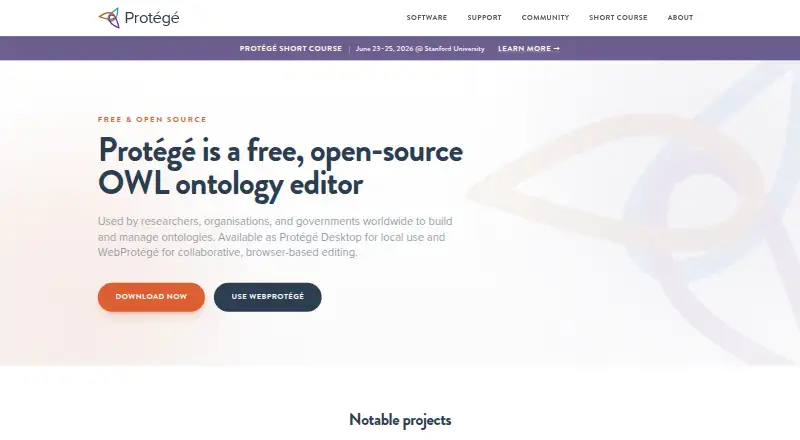
What Protégé is
Protégé is a free ontology editor for building and managing ontologies, available as the desktop application Protégé Desktop and the browser-based WebProtégé. Both editions support OWL 2 and are described as cross-compatible. WebProtégé supports collaborative viewing and editing, with sharing, permissions, threaded discussions, watches, email notifications, and revision history. Ontologies can be uploaded and downloaded in formats including RDF/XML, Turtle, OWL/XML, and OBO. Protégé Desktop connects directly to description logic reasoners such as HermiT and Pellet. It can hold multiple ontologies in one workspace and offers structure visualization, inference explanations, and refactoring operations. Desktop is written in Java and supports plug-ins. The project offers free support through mailing lists monitored by team members and experienced community users; users must subscribe before posting. Its documentation includes FAQs, tutorials, user guides, and developer documentation. The project says it is used by researchers, organisations, and governments worldwide.
Good
- Both editions support OWL 2.
- WebProtégé includes collaborative editing and revision history.
- Desktop connects to HermiT and Pellet reasoners.
- Desktop supports plug-ins.
- Free support and documentation are available.
Watch out
- Mailing-list users must subscribe before posting.
- WebProtégé and Desktop have different feature sets.
Who it suits
Protégé suits researchers and other users who need to create or manage ontologies with OWL 2. WebProtégé is suited to collaborative editing, while the desktop edition offers direct connections to description logic reasoners.
Verdict
Protégé offers both a collaborative browser editor and a desktop ontology workspace, with free access and support. Choose an edition based on whether collaboration or desktop reasoning tools matter more.
Plans and prices
From Protégé's own pricing page, checked 15 Oct 2026.
| Plan | Price | What it gives you |
|---|---|---|
| Protégé Desktop and WebProtégé | Free | Desktop requires Java · WebProtégé runs in a browser · OWL 2 ontology editing |
The facts
Each one read from Protégé's own pages, with the date it was checked.
What it does
- Collaboration
- WebProtégé provides sharing, permissions, threaded discussions, watches, email notifications, and revision history.checked 15 Oct 2026
- Cross compatibility
- WebProtégé and Protégé Desktop are described as cross compatible with each other.checked 30 Sep 2026
- Current release
- The official site lists Protégé Desktop version 5.6.9.checked 15 Oct 2026
- Desktop editor
- Protégé Desktop is a standalone application for editing multiple ontologies in one workspace.checked 15 Oct 2026
- Desktop reasoning
- Protégé Desktop connects directly to description logic reasoners including HermiT and Pellet.checked 30 Sep 2026
- Desktop tools
- Protégé Desktop supports multiple ontologies in one workspace, ontology structure visualization, inference explanations, and refactoring operations.checked 30 Sep 2026
- Developer API
- The WebProtégé repository contains separate server API, client, CLI, and core modules.checked 15 Oct 2026
- Documentation
- Protégé documentation includes FAQs, tutorials, user guides, and developer documentation.checked 30 Sep 2026
- Documentation depth
- Official documentation includes installation, getting started, views, menus, class-expression syntax, FAQs, tutorials, user guides, and developer documentation.checked 15 Oct 2026
- Editions
- Protégé is available as the desktop application Protégé Desktop and the browser based editor WebProtégé.checked 30 Sep 2026
- Extensibility
- Protégé Desktop is written in Java and uses a plug-in architecture for extensions.checked 30 Sep 2026
- File formats
- WebProtégé ontologies can be uploaded and downloaded in RDF/XML, Turtle, OWL/XML, OBO, and other formats.checked 30 Sep 2026
- History
- The project began at Stanford in the 1980s as Mark Musen’s doctoral research and has been developed for more than three decades.checked 15 Oct 2026
- Import and export
- WebProtégé supports ontology upload and download in RDF/XML, Turtle, OWL/XML, OBO, and other formats.checked 15 Oct 2026
- Independent comparison
- A comparative academic paper evaluates Protégé alongside Swoop, Vitro, and Fluent as ontology-building tools for Semantic Web work.checked 15 Oct 2026
- Independent description
- Wikipedia identifies Protégé as Java software for Linux, Mac OS X, and Windows with a BSD 2-Clause license and plug-in framework.checked 15 Oct 2026
- Java requirement
- The platform-independent desktop download requires Java.checked 15 Oct 2026
- License
- Protégé Desktop is released under the BSD 2-Clause license.checked 15 Oct 2026
- Limit: community criticism
- Hacker News commenters criticized perceived bugs, limited modernization, and a tendency to hand-edit Turtle instead of using Protégé for advanced work.checked 15 Oct 2026
- Limit: integration effort
- A G2 reviewer reported that Active Directory integration required support assistance and that hardware and software can be expensive.checked 15 Oct 2026
- Limit: interface and queries
- G2 feedback cites search queries, alarm triggers, and needing different plug-ins for different tasks as pain points.checked 15 Oct 2026
- Limit: technical complexity
- G2 feedback says the product can feel too technical and that adding extensions may be difficult.checked 15 Oct 2026
- Limit: usability research
- A usability study found Protégé less easy to use than two comparison editors and called for better contextual help, simpler terminology, and richer navigation and filtering.checked 15 Oct 2026
- Maintainer
- Protégé Desktop is community maintained, with Damien Goutte-Gattat identified as its current primary maintainer.checked 30 Sep 2026
The full review of Protégé
Protégé is an ontology editor for building and managing OWL 2 ontologies, with a browser edition for shared work and a desktop edition for ontology management. It suits researchers and teams who need to model semantic data and move between collaborative editing and desktop reasoning. Its strengths are the complementary editions and free access; choose another tool if you need a dedicated knowledge-graph platform or commercial support.
Overview
WebProtégé and Protégé Desktop support OWL 2 and are cross-compatible, giving users a way to share work in the browser and continue in the desktop workspace. The distinction matters: collaboration features are concentrated in WebProtégé, while the desktop edition provides the richer reasoning and refactoring toolkit. Protégé is therefore a good fit when those workflows can complement each other, but less convenient if a team expects every capability in one interface.
Key features
WebProtégé supports collaborative viewing and editing, sharing, permissions, threaded discussions, watches, email notifications and revision history. Together, these features help teams coordinate ontology changes and keep track of activity without relying only on exchanged files. It can upload and download ontologies in RDF/XML, Turtle, OWL/XML, OBO and other formats, which supports work across common ontology formats.
Protégé Desktop connects directly to description logic reasoners including HermiT and Pellet. It also supports multiple ontologies in one workspace, ontology structure visualization, inference explanations and refactoring. Those tools make Desktop the better choice for users who need to examine and manage ontology structure or work with reasoning; WebProtégé is the more suitable edition for browser-based collaboration.
Desktop is written in Java and uses a plug-in architecture, allowing extensions. Documentation includes FAQs, tutorials, user guides and developer documentation. Free support is offered through mailing lists monitored by team members and experienced community users, but users must subscribe before posting; that is useful community support, not a commercial support contract.
Pricing
Protégé Desktop and WebProtégé are free and open source, with OWL 2 support. The plan costs nothing, and there is no free trial because access is already free. Researchers, students and organizations can use both editions without a paid tier or trial deadline. The main trade-off is support: help comes through mailing lists, and posting requires a subscription.
Platforms
Protégé is available on Linux, macOS, Windows and the web. The browser edition supports collaborative work, while the desktop application supplies its ontology-management and reasoning tools. Protégé supports ontology modeling, semantic reasoning, RDF/SPARQL support, graph visualization and SPARQL queries, with deployment options for both desktop and web workflows.
Who it's for
Protégé is aimed at ontology builders, researchers and teams that need OWL 2 modeling, semantic reasoning or shared ontology work. Its use by researchers, organizations and governments worldwide makes it a credible option for institutional as well as individual projects. Teams that need shared review and change tracking can use WebProtégé; users focused on reasoning, inference explanations or refactoring have a stronger reason to use Desktop. The split is a limitation for anyone who wants one edition to handle both sets of work equally.
Pros and cons
- Pros: Both editions support OWL 2 and are cross-compatible, so work can move between browser collaboration and desktop tools.
- Pros: WebProtégé combines shared editing with permissions, discussions, watches, notifications and revision history, useful for coordinating changes.
- Pros: Desktop connects to HermiT and Pellet and includes visualization, inference explanations and refactoring for ontology work.
- Pros: Free, open-source access, multiple import and export formats, and a desktop plug-in architecture give users room to work and extend the application without a paid plan.
- Cons: Collaboration and the richer desktop reasoning tools are divided between editions, so the best workflow may require switching between them.
- Cons: Support is through mailing lists rather than a commercial contract, and users must subscribe before posting.
Alternatives
For readers comparing knowledge-graph tools, see Knowledge Graph Software.
- AllegroGraph may suit readers who want a platform with a free tier capped at 5 Million Triples or an enterprise option with custom pricing.
- GraphDB is another option with a free single-core license; GraphDB 11.0.0 and later requires a valid license for its free plan.
- RDFox may fit users who want to evaluate a paid product through a 30-day free evaluation license, limited to evaluation and non-commercial use.
- RDF Studio is a free semantic data workspace for readers seeking that kind of workspace instead.
- TypeDB may suit readers who want a fully managed dedicated database server, with its free Explore plan including 10 GB storage, 8 GB RAM and 2 vCPUs.
- Eclipse RDF4J is a free open-source Java framework; its latest release requires Java 25 or newer.
- QLever is a free open-source option under the Apache 2.0 license.
- Stardog may suit readers who want a free renewable one-year license, with limits of 1 million stored edges and 3 databases.
Verdict
Choose Protégé if you need a free OWL 2 ontology editor and value the option to collaborate in WebProtégé or use Desktop’s reasoning and ontology-management tools. Its cross-compatible editions, format support and desktop extensions make it a strong fit for ontology-focused work. Look elsewhere if you need a unified interface for collaboration and advanced desktop work, or require commercial support.
Alternatives to Protégé
- 1
Virtuoso Universal Server
Open sourceWebAPILinuxmacOS7.9From $99.99 a year - 2

Mendix
Free planAndroidiOSWebLinux7.8From $1,090 a month - 3

RDFox
Free planWebAPILinuxmacOS7.8Free plan - 4

Stardog
Free planAndroidiOSWebAPI7.7Free plan - 5
Eclipse RDF4J
Free planOpen sourceWebAPILinuxmacOS7.6Free plan - 6
Apache Jena Fuseki
Free planOpen sourceWebAPILinuxSelf-hosted7.5Free plan