QLever
QLever is an open-source graph database for loading and querying large RDF datasets.
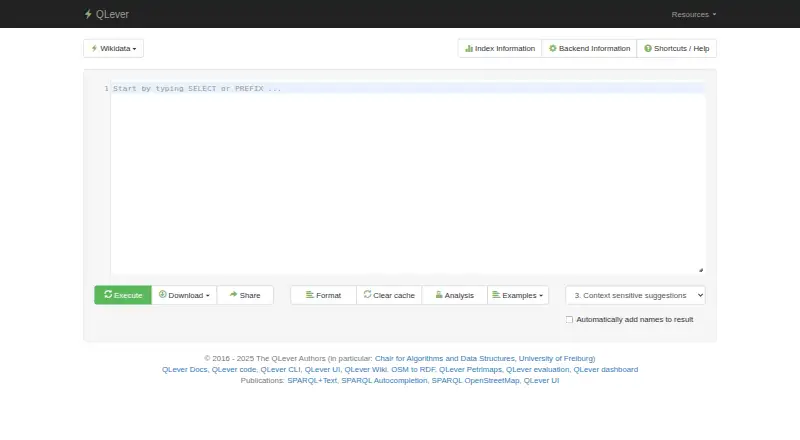
What QLever is
QLever is an open-source graph database for loading and querying large RDF datasets. It implements SPARQL 1.1, including federated queries, named graphs, the Graph Store HTTP Protocol and updates. The project says it can scale beyond a trillion triples on a single commodity machine. Other capabilities include text search over knowledge bases, context-sensitive SPARQL autocompletion and live query analysis. QLever also supports spatial queries and interactive map visualisation of many geometric objects, and it can run embedded inside C++ code without a client-server setup. Example datasets include Wikidata, Wikimedia Commons, OpenStreetMap, UniProt, PubChem and DBLP. It is self-hosted, with official packages for Debian, Ubuntu, Ubuntu-derived distributions and macOS, as well as Docker and Podman images. The Homebrew package is for ARM64 Apple Silicon Macs; Intel Macs are not supported by that package. On Windows, the documentation describes running Docker in a virtual machine, which may involve significant performance and RAM costs. QLever is free under the Apache 2.0 license.
Good
- Implements SPARQL 1.1 and federated queries.
- Includes text search and query autocompletion.
- Supports spatial queries and interactive map views.
- Can be embedded in C++ code.
- Free under the Apache 2.0 license.
Watch out
- Official Homebrew package does not support Intel Macs.
- Windows use requires Docker inside a virtual machine.
- Windows virtualisation may incur performance and RAM costs.
Who it suits
QLever suits developers and data teams working with large RDF datasets and SPARQL queries. Its embedded C++ option may fit applications that need a graph database without a client-server setup.
Verdict
QLever offers SPARQL querying alongside text and spatial features, with self-hosted and embedded deployment options. Check its platform constraints, especially the Windows virtual-machine requirement and Homebrew’s ARM64-only support.
Plans and prices
From QLever's own pricing page, checked 5 Oct 2026.
| Plan | Price | What it gives you |
|---|---|---|
| QLever | Free | Open-source software · Apache 2.0 license |
The facts
Each one read from QLever's own pages, with the date it was checked.
What it does
- Dataset examples
- The project lists demos for Wikidata, Wikimedia Commons, OpenStreetMap, UniProt, PubChem, and DBLP.checked 5 Oct 2026
- Embedded use
- QLever can run as an embedded database inside C++ code without a client-server setup.checked 5 Oct 2026
- Installation
- Official packages are available for Debian, Ubuntu, Ubuntu-derived distributions, and macOS; Docker and Podman images are also available.checked 5 Oct 2026
- Integrations
- The QLever UI exposes backend API URLs and offers query access via GET and POST examples using curl.checked 5 Oct 2026
- Query assistance
- QLever provides context-sensitive autocompletion for SPARQL queries and live query analysis.checked 5 Oct 2026
- Scale
- The project says QLever scales to more than a trillion triples on a single commodity machine.checked 5 Oct 2026
- Security and compliance
- The opened maker pages identify the Apache 2.0 license but do not state a security certification or compliance program.checked 5 Oct 2026
- SPARQL support
- QLever implements SPARQL 1.1, including federated queries, named graphs, the Graph Store HTTP Protocol, and updates.checked 5 Oct 2026
- Spatial features
- QLever supports efficient spatial queries and interactive map visualization of large numbers of geometric objects.checked 5 Oct 2026
- Support
- For bugs or missing features, the project asks users to search existing GitHub issues or open an issue or discussion.checked 5 Oct 2026
- Text search
- QLever includes text search over knowledge bases.checked 5 Oct 2026
- What it does
- QLever is a graph database implementing RDF and SPARQL for loading and querying large datasets.checked 5 Oct 2026
The company
- Headquarters
- Freiburg, Germanychecked 28 Sep 2026
Where it runs
- macOS limit
- The official Homebrew package supports ARM64 Apple Silicon Macs; Intel Macs are not supported by that package.checked 5 Oct 2026
- Windows limit
- The documentation says Windows use runs Docker inside a virtual machine and may incur significant performance and RAM costs; binary releases are in progress.checked 5 Oct 2026
The full review of QLever
QLever is an open-source RDF graph database for loading and querying large datasets with SPARQL. It is best suited to teams that want to run their own knowledge-graph infrastructure or embed a database in C++.
Its mix of federated queries, text search and spatial capabilities makes it a capable option for demanding graph workloads, though Windows users face a costly virtual-machine setup and Homebrew supports only Apple Silicon.
Overview
QLever implements SPARQL 1.1 for RDF data, including federated queries, named graphs, updates and the Graph Store HTTP Protocol. The project says it can handle more than a trillion triples on one commodity machine, making it worth considering for large self-hosted datasets. That is a project-stated scale, not a reason to overlook the operational work of running the database yourself.
For C++ applications, QLever can run as an embedded database without a client-server setup. That is a useful deployment choice for software built around C++; teams seeking a managed hosted service should look elsewhere.
Key features
- Federated SPARQL: Federation, named graphs, updates and the Graph Store HTTP Protocol cover a broad range of RDF workflows, including queries that draw on multiple sources.
- Text search and query assistance: Search across knowledge bases, with context-sensitive SPARQL autocompletion and live query analysis to help compose and inspect queries.
- Spatial querying: Efficient spatial queries and interactive maps of many geometric objects make QLever relevant to workloads that combine knowledge graphs and geographic data.
- RDF loading: Supported formats include Turtle (TTL), N-Triples (NT) and N-Quads (NQ). Demos cover Wikidata, Wikimedia Commons, OpenStreetMap, UniProt, PubChem and DBLP.
- API access: The UI exposes backend API URLs and provides GET and POST query examples using curl, giving developers a direct route to query integration.
Pricing
QLever is free and open source under the Apache 2.0 license. The QLever plan costs nothing. There is no paid tier or seat-based pricing in this plan; users take on the deployment and maintenance of self-hosted software instead.
Platforms
QLever supports Linux, macOS, Windows, web and API use, with self-hosting as its deployment option. Official packages cover Debian, Ubuntu, Ubuntu-derived distributions and macOS; Docker and Podman images offer additional installation routes.
The platform labels do not mean Windows installation is straightforward: the documented approach runs Docker inside a virtual machine, which can consume significant memory and reduce performance. Binary releases are in progress. On macOS, the official Homebrew package supports ARM64 Apple Silicon only, not Intel Macs.
Who it's for
QLever fits developers and organizations building large RDF knowledge bases who need SPARQL federation, text search or spatial queries and are prepared to host the database. Its embedded C++ mode is a particular draw for applications that need database functionality within the program itself.
It is a weaker fit for users who want managed hosting, or for Windows users who cannot absorb the virtual machine's performance and RAM costs. For bugs or missing features, the project directs users to search GitHub issues or open an issue or discussion.
Pros and cons
- Pro: Broad SPARQL 1.1 support, including federation, updates and named graphs, suits varied RDF workloads.
- Pro: Text search and spatial querying extend its usefulness beyond basic graph queries.
- Pro: Self-hosted and embedded C++ deployment options serve different application architectures.
- Con: Windows use requires Docker inside a virtual machine, with potentially significant performance and memory costs.
- Con: The official Homebrew package excludes Intel Macs.
- Con: Self-hosting means users must run and maintain their own deployment.
Alternatives
Explore the RDF Databases and Knowledge Graph Software categories to compare options.
- Fluree DB is another free, open-source option with native JSON-LD and SPARQL, runnable locally or self-hosted.
- GraphDB offers a free tier with one query in parallel and up to five repositories; consider it if those limits suit your workload.
- Eclipse RDF4J is a free open-source Java framework; its latest release requires Java 25 or newer.
- RDFox offers a 30-day, non-commercial evaluation license, with a commercial license available at custom pricing.
- Stardog has a free, renewable one-year license capped at one million stored edges and three databases, without high availability.
- Tentris offers a community plan with single-core licensing and in-memory storage.
- Apache Jena Fuseki is a free Apache 2.0 self-hosted server.
- RedStore is a free, GPL-3.0-or-later self-hosted option.
Verdict
Choose QLever if you need a free, self-hosted RDF engine with substantial SPARQL support, spatial features or an embedded C++ option. Its main advantage is that breadth at no license cost; its main reason to look elsewhere is the operational burden, particularly the Windows virtual-machine requirement.
Alternatives to QLever
- 1
Virtuoso Universal Server
Open sourceWebAPILinuxmacOS7.9From $99.99 a year - 2

RDFox
Free planWebAPILinuxmacOS7.8Free plan - 3

Stardog
Free planAndroidiOSWebAPI7.7Free plan - 4
Eclipse RDF4J
Free planOpen sourceWebAPILinuxmacOS7.6Free plan - 5
Apache Jena Fuseki
Free planOpen sourceWebAPILinuxSelf-hosted7.5Free plan - 6

GraphDB
Free planWebAPILinuxmacOS6.6Free plan