
Fluree DB
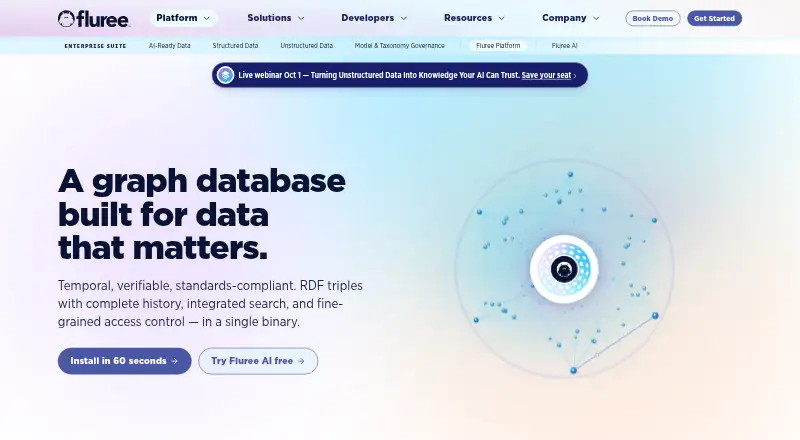
Fluree DB is a graph database built on RDF triples, combining temporal history, verifiable transactions, search, and fine-grained access controls in a single…
What Fluree DB is
Fluree DB is a graph database built on RDF triples, combining temporal history, verifiable transactions, search, and fine-grained access controls in a single binary. Each transaction is cryptographically signed and added to an immutable ledger, and the full history can be queried. Its search capabilities include full-text and vector search alongside graph data and time-travel queries. Attribute-, role-, and relationship-based policies are evaluated at query time down to individual triples. Fluree is based on W3C standards such as JSON-LD, RDF, SPARQL, OWL, and SHACL; listed capabilities include SPARQL 1.1, reasoning, RDF-star, and federated queries. Interfaces include SPARQL, FlureeQL, REST, MCP server configuration, LangChain, and LlamaIndex; official SDKs are listed for JavaScript/TypeScript, Python, and Java. It runs as a static binary without a JVM or external dependencies, with Docker, Homebrew, shell, PowerShell, and source-build options. Free options include FlureeDB Open Source and Fluree AI. The Business Source License 1.1 applies, with commercial licensing available by contacting Fluree.
Good
- Full transaction history is queryable.
- Policies apply down to individual triples.
- Supports graph, full-text, and vector search.
- Runs as a static binary without a JVM.
Watch out
- Commercial licensing requires contacting Fluree.
- Enterprise plan pricing is custom and not listed.
- HIPAA support is tied to Enterprise plans and a BAA.
Who it suits
Fluree DB is suited to developers and teams working with graph data, temporal records, and granular access policies. Its APIs, SDKs, integrations, and deployment options may suit projects with varied data sources or environments.
Verdict
Fluree DB combines graph data, verifiable history, search, and query-time policies, with standards-based interfaces and a range of connectors. Review its Business Source License and deployment requirements, and contact Fluree for commercial licensing or Enterprise pricing.
Plans and prices
From Fluree DB's own pricing page, checked 30 Sep 2026.
| Plan | Price | What it gives you |
|---|---|---|
| Fluree AI | Free | Free fuel allowance · Fuel covers tokens, storage & compute · 300+ connectors, MCP & API access · $0 to start |
| FlureeDB Open Source | Free | Open source on GitHub · Native JSON-LD + SPARQL · Run locally or self-host · Free |
| Enterprise | Priced on request | Fluree Sense, CAM & ITM · Licensed FlureeDB deployments · Single-tenant AWS & private deployment · SSO, SLAs & enterprise support · Custom |
The facts
Each one read from Fluree DB's own pages, with the date it was checked.
What it does
- Audit and support
- Every query, mutation and policy evaluation is captured in a tamper-evident log; enterprise plans can integrate Splunk, Datadog and Elastic, and vulnerability reports receive a response within one business day.checked 30 Sep 2026
- Compliance
- Fluree says its architecture supports SOC 2, ISO 27001, HIPAA under a BAA on Enterprise plans, and GDPR/UK GDPR via EU data residency; SOC 2 Type II attestation is in progress for Q3 2026.checked 30 Sep 2026
- Core database
- Fluree Core is a temporal, verifiable, standards-compliant graph database using RDF triples, complete history, integrated search and fine-grained access control in a single binary.checked 30 Sep 2026
- Data policies
- Attribute-based, role-based and relationship-based policies are evaluated at query time at individual-triple granularity.checked 30 Sep 2026
- Deployment
- Fluree DB is distributed as a single static binary with no JVM or external dependencies, and can run through Docker, Homebrew, shell installation, PowerShell or source builds.checked 30 Sep 2026
- Developer interfaces
- Fluree provides SPARQL, FlureeQL, a REST API, MCP server configuration, LangChain integration and a LlamaIndex connector.checked 30 Sep 2026
- Encryption
- Managed deployments encrypt data in transit with TLS 1.2+ and at rest with AES-256, and support customer-managed keys through AWS KMS, GCP Cloud KMS and Azure Key Vault.checked 30 Sep 2026
- Immutable ledger
- Every transaction is cryptographically signed and appended to an immutable ledger, with full temporal history queryable.checked 30 Sep 2026
- Integrations
- Connectors cover PostgreSQL, MySQL, SQL Server, Oracle, MongoDB, Salesforce, HubSpot, ServiceNow, Workday, SAP, Snowflake, Databricks, BigQuery and REST APIs.checked 30 Sep 2026
- License
- Fluree is available under the Business Source License 1.1, with commercial licensing available by contacting Fluree.checked 30 Sep 2026
- SDKs
- Official SDKs and libraries are listed for JavaScript/TypeScript, Python and Java.checked 30 Sep 2026
- Search capabilities
- Fluree DB provides full-text and vector search alongside graph data and time travel.checked 30 Sep 2026
- Standards
- Fluree is built on W3C standards including JSON-LD, RDF, SPARQL, OWL and SHACL.checked 30 Sep 2026
The company
- Headquarters
- Winston-Salem, North Carolina, USAchecked 28 Sep 2026
The full review of Fluree DB
Fluree DB is a graph database for applications that need linked data, searchable history and precise access rules together. It is best suited to teams building data-rich systems where provenance and query-time control matter; its standards support and single-binary deployment are appealing, but its Business Source License 1.1 calls for careful review.
Overview
Fluree Core brings RDF graph data, full temporal history, integrated search and access control into one database. Transactions are cryptographically signed and added to an immutable ledger, and the resulting history remains queryable. That makes Fluree a strong fit when applications need to examine how data changed over time, rather than maintain history as a separate concern.
Access policies can be attribute-, role- or relationship-based, evaluated at query time down to individual triples. This fine-grained control can help applications expose different parts of a graph to different users, but it also makes policy design an important part of the data architecture. Fluree uses W3C standards including JSON-LD, RDF, SPARQL, OWL and SHACL; it supports SPARQL 1.1, reasoning, RDF-star and federated queries.
Key features
- Verifiable temporal data: Signed transactions and an immutable ledger preserve a queryable history, useful for provenance and time-based questions.
- Graph, full-text and vector search: Search works alongside graph data and time travel, reducing the need to treat those capabilities as separate parts of the system.
- Query-time policies: Attribute-, role- and relationship-based rules apply at individual-triple granularity. The precision is valuable for differentiated access, though teams must account for policy design and upkeep.
- Developer interfaces: SPARQL, FlureeQL and a REST API sit alongside MCP server configuration, LangChain integration and a LlamaIndex connector. Official SDKs and libraries cover JavaScript/TypeScript, Python and Java.
- Connectors: Integrations cover PostgreSQL, MySQL, SQL Server, Oracle, MongoDB, Salesforce, HubSpot, ServiceNow, Workday, SAP, Snowflake, Databricks, BigQuery and REST APIs, offering routes to connect Fluree with established data systems.
- Deployment and security: The static binary has no JVM or external dependencies and can be installed through Docker, Homebrew, shell installation, PowerShell or source builds. Managed deployments use TLS 1.2+ in transit and AES-256 at rest, with customer-managed keys through AWS KMS, GCP Cloud KMS and Azure Key Vault.
- Audit and compliance: Queries, mutations and policy evaluations enter a tamper-evident log; Enterprise plans can integrate Splunk, Datadog and Elastic. Fluree says its architecture supports SOC 2, ISO 27001, HIPAA under a BAA on Enterprise plans, and GDPR/UK GDPR via EU data residency. SOC 2 Type II attestation is in progress for Q3 2026; organizations with compliance requirements should assess their own obligations and the applicable plan.
Pricing
Fluree has two free entry points and a custom-priced Enterprise plan. The free options lower the barrier to evaluation, while commercial licensing and production deployment requirements should be considered separately.
- FlureeDB Open Source — free: Open source on GitHub, native JSON-LD and SPARQL, and local or self-hosted operation. A fit for developers who want to run the database themselves; it is under the Business Source License 1.1, with commercial licensing available by contacting Fluree.
- Fluree AI — free: Starts at $0, with a free fuel allowance covering tokens, storage and compute, plus 300+ connectors and MCP and API access. The allowance is a defined fuel pool, so teams should assess whether it suits their intended usage.
- Enterprise — custom pricing: Includes Fluree Sense, CAM and ITM, licensed FlureeDB deployments, single-tenant AWS and private deployment, SSO, SLAs and enterprise support. This is the option for organizations requiring those deployment and support arrangements; pricing is custom.
Every vulnerability report receives a response within one business day. That response commitment is useful for security reporting, though it is not a substitute for the support arrangements included with Enterprise.
Platforms
Fluree supports API, Linux, macOS, self-hosted, web and Windows environments. Its static-binary distribution and multiple installation routes suit teams that want deployment flexibility without a JVM dependency.
Who it's for
Fluree is a good choice for teams building graph-based applications that need verifiable history, search and fine-grained policies in one system, particularly when standards-based interfaces and integration connectors matter. It is less suitable for buyers who want a conventional open-source license without reviewing the Business Source License, or who require Enterprise features but cannot accept custom pricing.
Pros and cons
- Pro: The signed, immutable ledger keeps full history queryable, supporting applications where provenance and past states matter.
- Pro: Fine-grained policies, graph data and full-text and vector search are combined in the core database.
- Pro: W3C standards, multiple query interfaces, SDKs and broad connector coverage offer varied ways to integrate Fluree.
- Pro: A static binary without a JVM or external dependencies can simplify deployment across supported environments.
- Con: The Business Source License 1.1 means teams should confirm that its terms fit their intended use; commercial licensing requires contacting Fluree.
- Con: Enterprise pricing is custom, making that plan a less straightforward option for buyers needing predictable published costs.
- Con: Fine-grained access control depends on deliberate policy design, adding a responsibility for teams managing complex data access.
Alternatives
RDF Databases is a useful category view for comparing other RDF options. Consider these alternatives when their licensing, scope or stated limits better match your requirements:
- Eclipse RDF4J is a free, open-source Java framework; choose it if that framework model suits your project and Java 25 or newer is acceptable for the latest release.
- GraphDB offers a free plan with a Lucene connector, five repositories and one parallel query; choose it if those stated limits fit your workload.
- RDFox offers a 30-day evaluation license for non-commercial use and a commercial license; choose it if a time-limited evaluation or its commercial licensing path better fits.
- Apache Jena Fuseki is a self-hosted server under Apache License 2.0; choose it if that license and server approach are a better match.
- Stardog has a free plan with a renewable one-year license, up to 1 million stored edges, three databases and community support; choose it if those caps and terms meet your needs.
- Tentris offers a community plan with a single-core license, in-memory storage, community support, SPARQL 1.1, RDF 1.1 and transactions; choose it if that scope matches your use case.
- AllegroGraph has a free edition with no expiration date or license key requirement, capped at 5,000,000 triples; choose it if that limit suits your project.
- Dydra offers a basic-use plan with limited resources and public evaluation accounts capped at five queries per second and one million statements per repository; choose it if those evaluation limits fit.
Verdict
Choose Fluree DB if your application needs a standards-based graph database that preserves verifiable history while combining search and fine-grained access control. Its integrated capabilities and deployment flexibility make a persuasive case for provenance-heavy systems. Look elsewhere if the Business Source License does not fit your use, or if you need Enterprise capabilities at a published price.
Getting started
- Visit https://flur.ee/platform/core.
- Choose FlureeDB Open Source or Fluree AI, both listed as free.
- For FlureeDB Open Source, use the GitHub option and run locally or self-host.
- Install through Docker, Homebrew, shell, PowerShell, or a source build.
- Connect through SPARQL, FlureeQL, or the REST API; SDKs are listed for JavaScript/TypeScript, Python, and Java.
Limits worth knowing
Fluree AI's free plan includes a free fuel allowance covering tokens, storage, and compute. Enterprise is billed at a custom price; no specific Enterprise amount is given.
Questions
Is Fluree DB free?
Yes. FlureeDB Open Source is listed as free, and Fluree AI is also listed as free.
What platforms does it support?
Listed platforms are API, Linux, macOS, self-hosted, web, and Windows.
What license does Fluree use?
Fluree is available under the Business Source License 1.1. Commercial licensing is available by contacting Fluree.
What plans are available?
The listed plans are FlureeDB Open Source, Fluree AI, and Enterprise. Enterprise is billed at a custom price.
What integrations are available?
Connectors cover PostgreSQL, MySQL, SQL Server, Oracle, MongoDB, Salesforce, HubSpot, ServiceNow, Workday, SAP, Snowflake, Databricks, BigQuery, and REST APIs.
Which developer interfaces and SDKs are listed?
Interfaces include SPARQL, FlureeQL, REST API, MCP server configuration, LangChain, and a LlamaIndex connector. Official SDKs and libraries are listed for JavaScript/TypeScript, Python, and Java.
Alternatives to Fluree DB
- 1
Virtuoso Universal Server
Open sourceWebAPILinuxmacOS7.9From $99.99 a year - 2

RDFox
Free planWebAPILinuxmacOS7.8Free plan - 3

Stardog
Free planAndroidiOSWebAPI7.7Free plan - 4
Eclipse RDF4J
Free planOpen sourceWebAPILinuxmacOS7.6Free plan - 5
Apache Jena Fuseki
Free planOpen sourceWebAPILinuxSelf-hosted7.5Free plan - 6

GraphDB
Free planWebAPILinuxmacOS6.6Free plan