Optymyze
Optymyze is a no-code SaaS platform for managing enterprise sales performance, including commissions, quotas, territories and objectives.
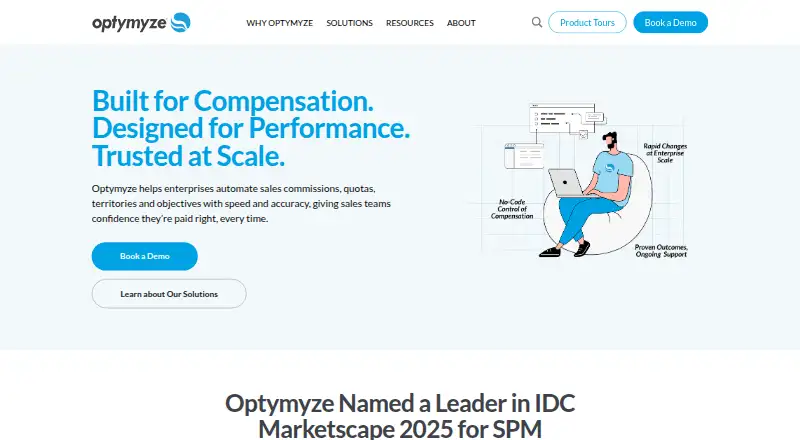
What Optymyze is
Optymyze is a no-code SaaS platform for managing enterprise sales performance, including commissions, quotas, territories and objectives. It automates commissions, bonuses and variable pay, with payout visibility for sales and finance teams. Teams can assign quotas, adjust them during a cycle, redesign territories and align territory rules with crediting. It also supports objectives, SPIFFs and contests, with results connected to compensation. Its data engine connects to CRM, ERP, HRIS and API sources to cleanse, transform and process large record sets. The maker lists more than 50 native connectors, including Salesforce, HubSpot, Marketo, Workday, Stripe and Chargebee, and REST APIs secured with OAuth 2.0. Security controls include encryption, SSO, role-based access and audit logs. The platform supports Android, iOS, web and API access; applications built on it are available on web and mobile without separate development. Pricing is on request, and the site directs visitors to book a demo.
Good
- Automates commissions, quotas, territories and objectives
- Payout visibility for sales and finance teams
- More than 50 native connectors
- REST APIs use OAuth 2.0
- Includes configurable retention and audit logs
Watch out
- Pricing is available on request
- Cloud storage is provisioned per customer contract
Who it suits
Optymyze is aimed at scaling teams, complex enterprises, global organizations and evolving businesses managing direct or indirect sales. It also serves organizations across industries such as insurance, life sciences, banking, SaaS and manufacturing.
Verdict
Optymyze brings compensation, quota and territory processes into a no-code enterprise platform. Organizations should contact the company for pricing and to discuss storage capacity and implementation needs.
The facts
Each one read from Optymyze's own pages, with the date it was checked.
What it does
- APIs
- Optymyze exposes REST APIs for compensation data, hierarchies, plan configuration, calculation runs, reports, and platform metadata, with OAuth 2.0 authentication.checked 30 Sep 2026
- Audience
- The platform supports direct sellers, channel partners, brokers, distributors and other indirect sellers across industries including insurance, pharmaceutical and life sciences, banking, SaaS, manufacturing and medical devices.checked 30 Sep 2026
- Cloud delivery
- Optymyze is delivered as a SaaS cloud platform with scalable storage and processing accessible from anywhere.checked 30 Sep 2026
- Compensation
- The platform provides plan design, crediting, calculations, adjustments and payouts on one no-code platform.checked 30 Sep 2026
- Compliance and audit
- The security page lists support for ASC 606, GDPR, SOC 2, CCPA, and PIPEDA, as well as immutable audit logs, configurable retention, and regional data residency options.checked 30 Sep 2026
- Core processes
- It automates sales commissions, quotas, territories and objectives.checked 30 Sep 2026
- Customer support
- Optymyze describes an enablement model combining expert guidance, operational partnership, implementation, and ongoing optimization.checked 30 Sep 2026
- Data retention
- The integration page says configurable archival policies can retain compensation data for seven or more years, with legal holds and archived data retrieval available.checked 30 Sep 2026
- Data storage limit
- Cloud storage capacity is provisioned per customer through the engagement contract and sized to enterprise data volumes and retention needs.checked 30 Sep 2026
- Integrations
- The maker lists 50+ native connectors, including Salesforce, HubSpot, Marketo, Workday, Stripe, Chargebee, and several databases and collaboration tools; Microsoft Dynamics 365 is supported through web services and iPaaS patterns.checked 30 Sep 2026
- Mobile availability
- Applications built on the platform are automatically available on web and mobile without separate development.checked 30 Sep 2026
- No-code data engine
- Its data engine connects to CRM, ERP, HRIS, and API sources and can cleanse, transform, and process millions of records in minutes.checked 30 Sep 2026
- Objectives and contests
- Optymyze supports objectives, SPIFFs, and contests with real-time results and links outcomes to compensation.checked 30 Sep 2026
- Pricing availability
- The official site directs visitors to book a demo and does not display a price on the pages reviewed.checked 30 Sep 2026
- Quota management
- Quota management includes workload balancing and what-if scenario modeling with instant deployment.checked 30 Sep 2026
- Quotas and territories
- The platform supports quota assignment and mid-cycle changes, territory redesign, and alignment of territories with crediting rules.checked 30 Sep 2026
- Scale
- The company reports 8+ trillion transactions annually, 99.5%+ payout accuracy and 90% fewer compensation disputes.checked 30 Sep 2026
- Security
- The maker states that data is encrypted in transit and at rest, and lists SSO, role-based access, threat monitoring, and penetration testing among its security controls.checked 30 Sep 2026
- Security compliance
- Optymyze states that it supports ASC 606, GDPR and SOC 2 compliance with immutable audit logs.checked 30 Sep 2026
- Security controls
- Security features include encryption in transit and at rest, SSO, role-based access, single-tenant deployment, multi-tenant isolation, threat monitoring and penetration testing.checked 30 Sep 2026
- What it does
- Optymyze is a unified no-code platform for enterprise sales performance management, including commissions, quotas, territories, and objectives.checked 30 Sep 2026
- Who it is for
- The solutions page names scaling teams, complex enterprises, global organizations, and evolving businesses as audiences for the platform.checked 30 Sep 2026
The full review of Optymyze
Optymyze is a no-code platform for managing enterprise sales performance, from compensation to quotas and territories. It is best suited to organizations with complex sales operations, large data volumes or global teams; smaller teams looking for a self-serve, clearly priced tool should look elsewhere.
Overview
The platform brings commissions, bonuses and variable pay together with quota assignment, territory design, objectives and contests. Sales and finance teams can see payout results, while administrators can adjust quotas mid-cycle and align territories with crediting rules. That breadth is useful when these processes need to work together; it also makes Optymyze a more substantial choice than a focused quota or commission tool.
Optymyze is delivered as SaaS, with storage capacity provisioned for each customer through its engagement contract. Its data engine connects to CRM, ERP, HRIS and API sources, then cleanses and processes large datasets. The company reports handling 8+ trillion transactions annually, 99.5%+ payout accuracy and 90% fewer compensation disputes. Those figures signal the scale it targets, but are company-reported metrics rather than a guarantee for an individual deployment.
Key features
Compensation and sales planning
Optymyze automates commissions, bonuses and variable pay, and provides payout visibility to sales and finance. Quota management includes workload balancing and what-if scenarios that can be deployed instantly. Teams can also run objectives, SPIFFs and contests with real-time results linked to compensation. This joined-up approach suits organizations that need incentives and planning decisions to stay aligned; teams needing only basic quota allocation may not need the wider platform.
Data, integrations and APIs
The no-code data engine can connect to CRM, ERP, HRIS and API sources, transform records and process millions of them in minutes. Optymyze offers 50+ native connectors, including Salesforce, HubSpot, Marketo, Workday, Stripe and Chargebee. Microsoft Dynamics 365 is supported through web services and iPaaS patterns, rather than being named among the native connectors. REST APIs cover compensation data, hierarchies, plan configuration, calculation runs, reports and platform metadata, with OAuth 2.0 authentication. The combination favors organizations that need to connect incentive operations to existing systems, though integration planning is part of the implementation conversation.
Controls and retention
Security controls include encryption in transit and at rest, SSO, role-based access, threat monitoring and penetration testing. The platform supports single-tenant deployment and multi-tenant isolation. Its security page lists support for ASC 606, GDPR, SOC 2, CCPA and PIPEDA, alongside immutable audit logs, configurable retention and regional data residency options. Configurable archival policies can retain compensation data for seven or more years, with legal holds and retrieval of archived data. These controls make the platform relevant to organizations with long retention and audit needs, though storage capacity is determined in the customer engagement contract.
Applications built on Optymyze are available on web and mobile without separate development. The company describes customer enablement as expert guidance, implementation, operational partnership and ongoing optimization—support that fits a complex rollout better than a purely self-serve buying model.
Pricing
Optymyze is paid software with custom pricing. The company directs prospective customers to book a demo rather than displaying a price. Cloud storage is sized to enterprise data volumes and retention needs through the engagement contract, so organizations should discuss both capacity and implementation as part of evaluating cost. There are no published plan tiers or free option to compare, which makes early budget screening harder than with a product offering transparent packages.
Platforms
Optymyze supports Android, iOS, web and API access. Its SaaS delivery makes the platform accessible from anywhere, while mobile availability for applications built on the platform avoids separate mobile development. API support is useful for organizations connecting compensation workflows to other systems rather than relying only on the interface.
Who it's for
Optymyze is aimed at scaling teams, complex enterprises, global organizations and evolving businesses. It supports direct sellers and indirect channels such as partners, brokers and distributors, with use cases across insurance, pharmaceutical and life sciences, banking, SaaS, manufacturing and medical devices. It is most compelling where teams need to coordinate compensation, territory and quota processes across many people, systems or regions—not for buyers seeking a lightweight tool with a published entry price.
Pros and cons
- Pros: Compensation, quotas, territories, objectives and contests sit within one platform, helping organizations coordinate plans and payouts instead of stitching together separate processes.
- Pros: More than 50 native connectors, REST APIs and broad data-processing capabilities support complex enterprise data flows.
- Pros: Audit logs, configurable long-term retention, regional residency options and multiple security controls address governance needs.
- Cons: Custom pricing and contract-sized storage make it difficult to estimate cost or compare packages before engaging with the company.
- Cons: The breadth of capabilities and described implementation partnership point to a substantial enterprise engagement, not a quick self-serve purchase.
Alternatives
For a narrower focus, compare Quota Management Software, Sales Compensation Software, Sales Commission Software and Sales Territory Management Software.
- Varicent Incentive Compensation Management is another paid option across Android, iOS, web and API, with package, payee and add-on pricing available by quote; consider it when comparing enterprise incentive compensation proposals.
- Forma.ai is a paid Android and web alternative with a one-time onboarding and implementation fee and a tailored-proposal CompOps platform; consider it when that packaging suits your evaluation.
- CaptivateIQ offers a paid web and API option with per-seat pricing, a one-time setup fee and a quote based on payees, compensation complexity and integrations; consider it when those pricing drivers fit your buying process.
- GTMKit Quota Planning offers a free Starter plan for up to 10 reps and two scenarios, plus a Pro plan at $199 a month; it is worth considering when quota planning is the priority and a free starting point matters.
- Fullcast Plan is a paid web option with routing priced by volume and policy complexity and management priced by users; consider it when those are the buying dimensions you want to evaluate.
- Lative starts at $5,000 a year for up to 20 quota-bearing reps, with planning, capacity and quota modeling, headcount management and simulations; it may fit a startup seeking a defined starting price and planning focus.
- Lumel Fabric Planning offers a paid Microsoft Fabric planning option priced pay-as-you-go or through reserved capacity, with annual commitment required for reserved capacity; consider it when that Microsoft Fabric pricing model suits your needs.
- CSnow Quota Allocation charges $40 a month per user plus a one-time company setup fee of 8000.00 USD; consider it when per-seat monthly pricing for quota allocation is preferable to a custom enterprise engagement.
Verdict
Choose Optymyze if your organization needs one configurable system for compensation, quotas, territories and incentive programs, backed by enterprise data handling and governance controls. Its breadth and implementation support are the strongest reasons to consider it; custom pricing and contract-based storage are the main reasons to look elsewhere if you need a fast, transparent purchase or a focused tool for a smaller team.
Alternatives to Optymyze
- 1

Galigeo Sales Territory Mapping
AndroidiOSWebAPI7.6From $30 a month - 2

Gradient Works
Free planWebAPI7.5From $799 a month - 3
Maptive
AndroidiOSWebAPI7.2From $110 a month - 4

eSpatial
AndroidiOSWebAPI7.1From $499 a year - 5
MapBusinessOnline
APImacOSWindows7.1From $150 a year - 6
EasyTerritory
AndroidiOSWebAPI7.0From $2,400 a year