OpenPBS
OpenPBS schedules jobs and manages workloads for high-performance computing environments, including clusters, clouds, and supercomputers.
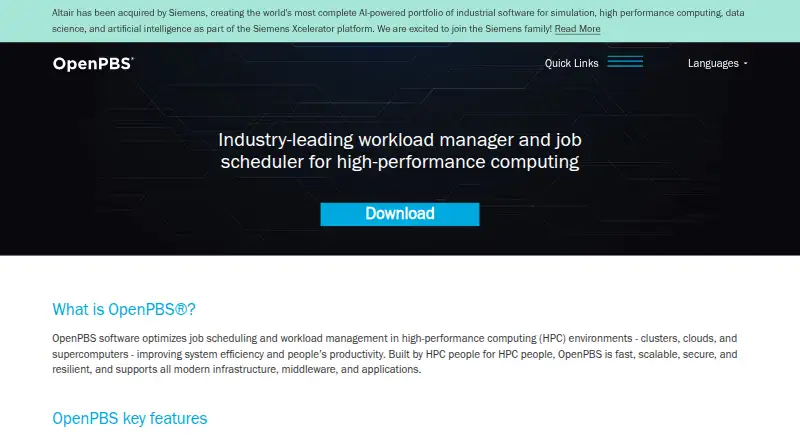
What OpenPBS is
OpenPBS schedules jobs and manages workloads for high-performance computing environments, including clusters, clouds, and supercomputers. Its policy-driven scheduler aims to balance job turnaround time and system utilization while choosing job placement. The software is designed for millions of cores and has been tested beyond 50,000 nodes. A plugin framework gives administrators visibility and room to extend customized deployments. Health checks monitor faults and can mitigate them automatically; the fail-over architecture is designed to avoid a single point of failure and keep jobs running through failures. OpenPBS is self-hosted and available at no charge under the AGPL 3.0 open-source license. PBS Pro is also dual licensed commercially. Public-sector organizations such as academic and research facilities generally choose the open-source license. Community support comes through a volunteer forum, with no guarantee that questions will be answered or bugs addressed. OpenPBS is integrated into the OpenHPC software stack. Its installation guide states that SELinux is not supported.
Good
- Self-hosted and free under AGPL 3.0.
- Supports clusters, clouds, and supercomputers.
- Designed to scale to millions of cores.
- Health checks can mitigate faults automatically.
Watch out
- Community forum support has no guarantees.
- OpenPBS does not support SELinux.
- Critical and high security fixes are delivered in the next major release.
Who it suits
OpenPBS suits organizations operating HPC clusters, clouds, or supercomputers that need job scheduling and workload management. Academic and research facilities are among the groups that generally opt for its open-source license.
Verdict
OpenPBS offers policy-driven scheduling and fault-management features for large HPC environments, with a free AGPL option. Its volunteer support has no guarantees, and SELinux is not supported.
Plans and prices
From OpenPBS's own pricing page, checked 1 Oct 2026.
| Plan | Price | What it gives you |
|---|---|---|
| OpenPBS open-source edition | Free | AGPL 3.0 license · community forum support has no guarantees |
The facts
Each one read from OpenPBS's own pages, with the date it was checked.
What it does
- Audience
- Public-sector organizations such as academia and research facilities generally opt for the open-source license.checked 1 Oct 2026
- Community support
- Community support is provided through a volunteer forum with no fee and no guarantee that questions will be answered or bugs addressed.checked 1 Oct 2026
- Deployment environments
- OpenPBS supports HPC clusters, clouds, and supercomputers.checked 1 Oct 2026
- Health checks
- The health-check framework monitors and automatically mitigates faults.checked 1 Oct 2026
- Integration
- OpenPBS is integrated into the OpenHPC software stack, a Linux Foundation Collaborative Project.checked 1 Oct 2026
- Licensing
- The PBS Pro software is dual licensed as commercial software and under the AGPL 3.0 open-source license.checked 1 Oct 2026
- Plugin framework
- Its flexible plugin framework provides administration visibility and extensibility for customized implementations.checked 1 Oct 2026
- Project support channels
- The project provides a community forum, contributor portal, source code repository, and issue tracker.checked 1 Oct 2026
- Purpose
- OpenPBS optimizes job scheduling and workload management in high-performance computing environments.checked 1 Oct 2026
- Resiliency
- Automatic fail-over architecture has no single point of failure, and jobs continue running despite failures.checked 1 Oct 2026
- Scalability
- OpenPBS supports millions of cores and has been tested beyond 50,000 nodes.checked 1 Oct 2026
- Scheduling
- Policy-driven scheduling balances job turnaround time and utilization with optimal job placement.checked 1 Oct 2026
- Security updates
- Security updates are primarily delivered as minor-version patches, and known critical and high issues are fixed in the next major release.checked 1 Oct 2026
Where it runs
- SELinux limitation
- The OpenPBS installation guide states that OpenPBS does not support SELinux.checked 1 Oct 2026
The full review of OpenPBS
OpenPBS is a self-hosted workload scheduler for high-performance computing (HPC), aimed at organizations running clusters, cloud infrastructure, or supercomputers. It is strongest for large research and public-sector environments that need policy control and recovery from infrastructure faults. The trade-off is operational responsibility, no guaranteed community response, and no SELinux support.
Overview
OpenPBS is designed for HPC rather than ordinary desktop or business task automation. It has been tested beyond 50,000 nodes and supports environments containing millions of cores, so it can remain relevant as a cluster grows substantially. Deployment is self-hosted across Linux and macOS, with API access for integration.
Its scheduler applies configured policies to balance job turnaround against overall utilization and to place work appropriately. That is useful when administrators must enforce priorities across competing research or production workloads. A plugin framework adds administrative visibility and allows customized implementations, although customization also leaves more design and maintenance work with the operating team.
PBS Pro is offered under a commercial license as well as AGPL 3.0. Academic and research organizations commonly use the open-source route. OpenPBS is also integrated into OpenHPC, a Linux Foundation Collaborative Project, which makes it a sensible candidate for teams already standardizing on that stack.
Key features
- Policy-based scheduling: Balances throughput and turnaround while applying placement rules, giving cluster administrators control over how scarce capacity is allocated.
- Health checks: Monitors system condition and can automatically mitigate detected faults, reducing the need for manual intervention during operations.
- Fail-over resilience: An automatic fail-over architecture avoids a single point of failure, and jobs can continue running when components fail.
- Large-scale operation: Support for millions of cores and testing past 50,000 nodes suit national, institutional, and other very large HPC installations.
- Extensibility and integration: Plugins expose administration information and support tailored implementations; dependency controls, retry and recovery, monitoring and alerts, and agent-based execution are supported.
- Security caveat: Security fixes are mainly issued in minor-version patches, while known critical and high-severity issues are fixed in the next major release. OpenPBS does not support SELinux, which can rule it out where that control is mandatory.
Pricing
| Plan | Price | What it means |
|---|---|---|
| OpenPBS open-source edition | free | AGPL 3.0 license; community forum support has no guarantees |
There are no paid seats or usage quotas attached to this edition. The cost advantage is substantial for universities, laboratories, and public agencies able to operate their own infrastructure. In return, the team must handle deployment and administration, comply with AGPL 3.0, and accept that volunteer questions may go unanswered and bugs may not be addressed through the forum.
Platforms
OpenPBS provides API access and runs on Linux and macOS. It is self-hosted, so the adopting organization supplies and operates the HPC environment rather than handing scheduling to a hosted provider. That model fits teams with infrastructure expertise; organizations wanting a managed control plane should consider a different product.
Who it's for
Choose OpenPBS when a research institution, public-sector body, or large enterprise needs policy-driven scheduling across a substantial HPC estate, plus automatic recovery when infrastructure components fail. Its scale and OpenHPC integration are particularly relevant to established cluster programs.
It is a weaker fit for small teams seeking a simple scheduler, guaranteed vendor assistance, or SELinux compatibility. The self-hosted model and AGPL obligations require deliberate operational and licensing decisions.
Pros and cons
Pros
- Handles environments tested beyond 50,000 nodes and supports millions of cores.
- Policy controls can balance job turnaround with utilization and placement requirements.
- Health checks and fail-over allow jobs to continue through component failures.
- Free AGPL edition and plugin extensibility suit public research and customized deployments.
Cons
- Volunteer forum support carries no response or bug-fix guarantee.
- SELinux is unsupported.
- Self-hosted deployment places infrastructure and maintenance work on the customer.
- Security remediation is tied primarily to minor patches and the next major release for critical and high issues.
Alternatives
AWS Batch is the better choice when you want a cloud service across Linux, macOS, web, and Windows; AWS Batch itself has no additional charge, but compute and storage are billed separately.
JS7 JobScheduler offers a free GPLv3 open-source option across more platforms, though its open-source plan excludes high-availability clustering and relies on community support.
HTCondor is a free, self-hosted alternative with software, source, and documentation freely available under an open-source license.
schedulix is another free AGPL scheduler for API, Linux, web, and Windows environments.
Webcron suits hosted API and web cron launches, with per-launch pricing and a free trial rather than HPC cluster management.
Google Cloud Batch fits teams already on Google Cloud; the batch service has no additional charge, while the underlying resources and quotas still apply.
Slurm Workload Manager is a free, GPLv2, self-hosted cluster scheduler for Linux environments.
System Scheduler targets Windows desktop scheduling, with a limited free version and a paid Professional edition.
For broader category comparisons, see Job Scheduler Software and GPU Cluster Management Software.
Verdict
OpenPBS is a strong choice for large HPC operators that need policy-controlled scheduling, extensibility, and fail-over without a license fee. Look elsewhere if SELinux is required, if you need guaranteed support, or if a managed service is preferable to running the scheduler yourself.