Google Cloud Batch
Google Cloud Batch is a managed service for scheduling, queuing, and running batch jobs on Google infrastructure.
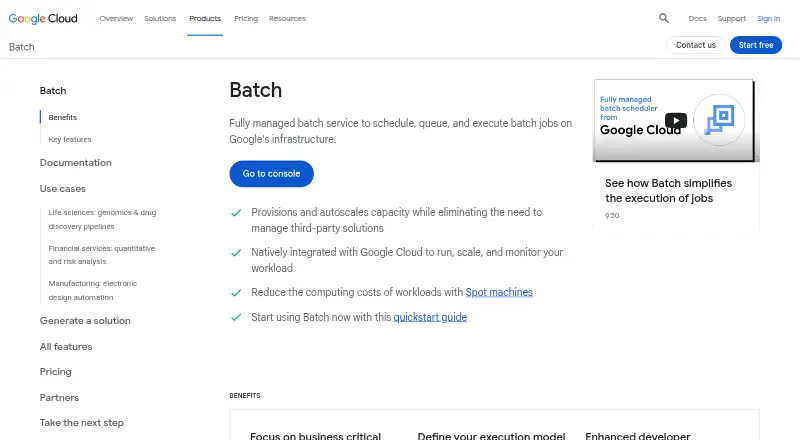
What Google Cloud Batch is
Google Cloud Batch is a managed service for scheduling, queuing, and running batch jobs on Google infrastructure. It obtains resources for each job, queues the work, and creates or removes resources during runtime to meet job specifications. Jobs can run executable scripts or containerized workloads, with tasks arranged in parallel or sequentially. Batch dynamically provisions and autoscales compute resources for parallel jobs. Jobs can use persistent disks, local SSDs, Cloud Storage buckets, and network file systems such as Filestore. Google Cloud identifies Cloud Storage, Pub/Sub, Cloud Logging, and Workflows as services for an end-to-end developer experience. State-change notifications for jobs and tasks can travel through Pub/Sub and be streamed to BigQuery for analysis. Batch supports IAM permissions and VPC Service Controls, and its documentation describes using Secret Manager for sensitive job data. Batch has no additional service charge, but the Google Cloud resources that jobs consume are billable. Jobs are subject to quotas and limits, including one task group per job and limits on parallel tasks, VM counts, and runtime. Finished jobs are automatically deleted after 60 days unless deleted earlier.
Good
- Automatically provisions resources to match job specifications.
- Tasks can run in parallel or sequentially.
- Supports persistent disks, local SSDs, buckets, and Filestore.
- Job and task state notifications can use Pub/Sub.
- Batch itself has no additional charge.
Watch out
- Google Cloud resources used by jobs are billable.
- Each job can have only one task group.
- Quotas limit parallel tasks, VM counts, and runtime.
- Finished jobs are deleted after 60 days.
Who it suits
Batch suits teams running script-based or containerized jobs on Google Cloud, especially when they want resources provisioned and scaled for parallel work. Users should account for resource charges and job limits.
Verdict
Google Cloud Batch handles job queuing and resource provisioning for workloads on Google infrastructure. Its service has no additional charge, but resource costs, quotas, and automatic job deletion are important to plan around.
Plans and prices
From Google Cloud Batch's own pricing page, checked 14 Oct 2026.
| Plan | Price | What it gives you |
|---|---|---|
| Batch service | Free | Supported Compute Engine machine series only · one task group per job · quotas apply · No additional charge for Batch; underlying GPUs, disks, VM instances, storage, logging and networking are billed |
The facts
Each one read from Google Cloud Batch's own pages, with the date it was checked.
What it does
- API and SDKs
- The service offers REST API v1 and v1alpha, gcloud batch commands, and client libraries for C++, Go, Java, Node.js, Python and .NET.checked 14 Oct 2026
- Automatic provisioning
- Batch obtains resources, queues jobs, and automatically creates and deletes resources to meet job specifications during runtime.checked 7 Oct 2026
- Capacity restrictions
- Jobs are limited to listed Compute Engine machine series and cannot contain more than one task group.checked 14 Oct 2026
- Compliance
- Google Cloud's Trust Center lists ISO/IEC 27001/27017/27018/27701, SOC 1/2/3, PCI DSS, and FedRAMP certifications, and alignment with GDPR and HIPAA.checked 7 Oct 2026
- Documentation depth
- Documentation includes quickstarts, job creation guides, logging analysis, troubleshooting, quotas, REST references and language-specific client-library references.checked 14 Oct 2026
- Documentation licence
- The API documentation states that documentation is CC BY 4.0 and code samples are Apache 2.0; it does not publish a licence for the managed Batch service itself.checked 14 Oct 2026
- Execution model
- Jobs contain tasks and runnables that can execute scripts directly on VMs or run containers.checked 14 Oct 2026
- Integrations
- Google lists Cloud Storage, Pub/Sub, Cloud Logging and Workflows as native Batch integrations.checked 14 Oct 2026
- Job limits
- A job can have only one task group, named group0; Batch's quotas and limits also cap parallel tasks, VM counts, and job runtime.checked 7 Oct 2026
- Job retention
- Google Cloud automatically deletes a Batch job 60 days after it finishes unless it is deleted earlier, and job information can be exported before deletion.checked 7 Oct 2026
- Launch history
- Google announced Batch as a fully managed service in Preview on July 13, 2022 and later described it as generally available in six regions.checked 14 Oct 2026
- Limit: complexity and pricing
- GetApp reviewers cite complex advanced features, steep learning, pricing confusion, bugs and difficult migration.checked 14 Oct 2026
- Limit: console and permissions
- TrustRadius reviewers report a difficult Logs Explorer, maze-like UI, unclear invoices and complicated group permissions.checked 14 Oct 2026
- Limit: learning curve
- G2 reviewers report a steep learning curve, complex setup and limited flexibility or features in some scenarios.checked 14 Oct 2026
- Limit: outages
- Google's status history records a US-central1 Batch incident on April 22, 2024 in which most new jobs remained queued for hours because of transaction contention and latency.checked 14 Oct 2026
- Logging and monitoring
- Standard integrations expose task stdout and stderr in Cloud Logging, audit logs and resource metrics in Cloud Monitoring.checked 14 Oct 2026
The company
- Company founding
- Google says Google Inc. was officially established in August 1998.checked 14 Oct 2026
- Company headquarters and size
- LinkedIn lists Google headquarters in Mountain View, California and more than 10,001 employees.checked 14 Oct 2026
- Company legal name
- Crunchbase identifies the maker as Google LLC, a subsidiary of Alphabet.checked 14 Oct 2026
- Founded
- 1998checked 28 Sep 2026
- Headquarters
- Mountain View, Californiachecked 28 Sep 2026
Money
- Limit: billing complaints
- Capterra reviews mention payment-profile hassles and describe the $300 credit offer as misleading for some uses.checked 14 Oct 2026
- Limit: billing complexity
- Gartner reviewers identify billing complexity as a recurring drawback.checked 14 Oct 2026
Where it runs
- Machine types
- Batch jobs can use only the machine series listed in its documentation, across general-purpose, compute-optimized, memory-optimized, and accelerator-optimized categories.checked 7 Oct 2026
Alternatives to Google Cloud Batch
- 1

ActiveBatch
AndroidiOSWebAPI7.6$10,000 one-time - 2

AWS Batch
Free planWebAPILinuxmacOS7.1Free plan - 3
Quartz Scheduler
Free planOpen sourceAPISelf-hosted6.9Free plan - 4

JAMS Scheduler
WebAPILinuxSelf-hosted6.7From $833 a month - 5
Webcron
Free planWebAPI6.7€0.01 one-time - 6
HCL Workload Automation
WebAPILinuxmacOS6.6