JS7 JobScheduler
JS7 JobScheduler automates business processes by running jobs across distributed systems.
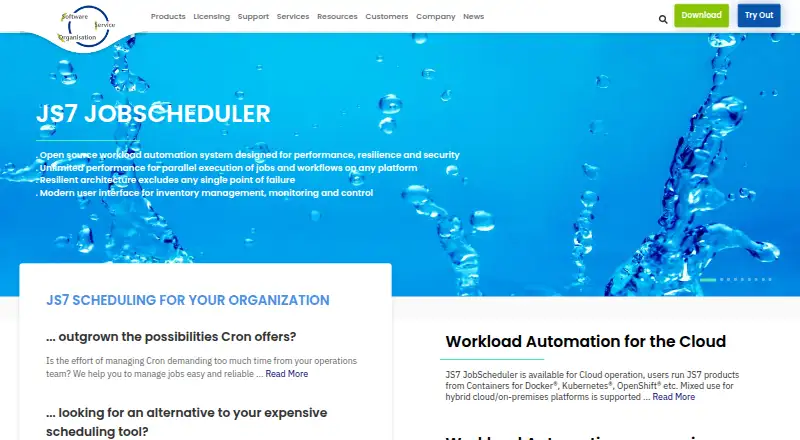
What JS7 JobScheduler is
JS7 JobScheduler automates business processes by running jobs across distributed systems. Workflows can execute jobs in sequence or in parallel, with dependencies such as fork/join, cycles, and resource locks. Agents run scripts and other executables; schedules can also run over SSH without agents. The browser-based JOC Cockpit provides inventory management, monitoring, and control, with a REST API for scheduling operations. Identity options include LDAP, OIDC, local users, and certificates, while roles and folder permissions govern access. HTTPS connections can use TLS/SSL certificates, and passwords or other sensitive job data can be stored in a Credential Store. The YADE add-on supports managed file transfers over protocols including FTP, SFTP, WebDAV, SMB, and HTTPS. An audit log records changes to scheduling objects, and job or workflow results can trigger email or command-line notifications. JS7 offers a free Open Source License under GPLv3. High-availability clustering requires a commercial license; commercial licensing options and pricing are available by contacting sales.
Good
- Runs jobs sequentially or in parallel with dependencies.
- Supports agent-based execution and scheduling over SSH.
- JOC Cockpit includes monitoring, control, and a REST API.
- Free Open Source License under GPLv3.
- Audit log and success or failure notifications.
Watch out
- High-availability clustering requires a commercial license.
- Commercial license pricing is available by contacting sales.
- LTS maintenance downloads require an LTS subscription and authentication.
Who it suits
JS7 suits teams that need to automate workflows across distributed systems, with dependency controls, monitoring, and agent-based or SSH execution. Open-source users can use community support and public resources; professional support is available to commercial license customers.
Verdict
JS7 combines distributed job automation with workflow controls, a web console, and an API. The free license excludes high availability, while commercial support and clustering require a commercial license.
Plans and prices
From JS7 JobScheduler's own pricing page, checked 29 Sep 2026.
| Plan | Price | What it gives you |
|---|---|---|
| Open Source License | Free | High availability clustering is not included · Community support and public resources · Free of charge under GPLv3. |
| Commercial License | Priced on request | Perpetual, pay-per-use, and subscription license models · Includes access to support options and services · Pricing available by contacting sales. |
The facts
Each one read from JS7 JobScheduler's own pages, with the date it was checked.
What it does
- Audit and notifications
- The audit log records user changes to scheduling objects, and the JOC Cockpit can send job or workflow success and failure notifications by email or command line to third-party tools.checked 29 Sep 2026
- Connection and credential security
- Connections can use HTTPS with TLS/SSL certificates, and sensitive job data such as passwords can be stored in a Credential Store.checked 29 Sep 2026
- Execution options
- Agents run executables and scripts, while agentless scheduling over SSH is also available.checked 29 Sep 2026
- File transfer
- The YADE add-on integrates managed file transfers using FTP, FTPS, SFTP, WebDAV, SMB, and HTTPS.checked 29 Sep 2026
- High availability
- JS7 offers clustering for the JOC Cockpit, Controller, and Agents, but clustering requires a commercial license.checked 29 Sep 2026
- Identity and access
- Authentication options include LDAP, OIDC, local users, certificates, and other identity services, with role and folder permissions for authorization.checked 29 Sep 2026
- Jobs and workflows
- Workflows can run jobs sequentially or in parallel and support dependencies such as fork/join, cycles, and resource locks.checked 29 Sep 2026
- Release access
- Public maintenance releases are available to all users for one year after general availability, while LTS maintenance downloads require authentication and an LTS subscription.checked 29 Sep 2026
- Support
- Open-source users can use community support and public resources; professional support and services are available to commercial license customers.checked 29 Sep 2026
- Web console and API
- The JOC Cockpit provides browser-based inventory management, monitoring, and control, and includes a REST API for scheduling operations.checked 29 Sep 2026
- Workload automation
- JS7 automates business processes and workflows by running jobs across distributed systems.checked 29 Sep 2026
Where it runs
- Platforms
- JS7 supports cloud operations with Docker, Kubernetes, and OpenShift, and on-premises operations on Windows, Linux, AIX, Solaris, and macOS.checked 29 Sep 2026
The full review of JS7 JobScheduler
JS7 JobScheduler is a workload automation platform for coordinating jobs across distributed systems. It is best suited to teams with interdependent processes that need centralized operational control. Its strongest case is the combination of workflow controls and flexible execution; the key trade-off is that high availability and professional support require a commercial license.
Overview
JS7 can run business processes as sequential or parallel workflows, with dependencies including fork/join, cycles, and resource locks. That makes it a stronger fit for coordinated processes than for teams that only need a basic schedule. Retries and recovery help address failures, while monitoring and alerts support ongoing operations.
Execution can use agents to run executables and scripts, or SSH scheduling without agents. The JOC Cockpit provides browser-based inventory management, monitoring, and control, and its REST API supports scheduling operations. These options suit both teams managing jobs in a console and those integrating scheduling with other systems.
Key features
- Workflow coordination: Sequential and parallel jobs, dependency controls, cycles, fork/join, and resource locks support processes with ordering and resource constraints.
- Execution flexibility: Agents handle scripts and executables; agentless SSH scheduling is useful where installing agents is not the preferred approach.
- Access and security: LDAP, OIDC, local users, certificates, and other identity services can authenticate users. Role and folder permissions govern access, HTTPS connections can use TLS/SSL certificates, and a Credential Store can hold sensitive job data such as passwords.
- Operations and audit: The audit log records user changes to scheduling objects. The JOC Cockpit can send success and failure notifications by email or command line to third-party tools.
- Managed file transfer: The YADE add-on integrates FTP, FTPS, SFTP, WebDAV, SMB, and HTTPS transfers, extending the scheduler to file-driven workflows.
- Clustering: JS7 supports clustering for the JOC Cockpit, Controller, and Agents, but this capability requires a commercial license. That is an important boundary for teams that need high availability.
Pricing
JS7 uses a freemium model. The Open Source License costs nothing, billed Free of charge under GPLv3. It includes community support and public resources, but excludes high availability clustering. This is the practical starting point for teams able to operate without clustering and rely on community help.
The Commercial License has custom pricing, with pricing available by contacting sales. Perpetual, pay-per-use, and subscription license models are offered, and the license includes access to support options and services. It is the relevant choice for organizations that need clustering or professional support. Public maintenance releases are available to all users for one year after general availability; LTS maintenance downloads require authentication and an LTS subscription.
Platforms
JS7 supports Linux, macOS, Windows, web, API, and self-hosted use. Its hybrid deployment option and agent-based execution suit environments that span systems, while SSH provides an agentless route for scheduling.
Who it's for
JS7 is a strong fit for operations and engineering teams coordinating dependent jobs across distributed systems, especially when they need identity controls, an audit trail, and both console and API access. It is less suitable for organizations that require high availability but cannot take on a commercial license, or for teams whose needs stop at straightforward, isolated job scheduling.
Pros and cons
- Pro: Workflow dependencies, parallel execution, retries, and recovery provide useful control over complex job sequences.
- Pro: Agents and SSH offer two execution approaches, and the browser console is paired with a REST API.
- Pro: Multiple authentication methods, permissions, credential storage, and audit logging address operational access and accountability.
- Con: High availability clustering is excluded from the free license, so resilient deployments require commercial licensing.
- Con: Professional support and services are reserved for commercial license customers; open-source users rely on community support and public resources.
- Con: LTS maintenance downloads require both authentication and an LTS subscription.
Alternatives
Consider these alternatives when their licensing or deployment profile better matches your workload:
- Job Scheduler Software for a broader category comparison.
- AWS Batch may suit teams already accounting for AWS infrastructure charges: the service has no additional charge, but compute and storage resources are billed separately.
- HTCondor is a free, open-source option with software, source code, and complete documentation freely available.
- OpenPBS is another free, self-hosted option, with community forum support that has no guarantees.
- Slurm Workload Manager is free self-hosted cluster software under GNU GPL v2.
- HCL Workload Automation is a paid alternative with a free trial and enterprise workload automation.
- PowerJob is a free open-source framework under Apache License 2.0, with a free trial also offered.
- ActiveBatch is a paid alternative with a free trial and execution-agent points that vary by operating system.
- BMC Helix AIOps is a paid alternative with custom pricing.
Verdict
Choose JS7 if your team needs to coordinate dependent jobs across distributed systems and values flexible execution, workflow controls, and operational oversight. The free GPLv3 license makes it a credible option when clustering and commercial support are not necessary. Look elsewhere if high availability is essential but a commercial license is not viable.
Getting started
- Visit the JS7 JobScheduler website.
- Choose the Open Source License or contact sales about commercial licensing.
- Use the Linux, macOS, or Windows platform, or a self-hosted or web deployment.
- Set up the JOC Cockpit to manage inventory, monitoring, and scheduling through its browser interface or REST API.
- Configure agents or SSH scheduling for job execution.
Limits worth knowing
The free Open Source License does not include high-availability clustering. LTS maintenance downloads require an LTS subscription and authentication; public maintenance releases are available to all users for one year after general availability.
Questions
Is JS7 JobScheduler free?
Yes. The Open Source License is free and is provided under GPLv3.
What does the free license exclude?
High-availability clustering is not included. Clustering for the JOC Cockpit, Controller, and Agents requires a commercial license.
What platforms does JS7 support?
Listed platforms include API, Linux, macOS, self-hosted, web, and Windows.
Does JS7 support SSH scheduling?
Yes. Scheduling over SSH is available without agents; agents can also run executables and scripts.
What support is available?
Open-source users can use community support and public resources. Professional support and services are available to commercial license customers.
What does commercial licensing cost?
Commercial pricing is available by contacting sales. Commercial licenses include access to support options and services.
Alternatives to JS7 JobScheduler
- 1

ActiveBatch
AndroidiOSWebAPI7.6$10,000 one-time - 2

AWS Batch
Free planWebAPILinuxmacOS7.1Free plan - 3
Quartz Scheduler
Free planOpen sourceAPISelf-hosted6.9Free plan - 4
Google Cloud Batch
Free planWebAPILinux6.8Free plan - 5

JAMS Scheduler
WebAPILinuxSelf-hosted6.7From $833 a month - 6
Webcron
Free planWebAPI6.7€0.01 one-time