HTCondor
HTCondor is a free, self-hosted workload management system for compute-intensive jobs.
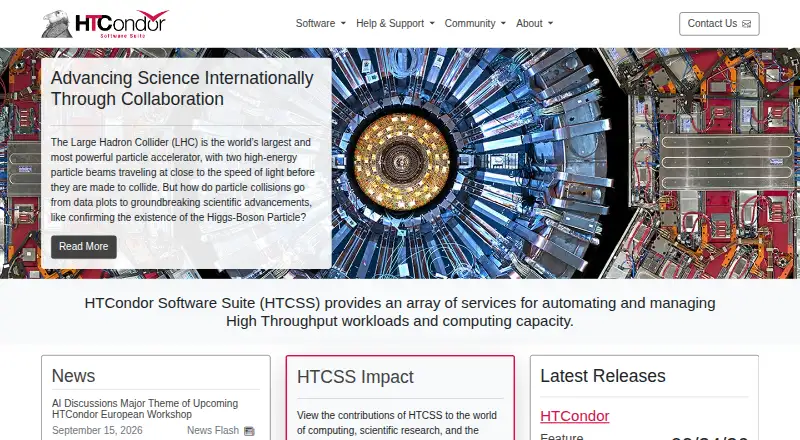
What HTCondor is
HTCondor is a free, self-hosted workload management system for compute-intensive jobs. It queues and schedules jobs, sets priorities, monitors resources, and manages computing across networked clusters, cloud resources, and international grids. Its ClassAd mechanism matches job requests with machine offers according to configurable requirements and preferences. If a machine running a job becomes unavailable, HTCondor can restart the job on another machine. It can transfer data when machines lack a shared file system or redirect job input and output to the submit machine. Separate installations can collaborate through flocking, and HTCondor-G interoperates with Globus-managed resources. The software supports Linux, MacOS, and Windows. The listed feature release is version 25.14.1, which adds a metric daemon for exporting metrics to Prometheus and Ganglia. Security fixes are provided for the current feature and current LTS versions; the previous LTS is supported for about twelve months after a new LTS release. Contracted support is available, with fees varying by support policy. HTCSS is distributed under Apache License 2.0 without warranties or conditions.
Good
- Free software, source code, and documentation under Apache 2.0.
- Can restart jobs when a machine becomes unavailable.
- Supports Linux, MacOS, and Windows.
- Exports metrics to Prometheus and Ganglia in version 25.14.1.
Watch out
- Self-hosted deployment requires managing the installation.
- Contracted support fees vary by support policy.
- Distributed without warranties or conditions.
Who it suits
HTCondor suits organizations that need to schedule compute-intensive jobs across machines and manage resources centrally. Its stated users include organizations in industry, government, and academia, with installations ranging from a handful to many thousands of workstations.
Verdict
HTCondor coordinates jobs across varied computing resources and includes recovery and data-handling options. It is free to use, while contracted support is a separate option with variable fees.
Plans and prices
From HTCondor's own pricing page, checked 30 Sep 2026.
| Plan | Price | What it gives you |
|---|---|---|
| HTCondor | Free | Software, source code, and complete documentation freely available under an open source license |
The facts
Each one read from HTCondor's own pages, with the date it was checked.
What it does
- Current release
- The feature release listed on September 24, 2026 is version 25.14.1.checked 30 Sep 2026
- Data handling
- HTCondor can transfer job data when machines lack a shared file system, or redirect job I/O to the submit machine.checked 30 Sep 2026
- Distributed computing
- HTCondor uses computing resources across networked clusters, cloud resources, and international grids.checked 30 Sep 2026
- Grid interoperability
- HTCondor supports collaboration between installations through flocking, and HTCondor-G interoperates with Globus-managed resources.checked 30 Sep 2026
- Intended users
- The maker says hundreds of organizations in industry, government, and academia use HTCondor installations ranging from a handful to many thousands of workstations.checked 30 Sep 2026
- Job recovery
- When a machine running a job becomes unavailable, HTCondor can automatically restart the job on another machine.checked 30 Sep 2026
- License
- HTCSS is licensed under Apache License, Version 2.0 and distributed on an as-is basis without warranties or conditions.checked 30 Sep 2026
- Monitoring integrations
- The 25.14.1 release adds a metric daemon that can export metrics to Prometheus and Ganglia.checked 30 Sep 2026
- Project home
- HTCSS is housed within the Center for High Throughput Computing at the University of Wisconsin–Madison and receives NSF funding through the PATh project.checked 30 Sep 2026
- Purpose
- HTCondor is a workload management system for compute-intensive jobs, with job queueing, scheduling, priorities, resource monitoring, and resource management.checked 30 Sep 2026
- Resource matching
- Its ClassAd mechanism matches job requests with machine offers using configurable requirements and preferences.checked 30 Sep 2026
- Security support
- HTCondor provides security fixes for the current feature version and current LTS version, and supports the previous LTS for approximately twelve months after a new LTS release.checked 30 Sep 2026
- Support options
- Contracted support offers guaranteed problem resolution, faster issue turnaround, telephone access, and priority email access; fees vary by support policy.checked 30 Sep 2026
Where it runs
- Supported platforms
- The maker lists Linux, MacOS, and Windows as supported platforms.checked 30 Sep 2026
The full review of HTCondor
HTCondor is an open-source workload manager for organizations running compute-intensive jobs across clusters and other networked resources. It is best for teams able to operate their own infrastructure; automatic job recovery and flexible resource matching are its strongest advantages.
Its core software is free, but running it is a self-hosted responsibility, not a managed service. Choose it when control over distributed compute matters more than turnkey operation.
Overview
HTCondor queues and prioritizes jobs, schedules them, and monitors and manages resources across networked clusters, cloud resources, and international grids. That range suits organizations pooling computing capacity from multiple environments, rather than users who need only a basic scheduler for one machine.
If a machine running a job becomes unavailable, HTCondor can restart that job on another machine. It can also transfer job data when machines lack a shared file system or redirect job input and output to the submit machine. These options help keep distributed work moving, though teams still need to deploy and operate the system themselves.
Key features
Scheduling and resource matching
HTCondor's ClassAd mechanism matches job requests to machine offers using configurable requirements and preferences. That gives administrators a way to express which resources suit a workload, but makes the system a better fit for teams prepared to define and manage those rules than for users seeking a hands-off scheduler.
Recovery, data, and interoperability
Automatic restart on another machine can reduce disruption when a resource fails. Data transfer and I/O redirection address environments where compute machines do not share a file system. Flocking lets separate HTCondor installations collaborate, while HTCondor-G interoperates with Globus-managed resources, making these capabilities useful for organizations coordinating work across distinct installations or grid resources.
Monitoring and maintenance
HTCondor includes resource monitoring, and release 25.14.1 adds a metric daemon that can export metrics to Prometheus and Ganglia. Its security policy covers the current feature and current LTS versions, plus the previous LTS for approximately twelve months after a new LTS release. Organizations that need guaranteed resolution, faster issue turnaround, telephone access, and priority email can buy contracted support; fees vary by support policy.
Pricing
The HTCondor plan costs free and includes the software, source code, and complete documentation under an open-source license. There is no free trial because the software is already free to use. This is a strong fit for organizations that can self-host and maintain their own installation without a software fee.
Contracted support is a separate option with variable fees, providing guaranteed problem resolution and faster access to assistance. The software is licensed under Apache License, Version 2.0 and distributed on an as-is basis without warranties or conditions, so teams requiring support guarantees should weigh that separate cost and arrangement.
Platforms
HTCondor supports Linux, MacOS, and Windows, and is self-hosted. That combination gives organizations flexibility across supported systems, but it does not remove the operational work of managing their own deployment.
Who it's for
HTCondor is aimed at organizations in industry, government, and academia that need to coordinate compute-intensive work across shared resources. Installations range from a handful to many thousands of workstations, so it can suit both smaller resource pools and large-scale environments. Its project is housed within the Center for High Throughput Computing at the University of Wisconsin–Madison and receives NSF funding through the PATh project.
It is less suitable for individuals or teams looking for a hosted service that handles deployment and operations. The self-hosted model and configurable matching are most valuable when an organization has the technical capacity to manage resources and job requirements.
Pros and cons
- Pros: Automatic restart on another machine can keep jobs moving when a machine fails.
- Pros: Configurable ClassAd matching and support for clusters, cloud resources, and international grids accommodate varied compute environments.
- Pros: Data transfer and I/O redirection address jobs running without a shared file system.
- Pros: Core software, source code, and documentation are free, with Prometheus and Ganglia metric export in release 25.14.1.
- Cons: Self-hosting leaves deployment and operation to the organization, so it is not a fit for those seeking a managed scheduler.
- Cons: Support guarantees and faster issue handling require a separate contract with variable fees.
- Cons: The license provides the software as-is without warranties or conditions.
Alternatives
Compare job scheduler software if you want to survey the category before choosing a workload manager.
- AWS Batch is worth considering if you prefer its no-additional-charge batch service model; compute and storage resources are billed separately, and AWS resource charges apply.
- JS7 JobScheduler offers a free GPLv3 open-source license, but its free option excludes high availability clustering and relies on community support.
- schedulix is another free, open-source option, licensed under GNU AGPL.
- OpenPBS offers a free AGPL 3.0 open-source edition with community forum support that has no guarantees.
- Google Cloud Batch charges no additional fee for the Batch service, but jobs incur charges for the Google Cloud resources they use and are subject to quotas.
- Slurm Workload Manager is a no-monetary-cost, self-hosted cluster option under GNU GPL v2.
- System Scheduler is a Windows alternative with a free version that requires users to remain logged in and has limited features.
- HCL Workload Automation is an alternative for enterprise workload automation.
Verdict
Choose HTCondor if your organization needs to coordinate compute-intensive jobs across varied resources and can run its own scheduler. Its free software, configurable resource matching, and automatic recovery make a compelling combination; look elsewhere if you need managed operations or guaranteed support included without a separate contract.
Getting started
- Visit the HTCondor project website
- Download the free software, source code, and documentation
- Deploy HTCondor on Linux, MacOS, or Windows infrastructure
- Configure job queues, priorities, resource requirements, and preferences
- Set up data transfer or submit-machine I/O redirection where needed
- Connect installations through flocking or Globus resources through HTCondor-G
Limits worth knowing
The free HTCondor plan is self-hosted, so you provide and manage the computing infrastructure. Contracted support is separate and has fees that vary by support policy.
Questions
How much does HTCondor cost?
HTCondor is free. Software, source code, and complete documentation are available under the Apache License 2.0; contracted support has fees that vary by support policy.
Which operating systems does HTCondor support?
The maker lists Linux, MacOS, and Windows as supported platforms.
Is HTCondor hosted or self-hosted?
HTCondor is deployed as a self-hosted workload management system.
Can HTCondor recover interrupted jobs?
Yes. When a machine running a job becomes unavailable, HTCondor can automatically restart the job on another machine.
What integrations are available for monitoring and grids?
Version 25.14.1 adds metric export to Prometheus and Ganglia. Flocking connects separate HTCondor installations, and HTCondor-G interoperates with Globus-managed resources.
What licence covers HTCondor?
HTCSS is licensed under Apache License, Version 2.0 and distributed on an as-is basis without warranties or conditions.
Alternatives to HTCondor
- 1

ActiveBatch
AndroidiOSWebAPI7.6$10,000 one-time - 2

AWS Batch
Free planWebAPILinuxmacOS7.1Free plan - 3
Quartz Scheduler
Free planOpen sourceAPISelf-hosted6.9Free plan - 4
Google Cloud Batch
Free planWebAPILinux6.8Free plan - 5

JAMS Scheduler
WebAPILinuxSelf-hosted6.7From $833 a month - 6
Webcron
Free planWebAPI6.7€0.01 one-time