
schedulix
Schedulix is open-source workload automation software for automating IT process workflows.
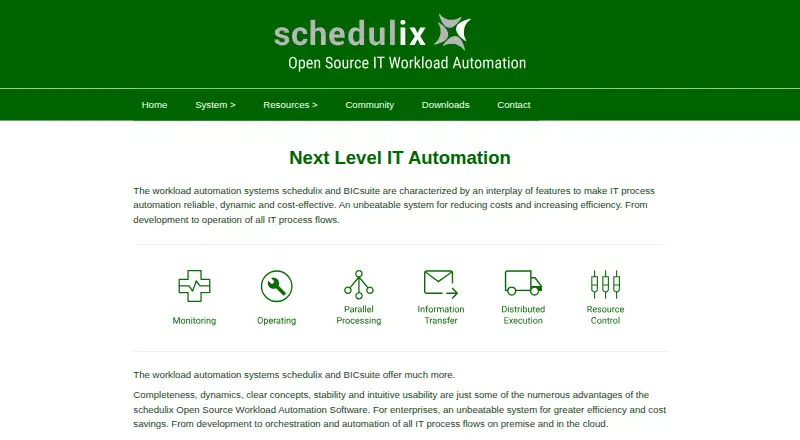
What schedulix is
Schedulix is open-source workload automation software for automating IT process workflows. Its browser interface supports administration, design, monitoring, and operations across systems. It can choose processes dynamically based on priorities and available resources, while workflows can use exit states, batch and job hierarchies, dependencies, resources, and triggers. The software provides an open, documented API, and its relational database repository supports SQL read access through Standard Catalog Interface views. The product describes authentication for users, job server agents, and user processes, along with delegated system privileges and an audit trail of operator interventions. Its maker says components restart without manual intervention after hardware, power, or operating-system failures, provided RDBMS data remains secure. Schedulix supports Linux, Windows, web, API, and self-hosted use, with hybrid deployment, dependency controls, retries, recovery, monitoring, and alerts. Source code is available on GitHub, and downloads include an RPM repository package and Windows packages. The software is free under the GNU AGPL. Paid support is limited to installations from an unmodified official source copy or an independIT package.
Good
- Open-source software licensed under GNU AGPL.
- Supports dynamic scheduling around priorities and resources.
- Provides an open, documented API.
- Includes authentication and an operator audit trail.
- Offers retries, recovery, monitoring, and alerts.
Watch out
- Paid support has installation eligibility requirements.
- The maker conditions automatic restarts on secure RDBMS data.
Who it suits
Schedulix may suit teams automating IT workflows that want open-source software and a browser interface for administration and monitoring. Its maker also offers paid support and consulting, subject to installation eligibility.
Verdict
Schedulix offers workflow automation with dynamic scheduling, operational controls, and an open API. Teams considering support should check the stated installation eligibility, and those relying on automatic recovery should note the RDBMS condition.
Plans and prices
From schedulix's own pricing page, checked 5 Oct 2026.
| Plan | Price | What it gives you |
|---|---|---|
| schedulix | Free | Open-source software licensed under GNU AGPL |
The facts
Each one read from schedulix's own pages, with the date it was checked.
What it does
- API and integration
- Schedulix provides an open, fully documented API, and its RDBMS repository supports SQL read access through Standard Catalog Interface views.checked 5 Oct 2026
- Community and assistance
- The maker points users to a Google Group for community support and offers consulting services including installation, maintenance, training, and interface development.checked 5 Oct 2026
- Dynamic scheduling
- Schedulix dynamically selects processes to run while considering priorities and resource availability.checked 5 Oct 2026
- Privacy
- The maker says its website uses no cookies, tracking tools, or analytics modules.checked 5 Oct 2026
- Purpose
- Schedulix is open-source workload automation software for automating IT process workflows.checked 5 Oct 2026
- Resilience
- The maker says schedulix components restart without manual intervention after hardware, power, or operating-system failures, assuming the RDBMS data remains secure.checked 5 Oct 2026
- Security
- The product page says users, job server agents, and user processes authenticate to the system, with delegated system privileges and an audit trail of operator interventions.checked 5 Oct 2026
- Source and packages
- The source code is available on GitHub, and the downloads page lists an RPM repository package and Windows packages.checked 5 Oct 2026
- Support eligibility
- Paid support applies only to installations built from an unmodified official source copy or installed from an independIT package.checked 5 Oct 2026
- Support levels
- Copper includes four tickets, Silver includes 20, and Gold includes unlimited tickets with guaranteed response times based on severity.checked 5 Oct 2026
- Upgrade path
- The maker says users can upgrade from schedulix to proprietary BICsuite editions without losing work.checked 5 Oct 2026
- Workflow concepts
- Its scheduling concepts include exit states, batch and job hierarchies, dependencies, resources, and triggers.checked 5 Oct 2026
Where it runs
- Browser interface
- A standard browser interface supports administration, design, monitoring, and operations across systems.checked 5 Oct 2026
The company
- Company
- The site identifies independIT Integrative Technologies GmbH as the schedulix developer and lists its address in Schrobenhausen, Germany.checked 5 Oct 2026
- Headquarters
- Schrobenhausen, Germanychecked 28 Sep 2026
The full review of schedulix
Overview
Schedulix is open-source workload automation software for coordinating IT process workflows. It is best suited to teams able to run self-hosted software and manage dependencies, resources, and execution priorities across jobs. Its workflow controls and open interfaces make it capable; its support terms and reliance on a secure RDBMS deserve careful consideration.
Key features
Dynamic scheduling selects processes according to priorities and resource availability, which is useful when a fixed run order cannot account for changing capacity. Dependencies, triggers, resources, exit states, and batch and job hierarchies let teams model more involved processes than a collection of independent scheduled tasks.
The browser interface supports administration, design, monitoring, and operations across systems. An open, fully documented API and SQL read access to the RDBMS repository through Standard Catalog Interface views give teams routes for integration and inspection. Dependency controls, retry and recovery, and monitoring and alerts support operational management, though they do not remove the need to run and maintain the deployment.
Users, job server agents, and user processes authenticate to the system; delegated system privileges and an audit trail of operator interventions provide administrative controls. The maker says components restart without manual intervention after hardware, power, or operating-system failures, provided the RDBMS data remains secure. That condition matters: recovery of the scheduler components is not a substitute for protecting the repository.
Source code is available on GitHub, with RPM repository and Windows packages on the downloads page. The maker also says users can move to proprietary BICsuite editions without losing work. Paid support, however, applies only to installations built from an unmodified official source copy or installed from an independIT package.
Pricing
The schedulix plan costs nothing and is open-source software licensed under GNU AGPL. There are no paid tiers or usage caps described for this plan. It fits teams prepared to operate the software themselves; those wanting paid assistance should first ensure their installation meets the support eligibility terms.
Paid support is offered separately: Copper includes four tickets, Silver includes 20, and Gold includes unlimited tickets with response times guaranteed according to severity. Consulting is also offered for installation, maintenance, training, and interface development. A Google Group is available for community support, but it is not a substitute for the defined ticket and response terms of paid support.
Platforms
Schedulix supports API, Linux, self-hosted, web, and Windows. Its deployment model is hybrid, and the downloads include RPM and Windows packages. The browser interface supports cross-system administration and monitoring, while teams should account for operating and securing the RDBMS repository.
Who it's for
Schedulix is a strong fit for technical teams that need workflow scheduling shaped by resource availability and dependencies, want browser-based operations plus API or SQL access, and can manage a self-hosted deployment. It is less suitable for teams that need support regardless of installation source or cannot take responsibility for keeping the RDBMS data secure.
Pros and cons
- Pro: Dynamic scheduling considers both priority and resource availability, supporting workloads that need more than fixed-time execution.
- Pro: The open API, SQL read access, and workflow hierarchy offer several ways to integrate and inspect operations.
- Pro: Authentication, delegated privileges, and an intervention audit trail provide concrete administrative controls.
- Con: Automatic component restart assumes the RDBMS data remains secure, so repository protection remains essential.
- Con: Paid support is limited to unmodified official-source builds or independIT packages, restricting support eligibility for other installations.
Alternatives
For a broader comparison, see Job Scheduler Software.
- AWS Batch may suit teams working with AWS resources: the service has no additional charge, but compute and storage resources are billed separately.
- JS7 JobScheduler is another open-source option with API, self-hosted, and web platforms; its free open-source license excludes high-availability clustering.
- HTCondor is a free alternative for Linux, macOS, self-hosted, or Windows environments, with software, source code, and documentation freely available under an open-source license.
- OpenPBS is a free AGPL 3.0 alternative for API, Linux, macOS, and self-hosted use; its community forum support has no guarantees.
- Webcron may fit users who prefer per-launch pricing, with listed timeouts of 180 or 600 seconds and no free plan.
- Google Cloud Batch has no additional charge for the batch service, while billable Google Cloud resources used by jobs are charged and jobs are subject to quotas.
- Slurm Workload Manager is a free, self-hosted cluster software option under GNU GPL v2.
- System Scheduler is a Windows-focused alternative with a free version that has limited features and requires the user to remain logged in.
Verdict
Choose Schedulix if your team needs resource-aware workflow automation, broad scheduling controls, and open integration options—and can operate the deployment and protect its RDBMS repository. Look elsewhere if your installation cannot meet the paid-support eligibility rules or your operations depend on recovery without that repository condition.
Alternatives to schedulix
- 1

ActiveBatch
AndroidiOSWebAPI7.6$10,000 one-time - 2

AWS Batch
Free planWebAPILinuxmacOS7.1Free plan - 3
Quartz Scheduler
Free planOpen sourceAPISelf-hosted6.9Free plan - 4
Google Cloud Batch
Free planWebAPILinux6.8Free plan - 5

JAMS Scheduler
WebAPILinuxSelf-hosted6.7From $833 a month - 6
Webcron
Free planWebAPI6.7€0.01 one-time