
ClearML
ClearML is an AI infrastructure platform organized into three layers: Infrastructure Control Plane, AI Development Center, and GenAI App Engine.
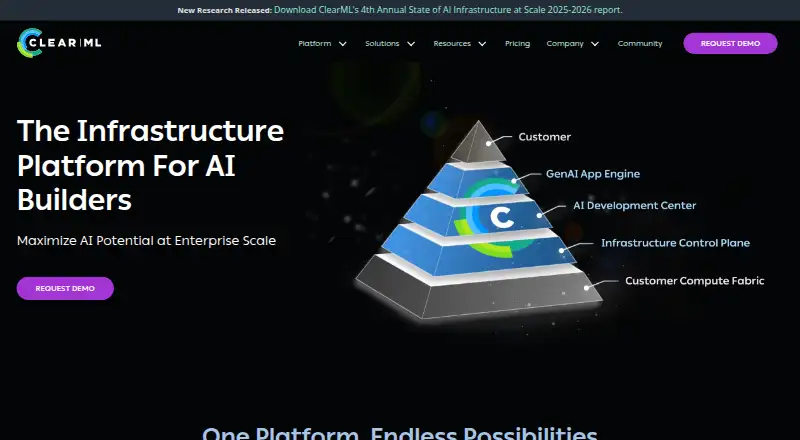
What ClearML is
ClearML is an AI infrastructure platform organized into three layers: Infrastructure Control Plane, AI Development Center, and GenAI App Engine. The Control Plane manages GPU resources across on-premises, cloud, and hybrid environments, including multi-tenant GPU-as-a-Service. The Development Center supports AI and machine-learning development, training, testing, and deployment with monitoring, pipelines, a model repository, and CI/CD integration. The GenAI App Engine deploys large language models on compute clusters and provides networking, authentication, access control, and monitoring. ClearML also lists experiment tracking, comparisons, artifacts, metrics and plots, and Git version control integration. Supported integrations include PyTorch, TensorFlow, Keras, scikit-learn, XGBoost, LightGBM, Optuna, Hydra, TensorBoard, Matplotlib, and LangChain. Storage integrations include AWS S3, Azure, Google Storage, and other S3-compatible services. It can run on ClearML servers, be self-hosted, or be delivered as a managed service. The Community plan is free; Pro costs $15 a month per user plus usage.
Good
- GPU management spans on-premises, cloud, and hybrid.
- Development tools include pipelines and CI/CD integration.
- Supports model registry, serving, and data versioning.
- Community plan is free.
Watch out
- Pro usage beyond included allowances is charged separately.
- Scale and Enterprise prices require a custom quote.
- Role-based access control is listed for Enterprise.
Who it suits
ClearML suits AI and machine-learning teams that need experiment management and model development tools alongside GPU resource management. Its hosting choices may also suit teams with self-hosted, VPC, on-premises, or hybrid requirements.
Verdict
ClearML brings infrastructure management and AI development capabilities into a layered platform with multiple hosting options. Review plan limits and access-control requirements when deciding whether its free or paid tiers fit your team.
Plans and prices
From ClearML's own pricing page, checked 3 Oct 2026.
| Plan | Price | What it gives you |
|---|---|---|
| Community | Free | Teams up to 3 · 100GB free artifact storage · 1GB metric events · 1M API calls/month · No credit card required |
| Pro | $15 a month | Teams up to 10 · 120GB free artifact storage · 1.2GB metric events · 1.2M API calls/month · Additional usage charged separately · Per User/Month + Usage |
| Enterprise | Priced on request | Multiple large projects · VPC or on-prem cluster · Request a Quote |
| Scale | Priced on request | Organizations with 8–48 GPUs · Custom quote · Pay for What You Use | VPC only |
The facts
Each one read from ClearML's own pages, with the date it was checked.
The company
- Company headquarters
- ClearML lists its global headquarters as 2288 Fulton St, Berkeley, California 94704, USA.checked 3 Oct 2026
- Headquarters
- Berkeley, California, USAchecked 23 Sep 2026
What it does
- Deployment options
- ClearML says its platform can be hosted on its servers, self-hosted, or provided as a managed service, with VPC, on-premises including air-gapped, and hybrid options.checked 3 Oct 2026
- Development
- The AI Development Center provides an integrated environment for developing, training, testing, and deploying AI/ML models, with tools including monitoring, pipelines, a model repository, and CI/CD integration.checked 3 Oct 2026
- Enterprise access controls
- The pricing page lists role-based access control and LDAP integration as Enterprise features and lists SSO integration for Scale and Enterprise.checked 3 Oct 2026
- Experiment tracking
- The pricing page lists experiment tracking, comparisons, artifacts, metrics and plots, and Git version control integration across Open Source, Free/Pro, and Scale/Enterprise tiers.checked 3 Oct 2026
- GenAI
- The GenAI App Engine deploys LLMs on compute clusters and provides networking, authentication, access control, and monitoring.checked 3 Oct 2026
- Infrastructure
- The Infrastructure Control Plane manages GPU resources across on-premises, cloud, and hybrid environments and supports multi-tenant GPU-as-a-Service.checked 3 Oct 2026
- Integrations
- The integrations documentation lists PyTorch, TensorFlow, Keras, scikit-learn, XGBoost, LightGBM, Optuna, Hydra, TensorBoard, Matplotlib, and LangChain among supported integrations.checked 3 Oct 2026
- Open source
- ClearML says its self-hosted version is 100% open source on GitHub.checked 3 Oct 2026
- Product
- ClearML describes its AI infrastructure platform as three layers: Infrastructure Control Plane, AI Development Center, and GenAI App Engine.checked 3 Oct 2026
- Self-hosted security
- The self-hosted server security guide recommends restricting public access to required ports and configuring web login authentication; it says file server token authentication starts with version 1.16.0.checked 3 Oct 2026
- Storage
- ClearML documents storage integrations for AWS S3, Azure, Google Storage, and other S3-compatible services, including MinIO and Backblaze B2.checked 3 Oct 2026
- Support
- Scale includes private Slack channel support and an SLA, while Enterprise includes white-glove support with a custom SLA and professional services.checked 3 Oct 2026
The full review of ClearML
Overview
ClearML is an AI infrastructure and development platform for teams building models and managing the compute behind them. It is best suited to organizations that need experiment workflows alongside GPU management, rather than teams looking only for a lightweight tracker. Its broad deployment choices are a strength, but the free tier’s team and usage caps call for careful planning as projects grow.
Key features
ClearML’s Infrastructure Control Plane manages GPU resources across on-premises, cloud, and hybrid environments, including multi-tenant GPU-as-a-Service. That makes it relevant for organizations coordinating shared compute across environments; teams that do not manage GPU infrastructure may find this layer more platform than they need.
The AI Development Center brings together model development, training, testing, and deployment with monitoring, pipelines, a model repository, and CI/CD integration. Experiment tracking covers comparisons, artifacts, metrics, plots, and Git version control integration. Integrations include PyTorch, TensorFlow, Keras, scikit-learn, XGBoost, LightGBM, Optuna, Hydra, TensorBoard, Matplotlib, and LangChain, giving teams a range of established tools to build around. Model registry, pipeline orchestration, serving, and data versioning are also supported.
The GenAI App Engine deploys LLMs on compute clusters and provides networking, authentication, access control, and monitoring. Storage integrations include AWS S3, Azure, Google Storage, and S3-compatible services such as MinIO and Backblaze B2. Together, these capabilities make ClearML a broader operating environment than an experiment tracker alone.
Teams can use ClearML-hosted servers, self-host, or choose a managed service, with VPC, on-premises—including air-gapped—and hybrid options. The self-hosted version is open source. Self-hosting offers control over deployment, but it also makes security configuration part of the operator’s job: ClearML recommends limiting public access to required ports and configuring web login authentication; file-server token authentication starts with version 1.16.0.
Pricing
ClearML uses a freemium model. Community costs nothing, requires no credit card, and supports teams up to 3. It includes 100GB free artifact storage, 1GB metric events, and 1M API calls/month. Those caps make it a practical starting point for small teams, but the team limit and monthly API quota may constrain broader adoption.
Pro costs $15 a month, billed Per User/Month + Usage. It supports teams up to 10 and raises the included allowances to 120GB free artifact storage, 1.2GB metric events, and 1.2M API calls/month; additional usage is charged separately. This is the clearest step up for a growing team, though per-user billing plus usage charges means the subscription price is not the whole cost.
Scale has custom pricing, billed Pay for What You Use | VPC only, and is aimed at organizations with 8–48 GPUs. It includes private Slack channel support and an SLA, making it a fit for GPU-focused organizations that need a VPC deployment and a defined support arrangement. Enterprise uses custom pricing by request for multiple large projects, with a VPC or on-prem cluster; its listed features include role-based access control, LDAP integration, SSO, white-glove support with a custom SLA, and professional services. SSO is also listed for Scale. These tiers target organizations with infrastructure and access-control requirements beyond the smaller Community and Pro team limits.
Platforms
ClearML supports API, Linux, macOS, self-hosted, web, and Windows environments. Its deployment flexibility suits teams spanning operating systems or requiring their own infrastructure, while the variety of hosting choices means buyers should decide whether they want to operate the platform themselves or use a hosted or managed option.
Who it's for
ClearML is a strong fit for AI/ML teams that want experiment management and model workflows tied to GPU infrastructure, particularly when they need cloud, on-premises, hybrid, or air-gapped deployment choices. It is less compelling for a small group seeking only experiment tracking, or for organizations unwilling to manage self-hosted security and usage-based costs.
Pros and cons
- Pros: GPU control, model development tools, and LLM deployment sit in one platform, reducing the need to assemble those layers separately.
- Pros: Multiple hosting modes, including self-hosted and air-gapped on-premises options, support organizations with different infrastructure constraints.
- Pros: Community starts at no cost without a credit card, and Pro raises team and usage allowances for a published per-user price.
- Cons: Community is capped at three team members, while Pro is capped at ten and charges separately for additional usage.
- Cons: Scale and Enterprise require custom pricing, so larger organizations must seek a quote rather than compare a fixed subscription.
- Cons: Self-hosting entails security configuration, including restricting exposed ports and setting up web login authentication.
Alternatives
For another freemium option with a free plan and free trial, Weights & Biases is worth comparing; its Free plan includes 5 model seats, 5 GB/mo storage, and 1 GB/mo Weave data ingestion. ZenML is an alternative with an open-source plan offering unlimited executions and projects for self-hosted use, while its Scale plan is $999 a month.
MLRun offers an open-source plan with community support and a managed option on Iguazio. Paperspace Gradient has a free plan with 5 GB storage and a Pro — User plan at $8 a month. For a web-only notebook option, Databricks Notebooks offers a Free Edition with one serverless workspace and limited compute size and usage.
Opik is another freemium option whose core observability and evaluation features are open-source and can be run locally. Amazon SageMaker Autopilot is a paid-plan alternative with a free trial and pay-as-you-go Amazon SageMaker AI pricing. Outerbounds offers a free Community option built around the open-source Metaflow framework.
Readers comparing categories can also browse MLOps Platforms, GPU Cluster Management Software, ML Experiment Tracking Software, Model Registry Software, and Data Version Control Tools.
Verdict
Choose ClearML if your team wants model development and experiment workflows alongside GPU infrastructure management, with deployment options ranging from hosted servers to air-gapped on-premises. Its main advantage is the scope of that integrated platform; look elsewhere if you need only a focused tracker or want predictable costs without team caps, usage charges, or custom enterprise quotes.
Getting started
- Open the ClearML website
- Choose ClearML-hosted, self-hosted, or managed deployment
- Select Community, Pro, Scale, or Enterprise
- Connect a supported ML framework or storage service
- Configure GPU resources and project workflows
- Set authentication and required access controls for self-hosted installations
Limits worth knowing
Community includes teams up to three, 100GB free artifact storage, 1GB metric events, and 1M API calls per month. Pro allows teams up to ten, 120GB free artifact storage, 1.2GB metric events, and 1.2M API calls per month, with additional usage charged separately.
Questions
Is ClearML free?
Yes. The Community plan costs nothing, requires no credit card, and supports teams up to three.
What does Pro cost?
Pro costs $15 a month per user plus usage. Additional usage is charged separately.
Can ClearML be self-hosted?
Yes. ClearML can be self-hosted, hosted on its servers, or provided as a managed service, with VPC, on-premises, air-gapped, and hybrid options.
Is ClearML open source?
ClearML says its self-hosted version is 100% open source on GitHub.
Which integrations are supported?
Listed integrations include PyTorch, TensorFlow, Keras, scikit-learn, XGBoost, LightGBM, Optuna, Hydra, TensorBoard, Matplotlib, and LangChain. Storage integrations include AWS S3, Azure, Google Storage, MinIO, Backblaze B2, and other S3-compatible services.
What do Scale and Enterprise provide?
Scale is for organizations with 8–48 GPUs and uses a custom quote with VPC-only billing. Enterprise supports multiple large projects with VPC or an on-premises cluster and request-a-quote pricing.