
ZenML
ZenML orchestrates AI and machine-learning pipelines and Python-based agents.
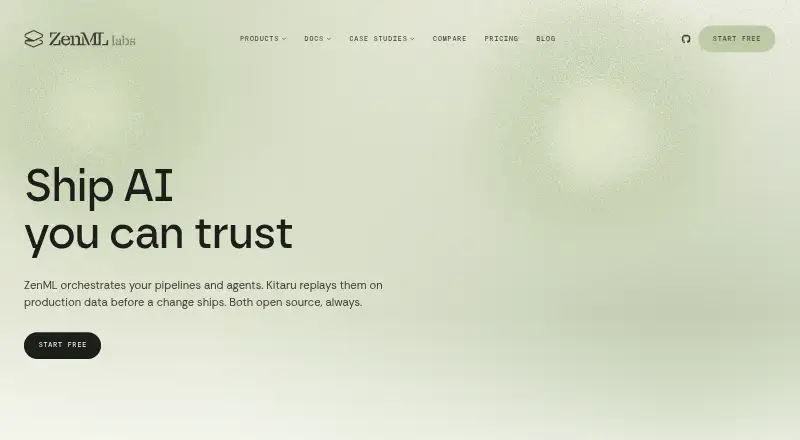
What ZenML is
ZenML orchestrates AI and machine-learning pipelines and Python-based agents. Its pipelines can run on Kubernetes, Vertex AI, SageMaker, AzureML, or a laptop without requiring code rewrites. It tracks versions of step outputs, including models and evaluation datasets, and can resume a run from any step. When code and inputs are unchanged, cached step results can be reused. The integrations directory lists 66 tools, including LangGraph, OpenAI Agents SDK, PyTorch, MLflow, AWS, and Google Cloud Vertex AI Pipelines. ZenML offers local, SaaS, and self-hosted deployment, with Docker and Kubernetes Helm methods. It says metadata is stored by ZenML while data, artifacts, and compute remain in the customer's infrastructure or VPC. The Open Source plan is free, with unlimited executions and projects for self-hosted use. Scale costs $999 a month and includes 2,000 executions, three projects, and five snapshots. Enterprise pricing is custom and adds SSO, custom-role RBAC, audit logs, and air-gapped deployment.
Good
- Runs pipelines across cloud platforms or a laptop.
- Versions artifacts and supports rerunning from any step.
- Caches results when code and inputs are unchanged.
- Free self-hosted plan has unlimited executions and projects.
- Enterprise includes SSO and audit logs.
Watch out
- Scale costs $999 a month.
- Scale is limited to 2,000 executions, three projects, and five snapshots.
- Managed compute is not offered.
- No free trial is listed.
Who it suits
The free Open Source plan is described for individuals and small teams; Scale is aimed at teams running ML in production. Enterprise is for organizations operating at scale.
Verdict
ZenML combines Python pipeline orchestration with artifact versioning, caching, and multiple deployment options. The free plan covers self-hosted use, while production teams can consider Scale or custom-priced Enterprise controls.
Plans and prices
From ZenML's own pricing page, checked 30 Sep 2026.
| Plan | Price | What it gives you |
|---|---|---|
| Open Source | Free | Unlimited executions · Unlimited projects · Self-hosted |
| Scale | $999 a month | 2,000 executions · 3 projects · 5 snapshots · Monthly executions, per workspace |
| Enterprise | Priced on request | Unlimited executions · Unlimited projects · SSO · Custom-role RBAC · Audit logs · Air-gapped deployment · Custom |
The facts
Each one read from ZenML's own pages, with the date it was checked.
What it does
- Artifact versioning
- ZenML versions step results, including models and evaluation datasets, and supports re-execution from any step.checked 30 Sep 2026
- Caching
- ZenML caches step results and reuses them when code and inputs have not changed.checked 30 Sep 2026
- Data handling
- ZenML says it stores metadata while data, artifacts, and compute stay in the customer's infrastructure or VPC.checked 30 Sep 2026
- Deployment
- ZenML supports local, SaaS, and self-hosted deployment, including Docker and Kubernetes Helm deployment methods.checked 30 Sep 2026
- Enterprise controls
- The Enterprise plan adds SSO, custom-role RBAC, audit logs, and air-gapped deployment.checked 30 Sep 2026
- Infrastructure
- Pipelines can run on Kubernetes, Vertex AI, SageMaker, AzureML, or a laptop without rewriting the code.checked 30 Sep 2026
- Integrations
- The integrations directory lists 66 tools, including LangGraph, OpenAI Agents SDK, PyTorch, MLflow, AWS, and Google Cloud Vertex AI Pipelines.checked 30 Sep 2026
- Overage
- ZenML says it does not cut off service for occasional monthly execution overages and may contact customers if overages become a pattern.checked 30 Sep 2026
- Purpose
- ZenML orchestrates AI and machine-learning pipelines and agents written in Python.checked 30 Sep 2026
- Security
- ZenML states that it is SOC 2 Type II and ISO 27001 certified.checked 30 Sep 2026
- Support
- The Open Source plan includes community support, Scale includes priority support, and Enterprise includes dedicated support with an SLA.checked 30 Sep 2026
- Target users
- The Open Source plan is described for individuals and small teams, Scale for teams running ML in production, and Enterprise for organizations at scale.checked 30 Sep 2026
The company
- Headquarters
- Munich, Germanychecked 28 Sep 2026
The full review of ZenML
ZenML is a Python-based platform for orchestrating AI and machine-learning pipelines and agents. It suits Python teams that need to run workflows across different infrastructure and keep track of their outputs. Its strongest case is portability and pipeline reproducibility; the main trade-off is that teams must supply their own compute.
Overview
ZenML brings pipeline orchestration together with experiment tracking, a model registry, model serving, and data versioning. Pipelines can run on Kubernetes, Vertex AI, SageMaker, AzureML, or a laptop without rewriting code, which is useful when teams move workloads between environments. That flexibility does not make ZenML a managed-compute service: teams remain responsible for where workloads run.
ZenML versions step results, including models and evaluation datasets, and supports re-execution from any step. Its cache reuses results when code and inputs have not changed. Together, these features can reduce repeated work and make it easier to revisit earlier pipeline outputs.
Key features
- Pipeline portability: Python pipelines can move across several cloud platforms, Kubernetes, and local machines without code rewrites. That is a meaningful advantage for teams with varied infrastructure, though it does not remove the need to provision and manage compute.
- Versioning and caching: Versioned step results and targeted re-execution help teams inspect and reproduce pipeline work. Caching avoids rerunning unchanged steps, making it particularly useful for workflows where repeated computation is costly.
- Integrations: The integrations directory lists 66 tools, including LangGraph, OpenAI Agents SDK, PyTorch, MLflow, AWS, and Google Cloud Vertex AI Pipelines. This breadth can help teams connect an existing stack rather than replace it.
- Deployment and data handling: ZenML supports local, SaaS, and self-hosted deployment, including Docker and Kubernetes Helm methods. It says metadata is stored by ZenML while data, artifacts, and compute stay in the customer's infrastructure or VPC, a useful arrangement for teams that want to keep those resources in their own environment.
- Security and enterprise controls: ZenML states that it is SOC 2 Type II and ISO 27001 certified. Enterprise adds SSO, custom-role RBAC, audit logs, and air-gapped deployment for organizations with stricter access and isolation needs.
Pricing
ZenML uses a freemium model, with no free trial. Its free plan is a substantial starting point, but it requires self-hosting; teams must handle deployment and infrastructure themselves.
| Plan | Price | What it includes | Best for |
|---|---|---|---|
| Open Source | free | Unlimited executions, unlimited projects, self-hosted deployment, and community support. | Individuals and small teams comfortable running ZenML themselves. |
| Scale | $999 a month | 2,000 executions, 3 projects, 5 snapshots, and priority support. | Teams running ML in production that want priority support and can work within the workspace limits. |
| Enterprise | Custom pricing | Unlimited executions and projects, SSO, custom-role RBAC, audit logs, air-gapped deployment, and dedicated support with an SLA. | Organizations at scale that need enterprise access controls or air-gapped deployment. |
Scale charges per workspace and is billed monthly. Its execution, project, and snapshot caps are the key trade-off against the unlimited Open Source plan; larger teams may need Enterprise. ZenML says occasional monthly execution overages do not cut off service, but it may contact customers if overages become a pattern. That soft landing is helpful, but it is not a substitute for planning around the quota.
Platforms
ZenML supports API, Linux, macOS, self-hosted, web, and Windows. Its local, SaaS, and self-hosted deployment options give teams flexibility in how they operate the platform, while compute remains outside ZenML's managed services.
Who it's for
ZenML is a strong fit for Python-based ML teams that need portable orchestration, repeatable pipeline outputs, and a way to connect tools they already use. Individuals and small teams can start with the free self-hosted plan; production teams can consider Scale if its per-workspace limits fit their workload. Organizations that need SSO, custom roles, audit logs, air-gapped deployment, or SLA-backed support have a clearer case for Enterprise.
It is less suitable for teams looking for managed compute or a free hosted service: the free plan is self-hosted, and ZenML does not provide managed compute.
Pros and cons
- Pro — Portable pipelines: Workloads can move among Kubernetes, major cloud ML platforms, and a laptop without rewriting code.
- Pro — Reusable pipeline results: Artifact versioning, re-execution from any step, and caching support reproducibility while avoiding unnecessary reruns.
- Pro — Flexible deployment and data placement: Local, SaaS, and self-hosted options pair with data and artifacts remaining in the customer's infrastructure or VPC.
- Con — No managed compute: Teams must provide and manage the infrastructure that runs their workloads.
- Con — Paid Scale has defined caps: At $999 a month, the plan still limits each workspace to 2,000 executions, 3 projects, and 5 snapshots.
- Con — The free option is self-hosted: Teams seeking a hosted starting point will need to consider a paid plan or another product.
Alternatives
For a broader MLOps comparison, browse MLOps Platforms; for registry-focused choices, see Model Registry Software; and for tracking-focused tools, see ML Experiment Tracking Software.
- Weights & Biases is worth comparing if a freemium option with a free trial and listed monthly free-plan limits is a better fit.
- ClearML may suit teams that prioritize a self-hosted version described as fully open source on GitHub.
- MLRun is another choice for teams considering a free open-source plan and a separate managed offering.
- Paperspace Gradient may fit readers comparing a free plan with a paid Pro option priced at $8 a month.
- Databricks Notebooks is an alternative for readers looking for a free web-based notebook option with limited compute.
- Metaflow is a free, Apache License 2.0 alternative for teams prepared to scale production in their own cloud account or Kubernetes cluster.
- Opik may suit readers looking for a free cloud plan with an open-source core observability and evaluation feature set.
- Amazon SageMaker Autopilot is a paid alternative with a free trial and pay-as-you-go pricing.
Verdict
Choose ZenML if your Python ML team needs portable pipeline orchestration, versioned results, and caching while keeping data and compute in your own environment. Its free self-hosted plan makes it practical to start, but the absence of managed compute and Scale's monthly quotas are good reasons to look elsewhere if you want infrastructure included or need more room without moving to custom-priced Enterprise.
Getting started
- Open the ZenML website
- Choose the Open Source, Scale, or Enterprise plan
- Use the API, web, or supported operating system
- Deploy locally or self-host with Docker or Kubernetes Helm
- Connect pipeline tools through the integrations directory
Limits worth knowing
The free Open Source plan is self-hosted. Scale costs $999 a month and includes 2,000 executions, three projects, and five snapshots; Enterprise has custom pricing.
Questions
Is ZenML free?
Yes. The Open Source plan costs nothing and includes unlimited executions and projects for self-hosted use.
What does Scale cost?
Scale costs $999 a month, billed monthly by workspace.
Which platforms does ZenML support?
ZenML is available through API, Linux, macOS, self-hosted deployment, web, and Windows.
Does ZenML provide managed compute?
No. Pipelines can run on customer-selected infrastructure such as Kubernetes, cloud AI services, or a laptop.
What does Enterprise add?
Enterprise includes unlimited executions and projects, SSO, custom-role RBAC, audit logs, and air-gapped deployment.
Is ZenML open source?
Its listed Open Source plan is free and self-hosted.
Alternatives to ZenML
- 1

Comet
Free planWebAPILinuxmacOS7.9From $19 a month - 2

DagsHub
Free planWebAPILinuxmacOS7.9From $99 a month - 3
TrueFoundry AI Gateway
Free planWebAPILinuxSelf-hosted7.6From $499 a month - 4

ClearML
Free planWebAPILinuxmacOS7.4From $15 a month - 5

MLRun
Free planWebAPILinuxmacOS6.6Free plan - 6

Hopsworks AI Lakehouse
Free planWebAPILinuxSelf-hosted6.4Free plan