
Opik
Opik helps teams building applications or agents that call an LLM log actions and evaluate behavior through development, testing, and production.
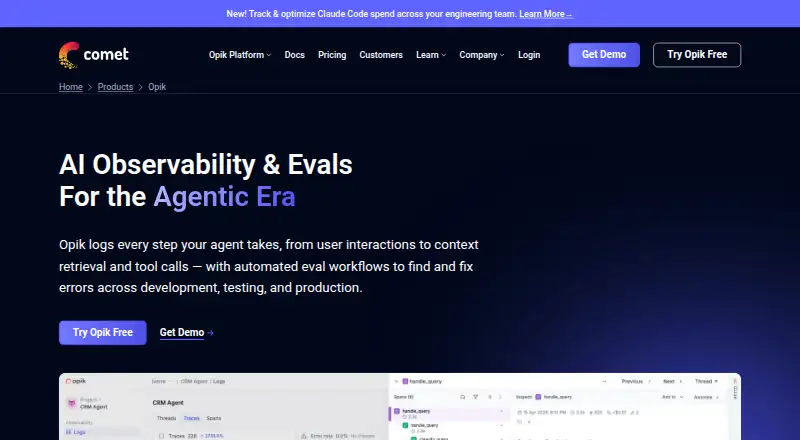
What Opik is
Opik helps teams building applications or agents that call an LLM log actions and evaluate behavior through development, testing, and production. It captures and visualizes traces, supports annotation, and provides audit logs. Its evaluation suite includes more than 30 metrics covering outcomes such as answer relevance, context precision, task completion, and hallucination. In production, it can evaluate traces in real time, alert when criteria fail, and track token use and model costs. Test Suites offer pass/fail assertions, an Agent Playground supports end-to-end tests, and a Prompt Optimizer provides six algorithms. The core observability and evaluation features are available as open-source code for local use. Opik includes a REST API and Python client, with Python and TypeScript SDKs listed, and integrations with more than 40 frameworks, model providers, and gateways, including LangChain, OpenAI, Google ADK, and LangGraph. Free Cloud allows up to 10 team members, 25,000 spans monthly, and 60-day retention. Pro Cloud costs $19 per month and lists up to 50 team members and 100,000 spans monthly.
Good
- Evaluations cover more than 30 metrics.
- Production monitoring can alert on failed criteria.
- Tracks token usage and model costs.
- Core features are available as open-source code.
- Integrates with more than 40 tools and services.
Watch out
- Free Cloud is limited to 25,000 spans monthly.
- Free Cloud retains data for 60 days.
- Pro Cloud costs $19 per month.
Who it suits
Opik is for teams building LLM applications or agents that need tracing, evaluation, and production monitoring. Its free plans are described as suitable for development and testing.
Verdict
Opik brings trace inspection, testing, evaluation, and production monitoring into one platform, with a local open-source option. Free Cloud has span and retention limits; Pro Cloud is $19 per month.
Plans and prices
From Opik's own pricing page, checked 21 Oct 2026.
| Plan | Price | What it gives you |
|---|---|---|
| Free Cloud | Free | Up to 10 team members · 25k spans/month · 60-day retention · Free plan |
| Open Source | Free | Full AI observability and agent testing · self-hosted · Free |
| Pro Cloud | $19 a month | Up to 50 team members · 100k spans/month · 60-day retention · customizable span limits and retention · Per month |
| Enterprise | Priced on request | Unlimited team members · custom usage plans · flexible deployments · SSO · dedicated support and SLAs · SOC 2, ISO 27001, ISO 9001, HIPAA and GDPR · Custom |
The facts
Each one read from Opik's own pages, with the date it was checked.
What it does
- Agent optimization
- Opik includes prompt and tool optimization with multiple optimization algorithms and an optimization dashboard.checked 21 Oct 2026
- Annotation
- Reviewers can annotate traces or complete conversations using custom feedback schemas and annotation queues.checked 21 Oct 2026
- API and SDKs
- Opik offers a REST API, Python and TypeScript SDKs, and OpenTelemetry ingestion for languages including Java, Ruby and .NET.checked 21 Oct 2026
- Audience
- The pricing page describes Opik as a platform for teams building applications or agents that make calls to an LLM, and says its free plans suit development and testing.checked 30 Sep 2026
- Documentation
- Documentation includes feature guides, integration pages, self-hosting instructions, SDK references, REST API references, cookbooks and a changelog.checked 21 Oct 2026
- Enterprise security
- The pricing page lists enterprise SSO and SOC 2, ISO 27001, ISO 9001, HIPAA, and GDPR compliance for the Enterprise plan.checked 30 Sep 2026
- Evaluation
- Opik supports datasets, experiments, assertions and LLM-as-a-judge metrics for issues such as hallucination, relevance and moderation.checked 21 Oct 2026
- Framework integrations
- Named integrations include LangChain, LangGraph, LlamaIndex, CrewAI, AutoGen, Google ADK, OpenAI Agents, Semantic Kernel and many others.checked 21 Oct 2026
- Funding
- TechCrunch reported a $50 million Series B in November 2021, bringing Comet's reported total raised to almost $70 million.checked 21 Oct 2026
- Guardrails
- Self-hosted deployments can use PII, topic and custom guardrails to detect or block unsafe inputs and outputs.checked 21 Oct 2026
- Integrations
- The integration catalog covers TypeScript, Python, Java, .NET and Ruby ecosystems plus no-code tools and OpenTelemetry.checked 21 Oct 2026
- Launch
- Comet announced Opik as an open-source LLM evaluation platform in September 2024.checked 21 Oct 2026
- License
- The repository and full platform are released under the Apache-2.0 license.checked 21 Oct 2026
- Limit: interface
- The Slashdot reviewer said the user interface could be made more attractive.checked 21 Oct 2026
- Limit: learning curve
- The Gartner reviewer said it took time to fully understand the product.checked 21 Oct 2026
- MCP extensibility
- Its MCP server lets Claude Code, Cursor, VS Code Copilot, Codex and opencode query traces, score outputs and run evaluations from chat.checked 21 Oct 2026
- Open source
- The core observability and evaluation feature set is available as open-source code that users can download and run locally.checked 30 Sep 2026
- Praise: debugging
- The Gartner reviewer praised feedback scores, cost visibility and debugging features for improving AI output quality.checked 21 Oct 2026
- Praise: feature breadth
- The Slashdot reviewer praised support for many LLM providers, scalability for high trace loads and a fast-moving roadmap.checked 21 Oct 2026
The company
- Company profile
- Comet is a privately held software-development company headquartered in New York with 51–200 employees and a 2017 founding year.checked 21 Oct 2026
- Company usage claim
- Comet says more than 150,000 builders use Opik.checked 21 Oct 2026
- Founded
- 2017checked 23 Sep 2026
- Headquarters
- New York City, United Stateschecked 23 Sep 2026
Money
- Free plan limits
- The Free Cloud plan lists up to 10 team members, 25,000 spans per month, and 60-day data retention.checked 30 Sep 2026
The full review of Opik
Overview
Opik is an observability and evaluation platform for applications and agents that call large language models. It suits teams that want to trace, test, and evaluate agent behavior across development and production, especially those that value a self-hosted option. Its broad workflow is a strong draw, but Cloud users need to plan around monthly span caps.
Key features
Opik records and visualizes agent actions, with trace annotation and audit logs for investigating behavior. More than 30 evaluation metrics cover outcomes such as answer relevance, context precision, task completion, and hallucination. That range can support varied evaluation needs, though teams must still choose criteria suited to their applications.
Production monitoring evaluates traces in real time, can alert on failed criteria, and tracks token usage and model costs. Test Suites add pass/fail assertions, the Agent Playground supports end-to-end tests, and the Prompt Optimizer offers six algorithms. Connecting these capabilities lets teams carry evaluation from testing into production rather than treating it as a pre-release task alone.
The core observability and evaluation feature set is open source and can run locally. Opik includes a REST API and Python client, and its pricing page lists Python and TypeScript SDKs alongside more than 40 integrations. Examples include LangChain, OpenAI, Google ADK, and LangGraph, giving teams several familiar routes into an existing stack.
Pricing
Free Cloud costs $0 and allows up to 10 team members, 25,000 spans per month, and 60-day data retention. It is a useful starting point for development and testing, but the span ceiling may constrain teams evaluating heavier workloads.
Open Source costs $0 and provides the full AI observability and agent testing feature set using the same codebase as hosted versions, for self-hosting. It avoids a Cloud span quota, but teams take on running it locally rather than using the hosted service.
Pro Cloud is $19 per month and includes up to 50 team members, 100,000 spans per month, and 60-day retention, with customizable span limits and retention periods. It adds room for larger teams and workloads than Free Cloud, while the monthly span allowance remains a planning consideration. Community and self-service support are listed across plans; Pro also includes email support.
Enterprise has custom pricing, unlimited team members, custom usage plans, flexible deployments, dedicated support, and SLAs. It is the fit for organizations that need those deployment and support terms. Enterprise security offerings include SSO and SOC 2, ISO 27001, ISO 9001, HIPAA, and GDPR compliance. Comet's Trust Center lists ISO 9001:2015, ISO/IEC 27001:2022, and SOC 2 Type 2 compliance.
Platforms
Opik is available through an API, on Linux, on the web, and as self-hosted software. The choice between hosted Cloud and local deployment is useful for teams with different operating preferences; the open-source option keeps the core feature set available to run locally.
Who it's for
Opik is aimed at teams building applications or agents that make calls to an LLM. Its tracing, tests, evaluation metrics, and production alerts suit teams that need to follow behavior throughout the development lifecycle. Free Cloud is suited to development and testing within its 25,000-span monthly cap; self-hosting is a natural choice for teams that want the full feature set locally. Teams that need more Cloud capacity can move to Pro, while enterprise deployment, support, and compliance requirements point toward custom-priced Enterprise.
Pros and cons
- Pros: Tracing, evaluation, prompt and agent testing, and production monitoring share one platform, connecting pre-release checks with live monitoring.
- Pros: The open-source version offers the full observability and agent testing feature set for local self-hosting at $0.
- Pros: More than 30 metrics and over 40 integrations give teams a broad starting point for evaluation and connecting tools.
- Cons: Free Cloud is capped at 25,000 spans per month and 60-day retention, which can limit room for growing workloads.
- Cons: Pro Cloud raises the span ceiling to 100,000 per month but still has a published cap; higher or customized usage requires plan changes.
- Cons: Enterprise uses custom pricing, so teams seeking a fixed published cost cannot compare it on price alone.
Alternatives
Langfuse is worth considering for a different free-tier balance: its Hobby plan allows 50,000 units per month and 30 days of data access for two users, while Opik Free Cloud allows 25,000 spans per month, 60-day retention, and up to 10 team members. LangWatch is another option if open-source software under Apache 2.0 is a priority. W&B Weave may suit teams looking for a free plan that specifies 1 GB monthly ingestion and 5 GB storage alongside evaluations, tracing, and scorers.
OpenLIT is a free alternative with an OSS plan advertising unlimited self-hosted usage, users, projects, and environments. Arize AX offers a free SaaS plan with 25,000 trace spans per month, 15-day retention, and unlimited users and evaluations. Laminar has a free plan with 1 GB data, seven-day retention, one project, and one seat. Traceloop is an alternative built around OpenLLMetry, an open-source observability project on OpenTelemetry. Helicone is another freemium option that describes itself as open source.
For broader discovery, browse AI Agent Observability Tools, AI LLM Observability Tools, AI LLM Evaluation Tools, Model Monitoring Software, LLM Observability Tools, or Machine Learning Model Monitoring Software.
Verdict
Choose Opik if your team needs one workflow for agent traces, evaluation, testing, and production monitoring, with the option to self-host the open-source core. Its strongest case is that breadth across the development lifecycle; look elsewhere if you need Cloud usage without span caps or a fixed Enterprise price.
Getting started
- Open the Opik website
- Choose Free Cloud, Open Source, Pro Cloud, or Enterprise
- Use the web, API, Linux, or self-hosted deployment path
- Connect through the REST API, Python client, or listed SDKs
- Add an integration such as LangChain, OpenAI, Google ADK, or LangGraph
- Use the free trial if you want to evaluate the service
Limits worth knowing
Free Cloud is free (billed $0) and allows up to 10 team members, 25,000 spans per month, and 60-day data retention. Pro Cloud is $19 a month for up to 50 team members and 100,000 spans monthly, with customizable span limits and retention periods.
Questions
Does Opik have a free plan?
Yes. Free Cloud is free (billed $0), and an Open Source plan is also free.
What does Free Cloud include?
Free Cloud supports up to 10 team members, 25,000 spans per month, and 60-day data retention.
Is Opik open source?
Yes. Its core observability and evaluation feature set is available as open-source code for local use.
How much does Pro Cloud cost?
Pro Cloud costs $19 a month.
Which integrations are available?
The pricing page describes more than 40 integrations, including LangChain, OpenAI, Google ADK, and LangGraph.
What platforms does Opik support?
Opik is available through API, Linux, web, and self-hosted deployments.
Alternatives to Opik
- 1

Weights & Biases
Free planAndroidiOSWebAPI8.3From $60 a month - 2

Flyte
Free planOpen sourceWebAPILinuxSelf-hosted8.0Free plan - 3
Metaflow
Free planOpen sourceWebAPILinuxmacOS7.5Free plan - 4

ClearML
Free planWebAPILinuxmacOS7.4From $15 a month - 5

ZenML
Free planWebAPILinuxmacOS7.1From $999 a month - 6

MLRun
Free planWebAPILinuxmacOS6.6Free plan