OpenLIT
OpenLIT is an open-source Agent Harness Engineering platform for LLM tracing, evaluations, prompt management and cost tracking, built on OpenTelemetry.
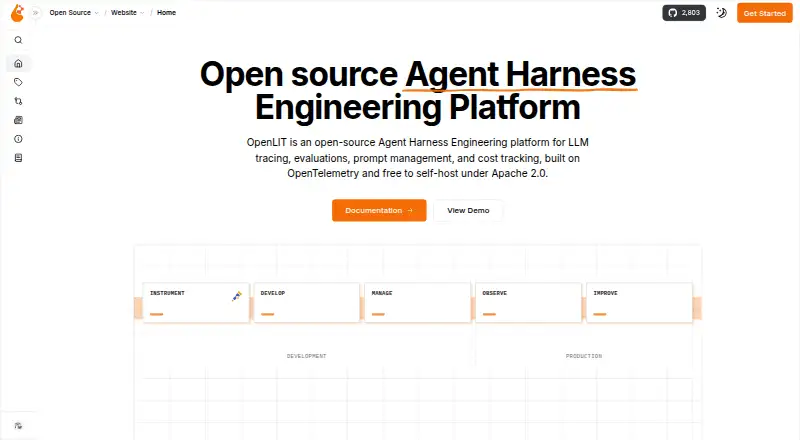
What OpenLIT is
OpenLIT is an open-source Agent Harness Engineering platform for LLM tracing, evaluations, prompt management and cost tracking, built on OpenTelemetry. Tracing can capture model calls, tool use and retrievals, with filters for user, session, cost, latency and metadata. Evaluations support an LLM judge, heuristics or human review on production traffic or experiments. Prompt Hub provides prompt versioning, dynamic variables and API retrieval, as well as AI-assisted improvement. OpenGround compares models side by side for latency, tokens and cost, including with a user’s own key. Coding-agent monitoring covers sessions, cost, tokens, repository activity and code impact. The project lists 56+ integrations across LLMs, agent frameworks, vector databases and GPUs. It can be self-hosted with Docker Compose or Kubernetes Helm and receives OpenTelemetry data through OTLP. The Apache 2.0-licensed project says self-hosting keeps prompts, traces and secrets in the user’s environment. Its free OSS plan lists unlimited self-hosted usage, users, projects and environments. The Cloud plan is marked as coming soon, with price and features not listed.
Good
- Free OSS plan includes unlimited self-hosted usage.
- Tracing covers calls, tools and retrievals.
- Evaluations can use human review.
- Prompt Hub supports versioning and API retrieval.
- Self-hosting supports Docker Compose or Kubernetes Helm.
Watch out
- Cloud plan is listed as coming soon.
- Community support is via GitHub.
- Fleet Hub lists single-cluster collector monitoring.
Who it suits
OpenLIT may suit developers who need LLM tracing, evaluations, prompt workflows and cost visibility. It is especially relevant to those who want to self-host and keep prompts and traces in their environment.
Verdict
OpenLIT combines observability with prompt management and model evaluation, and its OSS plan is free for self-hosted use. Readers seeking a hosted option should note that Cloud is still listed as coming soon.
Plans and prices
From OpenLIT's own pricing page, checked 14 Oct 2026.
| Plan | Price | What it gives you |
|---|---|---|
| OSS | Free | Unlimited self-hosted usage · unlimited users · unlimited projects/environments · community GitHub support · Apache 2.0 |
| Cloud | Priced on request | Fully hosted service · managed infrastructure and upgrades · pricing shared at launch · waitlist only |
The facts
Each one read from OpenLIT's own pages, with the date it was checked.
What it does
- Agent observability
- The platform records LLM calls, tool calls and agent steps for production analysis.checked 14 Oct 2026
- Coding agent monitoring
- Coding agent observability tracks sessions, cost, tokens, repository activity, and code impact.checked 29 Sep 2026
- Coding-agent monitoring
- OpenLIT tracks coding-agent sessions, costs, tokens and repository activity.checked 14 Oct 2026
- Custom dashboards
- Dashboards are backed by ClickHouse and support charts, tables, filters, folders, import and export.checked 14 Oct 2026
- Deployment
- The platform can be self-hosted using Docker Compose or Kubernetes Helm and accepts OpenTelemetry data through OTLP.checked 29 Sep 2026
- Documentation depth
- The documentation includes provider-specific SDK guides, observability pages, controller deployment material, CLI configuration and an indexed documentation file.checked 14 Oct 2026
- Evaluations
- OpenLIT includes built-in evaluations, programmatic evaluations and LLM-as-a-judge workflows that can run locally or in CI.checked 14 Oct 2026
- Funding disclosure
- The reviewed Crunchbase profile does not show a funding total or disclosed funding rounds for OpenLIT.checked 14 Oct 2026
- Go SDK capability
- The Go SDK wraps provider clients and emits traces and metrics for standard and streaming calls, embeddings and image generation.checked 14 Oct 2026
- GPU monitoring
- The GPU collector and dashboards expose utilization, memory, temperature and power metrics.checked 14 Oct 2026
- Guardrails
- The SDK includes guards for prompt injection, jailbreak and sensitive-topic detection using LLM and regular-expression checks.checked 14 Oct 2026
- Integration examples
- Documented integrations include OpenAI, Anthropic, Cohere, Mistral, Ollama, Bedrock, Vertex AI, LangChain, LlamaIndex, Pinecone, Chroma, Qdrant and Milvus.checked 14 Oct 2026
- Integrations
- The home page advertises more than 56 integrations spanning LLMs, agent frameworks, vector databases and GPUs.checked 14 Oct 2026
- Licence
- The project is licensed under Apache License 2.0.checked 14 Oct 2026
- License and data
- OpenLIT is Apache 2.0 licensed, and its site says self-hosting keeps prompts, traces, and secrets in the user's environment.checked 29 Sep 2026
- Limit: independent review coverage
- Product Hunt lists OpenLIT launches but currently shows no user reviews.checked 14 Oct 2026
- Model comparison
- OpenGround compares models side by side for latency, tokens, and cost, and supports bring-your-own-key model comparison.checked 29 Sep 2026
- Notable limits
- Fleet Hub lists single-cluster collector monitoring, while the self-hosted plan lists unlimited usage, historical data, users, projects, and environments.checked 29 Sep 2026
The company
- Company background
- OpenLIT says the project is community-driven, built in public on GitHub, and used by developers worldwide.checked 29 Sep 2026
- Company founder
- Crunchbase identifies Aman Agarwal as a founder.checked 14 Oct 2026
- Company headquarters
- Crunchbase places OpenLIT in New Delhi, Delhi, India.checked 14 Oct 2026
- Company legal name
- Crunchbase lists the legal name as OpenLIT and operating status as active.checked 14 Oct 2026
- Company size
- Crunchbase lists the company size as 1–10 employees.checked 14 Oct 2026
- Company type
- Crunchbase classifies OpenLIT as a private non-profit company.checked 14 Oct 2026
The full review of OpenLIT
OpenLIT is an open-source platform for tracing and evaluating LLM and agent activity, managing prompts, and tracking costs. It is best suited to technically capable teams that want to self-host on OpenTelemetry; the trade-off is that hosted Cloud service is not yet available.
Overview
OpenLIT brings operational visibility and prompt workflows into one platform. It can capture model calls, tools and retrievals, then support evaluation, model comparison and cost review across production traffic and experiments. That breadth is useful for teams building agents as well as conventional LLM applications, but it also means the best fit is a team prepared to deploy and operate its own tooling.
The Apache 2.0 license and Docker Compose or Kubernetes Helm deployment give teams control over the environment. OpenLIT says self-hosting keeps prompts, traces and secrets within the user's environment. Teams that want a managed service instead will need to wait: Cloud is coming soon.
Key features
Tracing and evaluations
Tracing covers calls, tools and retrievals, with filters for user, session, cost, latency and metadata. Those dimensions help teams investigate a costly or slow interaction without losing the context of the agent's work. Evaluations can use an LLM judge, heuristics or human review, and run against production traffic or experiments. This range accommodates both automated checks and human judgment, though it asks teams to decide which evaluation method suits each use.
Prompt Hub and model comparison
Prompt Hub provides versioning, dynamic variables and API retrieval, with unlimited prompt fetching and AI-assisted improvement. It gives teams a way to manage changing prompts alongside observability rather than treating prompt deployment as an unrelated workflow. OpenGround compares models side by side on latency, tokens and cost, including comparisons using a team's own model keys; those measures make it useful when balancing performance against spend.
Agent monitoring, integrations and secrets
Coding agent monitoring tracks sessions, cost, tokens, repository activity and code impact, extending visibility beyond model calls to coding work. The 56+ integrations span LLMs, agent frameworks, vector databases and GPUs, including OpenAI, Anthropic, LangChain, Pinecone and NVIDIA NIM. Vault stores LLM API keys with AES-256-GCM encryption and supports key- and tag-based retrieval with API authentication. Together, these capabilities make OpenLIT relevant to teams with a varied AI stack, not just those using one model provider.
Pricing
OSS
OSS costs nothing. It includes unlimited self-hosted usage, users, projects and environments, plus community support through GitHub. There is no stated usage quota or seat cap, which makes it a strong fit for teams willing to manage deployment themselves. The trade-off is operational responsibility and community support rather than a hosted service. The plan lists Google, Azure AD and GitHub sign-in.
Cloud
Cloud is coming soon, with custom pricing and a hosted service whose pricing and feature set will be shared at launch. It is not a current option for teams that need a managed deployment today.
Platforms
OpenLIT supports API, Linux, macOS, self-hosted, web and Windows. Self-hosting is available through Docker Compose or Kubernetes Helm, and the platform accepts OpenTelemetry data through OTLP. Fleet Hub lists single-cluster collector monitoring, a meaningful limit for teams operating collectors across multiple clusters; the unlimited usage, users, projects and environments in the self-hosted plan do not remove that monitoring constraint.
Who it's for
OpenLIT suits engineering teams that want one self-hosted place to inspect LLM and agent traces, evaluate behavior, manage prompts and compare model costs. Its broad integrations and coding-agent monitoring are particular strengths for teams working across frameworks or building coding agents. It is less suitable for buyers who need managed hosting now, or organizations that require support beyond a GitHub community.
Pros and cons
- Pros: Unlimited self-hosted users, projects, environments and usage avoid plan quotas as a team grows.
- Pros: Tracing, evaluations, prompt versioning and model comparisons cover several connected development tasks in one platform.
- Pros: Apache 2.0 licensing, OTLP ingestion and deployment via Docker Compose or Helm give teams deployment flexibility and data control.
- Cons: Cloud is not yet available, so teams seeking hosted operations cannot adopt it as a managed service today.
- Cons: OSS support is community-based on GitHub, and self-hosting leaves deployment and operation to the team.
- Cons: Fleet Hub's collector monitoring is limited to a single cluster, which may constrain multi-cluster operations.
Alternatives
PetalTrace is another free option with API, Linux, macOS, self-hosted, web and Windows platforms; its maker describes itself as building modular, composable tools for agentic AI systems.
Choose W&B Weave if a hosted alternative with published limits is preferable: its free plan includes 1 GB/mo Weave data ingestion, 5 GB/mo storage, and AI application evaluations, tracing and scorers.
SigNoz offers a self-hosted community plan at no cost, with infrastructure, storage, scaling, upgrades and backups managed by the user.
Opik is an alternative whose core observability and evaluation features are available as open-source code to run locally.
Agenta may suit smaller teams seeking explicit entry-plan caps: its Hobby plan is free and includes 2 team members, 5,000 agent runs/month, 20 evaluations/month and 1-week trace retention.
Langfuse is another freemium option; its Hobby plan is free and includes 50k units / month, 30 days of data access and 2 users.
Traccia offers a free Hobby plan with 50K events and 7 days retention, while its Observe plan is $99 a month with 500K events.
TraceRoot is another freemium alternative for teams considering web-based tooling.
Verdict
Choose OpenLIT if your team can self-host and wants observability, prompt management and evaluation together without per-seat or usage caps in the OSS plan. Its combination of OpenTelemetry support, broad AI-stack integrations and data control is the central reason to choose it. Look elsewhere if you need hosted service or non-community support now; Cloud has not launched, and OSS expects your team to run the platform.
Getting started
- Visit https://openlit.io/ to get started.
- Choose the free OSS plan for self-hosted deployment.
- Deploy with Docker Compose or Kubernetes Helm.
- Send OpenTelemetry data through OTLP.
- Sign in with Google, Azure AD, or GitHub.
Limits worth knowing
The OSS plan lists unlimited self-hosted usage, users, projects, and environments. Fleet Hub lists single-cluster collector monitoring; the Cloud plan is coming soon.
Questions
Is OpenLIT free?
The OSS plan costs nothing and includes unlimited self-hosted usage, users, projects, and environments.
Can OpenLIT be self-hosted?
Yes. It can be deployed with Docker Compose or Kubernetes Helm and accepts OpenTelemetry data through OTLP.
What does OpenLIT trace?
Tracing can capture LLM calls, tools, and retrievals, with filters for user, session, cost, latency, and metadata.
What integrations does OpenLIT list?
The site lists 56+ integrations across LLMs, agent frameworks, vector databases, and GPUs, including OpenAI, Anthropic, LangChain, Pinecone, and NVIDIA NIM.
What is the OpenLIT license?
OpenLIT is Apache 2.0 licensed.
Is there a hosted plan?
The Cloud plan is marked as coming soon. Its pricing and feature set are to be shared at launch.
Alternatives to OpenLIT
- 1

W&B Weave
Free planOpen sourceiOSWebAPILinux8.7From $60 a month - 2

Opik
Free planOpen sourceWebAPILinuxmacOS8.4From $19 a month - 3

Langfuse
Free planOpen sourceWebAPILinuxSelf-hosted8.2From $29 a month - 4

LangWatch
Free planOpen sourceWebAPILinuxmacOS8.2From €29 a month - 5

Agenta
Free planOpen sourceWebAPISelf-hosted8.0From $29 a month - 6

LangSmith
Free planWebAPILinuxmacOS8.0$39 usage-based