
OpenEduCat
OpenEduCat is a modular education platform for institutions, with cloud hosting and on-premise deployment.
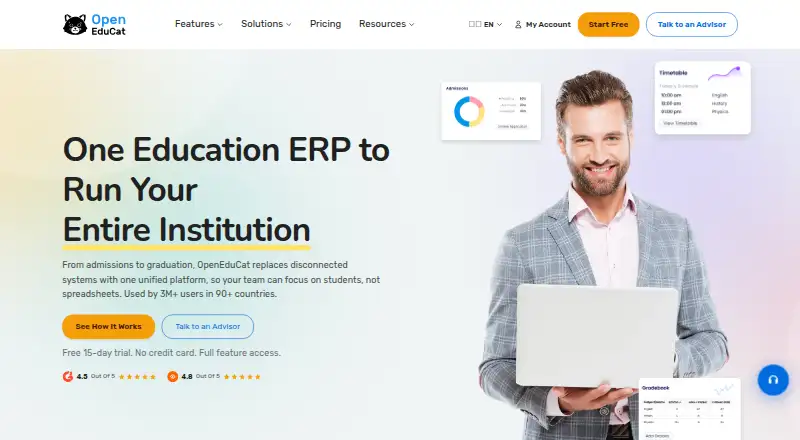
What OpenEduCat is
OpenEduCat is a modular education platform for institutions, with cloud hosting and on-premise deployment. Institutions can choose the modules they need and add more as they grow; the pricing pages state there are no per-student fees. Its systems connect student information with admissions, fees, library, hostel, and other institution functions, and its SIS supports real-time collaboration around student data. Community Edition supports standards and single sign-on options including SCORM, xAPI, LTI 1.3, SAML, Shibboleth, OAuth2, Azure AD, and Google Workspace. Android and iOS apps, assessments, certificates, and API access are listed. The Free Edition has no learner cap or time limit, though capacity depends on hardware. Institutions own their data and can self-host without student limits or license call-home. The Free Edition uses the LGPL-3.0 license, with source code public on GitHub. A 15-day trial is offered without a credit card; the site lists a No Refund Policy. OpenEduCat Core is listed at $489 a year.
Good
- Institutions can add modules as needs grow.
- No per-student fees are listed.
- Free Edition has no learner cap or time limit.
- Supports cloud hosting and on-premise deployment.
- Android and iOS apps are listed.
Watch out
- The required Core subscription is $489 a year.
- The site lists a No Refund Policy.
- Free tier capacity depends on hardware.
Who it suits
OpenEduCat may suit institutions that want to assemble education functions from modules and choose cloud or on-premise deployment. It is also relevant to institutions seeking self-hosting, data ownership, and no per-student fees.
Verdict
OpenEduCat offers a broad modular education system with cloud and self-hosted options, plus a free edition without a learner cap. Institutions should note that Core is required for deployments and the listed refund policy is no refunds.
Plans and prices
From OpenEduCat's own pricing page, checked 20 Sep 2026.
| Plan | Price | What it gives you |
|---|---|---|
| Community Edition | Free | No learner cap · No time limit · Free edition |
| OpenEduCat Core — 1 Year | $489 a year | Required base for every deployment · billed annually |
| Modules & Apps — 1 Year | $79 a year | Modular education features · Examples include Assignment, Classroom, Exam, and SSO · billed annually |
| 25 Users Cloud Pack — 1 Year | $29 a year | 25 users · Cloud only |
| OpenEduCat Core — 2 Years | $978 a year | Required base for every deployment · 2-year term; buy 2 years, get the 3rd year free |
| Modules & Apps — 2 Years | $158 a year | Modular education features · 2-year term; buy 2 years, get the 3rd year free |
| 25 Users Cloud Pack — 2 Years | $58 a year | 25 users · 2-year term; cloud only; buy 2 years, get the 3rd year free |
| OpenEduCat Core — One-Time On-Premise | $1,319, paid once | On-premise licensing · Required base for every deployment · One-Time (On-Premise) |
| OpenEduCat Core — One-Time On-Premise | $1,319 a month | On-premise licensing · Required base for every deployment · One-Time (On-Premise) |
| Modules & Apps — One-Time On-Premise | $208, paid once | On-premise licensing · Modular education features · One-Time (On-Premise) |
| Modules & Apps — One-Time On-Premise | $208 a month | On-premise licensing · Modular education features · One-Time (On-Premise) |
| OpenEduCat Core | $489 a year | Required base for every deployment. · $489 for 1 year |
| Two-Year License | $978 a year | Applies to listed two-year pricing; taxes are not included. · buy 2 years, get the 3rd year free |
| Core On-Premise | $1,319, paid once | One-time on-premise licensing. · $1,319 one-time |
The facts
Each one read from OpenEduCat's own pages, with the date it was checked.
What it does
- API access
- Yeschecked 20 Sep 2026
- Assessments
- Yeschecked 20 Sep 2026
- Certificates
- Yeschecked 20 Sep 2026
- Deployment options
- It supports cloud hosting and on-premise deployment.checked 27 Sep 2026
- Global reach
- The platform reports more than 3 million users across over 90 countries.checked 27 Sep 2026
- Modular pricing
- Institutions pay for the modules they need and can add more as they grow.checked 27 Sep 2026
- Module count
- The platform offers more than 70 modules on a single database.checked 27 Sep 2026
- Native integrations
- It integrates with admissions, fees, library, hostel, and other institution systems.checked 27 Sep 2026
- No per-student fees
- The pricing pages state there are no per-student fees.checked 27 Sep 2026
- Open-source license
- The Free Edition is licensed under LGPL-3.0 and its source code is public on GitHub.checked 27 Sep 2026
- Real-time collaboration
- The SIS enables real-time collaboration around student data.checked 27 Sep 2026
- Refund policy
- The site lists a No Refund Policy.checked 27 Sep 2026
- Security compliance
- The site describes FERPA-aligned handling, audit trails, and enterprise-grade security.checked 27 Sep 2026
- SSO support
- Yeschecked 20 Sep 2026
- Standards and SSO
- Community Edition supports SCORM, xAPI, LTI 1.3, SAML, Shibboleth, OAuth2, Azure AD, and Google Workspace SSO.checked 27 Sep 2026
The company
- Company history
- OpenEduCat says it was founded in 2014 and has served education for over 12 years.checked 27 Sep 2026
- Data ownership
- Institutions own their data and can self-host without student limits or license call-home.checked 27 Sep 2026
- Founded
- 2014checked 28 Sep 2026
- Headquarters
- Indiachecked 28 Sep 2026
Money
- Free plan
- Yeschecked 20 Sep 2026
- Free tier limits
- There is no course, assignment, or learner cap; capacity depends on hardware.checked 27 Sep 2026
- Free trial
- A 15-day trial is offered without requiring a credit card.checked 27 Sep 2026
Where it runs
- Mobile app
- Yeschecked 20 Sep 2026
- Mobile apps
- The pricing page lists Android App and IOS App products.checked 27 Sep 2026
The full review of OpenEduCat
Overview
OpenEduCat is a modular education platform that brings learning tools and student information management together. It is best suited to institutions that want to connect academic and campus operations rather than assemble separate systems. Its breadth and uncapped Community Edition are compelling, but paid deployments require Core, so the free edition is the clearest route for institutions prepared to manage their own hosting.
Key features
OpenEduCat offers more than 70 modules on a single database, with real-time collaboration around student data. Assessments and certificates are supported, and native integrations connect admissions, fees, library and hostel systems. That scope can suit institutions trying to coordinate administrative and academic work in one platform; the trade-off is that its modular pricing requires buyers to decide which capabilities they need.
The Community Edition supports SCORM, xAPI and LTI 1.3, plus SAML, Shibboleth, OAuth2, Azure AD and Google Workspace single sign-on. It also provides API access. These standards and sign-in options make the free edition unusually capable as a foundation, while the listed Android and iOS apps extend access to mobile devices.
Institutions can choose cloud hosting or on-premise deployment and retain ownership of their data. OpenEduCat describes FERPA-aligned handling, audit trails and enterprise-grade security. Self-hosting avoids student limits and license call-home, but requires Linux, Python 3.10+ and PostgreSQL 14+, and actual capacity depends on the hardware in use.
Pricing
The Community Edition costs nothing edition, has no time limit and imposes no course, assignment or learner cap. It is licensed under LGPL-3.0, with public source code on GitHub. The absence of a learner ceiling is valuable for institutions able to host and maintain it, though hardware still sets practical capacity.
Every paid deployment requires OpenEduCat Core. The annual Core plan is $489 a year; the Modules & Apps plan is $79 a year and adds modular education features such as Assignment, Classroom, Exam and SSO. Since Core is mandatory, the module price is not the full cost of a paid deployment. Institutions pay for needed modules and can add more as they grow, with no per-student fees.
Two-year options cost $978 a year for Core and $158 a year for Modules & Apps; both advertise a third year free when buying two years. The 25 Users Cloud Pack is $29 a year, or $58 a year for a two-year term with the same third-year offer. It is cloud-only and limited to 25 users, so it is not a substitute for an uncapped institutional deployment.
For on-premise licensing, Core is $1,319 a month on a one-time plan, while Modules & Apps is $208, paid once. The distinct billing descriptions make it important to confirm the purchase terms before choosing these options. A 15-day trial requires no credit card, but the refund policy is no refunds.
Platforms
OpenEduCat supports Android, iOS, Linux, API access and self-hosting. Cloud hosting is also an option. Self-hosted installations require Linux, Python 3.10+ and PostgreSQL 14+.
Who it's for
OpenEduCat is a strong fit for schools and other education institutions seeking a broad set of connected academic and administrative modules, especially those that value data ownership, standards support and a free edition without learner caps. Institutions with limited technical capacity may prefer a hosted deployment. Buyers seeking only one narrow function, or unwilling to take on a mandatory Core plan for paid use, should compare more focused products.
Pros and cons
- Pro: The Community Edition has no time or learner cap, making it viable for institutions whose hardware can support their needs.
- Pro: More than 70 modules, native institutional integrations and standards support can bring a wide range of campus work onto one database.
- Pro: Institutions own their data, and self-hosting avoids student limits and license call-home.
- Con: Core is required for every paid deployment, so the $79 a year module price alone understates the cost of using paid features.
- Con: Self-hosting carries explicit infrastructure requirements, and real capacity depends on hardware.
- Con: The 25 Users Cloud Pack is narrowly capped, and the no-refund policy leaves little room to reverse a purchase.
Alternatives
For a narrower need, compare School Accounting Software, Course Registration Software, Exam Scheduling Software and Education CRM Software; for a learning-focused shortlist, see Learning Management Systems.
- Software Unlimited School Accounting System is a paid school-accounting alternative with a free trial and Android, iOS, macOS, web and Windows platforms.
- PowerSchool Behavior Support is a paid option focused on behavior support, with Android, iOS and web platforms.
- Sparkrock Ed K-12 ERP is a paid alternative with Android, iOS and web platforms; its plans use employee or student counts.
- School Console is a paid school subscription with Android, iOS and web platforms; it has no free plan or trial, and pricing varies by institution size, modules and implementation length.
- Skyward School Business Suite offers custom-proposal pricing based on enrollment, campuses and feature suite, with Android, iOS and web platforms.
- Blackbaud Financial Edge NXT is a paid, web and API-accessible alternative with personalized pricing.
- Kuali Curriculum Management is a paid, web and API-accessible alternative with pricing available through a personalized demo.
- Black Mountain School Accounting is a web-based paid alternative with customized pricing based on population size and applications needed.
Verdict
Choose OpenEduCat if your institution wants a broad, connected education system and values uncapped self-hosting, data ownership and modular growth. Its free edition is the strongest starting point; look elsewhere if you need a small, focused tool or want paid features without Core as a required base.
Getting started
- Visit the OpenEduCat website.
- Choose the Community Edition or start the 15-day trial without a credit card.
- Select cloud hosting or plan an on-premise deployment.
- For self-hosting, use Linux, Python 3.10+, and PostgreSQL 14+.
- For a paid deployment, include OpenEduCat Core as the required base and select needed modules.
Limits worth knowing
The Free Edition has no learner cap or time limit, though capacity depends on hardware. Paid deployments require OpenEduCat Core, listed at $489 per year, and modules are priced separately.
Questions
Is OpenEduCat free?
Community Edition is free, with no learner cap or time limit. Paid deployments require OpenEduCat Core, listed at $489 per year.
Does OpenEduCat charge per student?
The pricing pages state that there are no per-student fees.
Can an institution self-host OpenEduCat?
Yes. Deployment options include on-premise hosting, and self-hosting can use Linux, Python 3.10+, and PostgreSQL 14+.
Is OpenEduCat open source?
The Free Edition is licensed under LGPL-3.0, and its source code is public on GitHub.
What platforms and apps are listed?
Listed platforms include Android, iOS, Linux, API, and self-hosted. The pricing page lists Android App and iOS App products.
How long is the trial, and does it require a credit card?
The trial lasts 15 days and does not require a credit card. The site lists a No Refund Policy.
Alternatives to OpenEduCat
- 1
Kinderpedia Admissions
AndroidiOSWebAPI7.6From €49 a month - 2

Neexa Education CRM
Free planAndroidWebAPIExtension7.6From $199 a month - 3
LeadSquared
AndroidiOSWebAPI7.5 - 4
EduCRM
Free planWebAPI7.3From €49.99 a month - 5
Salesforce Education Cloud
AndroidiOSWebAPI7.1From $87 a month - 6
AdmitCue
Free planWeb7.0Free plan