Kuali Curriculum Management
Kuali Curriculum Management helps higher education institutions manage curriculum proposals, reviews, approvals and academic changes.
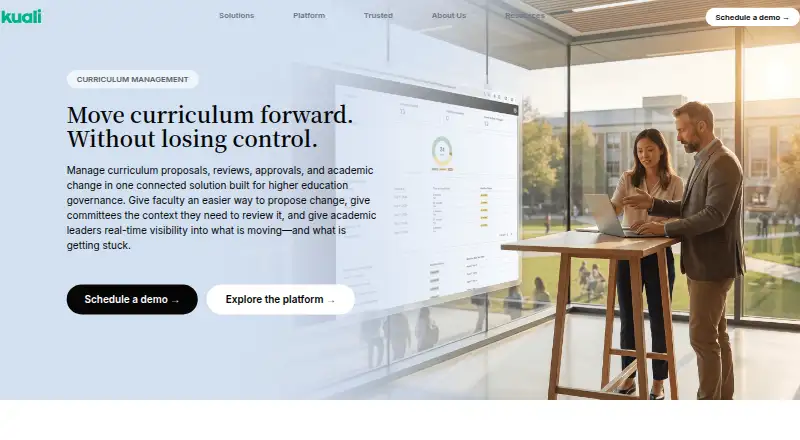
What Kuali Curriculum Management is
Kuali Curriculum Management helps higher education institutions manage curriculum proposals, reviews, approvals and academic changes. Institutions can configure forms for courses, programs, policies and other changes, then route proposals to faculty, committees and academic leaders under their approval structures. The system tracks proposals, approvals, bottlenecks and outstanding work. Reviewers can see prerequisites, corequisites and program relationships when assessing a proposed change. Embedded AI can create or modify workflows, adjust forms and approval processes, refine proposal content, and locate stalled proposals using natural-language prompts. Approved curriculum can flow into Kuali Catalog, and approved course information can connect with Kuali Syllabus Management. The API-first platform supports connections to campus systems through REST APIs and GraphQL. Kuali says customer data is encrypted in transit and at rest, and role-based access is configurable. Product implementation and support are handled in-house. The product page invites institutions to schedule a demo but gives no numeric price, free plan or free trial.
Good
- Configurable forms cover courses, programs and policies.
- Routes proposals according to institutional approval structures.
- Tracks bottlenecks and outstanding work.
- Approved curriculum can flow into Kuali Catalog.
- Supports REST APIs and GraphQL.
Watch out
- No numeric price is stated.
- No free plan or free trial is stated.
- Permanent deletion requires a support portal request.
Who it suits
It is intended for higher education institutions and teams managing curriculum processes across faculty, departments, registrars, committees and academic leadership. It may suit institutions that need configurable approval paths and curriculum lifecycle tracking.
Verdict
Kuali Curriculum Management focuses on governance workflows and visibility across academic curriculum changes. Institutions should arrange a demo to discuss fit and pricing, and note the stated deletion process.
Plans and prices
From Kuali Curriculum Management's own pricing page, checked 3 Oct 2026.
| Plan | Price | What it gives you |
|---|---|---|
| Kuali Curriculum Management | Priced on request | Pricing available through a personalized demo; no numeric price stated |
The facts
Each one read from Kuali Curriculum Management's own pages, with the date it was checked.
What it does
- AI features
- Embedded AI can create or modify workflows, change forms or approval processes, refine proposal content, and find stalled proposals using natural-language prompts.checked 2 Oct 2026
- AI workflows
- Embedded AI can create or modify workflows, change forms or approval processes, refine proposal content, and identify stalled proposals using natural-language prompts.checked 3 Oct 2026
- Catalog integration
- Approved curriculum can flow into Kuali Catalog to reduce manual re-entry and keep published academic information aligned with approved changes.checked 2 Oct 2026
- Compliance
- Kuali says it supports FERPA compliance through secure infrastructure, access controls, and audit logging, with responsibilities shared between Kuali and customers.checked 3 Oct 2026
- Configurable forms
- Institutions can configure forms and workflows for courses, programs, policies, and other academic changes.checked 3 Oct 2026
- Connected products
- Approved curriculum can flow into Kuali Catalog, and approved course information can connect with Kuali Syllabus Management.checked 3 Oct 2026
- Data deletion
- Data marked as deleted is retained; customers can submit a support portal request for permanent deletion.checked 3 Oct 2026
- Dependencies
- Reviewers can see prerequisites, corequisites, program relationships, and other dependencies to assess proposed changes.checked 3 Oct 2026
- Governance routing
- Proposals can be routed to faculty, committees, and academic leaders according to institutional policies and approval structures.checked 3 Oct 2026
- Governance workflows
- Proposals can be routed to faculty, committees, and academic leaders according to institutional policies and approval structures.checked 2 Oct 2026
- Identity and backups
- Kuali says it supports federated single sign-on and multi-factor authentication through customer identity providers, and performs snapshot backups at least daily.checked 3 Oct 2026
- Integrations
- Kuali describes its platform as API-first and says its applications expose APIs, including REST and GraphQL, for connecting with institutional systems.checked 3 Oct 2026
- Intended users
- Kuali describes the product as built for higher education and references faculty, committees, academic leaders, and academic operations teams as users.checked 2 Oct 2026
- Notable limits
- The product page directs prospective customers to schedule a demo and does not state a public price or trial terms.checked 2 Oct 2026
- Other integrations
- Kuali says its platform is API-first and supports connections to campus systems through REST APIs and GraphQL.checked 2 Oct 2026
- Pricing availability
- The product page invites institutions to schedule a demo but does not state a numeric price, free plan, or free trial.checked 3 Oct 2026
- Process visibility
- The product tracks proposals, approvals, bottlenecks, and outstanding work across the curriculum lifecycle.checked 3 Oct 2026
- Proposal forms
- Configurable forms support proposals for courses, programs, policies, and other academic changes.checked 2 Oct 2026
- Purpose
- Kuali Curriculum Management manages curriculum proposals, reviews, approvals, and academic change for higher education governance.checked 3 Oct 2026
- Security
- Kuali says customer data is encrypted at rest and in transit and access can be controlled by configurable roles and permissions.checked 3 Oct 2026
- Support
- Kuali says curriculum product implementation and support are handled in-house by its team.checked 2 Oct 2026
- Who it is for
- The product is presented for higher education institutions and teams managing faculty, departmental, registrar, committee, and academic leadership curriculum processes.checked 3 Oct 2026
The company
- Company history
- Kuali says the Kuali project began in 2004 and that the Kuali Foundation invested in a company in 2014.checked 2 Oct 2026
- Headquarters
- Lehi, Utah, United Stateschecked 28 Sep 2026
The full review of Kuali Curriculum Management
Kuali Curriculum Management is a governance-focused system for higher-education curriculum proposals and academic changes. It suits institutions coordinating faculty, committee, registrar, and leadership review, especially when processes differ by proposal type. Its case is strongest where structured approvals and cross-system visibility matter more than a self-service purchase.
Overview
The platform brings proposal intake, review, approval, and curriculum change into one institutional process. Configurable forms cover courses, programs, policies, and other academic changes, while routing follows each institution’s approval structures. That makes it more appropriate for formal, multi-stage governance than for a team seeking only a simple catalog editor.
Process tracking shows proposal status, approvals, bottlenecks, and outstanding work across the curriculum lifecycle. Reviewers can see prerequisites, corequisites, program relationships, and related dependencies, giving committees and academic leaders context before they approve a change.
Key features
Configurable forms and routing
Institutions can tailor proposal forms and send submissions to faculty, committees, and academic leaders according to policy. This is useful when departments or proposal categories follow different paths. The trade-off is that organizations with a single, uncomplicated approval route may gain little from extensive configuration.
AI-assisted administration
Embedded AI accepts natural-language prompts to create or modify workflows, change forms or approval processes, refine proposal content, and find stalled proposals. These capabilities could reduce administrative effort in a heavily customized process, but they do not replace the institution’s responsibility to define sound governance rules.
Impact visibility and connected records
Dependency views expose prerequisites, corequisites, program relationships, and other links that can be affected by a proposed change. Approved curriculum can flow into Kuali Catalog, reducing duplicate entry and helping published academic information stay aligned. Approved course information can also connect with Kuali Syllabus Management.
Integration, security, and continuity
Kuali describes its platform as API-first, with REST and GraphQL interfaces for campus-system connections. Federated single sign-on and multi-factor authentication can use customer identity providers. Kuali says data is encrypted in transit and at rest, access is controlled through configurable roles and permissions, and snapshot backups run at least daily. Its Trust Center says an independent SOC 2 assessment covers security, availability, and confidentiality controls for select products. Data marked for deletion remains retained until a customer submits a support-portal request for permanent deletion, an operational consideration for institutions with strict retention policies.
Pricing
The Kuali Curriculum Management plan has custom pricing obtained through a personalized demo. No numeric price, free plan, or free-trial terms are stated, so buyers cannot compare costs or evaluate the product on a self-serve basis. The product is paid software, and Kuali says implementation and support for its curriculum products are handled in-house. Institutions should use the demo to establish licensing scope, implementation work, renewal terms, and any limits that apply to their environment.
Platforms
Kuali Curriculum Management is offered through web access and an API. Its API orientation is relevant for institutions that need curriculum data to connect with campus systems rather than operate as an isolated application.
Who it's for
This is designed for higher-education institutions and academic operations teams managing faculty, departmental, registrar, committee, and academic-leadership processes. It is a strong match when approvals are policy-driven, involve several groups, and require visibility into dependencies and stalled work. Smaller organizations with straightforward approvals, or buyers requiring transparent pricing and a trial, should consider alternatives.
Pros and cons
Pros
- Governance can reflect institutional policy: configurable forms and routing support different proposal types and approval structures.
- Better decision context: dependency information helps reviewers assess effects on prerequisites, corequisites, and program relationships.
- Less duplicate entry: approved curriculum can flow to Kuali Catalog and connect approved course information with Kuali Syllabus Management.
- Enterprise integration controls: REST and GraphQL APIs, federated sign-on, multifactor authentication, role permissions, encryption, and daily snapshot backups support campus IT requirements.
- In-house service: Kuali says its team handles implementation and support for the curriculum products.
Cons
- No public price or trial: every institution must pursue a demo before it can assess cost or access the product.
- Configuration may be excessive for simple processes: organizations with one basic approval path may not benefit from the product’s governance depth.
- Deletion requires a support request: deleted data is retained until permanent deletion is separately requested.
- Integration work remains part of adoption: API availability enables connections but does not remove the planning required to link campus systems.
Alternatives
For a broader research-administration comparison, see Research Administration Software. For focused curriculum tools, browse Curriculum Management Software. Institutions evaluating finance-oriented products can consult School Accounting Software.
- OneRamp ERA Suite is a paid Android, iOS, and web option when mobile platform coverage matters more than Kuali’s curriculum-governance focus; pricing requires contacting the company.
- OpenClinica is the better fit for research data capture when a free plan, free trial, or a defined Launch tier at $750 a month is important; its Launch limits include 150 participants, three sites, EDC only, and email notifications without API/SM support.
- Cayuse Award Management is an alternative for award-management workflows with API and web access; pricing requires an information request.
- GrantsNow is a paid web-based alternative.
- InfoEd Global is a paid option with API, self-hosted, web, and Windows platforms when deployment flexibility is a priority; pricing is provided through a demo.
- Pure Award Management is a paid API and web alternative.
- CommunityForce is a paid web platform when awards management is the requirement; pricing is discussed through a demo or expert consultation.
- eProtocol is a paid self-hosted and web alternative.
Verdict
Choose Kuali Curriculum Management if your institution needs configurable, policy-driven curriculum governance with dependency awareness, lifecycle tracking, and connections to campus systems. Look elsewhere if transparent pricing, a free trial, mobile access, or a simpler approval process is more important than institutional workflow depth.