
Atlas
Atlas is a web platform for curriculum planning, assessment, and reporting in public, independent, and international schools.
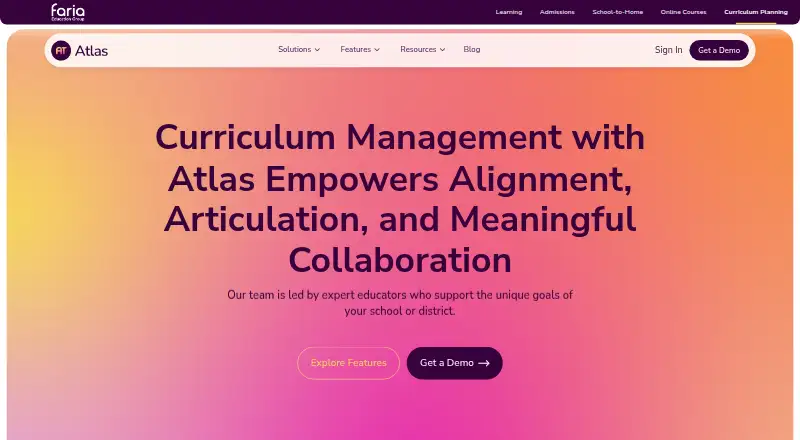
What Atlas is
Atlas is a web platform for curriculum planning, assessment, and reporting in public, independent, and international schools. It serves coordinators, teachers, students, and parents. Schools can tailor unit-planner templates with requirements and examples, while teachers can prepare lesson plans aligned to unit standards, attach resources, and send plans to Google Classroom.
AI-powered curriculum reports identify alignment gaps, coverage patterns, and opportunities to improve curriculum coherence. Schools can select from almost 3 million standards, request additions, or add and customize their own. Atlas also supports approval workflows, version history, curriculum levels, and PDF exports. Listed connections include Google Classroom, ManageBac, ClassLink, LTI platforms such as Canvas and Schoology, and sign-in through Google, Office 365, Clever, or school ADFS. Pricing is on request, and a free trial is offered without a stated duration. Standard support comes with every license; premium support is listed at $650 annually. Atlas began as a tool for a Portland independent school in 1999, and Rubicon joined Faria Education Group in 2018.
Good
- Customizable unit templates can include requirements and examples.
- Teachers can align lesson plans to unit standards.
- AI reports highlight alignment gaps and coverage patterns.
- Schools can select from almost 3 million standards.
- Supports Google Classroom, Canvas, Schoology, ManageBac, and ClassLink.
Watch out
- Pricing is available on request rather than as a listed license price.
- Premium support is an additional $650 annually.
Who it suits
Atlas suits school coordinators and teachers planning curricula, aligning lessons to standards, and reviewing curriculum coverage. Its reporting and sharing tools may also be useful to students and parents served by a school using the platform.
Verdict
Choose Atlas if your school needs web-based curriculum planning, standards alignment, and reports on curriculum coverage. Consider the on-request pricing and the separate cost of premium support when evaluating it.
Plans and prices
From Atlas's own pricing page, checked 30 Sep 2026.
| Plan | Price | What it gives you |
|---|---|---|
| Standards | Free | Atlas standards library; schools can add or customize standards |
| Public Atlas Site | $500 a year | Public curriculum website · configurable visibility · optional password · automatic updates · Annual fee |
| Premium Support | $650 a year | Email and phone support · priority response · custom resources · user/course additions · template modifications · virtual training · FariaLearn courses · Annual fee |
| Core Atlas subscription | Priced on request | Curriculum planning, lesson planning, analytics and integrations · Contact sales; free trial offered |
The facts
Each one read from Atlas's own pages, with the date it was checked.
Money
- Additional service costs
- The services page lists project work at $80 per hour with a $320 minimum, virtual training at $200 per training, and onsite training at $2,000 per day plus travel costs.checked 30 Sep 2026
- Lesson planning
- Teachers or schools can create lesson templates, attach resources and standards, and send lessons to Google Classroom.checked 14 Oct 2026
What it does
- AI authoring
- Atlas AI generates starting unit content from course, grade, standards and teacher instructions, including student-friendly or multilingual output.checked 14 Oct 2026
- AI transparency
- Atlas displays when AI was used so collaborators can see AI-assisted content creation.checked 14 Oct 2026
- Analytics
- Atlas offers AI-powered curriculum reports that identify alignment gaps, coverage patterns, and opportunities to improve curriculum coherence.checked 30 Sep 2026
- API
- The public API provides programmatic read access to curriculum data through HTTPS JSON endpoints using bearer tokens and personal API keys.checked 14 Oct 2026
- Assessment analytics
- Schools can customize assessment methods and review their use with pie and bar reports.checked 14 Oct 2026
- Audience
- The platform serves school coordinators, teachers, students, and parents.checked 30 Sep 2026
- Collaboration
- Comments and discussions can be attached to courses, units and reports for curriculum collaboration.checked 14 Oct 2026
- Course calendar
- Course-at-a-glance views include unit calendars whose durations can be adjusted with a sliding control.checked 14 Oct 2026
- Curriculum analytics
- Analytics identify alignment gaps, coverage patterns, scope-and-sequence relationships, redundancies and interdisciplinary links.checked 14 Oct 2026
- Curriculum browsing
- Teachers can browse school- and district-wide curriculum and filter it by grade, subject or course.checked 14 Oct 2026
- Dashboards
- Users can personalize landing pages, rearrange panels and create dashboards for user groups.checked 14 Oct 2026
- Documentation
- The help center contains separate getting-started, administrator and user guides, videos, webinars and update notes.checked 14 Oct 2026
- Global search
- Keyword and standards search can show where concepts occur across subjects, grades and courses using charts and filters.checked 14 Oct 2026
- History
- Atlas says its first version was created in 1999 for an independent school in Portland, Oregon, and that Rubicon joined Faria Education Group in 2018.checked 30 Sep 2026
- Integrations
- The feature page lists sign-in with Google, Office 365, Clever, or school ADFS, plus ManageBac, Google Classroom, LTI platforms such as Canvas and Schoology, and ClassLink.checked 30 Sep 2026
- Learning goals
- The system tracks school learning goals such as student-learning outcomes, 21st-century skills and career skills.checked 14 Oct 2026
- Legal entity
- The website footer identifies Rubicon West LLC as the copyright holder, and Faria's privacy terms identify it as a Delaware entity operating Atlas.checked 14 Oct 2026
- Limit: implementation support
- An independent school curriculum document says a Rubicon Atlas rollout lost momentum because the school lacked enough structure and support.checked 14 Oct 2026
The company
- Company history
- Atlas originated in 1999 for a Portland independent school, Rubicon was founded in 1989, joined Faria in 2018 and launched Atlas in 2020.checked 14 Oct 2026
- Company scale
- Atlas says it is used by educators at more than 6,000 schools and districts, while Faria says its wider group serves over 10,000 schools in 130 countries.checked 14 Oct 2026
- Founded
- 1999checked 23 Sep 2026
- Headquarters
- Portland, Oregon, United Stateschecked 23 Sep 2026
The full review of Atlas
Atlas is a school curriculum platform that brings planning, standards alignment, assessment, and reporting into a shared online workspace. It is most relevant to school leaders and teachers coordinating curriculum across levels and courses. Its planning tools are broad, but the custom-priced core license and separately priced services call for careful budgeting.
Overview
Atlas serves public, independent, and international schools, with tools for coordinators, teachers, students, and parents. Schools can shape unit-planner templates around their own requirements and examples; teachers can then build standards-aligned lesson plans, add resources, and send plans to Google Classroom. Approval workflows and version history support review and continuity, particularly for schools with established curriculum approval processes.
The platform began in 1999 as a system created for an independent school in Portland, Oregon. Rubicon joined Faria Education Group in 2018.
Key features
- Custom planning: Schools can tailor unit templates rather than adopt a fixed planning format, and include guidance to help staff write consistently. Teachers can connect lessons to unit standards and attach resources, making the platform useful for coordinated planning across curriculum levels.
- Curriculum reporting: AI-powered reports surface alignment gaps, coverage patterns, and opportunities to improve coherence. These tools can help curriculum leaders see where planned coverage needs attention, though they are aimed at school-level curriculum work rather than individual lesson delivery alone.
- Standards library: Schools can choose from almost 3 million standards, request additions, or create and customize their own. That breadth gives schools options across varied curricula, while the ability to add standards helps when existing entries do not fit.
- Connections and governance: Sign-in options include Google, Office 365, Clever, and school ADFS. Integrations include ManageBac, Google Classroom, LTI platforms such as Canvas and Schoology, and ClassLink. Approval workflows and version history add structure to collaborative work; PDF exports provide a way to take curriculum materials out of the platform.
- Security and privacy: Faria says its learning platform is ISO/IEC 27001:2022 certified and encrypts data in transit and at rest. It also says it is GDPR-compliant and hosts data in locations including Canada, China, and the EU. Schools should weigh those protections alongside their own requirements for data hosting and governance.
Pricing
Atlas’s main platform uses custom pricing, and a free trial is offered without a stated duration. Schools should ask sales about the license cost and trial terms before comparing budgets. Standard support is included with every license, but premium support and implementation services add separate charges.
| Plan or service | Price | What it includes |
|---|---|---|
| Standards | free | Atlas standards library; schools can add or customize standards. |
| Public Atlas Site | $500 a year (billed Annual Fee) | A customized public page for sharing selected curriculum. |
| Premium Support | $650 a year (billed Annually) | Priority email response, custom resources and videos, annual user and course support, unit-template modifications, and virtual technical training. |
The free Standards plan covers the standards library, not the full planning and reporting platform. The Public Atlas Site suits schools that want to publish selected curriculum, rather than use it as a substitute for the core license. Premium Support is optional; schools can use the included standard support instead, but do not receive its priority response and additional services.
Other service costs can add up: project work is $80 per hour with a $320 minimum, virtual training is $200 per training, and onsite training is $2,000 per day plus travel costs. Schools expecting setup or staff training should include these charges in their total cost estimate.
Platforms
Atlas is web-based. Its integration options connect it with common school identity and learning systems, including Google Classroom and LTI platforms such as Canvas and Schoology. It also offers PDF curriculum exports.
Who it's for
Atlas is a strong fit for schools that need shared unit and lesson planning, standards alignment, and reports on coverage across curriculum levels. Its configurable templates and broad standards library suit teams coordinating curriculum across departments or programs. A school seeking only a low-cost individual planning tool may find the custom-priced core license and additional service fees hard to justify.
Pros and cons
- Pro: Custom unit templates and standards options let schools align planning to their own requirements instead of working within a single fixed structure.
- Pro: AI-powered reports identify alignment gaps and coverage patterns, supporting curriculum review beyond the creation of plans.
- Pro: Google Classroom sharing, multiple sign-in choices, and LMS integrations connect planning with school systems.
- Pro: Standard support is included with every license, and the Standards plan is free for schools that need the library alone.
- Con: The core platform has custom pricing, so schools cannot assess its license cost from a published rate.
- Con: Premium support, project work, and training carry separate charges; schools needing substantial assistance should budget beyond the license.
- Con: The trial has no stated duration, making it harder to plan an evaluation period without confirming terms with sales.
Alternatives
For a broader comparison, browse Curriculum Management Software.
- OpenCurriculum is worth considering for teams that want a free starting tier: its Teacher plan covers one user, 10 courses, and 200 MB of storage, while its Team plan covers up to 10 users, 50 courses, and 1.5 GB.
- Outcomap may suit users who want a free, limited mapping tool: its forever-free plan allows one map, five AI map generations and edits per month, and PDF exports up to five pages; the Pro plan is $90 a year.
- ExamSoft is another paid option, with capabilities and terms dependent on the customer’s order form.
- Modern Campus CMS is another paid platform to consider.
- Ilios is a paid, open-source option for schools that prioritize software they can fork and adapt through its community project.
- CourseLoop is another paid curriculum-management option.
- Kuali Curriculum Management is a paid alternative whose pricing is available through a personalized demo.
- PeopleGrove Engagement Hub is another web-based option to consider.
Verdict
Atlas is best for schools that need a coordinated, standards-based approach to curriculum planning and want reporting to identify coverage and alignment issues. Its customizable planning, standards library, and school-system integrations make it a serious option for curriculum teams. Look elsewhere if a published core price or a lighter-cost individual tool is essential; custom licensing and potentially substantial support and training charges make the total commitment important to establish first.
Getting started
- Visit https://www.onatlas.com/.
- Contact sales or start the offered free trial.
- Choose the web platform for your school community.
- Sign in with Google, Office 365, Clever, or school ADFS, or use a listed integration.
- Customize unit-planner templates and select or add standards.
Limits worth knowing
A free Standards plan provides the standards library, and schools can add or customize standards.
Questions
How much does Atlas cost?
Pricing for Atlas is on request. A customized Public Atlas Site is listed at $500 per year, and Premium Support at $650 annually.
What platforms does Atlas support?
Atlas is a web platform.
Which school systems and sign-in options are listed?
Integrations include ManageBac, Google Classroom, LTI platforms such as Canvas and Schoology, and ClassLink. Sign-in options include Google, Office 365, Clever, and school ADFS.
Can schools customize standards?
Yes. Schools can select from almost 3 million standards, request additions, or add and customize their own.
What support comes with a license?
Standard support is included with every license. Premium support is listed for $650 annually.
Alternatives to Atlas
- 1

Ilios
Open sourceAndroidiOSWebAPI7.7From $1,000 a month - 2
OpenCurriculum
Free planWebAPISelf-hosted7.3From $5 a month - 3
mapEDU
Free planWebAPI6.7Free plan - 4
ExamSoft
iOSWebmacOSWindows6.6 - 5
Outcomap
Free planWeb6.5From $90 a year - 6
Watermark Curriculum Strategy
AndroidiOSWebAPI6.5