
Open Archiver Enterprise
Open Archiver Enterprise stores company email as a searchable archive on infrastructure the organization controls.
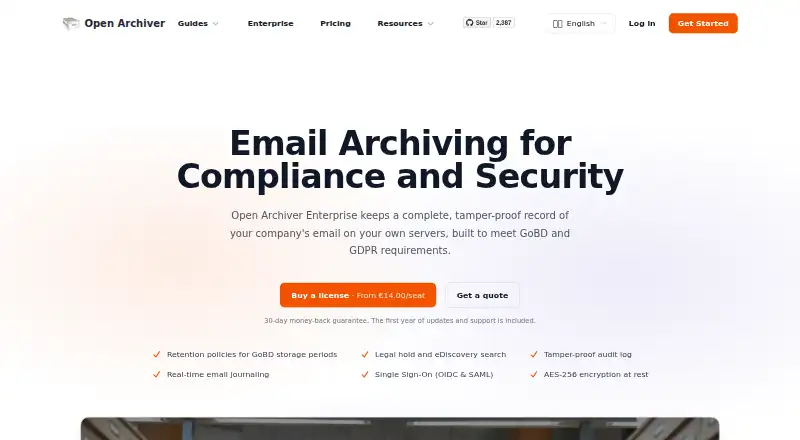
What Open Archiver Enterprise is
Open Archiver Enterprise stores company email as a searchable archive on infrastructure the organization controls. It connects to Google Workspace, Microsoft 365, and IMAP, and supports bulk imports from PST, EML, and MBOX files. Enterprise journaling captures unmodified messages for each recipient, including BCC recipients, alongside mailbox synchronization. Compliance features include retention policies, legal holds, a hash-chained audit log, and integrity reports for GoBD and GDPR-related workflows. The product supports full-text search across email and attachments, eDiscovery tools, and EML export. Enterprise security options include AES-256 encryption for archived files, OIDC and SAML single sign-on, group role mapping, and organization-wide two-factor authentication policies. The vendor says emails, the index, and encryption keys remain on customer-controlled servers; stored messages are plain .eml files. The self-hosted open-source edition is free. Enterprise is a perpetual license purchased once per archived mailbox at €14, paid once, with the first year of updates and support included. Enterprise features are licensed individually, so a license may not include every feature.
Good
- Supports journaling that includes BCC recipients
- Provides retention policies and legal holds
- Searches email and attachments in full text
- Emails and keys stay on customer-controlled servers
Watch out
- Enterprise is purchased once per archived mailbox
- Updates and technical support stop if support lapses
- Enterprise features are licensed individually
Who it suits
It suits organizations that want email archives on infrastructure they control and need retention, legal hold, or search tools. Its self-hosted deployment may appeal to teams managing their own server environment.
Verdict
Open Archiver Enterprise combines self-hosted email storage with search and compliance tools. Review the per-mailbox license and feature entitlements to confirm they cover the required archive workflows.
Plans and prices
From Open Archiver Enterprise's own pricing page, checked 15 Oct 2026.
| Plan | Price | What it gives you |
|---|---|---|
| Self-hosted | Free | open-source edition · self-hosted containers · community support · IMAP, PST, EML, Mbox, Microsoft 365 and Google Workspace ingestion · free self-hosting |
| Enterprise Edition | €14, paid once | 500+ seats: €14.00/seat · 300–499: €17.00/seat · 100–299: €21.00/seat · 50–99: €26.50/seat · 25–49: €29.00/seat · 10–24: €38.00/seat · 5–9: €57.00/seat · 1–4: €65.00/seat · license never expires · per seat; 1 year of updates and support included |
The facts
Each one read from Open Archiver Enterprise's own pages, with the date it was checked.
What it does
- API authentication
- API clients can authenticate with short-lived login JWTs or long-lived API keys passed in the X-API-KEY header.checked 15 Oct 2026
- API rate limiting
- The API defaults to 100 requests per minute per IP and returns HTTP 429 when the limit is exceeded; environment variables can change the limits.checked 15 Oct 2026
- Audit log
- Enterprise adds a tamper-evident audit log and auditor-oriented integrity reports.checked 15 Oct 2026
- Compliance
- Enterprise includes retention policies, legal holds, a hash-chained audit log and integrity reports for GoBD and GDPR-related workflows.checked 4 Oct 2026
- Data control
- The product is self-hosted; the vendor says emails, index and encryption keys stay on servers the customer controls.checked 4 Oct 2026
- Deduplication
- Message-level deduplication is included in both the open-source and Enterprise editions.checked 15 Oct 2026
- Deployment
- The installation guide describes deploying the web interface with Docker Compose on a server or local machine.checked 4 Oct 2026
- Deployment portability
- Both editions use the same database schema, so an open-source deployment can be switched to Enterprise by changing the Docker image and license key without reimporting or reindexing.checked 15 Oct 2026
- Documentation depth
- The documentation site includes installation, provider setup, search, indexing, upgrades, troubleshooting, enterprise features and a detailed API reference.checked 15 Oct 2026
- Edition limit
- Enterprise features are entitled individually by the license key, so a plan can include some Enterprise features and not others.checked 4 Oct 2026
- Email journaling
- Enterprise supports real-time SMTP email journaling with per-recipient archiving and preservation of original messages.checked 15 Oct 2026
- Encryption
- Enterprise encrypts archived files at rest with AES-256, while stored credentials are encrypted in both editions.checked 15 Oct 2026
- Enterprise compliance
- Enterprise is marketed as preserving tamper-proof email records on the customer’s own servers for GoBD and GDPR requirements.checked 15 Oct 2026
- Ingestion
- Connects to Google Workspace, Microsoft 365 and IMAP, and supports bulk import from PST, EML and MBOX files.checked 4 Oct 2026
- Ingestion integrations
- Documented ingestion sources include Google Workspace, Microsoft 365, generic IMAP, OAuth mailboxes, EML, PST and Mbox files.checked 15 Oct 2026
- Installation model
- The recommended installation is Docker Compose, with bundled PostgreSQL, Valkey and Meilisearch services or externally managed equivalents.checked 15 Oct 2026
- Integrity verification
- The system records hashes for archived email and attachments and provides integrity verification functions.checked 15 Oct 2026
- Journaling
- Enterprise email journaling captures unmodified messages per recipient, including BCC recipients, alongside mailbox sync.checked 4 Oct 2026
- Legal hold
- Enterprise includes legal hold and eDiscovery search capabilities.checked 15 Oct 2026
- License
- The public GitHub repository identifies OpenArchiver as GNU Affero General Public License version 3.0 software.checked 15 Oct 2026
- Limit: folder controls
- Tuxoche notes that Open Archiver excludes spam by default but archives the trash folder, which the reviewer considers undesirable.checked 15 Oct 2026
The company
- Company founded
- The company record states that LogicLabs OÜ was established on 14 October 2022.checked 15 Oct 2026
- Company headquarters
- The company record lists Tartu mnt 67/1-13b, Tallinn, Estonia as the registered address.checked 15 Oct 2026
- Company legal name
- Estonian business data identifies the maker as LogicLabs OÜ, registry code 16593924.checked 15 Oct 2026
The full review of Open Archiver Enterprise
Open Archiver Enterprise is a self-hosted email archive for organizations that need searchable records and compliance controls on infrastructure they manage. It suits teams with mailbox-level licensing needs and a preference for retaining control of email, indexes, and encryption keys. Its strongest case is the combination of journaling, retention tools, and portable email files; the per-mailbox license and feature-by-feature entitlements merit careful review before purchase.
Overview
The archive connects to Google Workspace, Microsoft 365, and IMAP, and can also bulk-import PST, EML, and MBOX files. Full-text search covers email and attachments, with EML export for taking messages out of the archive. Keeping the system self-hosted puts the data and keys on infrastructure the organization controls, a meaningful advantage for teams with strict data-governance requirements—but it also makes deployment and ongoing operation the customer’s responsibility.
Key features
Enterprise journaling captures unmodified messages for each recipient, including BCC recipients, alongside mailbox synchronization. That recipient-level capture is useful when a compliance workflow needs a record of what was sent, not merely a synchronized mailbox copy.
Retention policies, legal holds, a hash-chained audit log, and integrity reports support GoBD and GDPR-related workflows. AES-256 encryption protects archived files, while OIDC and SAML single sign-on, identity-provider group role mapping, and organization-wide two-factor-authentication policies support centralized access controls. These tools make the Enterprise edition a stronger fit for regulated or audit-conscious teams than an archive centered on storage and search alone.
Emails are stored as plain .eml files, and the product accepts bulk imports from PST, EML, and MBOX. That combination supports moving existing archives in and keeping messages in a portable format. Enterprise features are granted individually by license key, however, so buyers should confirm that their chosen license covers every required workflow rather than assume the edition includes every feature.
Pricing
The free Self-hosted plan costs nothing and is the open-source edition, with community support. It is a practical starting point for organizations that can work without Enterprise entitlements and want to run the archive on their own infrastructure.
Enterprise Edition costs €14, paid once, paid once per archived mailbox for a perpetual license. Larger seat counts receive a lower per-seat rate. The first year of updates and support is included; after support lapses, the license and Enterprise features continue working, but updates and technical support stop. This is a better fit for teams that value a one-time license and can plan for support renewal separately than for buyers seeking a recurring per-user subscription.
Because Enterprise capabilities are licensed individually, the €14/user starting price should not be treated as a guarantee that every listed Enterprise feature is included. Confirm the required entitlements and mailbox count before committing.
Platforms
Open Archiver Enterprise supports API, Linux, self-hosted, and web environments. Its installation guide describes deploying the web interface with Docker Compose on a server or local machine, giving administrators a documented route to run it on infrastructure they control.
Who it's for
Choose it if your organization needs searchable email records, recipient-level journaling, legal holds, and control over where archived data and keys reside. Plain .eml storage and bulk import options also suit teams that want accessible message files and a path for bringing existing archives into the system.
Look elsewhere if you need a managed cloud service, or if your purchase depends on a single package that guarantees every compliance feature without checking individual entitlements. The self-hosted model and mailbox-based licensing are central to the product, not incidental details.
Pros and cons
- Pros: Journaling captures unmodified messages per recipient, including BCC recipients, which is more useful for complete correspondence records than mailbox sync alone.
- Pros: Retention, legal holds, audit logging, and integrity reporting address practical compliance and investigation workflows.
- Pros: Customer-controlled hosting, encryption keys, and plain .eml storage offer data control and portability.
- Cons: The customer operates the self-hosted deployment, so it is not the straightforward choice for teams seeking a vendor-managed archive.
- Cons: Enterprise features are licensed individually, so buyers must verify feature coverage against their actual workflows.
- Cons: The perpetual license includes updates and support for only the first year; continued technical help and updates stop if support lapses.
Alternatives
MailArchiva is another freemium, self-hosted option with a perpetual per-mailbox license; consider it if its licensing and support terms better fit your deployment.
Jatheon Cloud is the cloud-oriented alternative, with annual per-user billing and unlimited storage without egress fees at exit; choose it if you prefer hosted service over customer-controlled infrastructure.
MessageSolution Enterprise Email Archive is a quote-based option with editions tied to organization size and a $600 annual maintenance minimum; consider it if that purchasing model suits your organization.
MailStore Server has a paid Starter Kit for up to five users at $259, paid once, including 12 months of standard update and support and excluding VAT; consider it if a small fixed-seat package is a closer fit.
Intradyn Email Archiving is another self-hosted archive option.
Zoho eProtect is a web-based paid alternative.
Global Relay Archive is a paid option designed for enterprise-scale recordkeeping.
OpenText Retain Unified Archiving is another paid option with broad platform support.
For a wider comparison, see Email Archiving Software.
Verdict
Open Archiver Enterprise is a strong fit for organizations that want self-hosted email retention with recipient-level journaling, compliance controls, and portable message files. Its main reason to choose is the combination of control and audit-oriented features; its main reason to look elsewhere is the operational burden of self-hosting or uncertainty about which Enterprise entitlements a license includes. Confirm feature coverage and mailbox pricing before buying.
Alternatives to Open Archiver Enterprise
- 1
NinjaOne
AndroidiOSWebAPI7.9From $1.50 a month - 2

Jatheon Cloud
AndroidiOSWebAPI7.5From $60 a month - 3

MailStore Server
WebAPISelf-hostedWindows6.6$259 one-time - 4

ArcTitan
AndroidiOSWeb6.4 - 5
MessageSolution Enterprise Email Archive
iOSWebLinuxmacOS6.4 - 6

Cryoserver
WebLinuxmacOSSelf-hosted6.3