NESER
NESER is a free Nintendo emulation systems engine written in Rust, with native desktop and browser frontends.
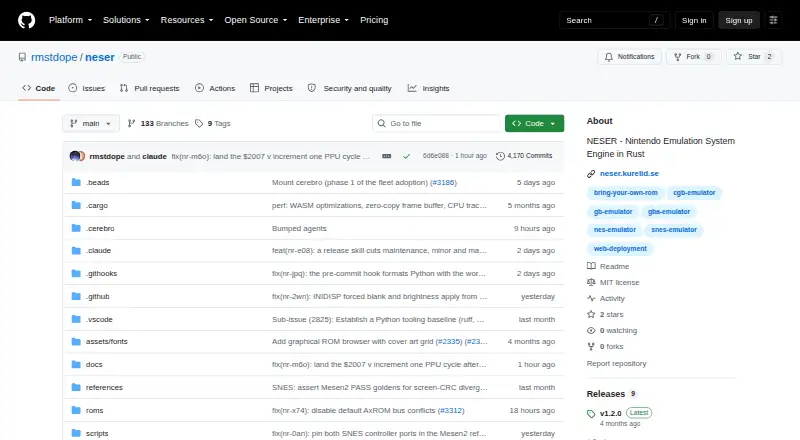
What NESER is
NESER is a free Nintendo emulation systems engine written in Rust, with native desktop and browser frontends. It supports NES and Famicom variants, Game Boy and Game Boy Color, Game Boy Advance, and Super Nintendo systems. Shared platform code handles audio, video, input, save states, configuration, ROM browsing and debugging. The native frontend accepts keyboard and gamepad input, with NES-specific support for devices such as the Zapper, SNES Mouse, Arkanoid paddle, Power Pad and Four Score. NES users can choose shader presets including CRT, NTSC, smooth, PAL or none. The browser frontend accepts ROM files with extensions including .nes, .gb, .gbc, .cgb, .gba, .sfc and .smc. For scripting and CI, headless mode runs a ROM and writes a PNG frame; captures are byte-identical for the same ROM and frame count across runs and builds. NES development tools include a debugger, CPU trace, breakpoints and deterministic autorun recording and playback. A built-in open-source GBA BIOS means an external BIOS file is not required. Installation options include prebuilt releases or `cargo install neser`.
Good
- Supports NES, Game Boy, Game Boy Advance and SNES systems.
- Includes save states and debugging tools.
- Native frontend supports keyboard and gamepad input.
- Headless mode writes PNG frames.
- Free and MIT-licensed.
Watch out
- Linux source builds may require system development packages.
- No third-party service integrations are listed.
- The MIT license provides the software without warranty.
Who it suits
NESER suits people looking to run supported Nintendo systems through a desktop or browser frontend. Its headless capture and NES debugging options may also suit scripting, CI and development workflows.
Verdict
NESER pairs several Nintendo system emulators with desktop and browser frontends, plus tools for NES development and headless capture. Linux source builds may require additional system packages.
Plans and prices
From NESER's own pricing page, checked 2 Oct 2026.
| Plan | Price | What it gives you |
|---|---|---|
| Free | Free | MIT-licensed software |
The facts
Each one read from NESER's own pages, with the date it was checked.
Where it runs
- Browser frontend
- The web frontend is built from a Rust WASM target and JavaScript, and accepts `.nes`, Game Boy, `.gba`, and SNES ROM extensions.checked 2 Oct 2026
- GBA BIOS
- NESER includes a built-in open-source GBA BIOS, so an external BIOS file is not required.checked 1 Oct 2026
- ROM browser
- The ROM browser can scan configured cartridge paths, display metadata and cover art, filter entries, and launch selected ROMs.checked 2 Oct 2026
What it does
- Controllers
- The native frontend supports keyboard and gamepad input, with NES-specific support for devices including Zapper, Arkanoid paddle, Power Pad, and Four Score.checked 2 Oct 2026
- Debugging
- NESER documents debugger, CPU trace, breakpoint, and deterministic autorun recording and playback options.checked 2 Oct 2026
- Downloads
- Prebuilt archives are available through GitHub Releases, and the README also documents installation with `cargo install neser`.checked 2 Oct 2026
- Frontends
- NESER provides native desktop and browser frontends.checked 1 Oct 2026
- Headless capture
- The --headless mode runs a ROM without opening a window and writes a PNG frame for scripting and CI.checked 1 Oct 2026
- Headless use
- The `--headless` option can run a ROM and write a PNG frame, with the README describing it as intended for scripting and CI.checked 2 Oct 2026
- Input
- The native frontend supports keyboard and gamepad input.checked 1 Oct 2026
- Installation
- Users can download pre-built releases or install NESER from crates.io with cargo install neser.checked 1 Oct 2026
- Integration
- The project documents a crates.io installation route and a browser frontend, but its README does not list third-party service integrations.checked 2 Oct 2026
- Latest listed release
- The GitHub Releases page marks v1.2.0 as the latest release and dates it 2026-06-02.checked 2 Oct 2026
- License
- NESER is licensed under the MIT License.checked 1 Oct 2026
- Limit
- Linux source builds may require system development packages for backend libraries such as ALSA and Wayland/X11.checked 2 Oct 2026
- NES controllers
- NES-specific controller support includes standard joypads, SNES controllers, SNES Mouse, Zapper, Arkanoid paddle, Power Pad, Four Score, Famicom expansion-port controllers, and VS System/PlayChoice-10 inputs.checked 1 Oct 2026
- Purpose
- NESER is a Nintendo emulation systems engine written in Rust with native desktop and browser frontends.checked 2 Oct 2026
- Reproducibility
- Headless captures use zero-initialised RAM and produce byte-identical PNGs for the same ROM and frame count across runs and builds.checked 1 Oct 2026
- Security and compliance
- The repository identifies the software as MIT-licensed; the license provides the software “as is” without warranty.checked 2 Oct 2026
- Shared features
- The project describes shared audio, video, input, save-state, configuration, ROM browsing, and debugging features across its frontends.checked 2 Oct 2026
- Supported systems
- It supports NES/Famicom, Game Boy and Game Boy Color, Game Boy Advance, and Super Nintendo Entertainment System emulation.checked 2 Oct 2026
- Visual options
- NES users can select documented shader presets including CRT, NTSC, smooth, PAL, and none.checked 2 Oct 2026
- Web formats
- The web frontend supports .nes, .gb, .gbc, .cgb, .gba, .sfc, and .smc ROM extensions.checked 1 Oct 2026
The full review of NESER
NESER suits players who want Nintendo systems beyond the NES in one free app, and developers who need repeatable captures or NES debugging tools. Its strongest distinction is the combination of broad system coverage with a deterministic headless mode; Linux source builds can take extra setup.
Overview
NESER is a Rust-based Nintendo emulation engine with desktop and browser frontends. It covers NES and Famicom variants, Game Boy and Game Boy Color, Game Boy Advance, and SNES, so it is a practical single option for users moving among those systems rather than a dedicated NES-only emulator.
Start without a ROM path to open the ROM browser, or pass a path to load a game directly. The browser frontend accepts .nes, .gb, .gbc, .cgb, .gba, .sfc, and .smc files. On desktop, keyboard and gamepad input are supported. Save states and shader support round out its play features, though NESER’s standout strengths are its breadth and development tools.
Key features
- NES controller coverage: Beyond standard joypads, NES-specific support includes SNES controllers, SNES Mouse, Zapper, Arkanoid paddle, Power Pad, Four Score, Famicom expansion-port controllers, and VS System/PlayChoice-10 inputs. This makes NESER a better fit for users with unusual peripherals than a basic pad-focused setup.
- Visual presets: NES users can choose CRT, NTSC, smooth, PAL, or no shader. The range offers a useful choice of presentation without requiring a separate tool.
- Development tools: Debugger, CPU trace, breakpoints, and deterministic autorun recording and playback target NES development workflows. These are meaningful extras for developers, but are less central to someone who only wants to launch games.
- Repeatable headless capture: The --headless option runs a ROM without opening a window and writes a PNG frame for scripting or CI. Zero-initialised RAM and byte-identical output for the same ROM and frame count across runs and builds make it unusually suitable for stable capture pipelines.
- GBA BIOS included: NESER has a built-in open-source GBA BIOS, so a separate BIOS file is not required.
Pricing
NESER is free: its Free plan costs nothing and the software is MIT-licensed. There is no paid tier to trade against a cheaper, capped option, and no free trial is needed. The MIT license permits use under its terms, while providing the software as is without warranty.
Platforms
NESER supports web browsers and desktop builds for Windows, macOS, and Linux. Prebuilt archives are available through GitHub Releases, and Rust users can install it with cargo install neser. Linux users building from source may need development packages for backend libraries such as ALSA and Wayland/X11, a real setup cost compared with simply downloading a release.
Who it's for
NESER is a strong fit for players who want NES, Game Boy-family, GBA, and SNES support in one free program, especially those who value save states, shader choices, or less-common NES controllers. It is also a clear choice for NES developers and CI workflows that benefit from deterministic image captures and debugging facilities. Someone seeking only a straightforward NES player may not need its broader systems or development-focused features.
Pros and cons
- Pro: Broad Nintendo system coverage is paired with desktop and browser frontends, avoiding a one-system-only choice.
- Pro: Deterministic headless PNG output supports repeatable scripting and CI rather than only interactive play.
- Pro: NES debugging tools and an unusually wide documented controller range serve development and specialized hardware use.
- Con: Linux source builds may require backend development packages, adding work for users who cannot use a prebuilt release.
- Con: The software is supplied without warranty under the MIT license, so users should not expect a warranty-backed product.
Alternatives
Browse NES Emulators for the category. HalfNES is another free desktop option for Linux, macOS, and Windows, but it requires Java 8 or newer and has no save states. Choose binjnes if a free NES emulator with web and build-from-source versions is the narrower fit. Dendy is another free option spanning Linux, macOS, web, and Windows. Jnes suits Windows users who want freeware, provided they do not need to sell or distribute it through commercial channels. KuroganeNES is a free web-only alternative. Nintengo is another free option across Linux, macOS, web, and Windows. Geolith is a free desktop alternative for Linux, macOS, and Windows. puNES is a free alternative for Linux and Windows.
Verdict
Choose NESER if you want several Nintendo systems in one free app or need NES debugging and reproducible headless captures. Its breadth and development utility are the main reasons to pick it; users who want only a simple NES emulator, or who need a warranty-backed product, should look elsewhere.
Getting started
- Download a prebuilt archive from GitHub Releases or install with cargo install neser.
- Choose a native desktop build for Windows, macOS, or Linux, or use the browser frontend.
- Open NESER without a ROM path to browse for a ROM, or provide a ROM path to load it directly.
- Use the browser frontend with a supported ROM extension: .nes, .gb, .gbc, .cgb, .gba, .sfc, or .smc.
Questions
How much does NESER cost?
The Free plan is free. NESER is MIT-licensed software.
Which systems does it support?
It supports Nintendo Entertainment System and Famicom variants, Game Boy and Game Boy Color, Game Boy Advance, and Super Nintendo Entertainment System.
Which platforms can I use?
NESER has web, Windows, macOS, and Linux availability, with native desktop and browser frontends.
Can I use a controller?
The native frontend supports keyboard and gamepad input. NES-specific support includes devices such as the Zapper, Arkanoid paddle, Power Pad, and Four Score.
Is NESER open source?
Yes. NESER is licensed under the MIT License.
How can I install it?
You can download prebuilt releases or install it with cargo install neser.