Nintengo
Nintengo is a free NES emulator written in Go, available as desktop builds for Mac OS X, Linux, and Windows, as well as a WebAssembly version that runs in a …
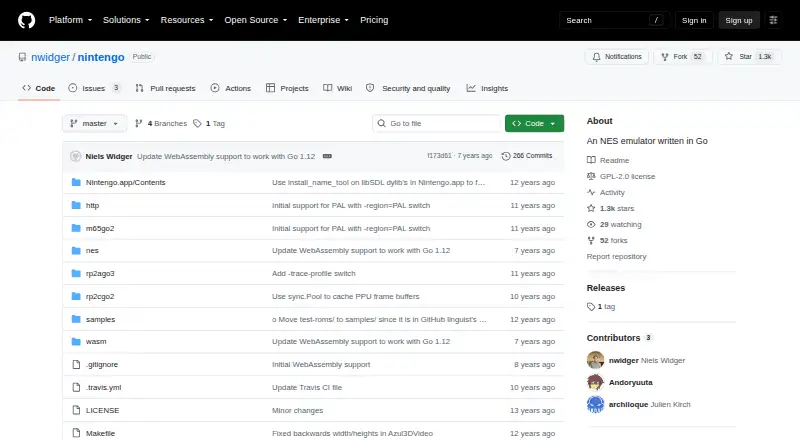
What Nintengo is
Nintengo is a free NES emulator written in Go, available as desktop builds for Mac OS X, Linux, and Windows, as well as a WebAssembly version that runs in a browser using a local web server. It opens .nes files either directly or inside ZIP archives and supports NTSC and PAL regions. Battery-backed saves use .sav files, while save states use .nst files. Two-player netplay is available through listen and connect options. The emulator can capture JPEG screenshots and record GIF video and WAV audio. Its controls include keyboard input, pausing, stepping, resetting, saving and loading states, and fast-forwarding. Debugging options include CPU instruction decoding, CPU and memory profiling, and an HTTP service address. Listed mapper support includes NROM, MMC1, UNROM, CNROM, MMC3, ANROM, and MMC2. WebAssembly support requires Go 1.11 or higher. Audio remains a work in progress, although all audio channels work in some capacity. The project is published under the GPL-2.0 license.
Good
- Runs .nes files and files inside ZIP archives.
- Supports NTSC and PAL regions.
- Includes battery-backed saves and save states.
- Supports two-player netplay.
- Offers JPEG, GIF, and WAV recording options.
Watch out
- Audio support is a work in progress.
- WebAssembly requires Go 1.11 or higher.
- Browser use requires a local web server.
Who it suits
Nintengo suits people looking for an NES emulator with desktop or browser-based options, save states, and two-player netplay. It may also appeal to users who want debugging and recording options.
Verdict
Nintengo covers core NES emulation alongside saves, netplay, and capture options. Its audio is still a work in progress, and browser use involves building and serving the WebAssembly version.
The facts
Each one read from Nintengo's own pages, with the date it was checked.
What it does
- Audio
- The README says audio support is a work in progress and that all audio channels work in some capacity.checked 2 Oct 2026
- Audio status
- Audio support is a work in progress, with all audio channels working in some capacity.checked 1 Oct 2026
- Debugging
- Command-line options include CPU instruction decoding, CPU profiling, memory profiling, and an HTTP service address.checked 1 Oct 2026
- Desktop build
- The README documents builds for Mac OS X, Linux, and Windows using Azul3D and Go.checked 1 Oct 2026
- Integrations
- The project page does not list third-party integrations.checked 1 Oct 2026
- Interface
- The listed controls include keyboard input, pause and stepping, reset, save and load state, and fast-forward speed options.checked 2 Oct 2026
- License
- The repository identifies its license as GPL-2.0.checked 2 Oct 2026
- Netplay
- Nintengo includes two-player netplay using listen and connect command-line arguments.checked 2 Oct 2026
- Purpose
- Nintengo is an NES emulator written in Go.checked 2 Oct 2026
- Recording
- The command-line options include GIF and JPEG video recording and WAV audio recording.checked 2 Oct 2026
- Region modes
- The emulator supports NTSC and PAL system regions.checked 1 Oct 2026
- ROM files
- The emulator accepts a .nes file or a .nes file inside a .zip archive.checked 2 Oct 2026
- ROM formats
- It runs .nes files and .nes files inside ZIP archives.checked 1 Oct 2026
- Save support
- Battery-backed saves use .sav files, and save states use .nst files.checked 2 Oct 2026
- Security
- The project page does not state security or compliance certifications.checked 1 Oct 2026
- WebAssembly
- WebAssembly support requires Go 1.11 or higher and runs in a browser after building nintengo.wasm.checked 1 Oct 2026
- Web support
- The project supports WebAssembly and can run in a browser using a local web server.checked 2 Oct 2026
Where it runs
- Desktop platforms
- The build instructions cover Mac OS X, Linux, and Windows.checked 2 Oct 2026
- Mapper support
- The listed supported mappers are NROM, MMC1, UNROM, CNROM, MMC3, ANROM, and MMC2.checked 2 Oct 2026