Dendy
Dendy is a free NES/Famicom emulator written in Go, with desktop binaries for Windows, macOS, and Linux and a WebAssembly version for modern browsers.
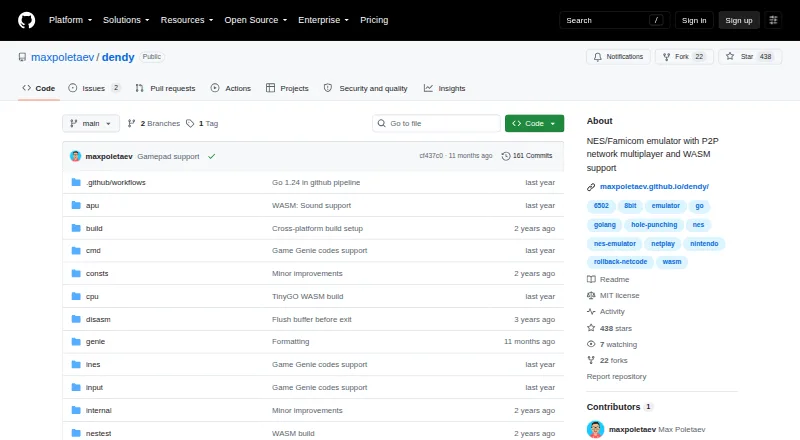
What Dendy is
Dendy is a free NES/Famicom emulator written in Go, with desktop binaries for Windows, macOS, and Linux and a WebAssembly version for modern browsers. The desktop program has no graphical interface: users launch it from the command line with a .nes ROM file. Player one can use a keyboard or detected gamepad, and a mouse can emulate the Zapper light gun. Options include save-state control, rewind, screenshots, CRT-effect toggling, and Game Genie codes. Dendy supports online multiplayer with rollback networking and peer-to-peer connections. A public relay can help players behind NATs discover one another and connect, but it will not work when both players are behind symmetric NATs. The browser build currently lacks netplay. The maker cautions that Dendy is not intended to match established emulators in accuracy or compatibility, so some games may fail or have issues. Sound emulation is still in progress and can produce pops and crackles. The project is MIT-licensed; installation with Go and building from source are also documented.
Good
- Free and available on desktop and modern browsers.
- Includes save states, rewind, and screenshots.
- Supports rollback-based network multiplayer.
- Offers CRT effects and Game Genie codes.
Watch out
- Desktop version has no graphical interface.
- Browser version does not support netplay.
- Some games may fail or have compatibility issues.
- Sound may pop or crackle.
Who it suits
Dendy may suit users comfortable launching a command-line emulator and interested in NES/Famicom netplay. Browser users should note that the WebAssembly version does not support netplay.
Verdict
Dendy offers useful emulator options and multiplayer, but its command-line desktop interface and stated compatibility limits matter. Its in-progress audio emulation may also affect playback.
The facts
Each one read from Dendy's own pages, with the date it was checked.
What it does
- Audio
- Sound-chip emulation is described as work in progress and may produce pops and crackles.checked 29 Sep 2026
- Command line
- The emulator has no GUI and is run from the command line with a .nes ROM file.checked 28 Sep 2026
- Compatibility limits
- The author says the emulator is not intended to match existing emulators in accuracy or compatibility and may not run some games.checked 28 Sep 2026
- Controls
- The emulator supports keyboard controls, likely detects connected gamepads, and emulates the Zapper with a mouse.checked 29 Sep 2026
- Dependencies
- The project lists Raylib Go bindings for graphics and audio and kcp-go for netplay.checked 28 Sep 2026
- Downloads
- Prebuilt binaries are available for Windows, macOS, and Linux, though the maker says they are not guaranteed to work on Windows.checked 29 Sep 2026
- Features
- Command-line options include save-state control, CRT-effect toggle, screenshots, rewind, and Game Genie codes.checked 29 Sep 2026
- Interface
- The desktop emulator has no GUI and is run from the command line with a .nes ROM file.checked 29 Sep 2026
- License
- The GitHub repository identifies the project as MIT licensed.checked 29 Sep 2026
- Limitations
- The maker cautions that Dendy is not intended to match established emulators in accuracy or compatibility, and lists tested games that fail or have issues.checked 29 Sep 2026
- Multiplayer
- Network multiplayer uses rollback networking, and the maker reports that ping up to 150 ms felt playable in testing.checked 29 Sep 2026
- NAT traversal
- Players behind NATs can use a public relay for hole punching; the approach does not work when both players are behind symmetric NATs.checked 29 Sep 2026
- Product
- Dendy is a NES/Famicom emulator written in Go with network multiplayer.checked 29 Sep 2026
- Relay hosting
- The maker hosts a public relay server and says users can build and run their own dendy-relay binary if it goes down.checked 29 Sep 2026
- Relay option
- The README says the author hosts a public relay and that users can run their own relay binary built from source.checked 28 Sep 2026
- Security and integrations
- The README describes no security or compliance certifications and names Raylib Go for graphics/audio and kcp-go for netplay as dependencies.checked 29 Sep 2026
- Web version
- A WebAssembly version runs in modern browsers and currently does not support netplay.checked 29 Sep 2026
Where it runs
- Browser version
- A WebAssembly version runs in modern browsers, but it does not currently support netplay.checked 28 Sep 2026
The company
- Maker
- The GitHub profile identifies Max Poletaev as the maker and lists Belgrade, Serbia.checked 29 Sep 2026
The full review of Dendy
Overview
Dendy is a free NES/Famicom emulator for people who want command-line control or rollback multiplayer rather than a menu-driven desktop app. Its feature set is appealing, but compatibility and unfinished audio make it a better fit for experimentation than dependable play across a broad game library.
Key features
Desktop play and controls
The desktop version launches from the command line with a .nes ROM file and has no graphical interface. That keeps the workflow direct for terminal-comfortable users, but is a substantial barrier for anyone who expects to browse a library or configure an emulator through menus. Player one can use a keyboard or detected gamepad; a mouse can emulate the Zapper light gun.
Save states and rewind give players ways to preserve progress and revisit difficult sections. Command-line options also include screenshots, a CRT-effect toggle, and Game Genie codes. These are useful extras, though they do not offset the project's stated limits on game compatibility.
Rollback netplay
Desktop network play uses peer-to-peer connections and rollback networking, a meaningful reason to consider Dendy for multiplayer. Players behind NAT can use a public relay for peer discovery and UDP hole punching, but the method will not work when both players are behind symmetric NATs. The maker hosts a relay and says users can build and run their own relay binary if the public one goes down.
Browser edition
A WebAssembly edition runs in modern browsers, offering an alternative to desktop installation. It does not support netplay, so choose the desktop build if multiplayer is central to the decision.
Pricing
Dendy is free, with no free trial because there is no paid plan to try. The MIT license also permits users to inspect, modify, and redistribute the software under its terms. Pre-built binaries are available for Windows, macOS, and Linux; installation with Go and building from source are also documented.
Platforms
Dendy supports Windows, macOS, and Linux desktop systems, plus modern browsers through WebAssembly. The desktop build relies on Raylib Go bindings for graphics and audio, while netplay uses kcp-go. Its command-line launch model applies to desktop use; the browser version removes that terminal entry point but also lacks netplay.
Who it's for
Dendy is best suited to users comfortable with terminal-based software who value rollback netplay, save states, rewind, or the ability to build and run a relay themselves. It is a weaker choice for players who want a graphical library, broad game compatibility, or consistently clean audio: the maker cautions that some games may fail or have issues, and sound emulation may produce pops and crackles.
Pros and cons
- Pros: Free, MIT-licensed software with desktop and browser options, plus save states, rewind, screenshots, CRT effects, and Game Genie codes.
- Pros: Desktop rollback netplay supports peer-to-peer play and offers a relay option for many users behind NAT.
- Cons: The desktop emulator has no GUI and must be launched from the command line with a ROM file.
- Cons: The browser edition lacks netplay, and the relay approach fails when both players are behind symmetric NATs.
- Cons: Compatibility is not the goal, and unfinished sound emulation may create pops and crackles.
Alternatives
Browse NES Emulators for more options. Choose NESER if you want another free, MIT-licensed option across Linux, macOS, web, and Windows; its free plan is free. Nintengo is another free choice for Linux, macOS, web, and Windows.
Geolith is free on Linux, macOS, and Windows, while puNES is free on Linux and Windows. For a free option spanning Linux, macOS, and web, consider binjnes; its free plan is free and covers the NES emulator, web, and build-from-source versions. Jnes is freeware for Windows, free to download and use, but cannot be sold or distributed through commercial channels. KuroganeNES is a free web option with no pricing or usage limits stated and an MIT license. HalfNES is another free option for Windows and Linux.
Verdict
Choose Dendy if you are comfortable with a command line and want rollback multiplayer alongside save-state and rewind tools without paying. Look elsewhere if you need a graphical desktop workflow, broader compatibility, or more settled audio emulation.