Memex
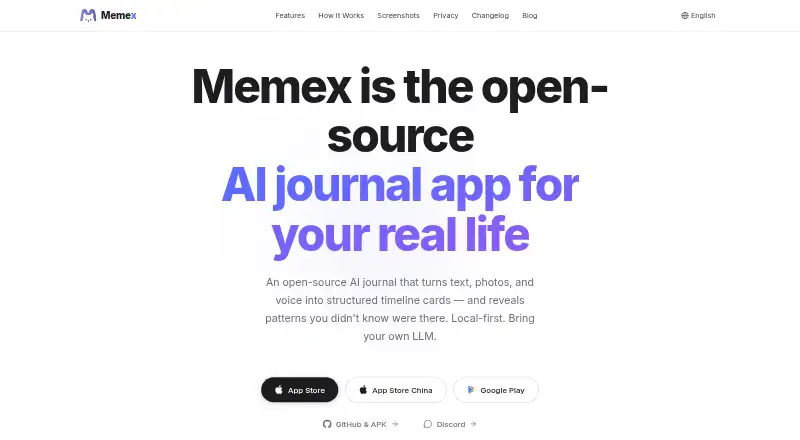
Memex is a free, open-source journal app for Android and iOS that turns text, photos, and voice into timeline cards and insights.
What Memex is
Memex is a free, open-source journal app for Android and iOS that turns text, photos, and voice into timeline cards and insights. It is aimed at people who capture everyday details in fragments, such as observations, tasks, and voice memos. On-device OCR, image labeling, and photo EXIF extraction help process captured material. AI agents sort records into categories such as tasks, events, people, places, and transactions; the app surfaces patterns through charts, timelines, quotes, and narrative summaries. Records are kept as Markdown files and in a local SQLite database, with export, backup, and restore options. Backups can go to iCloud Drive, a custom folder, or app storage. Users bring their own model provider, with options including OpenAI, Claude, Gemini, Ollama, and others. AI features require a configured model service, which may incur provider charges. When a third-party model is configured, text, photo metadata, OCR text, and card content may be sent directly to that provider for processing. Memex is published under GPL-3.0.
Good
- Captures text, photos, and voice.
- Stores journal records on-device as Markdown and SQLite.
- Offers backup and restore options.
- Open-source under GPL-3.0.
Watch out
- AI features require a configured model service.
- A model provider may charge separately.
- Configured providers may receive text and photo-related content.
Who it suits
Memex suits people who want to turn scattered notes, photos, and voice recordings into an organized personal journal. It may appeal to users who want local storage and a choice of AI model provider.
Verdict
Memex pairs local journal storage with AI organization and pattern summaries. Consider the model-provider requirements and potential sharing of captured content when configuring AI features.
Plans and prices
From Memex's own pricing page, checked 30 Sep 2026.
| Plan | Price | What it gives you |
|---|---|---|
| Free | Free | App is free to download · AI features require a configured model service, which may incur provider charges |
The facts
Each one read from Memex's own pages, with the date it was checked.
What it does
- AI providers
- Memex supports bring-your-own-model connections including OpenAI, Claude, Gemini, Ollama, and other providers.checked 30 Sep 2026
- Audience
- Memex is designed for people who capture life in fragments such as short notes, photos, voice memos, observations, tasks, and loose thoughts.checked 30 Sep 2026
- Automatic organization
- AI agents create typed cards for records, including tasks, events, metrics, people, places, galleries, articles, and transactions.checked 30 Sep 2026
- Availability
- The maker links to App Store and Google Play downloads and provides GitHub and an Android APK option.checked 30 Sep 2026
- Backup
- Users can back up and restore through iCloud Drive, a custom folder, or app storage.checked 30 Sep 2026
- Backup locations
- The app supports backup to iCloud Drive, a custom folder, or app storage.checked 30 Sep 2026
- Capture
- The app supports text, photo, and voice capture, with on-device OCR, image labeling, and photo EXIF extraction.checked 30 Sep 2026
- Custom agents
- Users can create agents with event-driven triggers, custom prompts, JavaScript execution, and inter-agent workflows on their phone.checked 30 Sep 2026
- Insights
- The app surfaces patterns across records as charts, timelines, quotes, and narrative summaries.checked 30 Sep 2026
- Integrations
- Listed model connections include Gemini, OpenAI, Anthropic Claude, AWS Bedrock, OpenRouter, and Ollama.checked 30 Sep 2026
- License
- The project is published under the GPL-3.0 license.checked 30 Sep 2026
- Local database
- The maker says records are stored on-device as Markdown files and in a local SQLite database, with no journal data uploaded to a server.checked 30 Sep 2026
- Model providers
- Users bring their own model provider; the site lists OpenAI, Claude, Gemini, Ollama, and other providers.checked 30 Sep 2026
- Organization
- AI agents organize records into typed cards for tasks, events, metrics, people, places, and other categories.checked 30 Sep 2026
- Privacy
- The maker says records stay on the device and prompts go directly to the selected model provider; the app does not operate a server storing journals.checked 30 Sep 2026
- Product
- Memex is an open-source, local-first AI journal that turns text, photos, and voice into structured timeline cards and insights.checked 30 Sep 2026
- Provider data sharing
- When a user configures a third-party LLM, text, photo metadata, OCR text, and card content may be sent directly to that provider for AI processing.checked 30 Sep 2026
- Security controls
- The app supports biometric authentication for app lock, with biometric data handled by the operating system.checked 30 Sep 2026
- Storage and export
- Records are stored as interconnected Markdown files, with one-click export and backup and restore options.checked 30 Sep 2026
- Support
- The project directs users to GitHub issues for bug reports and feature requests and Discord for community discussion and feedback.checked 30 Sep 2026
- What it does
- Memex captures text, photos, and voice and uses AI to organize them into timeline cards and surface patterns and insights.checked 30 Sep 2026
The company
- Headquarters
- Hong Kongchecked 28 Sep 2026
- Maker and team
- Memex says it is developed by a small team and open-source contributors, with Haibo Wu as product initiator and core contributor.checked 30 Sep 2026
Where it runs
- On-device processing
- The privacy policy says OCR, image labeling, photo EXIF extraction, and local SQLite storage run on-device.checked 30 Sep 2026
The full review of Memex
Memex is an open-source mobile journal that turns everyday notes and media into organized records and cross-entry insights. It is best for people who collect life in fragments and want those fragments to become useful reference material. The free app’s main trade-off is that AI requires a model provider you configure, which may charge separately.
Overview
Instead of leaving entries as a simple chronological diary, Memex uses AI agents to sort them into typed cards, then surfaces patterns as charts, timelines, quotes, and narrative summaries. That makes it a stronger fit for someone who wants to connect observations, tasks, and personal records than for someone seeking only a straightforward journal.
The maker says journal data stays on the device in Markdown files and a local SQLite database, with no journal data uploaded to a Memex server. Records can be exported or backed up and restored. This local-first approach is a meaningful advantage for users who value control over their archive. It does not mean AI processing is always local: when a third-party model is configured, text, photo metadata, OCR text, and card content may be sent directly to that provider. Memex says it does not see users’ data, API keys, or prompts, so provider choice remains an important part of the privacy decision.
Key features
Capture and organization
Text, photo, and voice capture cover the main ways people record a thought or moment. On-device OCR, image labeling, and photo EXIF extraction add structure to images, while agents can sort records into categories such as tasks, events, metrics, people, places, galleries, articles, and transactions. That breadth is useful when a journal mixes media and practical details; users who want only a dated text diary may not need the extra classification layer.
Insights and custom agents
Memex can show patterns across records through charts, timelines, quotes, and narrative summaries, giving accumulated entries more value than a feed alone. Custom agents add event-driven triggers, user-written prompts, JavaScript execution, and workflows between agents on the phone. Those controls will appeal to people willing to shape their own system, but they also make Memex a more involved choice than a basic note-taking app.
Storage, backup, and privacy controls
Markdown records, one-click export, and backup and restore options support portability. Backups can go to iCloud Drive, a custom folder, or app storage. OCR, image labeling, EXIF extraction, and local database storage run on-device, according to the privacy policy; the app also supports biometric locking, with biometric data handled by the operating system. Once a third-party model is used, however, some captured content may leave the device for processing.
Pricing
Free: free. Memex is free to download, making it a reasonable option for trying a local journal without a subscription. AI features require a configured model service, which may incur provider charges; the free download therefore does not guarantee cost-free AI use. No paid Memex plan is described.
Platforms
Memex is available on Android and iOS, with downloads linked through Google Play and the App Store. The project also offers an Android APK and GitHub access. It supports offline recording and audio import, transcript search, AI summaries, and transcription in 5 languages. GitHub issues are the route for bug reports and feature requests, while Discord is for community discussion and feedback.
Who it's for
Memex suits people who capture short notes, photos, voice memos, observations, tasks, and loose thoughts, then want those records organized into a searchable personal archive. It is particularly appealing to users who value local storage, exportable Markdown, or the ability to tailor agents. It is a weaker fit for anyone who wants AI without configuring a provider or who prefers a simple journal with no classification workflow.
Pros and cons
- Pro: On-device Markdown and SQLite storage keep the journal independent of a Memex-hosted archive, and export plus backup options give users ways to retain their records.
- Pro: Text, photo, and voice capture feed into varied card types and cross-entry summaries, suiting journals that contain more than prose.
- Pro: Custom agents support triggers, prompts, scripts, and inter-agent workflows for users who want to adapt organization to their habits.
- Con: AI requires a separately configured model provider and may bring provider charges, adding setup and potential cost to a free app.
- Con: Configured third-party AI may receive text, photo metadata, OCR text, and card content, which narrows the privacy benefit of keeping the journal database local.
- Con: Its structured cards and agent controls are more than a minimal diary requires, so users seeking only quick, plain entries may find the approach unnecessarily elaborate.
Alternatives
For a voice-first workflow, AudioPen offers transcription and rewriting, with a free tier that limits recordings to 3 minutes and includes limited voice typing sessions. Audionotes is another option for voice notes and transcripts: its free plan offers unlimited voice notes capped at 1 minute per note, unlimited text notes, transcripts, summaries, and 99+ languages.
Voicenotes may suit users who want a defined transcription allowance rather than Memex’s provider-based AI setup: its free Basic plan includes 100 weekly transcription minutes, 30-day history, unlimited recordings, and 100+ languages. For a desktop and browser extension alongside mobile, Memoth supports extension, iOS, and macOS, with a Guest plan limited to one 3-minute recording.
Murble is worth considering for on-device transcription: its free plan includes unlimited recording and on-device transcription, plus AI summaries and search. VoiceJournal has a more explicit free cap of 10 notes total and 2 minutes per recording, with basic AI transcription. For iOS and macOS users who prioritize on-device transcription and exporting, Cleft offers those features in its free Basic plan, along with tags and search.
PlancyAI offers a free plan with 5 voice memos or notes per day, 100 voice minutes per month, and a 7-day Pro trial. To compare more options, browse AI Voice Note Apps or AI Journal Apps.
Verdict
Choose Memex if you want a local-first journal that can turn mixed notes and media into structured cards and patterns, and you are comfortable selecting an AI provider when you need those features. Its exportable Markdown archive and customizable agents are the strongest reasons to pick it. Look elsewhere if you want AI included without provider setup or prefer a simpler journal with fewer moving parts.
Alternatives to Memex
- 1

Stoic
Free planAndroidiOSWebmacOS8.2From $39.99 a year - 2

Dayora
Free planAndroidiOSWebLinux8.0From $6 a month - 3

Reflection
Free planAndroidiOSWebAPI8.0Free plan - 4
Mindsera
Free planAndroidiOSWeb7.8From $129 a year - 5
Rosebud
Free planAndroidiOSWebmacOS7.6From $107.99 a year - 6
Reflectly
Free planAndroidiOS7.4Free plan