
Dayora
Dayora is a web journaling app that returns a summary, an insight and a suggested next step for journal entries.
What Dayora is
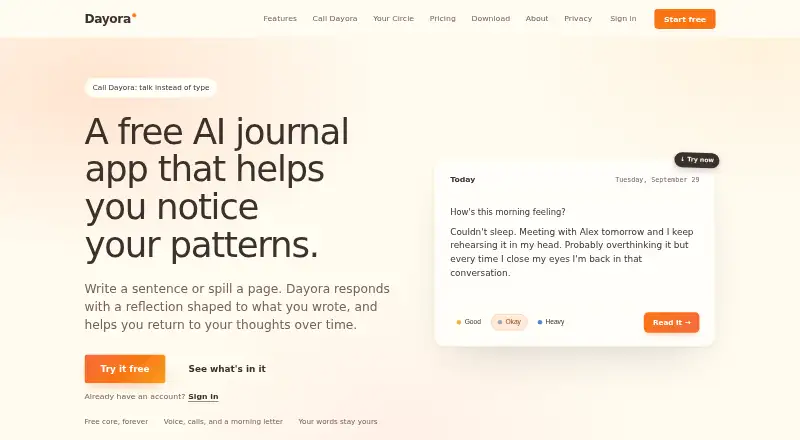
Dayora is a web journaling app that returns a summary, an insight and a suggested next step for journal entries. Users can dictate entries for transcription and reflection, or use Reflect to explore an entry or start a conversation with context from their journal. Mood and energy can be recorded with entries, and trends can be viewed over time. The free plan includes Your Circle, which tracks people and relationship context from journal entries. Journals can be exported as JSON, PDF or Word. The app can be set to 11 languages, and entries may also be written in other languages. Dayora says journal content is sent to OpenAI to generate reflections, and that OpenAI may use it to train and improve its models under Dayora's data-sharing agreement. Dayora says journal text and account records are encrypted in transit with TLS 1.3 and at rest with AES-256. The free plan includes unlimited entries and voice journaling; Plus costs $9 a month, with a founding price of $6 a month available until 1 November 2026. Dayora says it is operated by Crafted in Context Pty Ltd in Victoria, Australia.
Good
- Free plan includes unlimited journal entries.
- Voice journaling includes transcription and reflection.
- Mood and energy trends can be viewed over time.
- Journal exports are available in JSON, PDF and Word.
- Journal text and account records are encrypted at rest and in transit.
Watch out
- Journal content is sent to OpenAI for reflections.
- OpenAI may use journal content to train and improve its models.
- Plus voice calls are capped at five minutes each and ten per day.
- Plus costs $9 a month at the standard price.
Who it suits
Dayora may suit people who want help reflecting on journal entries and noticing personal patterns. It also fits users who want voice journaling, mood tracking or journal exports in several formats.
Verdict
Dayora pairs journaling with summaries, conversational reflection and mood tracking, and provides several export formats. Consider its stated OpenAI data handling alongside the encryption details when deciding whether to use it for personal entries.
Plans and prices
From Dayora's own pricing page, checked 15 Oct 2026.
| Plan | Price | What it gives you |
|---|---|---|
| Dayora | Free | Unlimited entries · AI reply on every entry · voice transcription up to 5 minutes · mood tracking · Reflect up to 300 messages/day · Your Circle · editable/deletable memory · JSON/PDF/Word export · one 30-day report after 10 entries · forever |
| Extra Deep Self Report | $4, paid once | One additional report · purchased reports do not expire · one-off purchase |
| Dayora Plus founding | $6 a month | About 20 call minutes/month · one Deep Self Report/month · daily synthesis email · deeper Reflect memory · mirror moments · relationship stories · 20-minute voice notes · monthly; founding price locked when joining before 1 November 2026 |
| Dayora Plus (founding price) | $6 a month | About 20 voice-call minutes monthly · one Deep Self Report monthly · daily synthesis email · 5 minutes per call · 10 calls per day · Monthly; founding price available until 1 November 2026 |
| Extra call minutes | $6, paid once | 30 additional call minutes · purchased minutes do not expire · one-off purchase |
| Dayora Plus | $9 a month | About 20 call minutes/month · one Deep Self Report/month · daily synthesis email · deeper Reflect memory · mirror moments · relationship stories · monthly |
| Dayora Plus annual | $72 a year | Same Plus features and monthly allowances · included minutes and report reset monthly · annually |
The facts
Each one read from Dayora's own pages, with the date it was checked.
What it does
- AI model
- Dayora says GPT-5.6 Terra handles reflections and pattern features, while Whisper handles voice transcription and calls.checked 15 Oct 2026
- AI processing
- Journal content is sent to OpenAI to generate reflections, and OpenAI may use that content to train and improve its models under Dayora's data-sharing agreement.checked 29 Sep 2026
- Call limits
- Plus calls are capped at five minutes each and ten calls per day; the monthly included allowance is about 20 minutes.checked 29 Sep 2026
- ChatGPT import
- ChatGPT exports can be scanned in the user's browser and only selected messages are uploaded as dated entries.checked 15 Oct 2026
- Desktop availability
- Dayora runs in modern browsers on phones and computers, and browser installation creates a desktop-style app; signed macOS and Windows installers are planned after the first release.checked 15 Oct 2026
- Developer API limitation
- Ora's independent audit reports no publicly reachable REST, GraphQL, or OpenAPI API and no agent authentication documentation.checked 15 Oct 2026
- Domain trust warning
- ScamAdviser gives dayora.ai a trust score of 0, citing a young domain, hidden WHOIS ownership, and low traffic ranking while also noting valid SSL.checked 15 Oct 2026
- Export
- Users can export their journal as JSON, PDF, or Word.checked 29 Sep 2026
- Import limitation
- Notion and Apple Notes imports are not supported; ChatGPT and Rosebud are the stated available imports.checked 15 Oct 2026
- Independent comparison
- Know Your Ethos characterizes Dayora as a completely free, web-based journal with voice support, mood tracking, daily summaries, pattern recognition, and Your Circle relationship tracking.checked 15 Oct 2026
- Independent privacy criticism
- TAIFY lists generous free access and editable memory as strengths but warns that entries are sent to OpenAI and that there are no independent reviews yet.checked 15 Oct 2026
- Languages
- The interface supports 13 listed languages, while entries may be written in any language and answered in the chosen language.checked 15 Oct 2026
- Limit: data control
- Trovera says Dayora stores entries on servers, offers English-only voice interaction, and has a business model whose long-term direction is uncertain.checked 15 Oct 2026
- Limit: language interface
- Mann reports that Dayora has no Indian-language interface, although the service says it answers in the language written.checked 15 Oct 2026
- Limit: offline use
- PWA Directory describes Dayora as online-only and reports no evidence of offline support.checked 15 Oct 2026
- Medical scope
- Dayora describes itself as a wellness journaling tool and says it is not therapy, a clinical service, or a crisis line.checked 15 Oct 2026
- Mood tracking
- Users mark mood on a five-point Rough-to-Great scale and can view mood across the year.checked 15 Oct 2026
The company
- Company
- Dayora's FAQ says it is operated by Crafted in Context Pty Ltd in Victoria, Australia.checked 29 Sep 2026
- Company size
- Crunchbase lists Dayora's organization as a private Melbourne, Australia company with 1–10 employees.checked 15 Oct 2026
- Founded
- Crafted in Context's company site lists 2025 as its founding year and identifies Dayora as a live product.checked 15 Oct 2026
- Headquarters
- Victoria, Australiachecked 28 Sep 2026
- Legal maker
- The service is operated by Crafted in Context Pty Ltd, ACN 694 376 853, registered in Victoria, Australia.checked 15 Oct 2026
Where it runs
- Independent platform praise
- PWA Directory praises the free core, mood and energy tracking, daily AI summaries, voice transcription, Reflect, relationship insights, and editable memory.checked 15 Oct 2026
- Limit: regional app availability
- Mann reports no Dayora listing in India's Apple or Google stores and describes access there as a browser tab billed in US dollars.checked 15 Oct 2026
The full review of Dayora
Overview
Dayora is a journaling app for people who want more than a private record of their day: it turns entries into reflections and tracks moods, energy and relationships. It suits writers looking for prompts and help spotting personal patterns, especially those who want to journal by voice as well as text.
Its mix of entry-based feedback, conversational reflection and export options is compelling, but personal writing is sent to OpenAI, which may use it to train and improve its models under Dayora’s data-sharing agreement. That is a substantial consideration for anyone journaling about sensitive experiences.
Key features
Reflections, chat and reports
Dayora responds to entries with a summary, an insight and a suggested next step. That gives each session a clear reflective prompt, rather than leaving users to interpret their writing alone. Reflect chat can explore a specific entry or start a conversation using context from the journal, making it a better fit for people who want an ongoing exchange than for those seeking only a blank page.
Guided prompts, personalized insights and a Deep Self Report add structure for users who need help getting started or looking back across their writing. The free plan provides one 30-day report after 10 entries; paid plans include one report monthly. Each report may be useful for periodic review, but Dayora’s strongest appeal is the regular entry-level reflection.
Voice and tracking
Users can speak entries, which Dayora transcribes and reflects on. This removes the need to type every thought, though Plus voice calls have firm limits: five minutes per call, ten calls per day and about 20 minutes included monthly. Mood and energy can be logged alongside entries, with trends over time for readers who want to notice shifts rather than rely on memory.
Your Circle, included on the free plan, tracks people and relationship context from journal entries. That may help users revisit how relationships feature in their writing, while also making the data-handling trade-off especially relevant: the material used for reflection can include details about other people.
Privacy and portability
Dayora says journal text and account records are encrypted in transit with TLS 1.3 and at rest with AES-256. It also sends journal content to OpenAI for reflections, and OpenAI may use that content to train and improve its models under Dayora’s data-sharing agreement. Encryption protects data in transit and at rest; it does not alter those stated processing terms. Readers uncomfortable with that arrangement should choose a journal that better matches their privacy expectations.
Exports are available in JSON, PDF and Word, giving users practical ways to keep a copy or move their writing elsewhere. The app can be set to 11 languages, and entries may also be written in other languages.
Pricing
The free Dayora plan costs nothing, billed Forever. It includes unlimited journal entries, voice journaling and transcription, Reflect chat up to 300 messages a day, and one 30-day Deep Self Report after 10 entries. It is a generous way to use the core journaling and reflection features without a trial deadline, though it does not include the monthly report and daily synthesis email included with Plus.
Dayora Plus (founding price) costs $6 a month, billed Monthly, with that founding price available until 1 November 2026. Dayora Plus costs $9 a month, billed Monthly, at the standard price after 1 November 2026. Both paid plans include about 20 voice-call minutes monthly, one Deep Self Report monthly and a daily synthesis email, subject to the five-minute-per-call and ten-calls-per-day caps. Plus is for regular users who value the monthly report and email; the call allowance is modest, so frequent voice users may need more.
Extra Deep Self Report costs $4, paid once, billed One-time purchase, and the purchased report does not expire. Extra call minutes cost $6, paid once, billed One-time purchase, for 30 extra minutes that do not expire. These purchases suit occasional needs better than a monthly plan, but the extra minutes do not remove the per-call or daily caps.
There is no free trial. Dayora is operated by Crafted in Context Pty Ltd in Victoria, Australia; support for urgent technical or account issues is directed to [email protected].
Platforms
Dayora supports Android, iOS, Linux, macOS, web and Windows. It has no mobile apps, so mobile users should not assume a dedicated app experience despite the listed Android and iOS platform support.
Who it's for
Dayora is a strong fit for people who want prompts, AI responses and mood or relationship tracking to make journaling more reflective. Voice entry and multiple export formats broaden its appeal. It is a weaker choice for anyone who wants journaling content kept away from OpenAI’s stated model-improvement use, or who needs more than the included voice-call minutes without buying extras.
Pros and cons
- Pro: Unlimited free entries and up to 300 Reflect messages a day make it possible to build a substantial journal without a paid subscription.
- Pro: Voice transcription, entry summaries, mood and energy trends, and Your Circle give users several ways to reflect beyond rereading entries.
- Pro: JSON, PDF and Word exports provide useful options for keeping or moving journal data.
- Con: Journal content goes to OpenAI, which may use it to train and improve its models under Dayora’s data-sharing agreement; that is a meaningful trade-off for private writing.
- Con: Plus voice use is limited to about 20 minutes monthly, with five-minute calls and a ten-call daily cap.
- Con: Despite Android and iOS support, Dayora has no mobile apps.
Alternatives
For a wider comparison, see AI Journal Apps.
- Rosebud is another freemium option, with a free plan, a free trial and platforms including Android, iOS, macOS, web and Windows. Choose it if that trial or platform combination better suits your needs.
- Yorishiro offers a free Write plan with unlimited entries, data export, 10 AI analyses a month and three AI conversations a month, plus a free trial. It may suit writers who prefer a defined monthly AI allowance.
- Reflection has a free plan with unlimited private entries, prompts, reminders, imports and exports, plus a free trial. Choose it if private entries and basic journaling tools are the priority.
- Stoic offers a free plan and a free trial, with paid options for additional guided journals, reflections, exercises, mood and habit tracking. It is worth considering for readers focused on guided exercises and habits.
- Mindsera has a free plan and a free trial; its Curious plan includes a minimal journal, habit tracker, passcode, tags, smart highlights and data export. It may fit readers who want those organizing tools alongside journaling.
- Nuju has a free plan that saves three entries and includes a mood check-in and one personal reveal, as well as a free trial. It may suit someone who wants a smaller, more bounded free journaling option.
- Auricle offers unlimited free entries and an AI follow-up question on its free plan, with a free trial. It may suit readers who want a question-led approach to reflection.
- Inlet offers writing, prompts, aims and day summaries free, without a trial clock or card requirement. It may suit readers who want those journaling tools without a trial period.
Verdict
Choose Dayora if you want a free, open-ended journal that actively responds to entries and helps you track patterns across mood, energy and relationships. Its voice input, chat and export formats make it more than a basic diary. Look elsewhere if sending journal content to OpenAI under the stated data-sharing terms is not acceptable, or if you need a dedicated mobile app or a larger voice allowance.
Getting started
- Open the Dayora website or use it on Android, iOS, Linux, macOS, or Windows.
- Choose the free plan or a paid plan.
- Create journal entries by typing or speaking them.
- Use Reflect chat to explore an entry or start a journal-context conversation.
- Record mood and energy with entries, then review trends over time.
- Export the journal as JSON, PDF, or Word if needed.
Limits worth knowing
The free plan limits Reflect chat to 300 messages per day and includes one 30-day Deep Self Report after 10 entries. Plus includes about 20 voice-call minutes monthly, with calls limited to five minutes and ten calls per day. Plus also includes one Deep Self Report monthly; Extra Deep Self Reports cost $4, paid once-time purchase.
Questions
Is Dayora free?
Yes. The free plan costs nothing, billed forever, and includes unlimited entries, voice journaling and transcription, Reflect chat up to 300 messages a day, and one Deep Self Report after 10 entries.
How much does Dayora Plus cost?
Dayora Plus is $9 a month at the standard price after 1 November 2026. The founding price is $6 a month until 1 November 2026.
Does Dayora offer a free trial?
No. Dayora has a free plan and does not offer a free trial.
Which platforms does Dayora support?
Dayora is available on Android, iOS, Linux, macOS, web, and Windows.
Can I export my journal?
Yes. Dayora supports full journal export in JSON, PDF, or Word format.
Who operates Dayora?
Dayora’s FAQ says it is operated by Crafted in Context Pty Ltd in Victoria, Australia.
Alternatives to Dayora
- 1

Stoic
Free planAndroidiOSWebmacOS8.2From $39.99 a year - 2

Reflection
Free planAndroidiOSWebAPI8.0Free plan - 3

Mindsera
Free planAndroidiOSWeb7.8From $129 a year - 4
Rosebud
Free planAndroidiOSWebmacOS7.6From $107.99 a year - 5
Reflectly
Free planAndroidiOS7.4Free plan - 6
Yorishiro
Free planAndroidiOSWebmacOS7.4From $22.99 a year