Invenio
Invenio is a free, open-source suite for research repositories, library systems, and building information applications.
What Invenio is
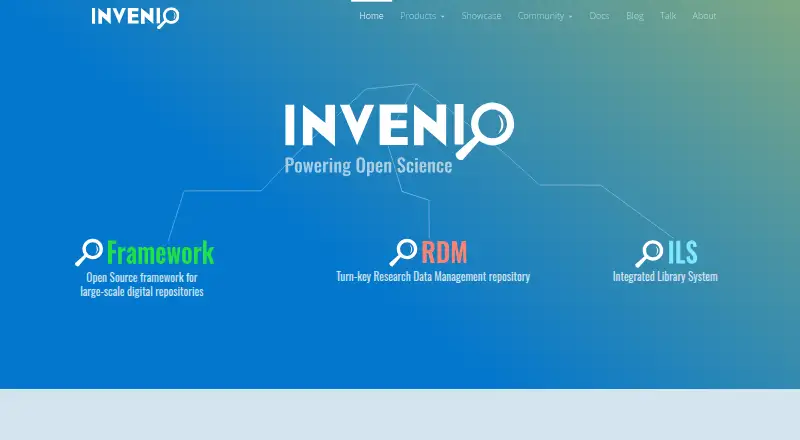
Invenio is a free, open-source suite for research repositories, library systems, and building information applications. Its products include InvenioRDM, a research data management repository; InvenioILS, an integrated library system; and Invenio Framework, a code library for building large-scale systems. InvenioRDM is intended for institutions, companies, and individuals, and can be deployed on bare metal, virtual machines, or containers such as Kubernetes and OpenShift. It supports institutional single sign-on, storage systems, cloud options, permissions, and custom fields, and integrates with ORCID, DataCite, and OpenAIRE.
Invenio Framework provides REST APIs, configurable search, metadata and serialization tools, DOI minting, fixity checks, and BagIt archival exports. InvenioILS includes cataloguing, circulation workflows, acquisitions, and interlibrary loans. The framework is a code library for building applications; InvenioRDM is the repository application intended to serve as one. Invenio products are available as free open-source software, with self-hosted deployment available.
Good
- Free open-source software with self-hosting available
- InvenioRDM integrates with ORCID, DataCite, and OpenAIRE
- Framework includes REST APIs and preservation tools
- InvenioILS covers acquisitions and interlibrary loans
Watch out
- Framework is a code library, not a repository application
- Only supported versions are guaranteed security fixes
- InvenioRDM deployment requires an infrastructure environment
Who it suits
InvenioRDM suits research institutions, private companies, and individuals seeking a research data repository. InvenioILS is aimed at library operations, while the Framework suits teams building repository or information-system applications.
Verdict
Invenio offers distinct products for repository management, library workflows, and application development, so the right fit depends on which component is needed. InvenioRDM is the repository application; the Framework is for building software rather than using as a repository solution.
Plans and prices
From Invenio's own pricing page, checked 11 Oct 2026.
| Plan | Price | What it gives you |
|---|---|---|
| Invenio products (free open source) | Free | Free open source software · self-hosted deployment is available |
The facts
Each one read from Invenio's own pages, with the date it was checked.
What it does
- APIs and formats
- Invenio is JSON-native and provides REST APIs; its framework can serialize data as BibTeX, CSL, DataCite, Dublin Core, JSON-LD, or MARCXML.checked 11 Oct 2026
- Community support
- Users can seek community help through the Invenio chatroom and forum, and the project also lists commercial hosting and support providers.checked 11 Oct 2026
- Deployment
- InvenioRDM runs on bare metal, virtual machines, and container platforms such as Kubernetes and OpenShift.checked 11 Oct 2026
- Framework data and preservation
- Invenio Framework supports JSON Schema metadata, serializers for formats including BibTeX and DataCite, DOI minting, fixity checks, and BagIt archival exports.checked 11 Oct 2026
- Framework use
- Invenio Framework can be used to build digital repositories, enterprise search engines, and integrated library systems.checked 11 Oct 2026
- ILS features
- InvenioILS includes bibliographic cataloguing, configurable circulation workflows, acquisitions, interlibrary loans, backoffice tools, and REST APIs.checked 11 Oct 2026
- Institutional integration
- InvenioRDM supports institutional single sign-on, storage systems, public and private clouds, permissions models, and custom fields.checked 11 Oct 2026
- Library features
- InvenioILS supports cataloguing, configurable circulation workflows, acquisitions, interlibrary loans, back-office tools, and REST APIs.checked 11 Oct 2026
- Notable limit
- Invenio Framework is a code library for building applications, while InvenioRDM is the repository application intended for use as a repository solution.checked 11 Oct 2026
- Open Science integrations
- InvenioRDM integrates with ORCID, DataCite, and OpenAIRE.checked 11 Oct 2026
- Open source
- Invenio products are free open source software, and Invenio Framework is licensed under MIT.checked 11 Oct 2026
- Preservation
- Invenio Framework supports persistent identifiers such as DOIs, links between versions, fixity checks, and BagIt archival package exports.checked 11 Oct 2026
- Product suite
- Invenio includes InvenioRDM, a repository/document management platform; InvenioILS, an integrated library system; and Invenio Framework, a code library for building large-scale information systems.checked 11 Oct 2026
- Project history
- The first Invenio release, then named CDSWare, was on August 1, 2002.checked 11 Oct 2026
- RDM deployment
- InvenioRDM runs on bare-metal, virtual machines, and container platforms such as Kubernetes and OpenShift.checked 11 Oct 2026
- RDM purpose
- InvenioRDM is a turn-key research data management repository platform based on Invenio Framework and Zenodo.checked 11 Oct 2026
- Record and file scale
- InvenioRDM is described as supporting 1 to 100 million records and files from 1 byte to several petabytes.checked 11 Oct 2026
- Research integrations
- InvenioRDM integrates with Open Science infrastructure including ORCID, DataCite, and OpenAIRE.checked 11 Oct 2026
- Scale
- Invenio Framework is designed to manage more than 100 million records and petabytes of files.checked 11 Oct 2026
- Search and APIs
- Invenio Framework provides RESTful APIs and configurable search with facets and citation networks.checked 11 Oct 2026
- Security
- The maker says Invenio was created with security and long-term preservation in mind, and the framework supports OAuth or SSO authentication and fine-grained access rights.checked 11 Oct 2026
- Security fixes
- Only supported Invenio versions are guaranteed to receive security fixes.checked 11 Oct 2026
- Security reporting
- The security policy asks users to report security issues privately by email and says an Invenio architect normally acknowledges receipt within 1–2 working days.checked 11 Oct 2026
The company
- Founded
- 2002checked 28 Sep 2026
The full review of Invenio
Invenio is a free, open-source suite covering research repositories, library management and the development of large information systems. It is strongest for institutions or technical teams able to run self-hosted infrastructure and tailor integrations. The suite is powerful and unusually broad, but choosing the correct component is essential.
Overview
Founded in 2002, Invenio has grown from the project first released as CDSWare into a product family with three distinct roles. InvenioRDM is the ready-made research data management repository, InvenioILS handles library operations, and Invenio Framework is a code library for building applications. That separation makes Invenio flexible, but the Framework should not be mistaken for a finished repository product.
Key features
Research repository
InvenioRDM is designed for research institutions, companies and individuals that need a repository rather than a general file-sharing tool. Its stated range of 1 to 100 million records and files from one byte to several petabytes gives it a credible path from small projects to very large collections. Deployment works on bare metal, virtual machines, Kubernetes and OpenShift, so organizations can match it to existing infrastructure.
Institutional single sign-on, storage integrations, public and private cloud support, permission models and custom fields help RDM fit established environments. ORCID, DataCite and OpenAIRE integrations connect repository records to research identity, DOI and open-science workflows. Granular access control and audit logs are useful when collections combine public, restricted and private material.
Development and preservation framework
Framework is aimed at developers creating digital repositories, enterprise search engines or integrated library systems. It is JSON-native, built with Python 3 and Flask, and uses OpenSearch with PostgreSQL or MySQL. REST APIs, configurable search facets and citation networks provide a substantial foundation, but building an application still requires engineering work.
JSON Schema metadata and serializers for BibTeX, CSL, DataCite, Dublin Core, JSON-LD and MARCXML support exchange between systems. DOI minting, persistent identifiers, links between versions, fixity checks and BagIt archival exports strengthen preservation workflows. OAuth or single sign-on authentication and fine-grained access rights support controlled deployments.
Library management
InvenioILS covers bibliographic cataloguing, configurable circulation workflows, acquisitions, interlibrary loans, back-office tools and REST APIs. It is a better fit for organizations seeking an integrated library system than for teams that only need a repository.
Pricing
Invenio products are free open-source software: the listed plan costs free and supports self-hosted deployment. There are no paid tiers or seat quotas stated. The trade-off is operational responsibility: running infrastructure, upgrades and integrations remains with the adopting organization unless it engages a commercial hosting or services provider.
Platforms
Invenio supports API, Linux, macOS, web and self-hosted use. RDM can run on bare metal, virtual machines or container platforms including Kubernetes and OpenShift. This is a strong match for organizations controlling their deployment environment, but less suitable for buyers seeking a turnkey vendor-hosted service.
Who it's for
Choose InvenioRDM for a research repository that must accommodate substantial growth, institutional identity, complex permissions and open-science integrations. Choose InvenioILS when cataloguing and circulation are central. Choose Framework when a development team needs a Python-based foundation for a custom repository, search engine or library system. Smaller teams without infrastructure or software-maintenance capacity may find the self-hosted model demanding.
Pros and cons
Pros
- Broad, specialized suite: Separate RDM, ILS and Framework components cover repository, library and development requirements without forcing one product into every role.
- Very high stated scale: RDM targets up to 100 million records and petabyte-scale files, while Framework is designed beyond that threshold.
- Research and preservation depth: ORCID, DataCite, OpenAIRE, DOI support, fixity checks and BagIt exports address scholarly workflows and long-term custody.
- Open and adaptable: Free licensing, granular access rights, APIs and broad deployment choices allow substantial institutional control.
Cons
- Self-hosting burden: Infrastructure, security updates and application maintenance are not delegated through a paid hosted tier.
- Component confusion risk: Framework is a code library, so repository buyers need RDM rather than a development toolkit alone.
- Support is ecosystem-based: Community channels, training and listed commercial providers are available, but the product does not present a conventional bundled support plan.
- Version discipline matters: Security fixes are guaranteed only for supported Invenio versions.
Alternatives
For a broader directory of document-management choices, see Document Management Software. Group-Office is the better pick for teams wanting a freemium product with a free unlimited-user Community plan and a paid Professional tier. LogicalDOC suits buyers seeking an open-source community edition with basic access control, advanced search and web, SOAP and REST interfaces. OpenKM is another freemium document-management option. Transkribus is worth considering when document transcription is the priority. FlinkISO fits organizations looking for an on-premise quality-management system with unlimited concurrent users. OpenDocMan provides a self-installed community document-management edition with file locking and custom metadata. SeedDMS is a simpler free, self-hosted document-management alternative. DocuWare is the alternative for buyers wanting a commercial cloud-oriented document-management service.
Verdict
Invenio is a strong recommendation for research institutions, libraries and technically capable organizations that need open-source control, serious preservation functions and a repository capable of major scale. Its main reason to choose it is the combination of RDM, library workflows and an extensible framework under one project. Look elsewhere if you want a managed service, a conventional support contract or a simple application that requires little deployment expertise.
Alternatives to Invenio
- 1
FlinkISO
Free planOpen sourceAndroidiOSWebAPI8.6From $750 a year - 2

Box
Free planAndroidiOSWebAPI8.3From $5 a month - 3
Group-Office
Free planOpen sourceAndroidiOSWebLinux8.2From €12 a month - 4
OpenKM
Free planAndroidiOSWebAPI8.2From $100 a month - 5

DocuWare
AndroidiOSWebAPI7.9From £1,060 a month - 6
Oracle WebCenter Content
AndroidiOSWebAPI7.7$3,450 one-time