Oracle WebCenter Content
Oracle WebCenter Content is an enterprise document management and imaging platform for organizations handling documents in transactional business processes.
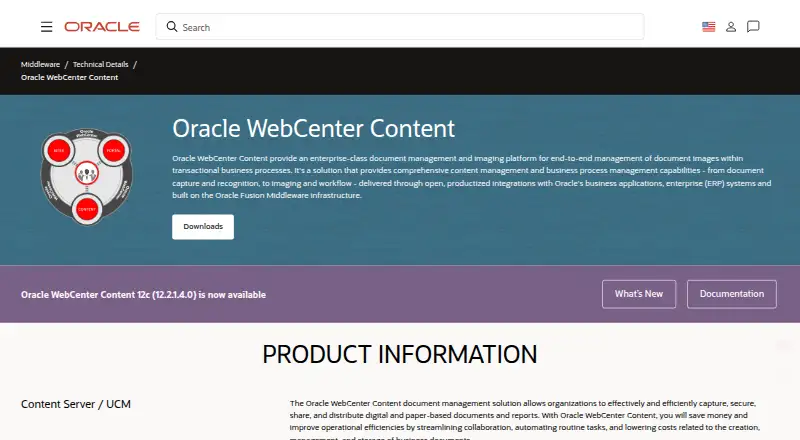
What Oracle WebCenter Content is
Oracle WebCenter Content is an enterprise document management and imaging platform for organizations handling documents in transactional business processes. Content Server captures, secures, shares, and distributes digital and paper documents and reports. Its imaging capabilities support processes such as high-volume invoice processing for Oracle Financial Management applications. Records Management provides controls for classification, retention, and destruction under retention and disposition policies. Capture supports production scanning, remote image capture, indexing, and learning-based recognition and data extraction. Integration choices include persistent URLs, Java API, Microsoft COM, ActiveX, RIDC, SOAP, and WSDL-based web services. Security configuration includes SSL, groups, roles, permissions, access control lists, and web services security. WebCenter Content can be deployed on premises or in Oracle Cloud Infrastructure; cloud listings offer paid Universal Credit pricing or BYOL, with resources billed by OCPU per hour and no numeric rate listed. Oracle documentation lists version 14.1.2.0.0 of WebCenter Content 14c. In that version, Lotus Notes desktop integration and SharePoint Connector are deprecated.
Good
- Handles digital and paper documents and reports.
- Supports scanning, indexing, and data extraction.
- Provides classification, retention, and destruction controls.
- Offers multiple integration and security configuration options.
- Supports on-premises and OCI deployment.
Watch out
- No free plan is listed.
- OCI cloud price has no numeric rate listed.
- Lotus Notes desktop integration is deprecated in 14c.
- SharePoint Connector is deprecated in 14c.
Who it suits
Oracle WebCenter Content suits organizations managing documents and records across business processes, particularly those that need imaging, capture, and retention controls. It is an enterprise platform with on-premises and cloud deployment options.
Verdict
WebCenter Content combines document management, imaging, capture, and records controls for enterprise processes. Consider the listed 14c integration deprecations and the lack of a numeric OCI rate when assessing fit.
Plans and prices
From Oracle WebCenter Content's own pricing page, checked 21 Sep 2026.
| Plan | Price | What it gives you |
|---|---|---|
| WebCenter Content for Oracle Cloud Infrastructure — Pay as Y | — | Oracle Cloud Infrastructure marketplace offering |
| WebCenter Content for Oracle Cloud Infrastructure — Annual C | — | Oracle Cloud Infrastructure marketplace offering |
| WebCenter Content Named User Plus license | $3,450, paid once | Named User Plus metric · software-update support listed at $759 |
| WebCenter Content for Oracle Cloud Infrastructure | Priced on request | PAID Universal Credit or BYOL; cloud resources billed by OCPU per hour |
| WebCenter Content Processor license | — | Processor metric · software-update support listed at $37,950 |
The facts
Each one read from Oracle WebCenter Content's own pages, with the date it was checked.
Where it runs
- Android app capabilities
- The Android app can browse, preview, favorite, download offline, upload, rename, move, copy, delete and check documents, and approve or reject workflows.checked 15 Oct 2026
- Android compatibility limit
- The Android app requires a WebCenter Content environment running version 11.1.1.8.0 or newer, with some features needing a January 2014 patch.checked 15 Oct 2026
- Application integrations
- Oracle supplies adapters for E-Business Suite, Siebel and PeopleSoft so users can attach and retrieve documents inside those applications.checked 15 Oct 2026
What it does
- API authentication
- REST authentication requires Oracle Web Services Manager and supports Basic Auth, bearer tokens after setup, or anonymous calls.checked 15 Oct 2026
- API extensibility
- REST requests map to IdcService calls, and the documentation describes CORS allow-list configuration through config.cfg settings.checked 15 Oct 2026
- API search
- The REST API supports Oracle's Universal Query Format for searches across supported WebCenter Content search engines.checked 15 Oct 2026
- Business-process management
- Oracle describes capture, recognition, imaging and workflow capabilities connected to Oracle business applications and ERP systems.checked 15 Oct 2026
- Capture
- Capture supports production scanning, remote image capture, flexible indexing, and learning-based document recognition and data extraction.checked 7 Oct 2026
- Capture and OCR
- Capture supports production scanning, remote web capture and flexible indexing, while Forms Recognition learns to classify and extract data from documents without fixed templates.checked 15 Oct 2026
- Cloud licensing
- Oracle Cloud Infrastructure Marketplace listings offer PAID Universal Credit pricing or BYOL, which applies existing on-premises licenses to OCI.checked 7 Oct 2026
- Content management
- Content Server lets organizations capture, secure, share, and distribute digital and paper-based documents and reports.checked 7 Oct 2026
- Current documentation
- Oracle's documentation lists WebCenter Content 14c version 14.1.2.0.0, dated December 2024.checked 7 Oct 2026
- Deployment
- Oracle provides guidance to lift and shift WebCenter Content to OCI and to deploy it on OKE.checked 7 Oct 2026
- Desktop client
- The Desktop client installer is available from a WebCenter Content server's My Downloads page or Oracle downloads.checked 15 Oct 2026
- Desktop integrations
- Desktop integrates with Windows Explorer, Microsoft Outlook, Office desktop applications and browser search providers.checked 15 Oct 2026
- Documentation depth
- Oracle publishes extensive 14c documentation covering REST APIs, release notes, installation, upgrades, desktop use, administration and system certifications.checked 15 Oct 2026
- Document repository
- The Content Server component captures, secures, shares and distributes digital and paper documents and reports.checked 15 Oct 2026
Money
- Cloud price unit
- Oracle lists WebCenter Content for Oracle Cloud Infrastructure with an OCPU-per-hour billing unit; the opened price list does not show a numeric rate.checked 7 Oct 2026
- Free plan
- Nochecked 21 Sep 2026
The company
- Company founded
- Oracle's LinkedIn company profile lists 1977 as its founding year.checked 15 Oct 2026
- Company headquarters
- Oracle's principal executive offices are at 2300 Oracle Way, Austin, Texas 78741.checked 15 Oct 2026
- Company legal name
- Oracle Corporation is the registrant's legal name in its SEC filing.checked 15 Oct 2026
- Founded
- 1977checked 28 Sep 2026
- Headquarters
- Austin, Texas, USAchecked 28 Sep 2026
The full review of Oracle WebCenter Content
Overview
Oracle WebCenter Content is an enterprise platform for managing documents and images within transactional business processes. It is best suited to organizations that need capture, records controls, and document handling across business workflows. Its range is compelling for that job, but 14c deprecations and custom-priced cloud options make fit and deployment choices important.
Key features
Content Server captures, secures, shares, and distributes paper-based and digital documents and reports. That gives organizations a way to bring varied content into managed processes; it is broader than a basic file repository and may be unnecessary for teams that only need straightforward file sharing.
Imaging supports high-volume invoice processing for Oracle Financial Management applications. Capture adds production scanning, remote image capture, flexible indexing, and learning-based document recognition and data extraction. These capabilities suit organizations processing documents at scale or from multiple capture routes, where turning images into usable business information is central to the workflow.
Records Management supports classification, retention, and disposition policies, including destruction controls. SSL, security groups, roles, permissions, access control lists, and web-services security provide ways to govern access. Granular access control, audit logs, version history, and single sign-on further suit environments where traceability and controlled handling matter.
Integration options include persistent URLs, Java API, Microsoft COM, ActiveX, RIDC, SOAP, and WSDL-based web services. That range can support varied enterprise connections, but organizations relying on Lotus Notes desktop integration or the SharePoint Connector should account for their deprecation in 14c. The Add Server to Desktop Integration option is also unavailable in that version's interface.
Pricing
WebCenter Content is paid software with no free plan. Oracle Cloud Infrastructure Marketplace offers Pay as Y and Annual C listings, both with custom pricing. The broader OCI option offers PAID Universal Credit pricing or BYOL, which lets customers apply existing on-premises licenses to OCI. Cloud resources are billed per OCPU-hour, but the OCI listing does not provide a numeric rate, so buyers should establish the expected infrastructure cost before choosing that route.
Oracle provides guidance for moving WebCenter Content to OCI and deploying it on OKE. That gives organizations cloud deployment paths, while BYOL may suit those with existing on-premises licenses; neither option removes the need to assess cloud resource costs alongside licensing.
Platforms
WebCenter Content supports Android, iOS, Linux, web, API, and self-hosted environments. The range suits organizations combining mobile access, integrations, and controlled deployment, rather than buyers seeking a single-device app.
Who it's for
This is a strong fit for organizations managing documents and records across business processes, particularly those with imaging, capture, retention, or governance requirements. Oracle provides documentation, community forums, training, learning paths, and certification resources. Smaller teams looking only for simple file storage, or organizations dependent on the deprecated 14c integrations, should weigh whether the platform's breadth is worth the operational fit.
Pros and cons
- Pro: Document management, imaging, capture, and records policies address multiple stages of enterprise content workflows in one platform.
- Pro: Granular permissions, audit logs, version history, and single sign-on support controlled access and traceability.
- Con: OCI cloud listings do not give a numeric OCPU-hour rate, making cloud cost assessment less direct.
- Con: Lotus Notes desktop integration and the SharePoint Connector are deprecated in 14c, which may disrupt organizations built around them.
Alternatives
For a different category, browse Enterprise Content Management Systems. The other listed categories—Corporate Tax Software, Managed File Transfer Software, Data Cleansing Software, Customer Community Software, and ETL Software—cover distinct needs rather than direct substitutes for enterprise content management.
For corporate tax work, Alphatax is a paid web, API, and Windows option with a free trial. Complete Tax Solutions is a paid web and Windows alternative with pricing by enquiry. CSC Corptax is enterprise corporate tax software with demo-request pricing. TaxCalc has a free trial and a 2026 Individual 6 plan at £42 a year, covering six returns for the 2025–26 tax year. CCH Axcess Practice is a paid Android, iOS, and web option with quote-based pricing. IRIS Personal Tax is a paid web, Windows, and self-hosted option with a standalone module. ONESOURCE Certificate Manager is a paid API, self-hosted, web, and Windows option with a free demo. PowerPlan Tax Provision is a paid web option.
Verdict
Choose Oracle WebCenter Content if your organization needs document capture, imaging, records governance, and access controls across enterprise processes. Its main advantage is the breadth of those capabilities; its main reason to look elsewhere is a dependency on deprecated 14c integrations or a need to know cloud pricing upfront.
Getting started
- Visit Oracle’s WebCenter Content product page.
- Choose a self-hosted deployment or review OCI Marketplace options.
- For OCI, select paid Universal Credit pricing or BYOL.
- Use Oracle’s deployment guidance for a lift-and-shift to OCI or deployment on OKE.
- Consult Oracle documentation, training, learning paths, or community forums for further guidance.
Questions
Does Oracle WebCenter Content have a free plan?
No. Its pricing model is paid.
Which platforms does it support?
Platforms listed are Android, iOS, Linux, web, API, and self-hosted.
How is OCI use priced?
Marketplace listings offer paid Universal Credit pricing or BYOL. Cloud resources are billed per OCPU-hour, and the numeric rate is not provided here.
What integrations does it support?
Options include persistent URLs, Java API, Microsoft COM, ActiveX, RIDC, SOAP, and WSDL-based web services.
What changed in WebCenter Content 14c?
Lotus Notes desktop integration and SharePoint Connector are deprecated, and the Add Server to Desktop Integration option is unavailable in the user interface.
Alternatives to Oracle WebCenter Content
- 1

Mongoose Web Server
Free planAndroidiOSWebAPI6.9Free plan - 2
Phusion Passenger
Free planLinuxmacOSSelf-hosted6.8From $23.52 a year - 3
Abyss Web Server
Free planLinuxmacOSSelf-hostedWindows6.7$59.95 one-time - 4

Caddy
AndroidWebAPILinux6.7From $25 a month - 5
CivetWeb
Free planAndroidiOSAPILinux6.7Free plan - 6
Static Web Server
Free planAndroidWebLinuxmacOS6.7Free plan