Guance Container Monitoring
Guance Container Monitoring tracks containers, pods and workloads while retaining context for short-lived objects.
What Guance Container Monitoring is
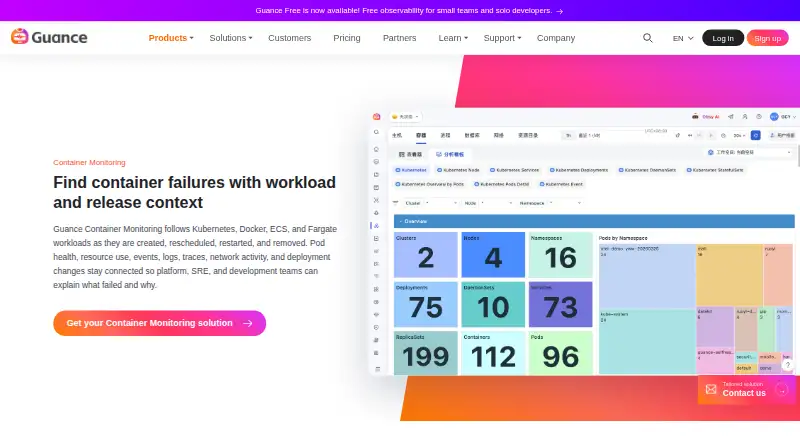
Guance Container Monitoring tracks containers, pods and workloads while retaining context for short-lived objects. It detects container creation, termination and restarts, as well as workload changes. Users can drill down from cluster and node to namespace, workload, pod and container, with metrics, logs, traces and network data tied together. Documented signals include CPU, memory, network and disk use, restart count, exit state, resource requests and limits, replica health and node pressure. Changes to objects such as Deployments, DaemonSets, Services, CronJobs and StatefulSets appear alongside health and performance signals. Monitors can cover node, pod, container, workload and service conditions, and alerts link to related telemetry and events. Guance also documents AWS Fargate collection scenarios, with coverage dependent on environment and collector configuration. Its Free Plan costs nothing and permits up to 10 hosts, 10,000 metric series per day, 10 million log records per day and seven-day rolling retention. Free-plan data cannot be moved to a Commercial Plan workspace.
Good
- Tracks workload changes, restarts and short-lived objects.
- Correlates metrics, logs, traces and network data.
- Drill-down spans clusters, nodes, workloads, pods and containers.
- Alerts link to related telemetry and events.
- Free Plan includes up to 10 hosts.
Watch out
- Free Plan data cannot migrate to a Commercial Plan workspace.
- Free Plan retention is seven days.
- Commercial and Enterprise Plan prices are not listed.
Who it suits
It suits teams that need visibility into Kubernetes or container workloads, correlated telemetry and alerts tied to operational changes. The Free Plan may suit a small environment within its 10-host limit.
Verdict
Guance Container Monitoring connects workload changes with health signals and related telemetry, with monitoring from cluster level down to individual containers. The Free Plan has clear host and retention limits, and its data cannot be migrated to a Commercial Plan workspace.
Plans and prices
From Guance Container Monitoring's own pricing page, checked 29 Sep 2026.
| Plan | Price | What it gives you |
|---|---|---|
| Free Plan | Free | Up to 10 hosts · 10,000 metric series/day · 10 million log records/day · 7-day rolling retention |
| Commercial Plan | — | Usage-based across infrastructure metrics, logs, data forwarding, Triggers, RUM page views, APM traces, synthetic tests, and notifications · Pay-as-you-go; charges depend on actual usage |
| Enterprise Plan | Priced on request | Enterprise plan; specific limits and price not stated on the opened page · Contact sales for pricing |
The facts
Each one read from Guance Container Monitoring's own pages, with the date it was checked.
What it does
- Alerting
- Users can create monitors for node, pod, container, workload, and service conditions and route alerts with links to related telemetry and events.checked 29 Sep 2026
- Change evidence
- It displays changes to Deployments, DaemonSets, Services, CronJobs, StatefulSets, and other workload objects beside health and performance signals.checked 29 Sep 2026
- Data protection
- Guance states that it encrypts data in transit and storage and does not access customer data without authorization.checked 29 Sep 2026
- Integrations
- The maker lists Kubernetes, AWS, Tencent Cloud, Huawei Cloud, Alibaba Cloud, Azure Monitor, and OpenTelemetry among its technology integrations.checked 29 Sep 2026
- Kubernetes drill-down
- Views let users investigate from cluster and node through namespace, workload, pod, and container.checked 29 Sep 2026
- Purpose
- Container Monitoring tracks containers, pods, and workloads and preserves operational context for short-lived objects.checked 29 Sep 2026
- Resource signals
- Documented signals include CPU, memory, network, disk, restart count, exit state, resource requests and limits, replica health, and node pressure.checked 29 Sep 2026
- Security and compliance
- The trust page lists Level 3 information security protection and ISO 9001, ISO 27001, and ISO 20000 certifications.checked 29 Sep 2026
- Serverless support
- Guance documents AWS Fargate collection scenarios for container metrics, logs, and traces, with coverage dependent on environment and collector configuration.checked 29 Sep 2026
- Support
- The site lists documentation, release notes, a status page, phone support, and sales email contact.checked 29 Sep 2026
- Telemetry correlation
- The product correlates container metrics, logs, traces, and network data in shared context.checked 29 Sep 2026
- Workload discovery
- It detects container creation, termination, restarts, and workload changes as they happen.checked 29 Sep 2026
The company
- Founded
- 2013checked 28 Sep 2026
- Headquarters
- Shanghai, Chinachecked 28 Sep 2026
Money
- Free-plan limits
- The Free Plan supports host, container, and Kubernetes collection with a maximum of 10 hosts, and its data cannot be migrated to a Commercial Plan workspace.checked 29 Sep 2026
The full review of Guance Container Monitoring
Overview
Guance Container Monitoring is an observability tool for containerized infrastructure, with Kubernetes views that follow workloads down to individual containers. It is best suited to teams that need to connect workload changes with metrics, logs, traces, and network signals; its main trade-off is the Free Plan’s small host cap and inability to move its data into a Commercial Plan workspace.
Rather than treating containers as static inventory, the product detects their creation, termination, restarts, and other workload changes as they occur. That makes it a practical fit for investigating short-lived workloads, where health signals alone may not explain what changed.
Key features
Kubernetes drill-down and change context
Users can investigate from cluster and node through namespace, workload, pod, and container. Resource signals include CPU, memory, network and disk activity, restart count, exit state, resource requests and limits, replica health, and node pressure. Guance also places changes to Deployments, DaemonSets, Services, CronJobs, StatefulSets, and other workload objects beside health and performance signals. That combination is useful when a team needs to distinguish a rollout or configuration change from a resource problem.
Correlated telemetry and alerting
Container metrics, logs, traces, and network data share context, and monitors can cover node, pod, container, workload, and service conditions. Alerts can link to related telemetry and events, reducing the gap between notification and investigation. The breadth is valuable for teams using several signal types, though it is less compelling if the need is limited to a single metric feed.
Collection, integrations, and safeguards
Guance documents AWS Fargate collection for container metrics, logs, and traces, with coverage dependent on the environment and collector configuration. Its integrations include Kubernetes, AWS, Tencent Cloud, Huawei Cloud, Alibaba Cloud, Azure Monitor, and OpenTelemetry. It states that data is encrypted in transit and at rest and is not accessed without authorization; its trust page lists Level 3 information security protection and ISO 9001, ISO 27001, and ISO 20000 certifications. Documentation, release notes, a status page, phone support, and sales email contact are also listed.
Pricing
Guance uses a freemium model and offers a free trial. The Free Plan costs free and allows up to 10 hosts, 10,000 metric series per day, 10 million log records per day, and seven-day rolling retention. It supports host, container, and Kubernetes collection, making it a reasonable starting point for a small environment or evaluation. The host ceiling and short retention limit its usefulness for larger estates or investigations that depend on older data. More importantly, Free Plan data cannot be migrated to a Commercial Plan workspace, so starting free creates a data-separation cost if the team later upgrades.
The Commercial Plan has custom pricing and is pay-as-you-go, with charges based on actual usage across infrastructure metrics, logs, data forwarding, Triggers, RUM page views, APM traces, synthetic tests, and notifications. That structure can suit teams whose consumption varies, but budgeting depends on usage across several product areas. It is the option to discuss with sales when an enterprise arrangement is needed, rather than a plan with a clear published allowance to compare against the free tier.
Platforms
Supported platforms include Linux, Windows, macOS, Docker, and Kubernetes. The broader platform list also includes Android, iOS, API, web, and self-hosted. Guance describes a hybrid deployment model. Container log collection, container metrics, resource alerts, image monitoring, and runtime events are supported.
Who it's for
This is a strong fit for platform and operations teams managing Kubernetes or mixed container environments that need workload-level context, change evidence, and multiple telemetry types in one investigation path. Fargate users may also find it relevant, provided their environment and collector configuration match the documented scenarios. The Free Plan is best for a small pilot that can tolerate its 10-host ceiling, daily quotas, seven-day retention, and separate workspace data. Teams needing long retention or a clean upgrade path should assess a paid plan before putting important history into the free workspace.
Pros and cons
- Pros: Kubernetes drill-down reaches from cluster to container, while workload changes sit beside resource and health signals; this gives teams useful operational context for transient workloads.
- Pros: Metrics, logs, traces, and network data are correlated, with alerting across nodes, pods, containers, workloads, and services.
- Pros: The Free Plan has no charge and includes container and Kubernetes collection, but remains capped at 10 hosts and seven-day rolling retention.
- Cons: Free Plan data cannot be migrated to a Commercial Plan workspace, which complicates a later move from evaluation to paid operation.
Alternatives
For database-specific needs, MySQL is a freemium option with a free plan and trial, while DBmarlin is another database-monitoring choice with a free plan but no free trial. Percona Monitoring and Management is worth considering when free, open-source database monitoring and management is the priority, though installation infrastructure may have separate costs. For broader application observability, Grafana Cloud Application Observability has an always-free tier with 2,232 host hours and a Pro plan priced at $0.03 a month with a $19 monthly platform fee and pay-as-you-go usage above its allowance. Teams focused on Kubernetes and wanting a stated annual commitment can compare New Relic Kubernetes Monitoring, whose Pro plan is $349 a year and includes unlimited full platform users and 100 GB of free data ingest, with additional ingest at $0.40/GB. For other monitoring categories, browse Database Monitoring, Container Monitoring, Mobile App Monitoring, and Continuous Profiling Tools.
Verdict
Choose Guance Container Monitoring if your team needs to trace changing container workloads through Kubernetes hierarchy and correlate their health with logs, traces, and network data. Its strongest case is the combination of workload-change context and cross-signal investigation. Look elsewhere if a free deployment must scale beyond 10 hosts, retain data longer than seven days, or transition its history into a paid workspace; for those needs, the plan boundary is a material drawback.
Getting started
- Visit the Guance Container Monitoring website.
- Choose the Free Plan; contact sales for Enterprise Plan pricing. The Commercial Plan is pay-as-you-go.
- Set up collection for your container or Kubernetes environment.
- Configure monitors for node, pod, container, workload, or service conditions.
- For AWS Fargate collection, account for environment and collector configuration.
Limits worth knowing
The Free Plan supports up to 10 hosts, 10,000 metric series per day, 10 million log records per day, and seven-day rolling retention. Free-plan data cannot be migrated to a Commercial Plan workspace.
Questions
Does Guance Container Monitoring have a free plan?
Yes. The Free Plan costs nothing and supports up to 10 hosts, 10,000 metric series per day, 10 million log records per day, and seven-day rolling retention.
Can free-plan data move to a Commercial Plan workspace?
No. Data from a Free Plan workspace cannot be migrated to a Commercial Plan workspace.
What platforms or technologies are listed?
Supported platforms include Linux, Windows, macOS, Docker, and Kubernetes. Listed technology integrations include Kubernetes, AWS, Tencent Cloud, Huawei Cloud, Alibaba Cloud, Azure Monitor, and OpenTelemetry.
Does it support AWS Fargate?
Guance documents AWS Fargate collection scenarios for container metrics, logs, and traces. Coverage depends on the environment and collector configuration.
What other plans are available?
The Commercial Plan is pay-as-you-go, with charges depending on actual usage. Enterprise Plan pricing requires contacting sales.
Who makes Guance, and where is it based?
The company was founded in 2013 and is headquartered in Shanghai, China.
Alternatives to Guance Container Monitoring
- 1

Checkmk
Free planOpen sourceAndroidiOSWebAPI8.8From $275 a month - 2
Netdata
Free planOpen sourceAndroidiOSWebAPI8.7From $4.50 a month - 3

Portainer
Free planOpen sourceAndroidiOSWebAPI8.6Free plan - 4

Uptrace
Free planOpen sourceWebAPILinuxmacOS8.4From $39 a month - 5
Coroot
Free planOpen sourceWebAPILinuxSelf-hosted8.2From $1 a month - 6

Middleware
Free planAndroidiOSWebAPI8.2$0.30 usage-based