
Middleware
Middleware is a full-stack observability platform for spotting and addressing issues across infrastructure, applications, and real-user activity.
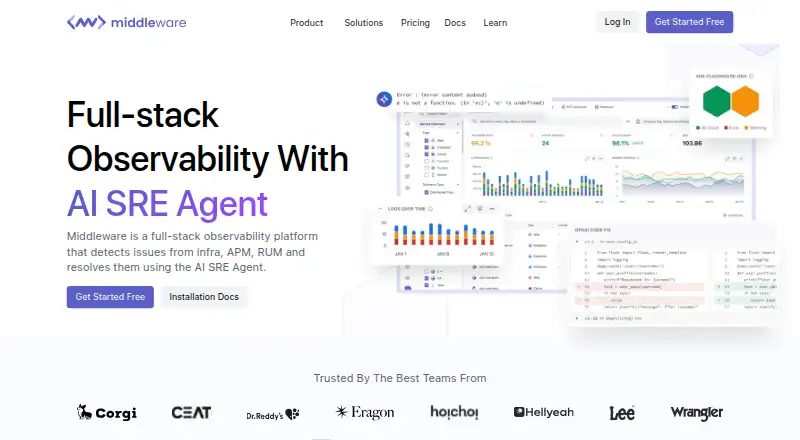
What Middleware is
Middleware is a full-stack observability platform for spotting and addressing issues across infrastructure, applications, and real-user activity. Its product range includes infrastructure monitoring, logs, application performance monitoring, metrics, distributed tracing, database monitoring, real-user monitoring, synthetic monitoring, browser testing, and LLM observability. Its AI SRE Agent and OpsAI capabilities include root cause analysis, issue detection, issue resolution support, and automatic pull request generation. The Free Forever plan allows up to 100GB of data, 1k RUM sessions, 20k synthetic checks, 10 browser test runs, and 2 million OpsAI tokens; data retention is 14 days. The Pay As You Go plan is listed at $0.30 a month, billed based on use, with default 30-day retention. Middleware advertises more than 450 built-in integrations and provides a Public API. It supports hybrid deployment and is listed for Android, iOS, Linux, macOS, Windows, web, and API. Middleware says data is encrypted at rest and in transit using TLS 1.2+ and AES-256.
Good
- Free plan includes up to 100GB of data.
- Includes distributed tracing and real-user monitoring.
- More than 450 built-in integrations are listed.
- Hybrid deployment is supported.
- Pay-as-you-go accounts can be cancelled anytime.
Watch out
- Free tier data retention is 14 days.
- Free Forever includes only 10 browser test runs.
- Free plan support is community based.
- BYOC pricing is not listed.
Who it suits
Middleware may suit teams that need visibility across infrastructure, applications, databases, and real-user activity. Its free tier includes community support, while BYOC lists 24x7 support and a dedicated account team.
Verdict
Middleware brings a wide set of monitoring tools into one observability platform, with a free tier and usage-based paid plan. Check the free tier’s data caps and retention alongside the monitoring coverage you need.
Plans and prices
From Middleware's own pricing page, checked 14 Oct 2026.
| Plan | Price | What it gives you |
|---|---|---|
| Free Forever | Free | 100 GB data · 1,000 RUM sessions · 20,000 synthetic checks · 10 browser test runs · 2 million OpsAI tokens · unlimited users · 14-day retention · monthly included usage |
| Pay As You Go | $0.30 a month | $1 per 1,000 RUM sessions · $1 per 5,000 synthetic checks · $10 per 1,000 browser-test runs · 30-day retention · SSO and security features · usage-based; $0.3 per GB of metrics, logs and traces |
| BYOC | Priced on request | volume discounts · dedicated account team · custom retention · bring your own cloud · 24x7 support · custom contract |
The facts
Each one read from Middleware's own pages, with the date it was checked.
What it does
- API
- Middleware's documentation lists a Public API and links to API documentation.checked 30 Sep 2026
- APM and tracing
- Application monitoring provides distributed traces, dependency views and frontend-to-backend correlation.checked 14 Oct 2026
- Audience
- Middleware says its mission is to empower organizations of all sizes to modernize their infrastructure stack with observability tools.checked 30 Sep 2026
- Cancellation
- Middleware says pay-as-you-go accounts can be cancelled anytime and data is retained for 30 days after cancellation for download.checked 30 Sep 2026
- Database monitoring
- Supported databases include MySQL, SQL Server, PostgreSQL, MongoDB, Oracle, ClickHouse, Redis, Elasticsearch and Cassandra.checked 14 Oct 2026
- Data limits
- The Free Forever plan includes up to 100GB of data, 1k RUM sessions, 20k synthetic checks, 10 browser test runs, and 2 million OpsAI tokens.checked 30 Sep 2026
- Data retention
- Free usage retains data for 14 days, pay-as-you-go for 30 days, and custom contracts can specify retention periods.checked 14 Oct 2026
- Deployment model
- The product is delivered as a hosted service; custom contracts can provide bring-your-own-cloud deployment for data-residency control.checked 14 Oct 2026
- Documentation depth
- Getting-started documentation covers host agents, SDKs, integrations, API keys, target URLs, operating systems and languages.checked 14 Oct 2026
- Infrastructure monitoring
- The platform monitors infrastructure, Kubernetes, containers, virtual machines and serverless services.checked 14 Oct 2026
- Integrations
- Documented integrations include AWS, Azure, Google Cloud, Vercel, databases, Datadog, Grafana, Prometheus, Logstash, Fluentd and the OpenTelemetry Collector.checked 14 Oct 2026
- Legal entity and funding
- Crunchbase identifies the legal entity as Middleware Lab Inc, a private seed-stage company with two funding rounds and 11 listed investors.checked 14 Oct 2026
- Licence
- The hosted Middleware platform is proprietary, while its public React Native SDK repository is licensed Apache 2.0.checked 14 Oct 2026
- Limit: customization
- A Capterra reviewer found the custom-dashboard options insufficient for their needs.checked 14 Oct 2026
- Limit: integrations
- Reviewers report that the range of third-party integrations and cloud services is limited.checked 14 Oct 2026
- LLM observability
- LLM monitoring traces model calls and agent steps and measures latency, token usage, cost and response-quality evaluations.checked 14 Oct 2026
- Log management
- Logs support live viewing, searching, anomaly detection, patterns, custom attributes and ingestion filtering.checked 14 Oct 2026
- Mobile SDK requirements
- The React Native SDK requires React Native 0.68+, Android minSdk 21 with compileSdk 35+, and iOS deployment target 13.0+.checked 14 Oct 2026
- Notable news: September 2026 release
- The September 30, 2026 update added a Free Forever plan, alert-based SLOs, expanded OpsAI issue detection, Slack root-cause analysis and richer log-anomaly views.checked 14 Oct 2026
The company
- Company founded
- Middleware was founded in 2022 and went through Y Combinator’s Winter 2023 batch.checked 14 Oct 2026
- Company size
- LinkedIn lists Middleware as privately held, headquartered in San Francisco, founded in 2022 and employing 51–200 people.checked 14 Oct 2026
- Founded
- 2022checked 23 Sep 2026
- Headquarters
- San Francisco, Californiachecked 23 Sep 2026
Money
- Limit: price
- A Capterra reviewer said the price felt high when comparing Middleware with alternatives.checked 14 Oct 2026
The full review of Middleware
Overview
Middleware is an observability platform for teams that need to watch infrastructure, applications, and user-facing performance together. Its broad coverage makes it a strong fit for organizations consolidating monitoring across those layers, though the free tier’s quotas and short retention make capacity planning important.
Founded in 2022 and headquartered in San Francisco, Middleware offers a hybrid deployment model, a Public API, and more than 450 built-in integrations spanning cloud, containers, databases, networking, and telemetry.
Key features
Monitoring and investigation
The product range covers infrastructure monitoring, logs, APM, metrics, distributed and transaction tracing, database monitoring, real user monitoring (RUM), synthetic monitoring, browser testing, and LLM observability. Dependency mapping and log correlation add context across related components, which can help teams investigate issues without treating each signal as an isolated tool. This breadth is useful for teams seeking one observability platform; organizations that only need a narrow monitoring function may not benefit from carrying such a wide product set.
Middleware describes its AI SRE Agent as a way to detect issues and help resolve them. Its OpsAI capabilities include root cause analysis, automatic issue detection, faster issue solving, and automatic PR generation. These capabilities broaden the platform beyond collection and visualization, although the free plan’s 2 million OpsAI tokens put a defined ceiling on usage.
Integrations, access, and security
More than 450 built-in integrations cover application monitoring, cloud, containers, databases, infrastructure and operating systems, networking, notifications, streaming, and telemetry. That range can reduce the need to build connections for common environments. Middleware also documents a Public API, giving teams an additional route to work with the platform.
Middleware says customer data is encrypted at rest and in transit with TLS 1.2+ and AES-256. Its security practices include regular penetration testing and vulnerability assessments, alongside firewalls, intrusion detection and prevention, and traffic filtering. These measures are relevant for teams assessing safeguards, but they do not replace an organization’s own security review.
Pricing
Free Forever
Free Forever costs nothing and includes unlimited users, community-based support, and 14-day data retention. Its allowances are up to 100GB of data, 1k RUM sessions, 20k synthetic checks, 10 browser test runs, and 2 million OpsAI tokens. This is a substantial way to evaluate broad coverage or support a modest workload, but the session, check, test-run, and token ceilings—and 14-day retention—can constrain sustained production use or longer investigations.
Pay As You Go
Pay As You Go costs $0.30 a month, with billing described as pay only for what you use. It includes default 30-day retention, SSO and security features, and a dedicated Slack/MS Teams channel. Usage charges include $1 per 1K RUM sessions, $1 per 5K synthetic checks, and $10 per 1K browser test runs. The longer retention and added access and support options suit teams moving beyond the free tier, but variable usage charges mean teams should watch session, check, and test volume. Accounts can be cancelled anytime, and data remains available for download for 30 days after cancellation.
BYOC
BYOC has custom pricing, with volume and multi-year contract discounts, custom data retention, bring-your-own-cloud deployment, 24x7 support, and a dedicated account team. It is aimed at organizations that need cloud control, tailored retention, or dedicated support; teams wanting straightforward self-service pricing should compare its custom-contract terms against Pay As You Go.
Platforms
Middleware supports Android, iOS, Linux, macOS, Windows, and web, and provides an API. Its hybrid deployment model gives teams a deployment option beyond a single environment.
Who it's for
Middleware suits organizations that need infrastructure and application observability alongside RUM, synthetic checks, and investigation tools in a single product range. The free plan is a practical starting point for evaluation or workloads within its caps; Pay As You Go fits teams needing longer retention and paid usage flexibility. BYOC is the more relevant option when bring-your-own-cloud deployment, custom retention, or 24x7 support matter. It is less compelling for buyers who need only one specialized monitoring capability or who cannot forecast usage-based costs.
Pros and cons
- Pros: Wide coverage across infrastructure, APM, logs, tracing, RUM, synthetic monitoring, and browser testing can consolidate observability needs.
- Pros: More than 450 integrations and a Public API offer multiple ways to connect Middleware with existing environments.
- Pros: A free plan includes unlimited users and generous breadth of monitoring quotas for evaluation.
- Cons: Free data retention is 14 days, limiting how far back teams can investigate on that tier.
- Cons: Pay As You Go charges scale with RUM sessions, synthetic checks, and browser test runs, so high activity can increase costs.
- Cons: Free support is community-based; dedicated account support and 24x7 coverage are reserved for BYOC.
Alternatives
For broader category comparisons, see Observability Platforms, Application Performance Monitoring, Kubernetes Monitoring, Real User Monitoring, Continuous Profiling Tools, and DevOps analytics software.
DevDynamics, HCL DevOps Velocity, GitClear, Hatica, Pluralsight, CDviz, Waydev, and DevStats are other options to compare.
Verdict
Middleware is a strong choice for teams that want broad observability coverage, extensive integrations, and AI-assisted issue investigation under one umbrella. Its free plan makes evaluation accessible, but short retention and capped usage require care; teams with heavier workloads should weigh Pay As You Go’s usage charges, while organizations needing cloud control or dedicated support should consider BYOC.
Limits worth knowing
Free Forever includes up to 100GB of data, 1k RUM sessions, 20k synthetic checks, 10 browser test runs, and 2 million OpsAI tokens, with 14-day retention. Pay As You Go has default 30-day retention and bills based on use.
Questions
Does Middleware offer a free plan?
Yes. Free Forever costs nothing and includes unlimited users, community-based support, and 14-day data retention, subject to its listed usage limits.
What does Middleware cost after the free plan?
Pay As You Go is listed at $0.30 a month and is billed based on usage. BYOC has no listed price.
Which platforms are listed for Middleware?
Android, API, iOS, Linux, macOS, web, and Windows are listed.
What does Middleware monitor?
Its listed products cover infrastructure, logs, APM, metrics, distributed tracing, databases, real-user monitoring, synthetic monitoring, browser testing, and LLM observability.
How long is data retained?
Free tier data retention is 14 days, and Pay As You Go has default 30-day retention. Custom contracts have custom retention rates.
What integrations and API access are listed?
Middleware advertises more than 450 built-in integrations and its documentation lists a Public API.
Alternatives to Middleware
- 1

Pluralsight
AndroidiOSWebAPI7.9From $299 a year - 2

DevDynamics
Free planWebAPILinuxmacOS7.8From $15 a month - 3

Allstacks
Free planWebAPI7.5From $200 a year - 4

Plandek
Free planWebAPISelf-hosted7.5From $2,555 a month - 5

Deviera
Free planWebAPISelf-hosted7.1From $25 a month - 6

GitClear
Free planWebAPIExtensionmacOS7.1From $29 a month