
Allstacks
Allstacks is an agentic platform for product and software development teams that plan, manage, measure, and optimize software creation.
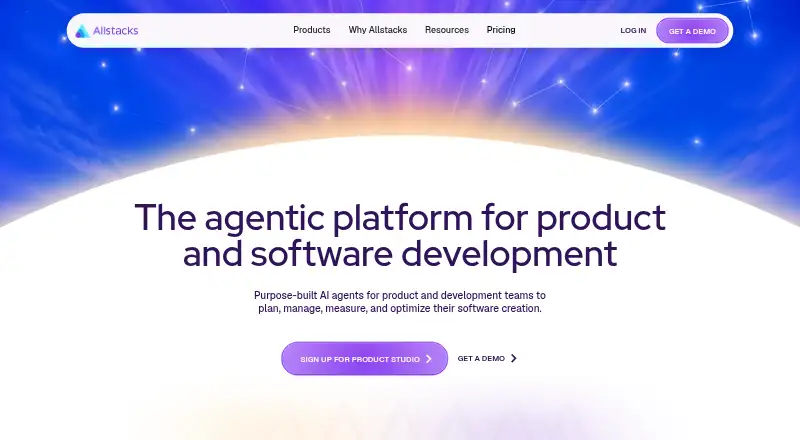
What Allstacks is
Allstacks is an agentic platform for product and software development teams that plan, manage, measure, and optimize software creation. Product Studio helps teams develop and share requirements and specifications grounded in code, customer feedback, and delivery history. Its adversarial AI reviewers pressure-test those artifacts for security, architecture, QA, feasibility, and go-to-market concerns. Software Engineering Intelligence surfaces delivery risks, forecasts completion dates, measures AI tool impact, and provides DORA, Flow, and SPACE metrics. Software Cost Capitalization classifies development work and creates audit-ready reports without timesheets. Integrations include Jira, Linear, Azure DevOps, GitHub, GitLab, Bitbucket, Claude, Cursor, GitHub Copilot, Jenkins, Slack, Confluence, Google Drive, Microsoft Teams, Google Calendar, and Gong, with no listed integration limits or charges. Allstacks provides web and API access. Starter is free for a limited time with unlimited usage and sessions for now, while paid plans are billed annually per contributor. Growth supports up to 500 contributors, and Enterprise offers unlimited contributors with expanded hosting and data options. Security details include AWS hosting, SOC 2 Type II certification, encryption, and recurring penetration tests.
Good
- Product Studio grounds specifications in code, feedback, and delivery history
- AI reviewers assess security, architecture, QA, feasibility, and go-to-market
- Provides DORA, Flow, and SPACE metrics
- Integrates with listed development, communication, and AI tools
- Pricing page says integrations are not limited or charged
- AWS hosting and SOC 2 Type II certification
Watch out
- Starter is free only for a limited time
- Paid plans require annual billing and minimum one-year contracts
- Growth is capped at 500 contributors
- Enterprise requires a minimum of 100 contributors
Who it suits
Allstacks suits product and software development teams needing planning, engineering intelligence, delivery metrics, or capitalization reporting. Software Engineering Intelligence is specifically aimed at software engineering leaders, while the plans cover organizations from early use to large deployments.
Verdict
Pick Allstacks when your organization wants one platform for product requirements, engineering intelligence, capitalization, and broad integrations. Look elsewhere if you need permanent free usage, monthly contracts, or a paid plan without a minimum one-year contract.
Plans and prices
From Allstacks's own pricing page, checked 14 Oct 2026.
| Plan | Price | What it gives you |
|---|---|---|
| Starter | Free | Product Studio workspace · unlimited usage and sessions for now · integrations included · credit and daily limits · limited time |
| Software Cost Capitalization Standalone | $200 a year | Unlimited contributors · support replies within 24 hours · day-zero reports from historical data · per contributor; billed annually; minimum 1-year contract |
| Standalone Software Cost Capitalization | $200 a year | unlimited contributors · automatic work classification · audit-ready reports · 24-hour support · historical day-zero reports · per contributor support add-on |
| Growth | $400 a year | up to 500 contributors · multitenant US or EU hosting · SSO/SAML · 2-year ingestion · 3-year retention · 24-hour support · per contributor |
| Enterprise | $600 a year | minimum 100 contributors · unlimited contributors and history · single-tenant US or EU hosting · data export API · site-to-site VPN · dedicated customer success · per contributor |
The facts
Each one read from Allstacks's own pages, with the date it was checked.
What it does
- AI reviews
- Product Studio uses adversarial AI reviewers to pressure-test artifacts for areas such as security, architecture, QA, feasibility, and go-to-market.checked 8 Oct 2026
- API
- Enterprise includes a data export API.checked 14 Oct 2026
- Capitalization
- Software Cost Capitalization classifies development work and generates audit-ready reports without timesheets.checked 8 Oct 2026
- Changelog MCP
- On October 1, 2026 Product Studio added smarter transparent search, ticket comments and custom MCP server connections.checked 14 Oct 2026
- Changelog October 2026
- On October 9, 2026 Product Studio added reusable skills, natural-language charts, safer Jira writes with human approval, structure-aware work trees and commenter roles.checked 14 Oct 2026
- Data collected
- The data-security policy says the service stores usernames or emails plus repository and project-management metadata, while not storing full source code or private communication.checked 14 Oct 2026
- Data deletion
- The security policy says customers can request deletion and Allstacks removes the data within 30 days.checked 14 Oct 2026
- Data handling
- The security page says Allstacks stores processed and hashed versions of sensitive data, discards raw data such as source code, and fulfills deletion requests within 30 days.checked 8 Oct 2026
- Delivery forecasting
- Allstacks forecasts completion dates from portfolio initiatives down to individual Jira stories using historical delivery data and machine learning.checked 14 Oct 2026
- Documentation and support
- The Help Center provides product updates, documentation, tutorials, videos and contact routes for support and demos.checked 14 Oct 2026
- Encryption
- Allstacks states that sessions and service connections use TLS above version 1.2 where supported and customer data at rest uses at least 256-bit encryption.checked 14 Oct 2026
- Engineering intelligence
- Software Engineering Intelligence surfaces delivery risks, forecasts completion dates, measures AI tool impact, and provides DORA, Flow, and SPACE metrics.checked 8 Oct 2026
- Engineering metrics
- The platform calculates DORA metrics and supports SPACE and Flow frameworks across more than 130 metrics.checked 14 Oct 2026
- Funding news
- Axios reported on October 26, 2022 that Allstacks raised $12.3 million and had raised $21.2 million since founding.checked 14 Oct 2026
- Integration limits
- The pricing page says Allstacks does not limit or charge for integrations.checked 8 Oct 2026
- Integrations
- Named native integrations include Jira, Linear, Azure DevOps, GitHub, GitLab, Bitbucket, ServiceNow, Claude, Cursor, GitHub Copilot, Jenkins, Slack, Confluence, Google Drive, Microsoft Teams, Google Calendar and Gong.checked 14 Oct 2026
- Intended users
- Allstacks says its products are built for product and software development teams, with Software Engineering Intelligence aimed at software engineering leaders.checked 8 Oct 2026
- Limit: customization
- AWS reviewers requested deeper report customization, more third-party integrations and more individual-contributor metrics.checked 14 Oct 2026
- Limit: setup complexity
- A Gartner review headline says the benchmarking framework can be efficient while setup is challenging.checked 14 Oct 2026
- Limit: update latency
- An AWS Marketplace reviewer said metrics required waiting until the next day and requested live updates.checked 14 Oct 2026
The company
- Company facts
- LinkedIn lists Allstacks as privately held, founded in 2017, headquartered in Raleigh, North Carolina, with 11–50 employees.checked 14 Oct 2026
- Company legal name
- Crunchbase lists the legal entity as ALLSTACKS, INC.checked 14 Oct 2026
- Founded
- 2017checked 28 Sep 2026
- Headquarters
- The company lists its address as 311 South Harrington Street, Suite 200, Raleigh, NC 27603.checked 8 Oct 2026
The full review of Allstacks
Allstacks is a broad platform for product and software-development organizations that want requirements work, engineering intelligence, and development-cost accounting in one system. It is best suited to teams willing to buy on an annual, per-contributor basis; smaller teams seeking a permanent, predictable free tier or short contracts should be cautious.
Overview
Founded in 2017 and headquartered in Raleigh, North Carolina, Allstacks combines planning, measurement, optimization, and financial classification for software creation. Product and engineering leaders can connect requirements to delivery evidence, while finance teams can obtain capitalization reports from the same development activity. That breadth is useful when these functions need a shared view, but it is unnecessary overhead if you only need a focused metrics dashboard.
The service runs on the web and through an API. Its connectors include Jira, Linear, Azure DevOps, GitHub, GitLab, Bitbucket, Claude, Cursor, GitHub Copilot, Jenkins, Slack, Confluence, Google Drive, Microsoft Teams, Google Calendar, and Gong. Allstacks says integrations are neither capped nor billed separately, so a mixed toolchain does not create an extra integration budget.
Key features
Requirements with delivery context
Product Studio supports ideation, definition, refinement, and sharing of requirements and specifications using code, customer feedback, and delivery history as context. Its adversarial AI reviewers challenge artifacts on security, architecture, quality assurance, feasibility, and go-to-market concerns. This is most valuable for teams that want structured scrutiny before work reaches engineering; it is less compelling when requirements already follow a separate, mature review process.
Engineering intelligence
The engineering-intelligence capability surfaces delivery risks, forecasts completion dates, and measures the effect of AI tools. DORA, Flow, SPACE, delivery, reliability, and custom metrics give engineering leaders several ways to examine throughput and stability rather than relying on a single velocity number. The practical benefit is a common evidence base for planning and improvement, provided the organization has enough contributor data to make those measures meaningful.
Capitalization and controls
Software Cost Capitalization classifies development work and produces audit-ready reports without requiring timesheets. Allstacks says it runs on AWS, holds SOC 2 Type II certification, uses TLS above 1.2 in transit and at least 256-bit encryption at rest, and undergoes third-party penetration tests twice a year. It stores processed, hashed versions of sensitive data, discards raw material such as source code, and fulfills deletion requests within 30 days. Those controls matter to security-conscious buyers, although organizations should still assess them against their own compliance requirements.
Pricing
Starter
Starter costs nothing for a limited time, with unlimited usage and sessions for now and integrations included. Usage-based pricing is planned to start later, so it is useful for evaluation but not a dependable long-term cost assumption.
Software Cost Capitalization Standalone
At $200 per contributor per year, billed annually with a minimum one-year contract, this plan is the focused choice for finance teams that only need capitalization. It allows unlimited contributors, includes day-zero reports from historical data, and promises support replies within 24 hours. It does not represent the wider product and engineering feature set.
Growth
Growth costs $400 per contributor per year, billed annually, with a minimum one-year contract. It supports up to 500 contributors, US or EU multitenant hosting, SSO/SAML, two years of historical-data ingestion, three-year retention, and 24-hour support replies. This fits mid-sized organizations that need broad operational coverage without dedicated tenancy; the contributor ceiling and annual commitment are material constraints.
Enterprise
Enterprise costs $600 per contributor per year, billed annually, with a minimum one-year contract and a minimum of 100 contributors. It adds unlimited contributors, optional single-tenant hosting in the US or EU, a data-export API, site-to-site VPN, a dedicated Customer Success Manager, unlimited historical-data ingestion, and enterprise support. The FAQ describes eight-hour enterprise support response times. The 100-contributor minimum makes it unsuitable for small departments, even though the plan removes Growth's scale limit.
Platforms
Allstacks is available through a web application and API. SSO is supported, and Growth and Enterprise provide hosting choices in the US or EU, with single-tenant deployment available on Enterprise.
Who it's for
Product and software-development teams are the intended audience, with engineering intelligence aimed particularly at software engineering leaders. Choose Allstacks when requirements quality, delivery forecasting, engineering metrics, AI-impact measurement, and capitalization need to share data. Look elsewhere if your organization wants only a lightweight planning tool, has fewer than 100 contributors but requires Enterprise isolation, or cannot accept annual per-contributor purchasing.
Pros and cons
- Pros: Product Studio links specifications to code, feedback, and delivery history; adversarial AI review covers several risk categories; engineering leaders get DORA, Flow, SPACE, reliability, delivery, and custom metrics; capitalization reports avoid timesheets; integrations are not limited or separately charged; security controls include SOC 2 Type II and recurring penetration tests.
- Cons: Every paid plan requires annual billing and at least a one-year contract; Growth stops at 500 contributors; Enterprise requires at least 100 contributors; Starter's unlimited terms are temporary and usage-based pricing is planned; the broader platform may be excessive for a single-purpose need.
Alternatives
Browse Value Stream Management Software or DevOps analytics software for category-wide comparisons. Choose ValueStream by MapVS when a forever-free plan with two maps, five stages per map, basic templates, limited recording, and 50 MB storage is enough. Choose HCL DevOps Velocity for a self-hosted option with an always-free Community Edition for two to three licenses. Swarmia suits companies with fewer than 10 developers that can accept a free tier without HRIS integrations or Swarmia AI, or its AI adoption and cost plan at $5 a month. Planview AdaptiveWork, Digital.ai TeamForge, CloudBees CI, Cora Value Stream Management, and Kovair Value Stream Management Platform are paid alternatives with pricing handled through sales or by request.
Verdict
Pick Allstacks for a product and engineering organization that wants one connected system for requirements, engineering intelligence, and audit-ready capitalization, especially when its integrations and security controls fit an existing enterprise stack. Look elsewhere if temporary free usage, monthly flexibility, a smaller minimum commitment, or a narrowly focused tool matters more than that breadth.
Getting started
- Open the Allstacks website
- Start with Starter or choose a paid plan
- Connect listed tools such as Jira, GitHub, Slack, or Confluence
- Use Product Studio to create and share requirements
- Review engineering intelligence metrics and delivery risks
- Choose Growth or Enterprise for SSO, hosting, retention, or expanded data options
Limits worth knowing
Starter is free for a limited time with unlimited usage and sessions for now; usage-based pricing is planned to start soon. Software Cost Capitalization Standalone, Growth, and Enterprise require annual billing and a minimum one-year contract, while Growth allows up to 500 contributors and Enterprise requires at least 100.
Questions
Does Allstacks have a free plan?
Yes. Starter is free for a limited time and currently includes unlimited usage and sessions. Its listed pricing is free.
What does Allstacks cost?
Software Cost Capitalization Standalone costs $200 a year per contributor, Growth costs $400 a year per contributor, and Enterprise costs $600 a year per contributor. Paid plans are billed annually and require a minimum one-year contract.
Which platforms are supported?
Allstacks lists web and API access.
What integrations are available?
Listed integrations include Jira, Linear, Azure DevOps, GitHub, GitLab, Bitbucket, Claude, Cursor, GitHub Copilot, Jenkins, Slack, Confluence, Google Drive, Microsoft Teams, Google Calendar, and Gong.
Does Allstacks support single sign-on?
Yes. SSO/SAML is listed on the Growth plan, and SSO is a stated capability.
What metrics are available?
The platform lists DORA, delivery, reliability, and custom metrics, along with Flow and SPACE metrics in Software Engineering Intelligence.
Alternatives to Allstacks
- 1

Plandek
Free planWebAPISelf-hosted7.5From $2,555 a month - 2
ValueStream by MapVS
Free planAndroidiOSWebAPI7.5Free plan - 3
Planview AdaptiveWork
AndroidiOSWebAPI6.9 - 4

Swarmia
Free planWebAPI6.9From $5 a month - 5
HCL DevOps Velocity
Free planWebLinuxmacOSSelf-hosted6.6Free plan - 6

Automic Continuous Delivery Automation
WebAPILinuxSelf-hosted6.5